

A Little Deeper Than Usual: Joan Didion on The Grateful Dead
Didion's never-before-read essay on the Dead comes from the late writer's New York Public Library archives.
In 1967, the Saturday Evening Post sent Joan Didion to San Francisco to experience the “abrupt mutation” occurring during the Summer of Love.
On her reporting trip, Didion watched the Grateful Dead rehearse behind Bob’s Floating Homes on the Sausalito waterfront. Afterwards, she interviewed the entire band, save for Pigpen (“easily the most photogenic member”), who was nowhere to be found.
An abbreviated scene from the interview was later including in Didion’s landmark collection of essays, Slouching Towards Bethlehem. but until now, the full three-page essay on her time with the band has never seen the light of day.
Last March, the New York Public Library opened up Didion and John Gregory Dunne’s literary archive to the public. Thanks to POW confrere Timothy Denevi, who is currently working on a Didion biography, we are now all able to read Didion’s full unexpurgated thoughts on “the boys,” who she found “very engaging and very unpretentious.”
For Dead scholars, it exists as a landmark early interview with the band directly after their release of their self-titled debut album, but before national stardom swept them on the Golden Road to unlimited devotion and drug consumption. For Didion scholars, it begs the question: what would she have made of the beguiling charm of the irascible Pigpen. Would literary and musical history have been irrevocably altered? Would she have become a harmonica aficionado? We will never know. After all, life proceeds by its own design.
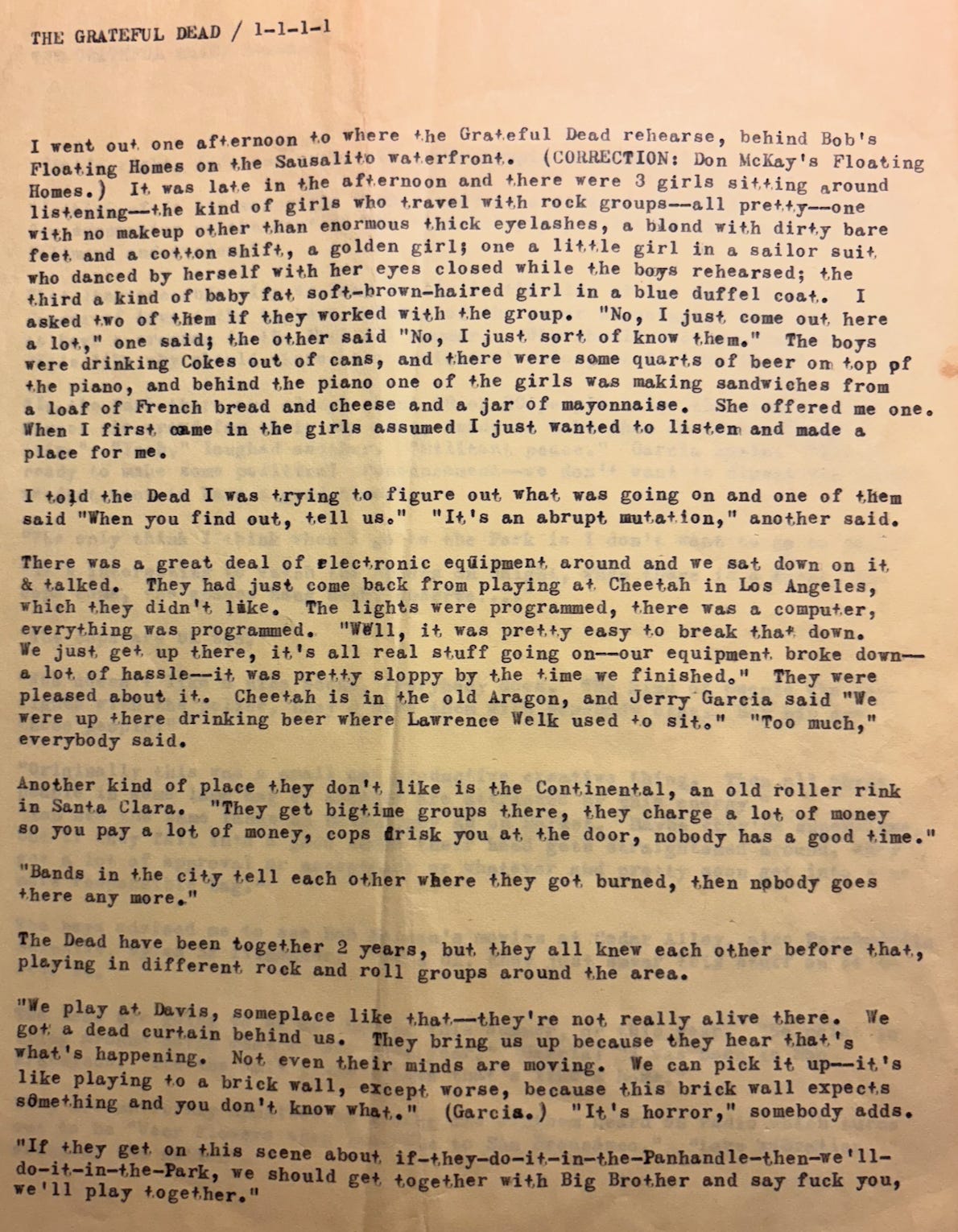
I went out one afternoon to where the Grateful Dead rehearse, behind Bob’s Floating Homes on the Sausalito waterfront. (CORRECTION: Don McKay’s Floating Homes.) It was late in the afternoon and there were 3 girls sitting around listening –– the kind of girls who travel with rock groups –– all pretty –– one with no makeup other than enormous thick eyelashes, a blond with dirty bare feet and a cotton shift, a golden girl; one a little girl in a sailor suit who danced by herself with her eyes closed while the boys rehearsed; the third a kind of baby fat soft-brown-haired girl in a blue duffel coat. I asked two of them if they worked with the group. “No, I just come out here a lot,” one said; the other said “No, I just sort of know them.” The boys were drinking Cokes out of cans, and there were some quarts of beer on top of the piano, and behind the piano one of the girls was making sandwiches from a loaf of French bread and cheese and a jar of mayonnaise. She offered me one. When I first came in the girls assumed I just wanted to listen and made a place for me.
I told the Dead I was trying to figure out what was going on and one of them said “When you find out, tell us.” “It’s an abrupt situation,” another said.
There was a great deal of electronic equipment around and we sat down on it & talked. They had just come back from playing at Cheetah in Los Angeles, which they didn’t like. The lights were programmed, there was a computer, everything was programmed. “Well, it was pretty easy to break that down. We just get up there, it’s all real stuff going on –– our equipment broke down –– a lot of hassle –– it was pretty sloppy by the time we finished.” They were pleased about it. Cheetah is in the old Aragon, and Jerry Garcia said “We were up there drinking beer where Lawrence Welk used to sit.” “Too much,” everybody said.
Another kind of place they don’t like is the Continental, an old roller rink in Santa Clara. “They get bigtime groups there, they charge a lot of money so you pay a lot of money, cops frisk you at the door, nobody has a good time.”
“Bands in the city tell each other where they got burned, then nobody goes there anymore.”
The Dead have been together 2 years, but they all knew each other before that, playing in different rock and roll groups around the area.
“We play at Davis, someplace like that –– they’re not really alive there. We got a dead curtain behind us. They bring us up because they hear that’s what’s happening. Not even their minds are moving. We can pick it up – it’s like playing to a brick wall, except worse, because this brick wall expects something and you don’t know what.” (Garcia.) “It’s horror,” somebody adds.
“If they get on this scene about if – they – do – it – in – the – Panhandle – then – we’ll – do – it – in – the – Park, we should get together with Big Brother and say fuck you, we’ll play together.”
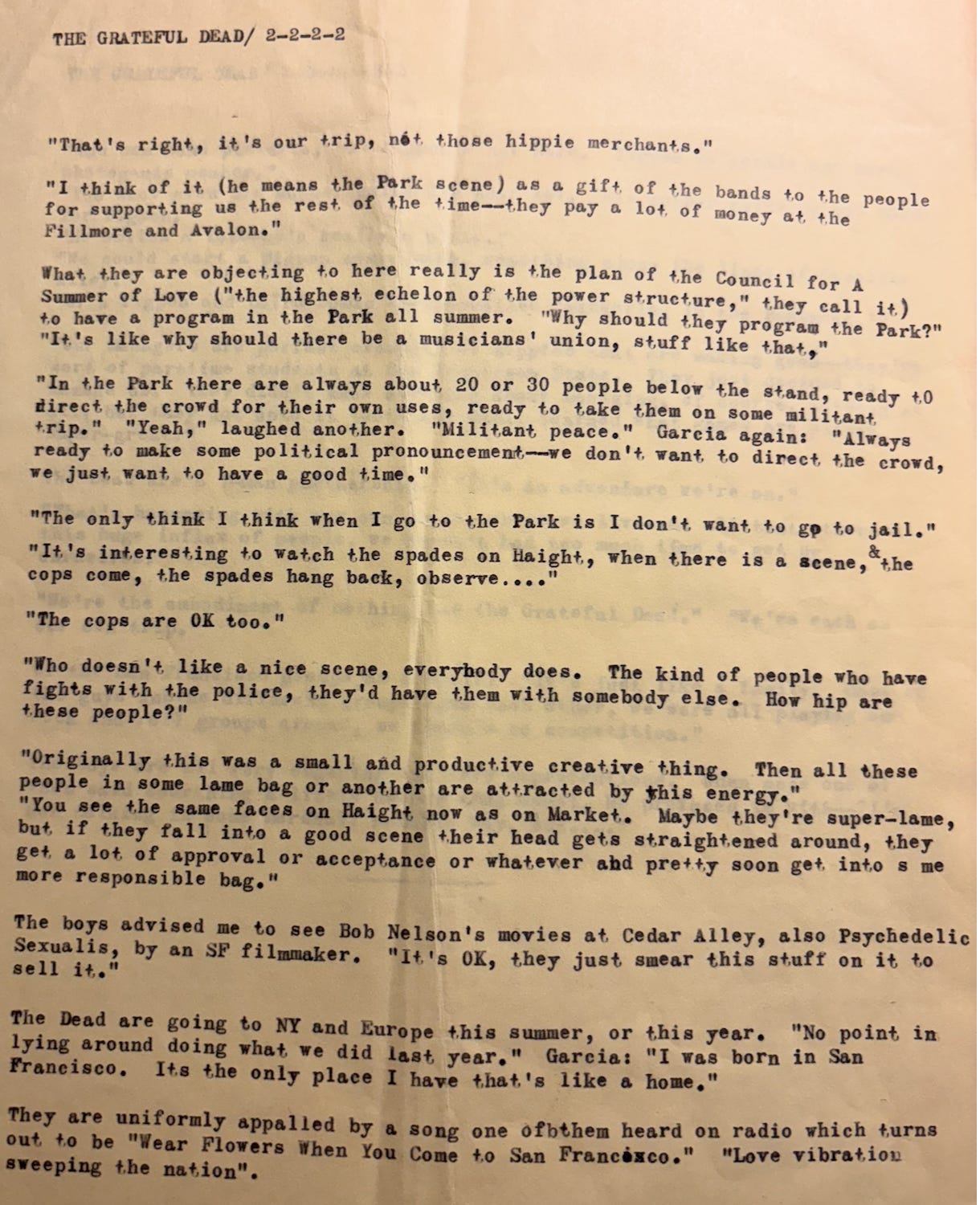
“That’s right, it’s our trip, not these hippie merchants.”
“I think of it (he means the Park scene) as a gift of the bands to the people for supporting us the rest of the time –– they pay a lot of money at the Fillmore and Avalon.”
What they are objecting to here really is the plan of the Council for A Summer of Love (“the highest echelon of the power structure,” they call it) to have a program in the Park all summer. “Why should they program the Park?” “It’s like why should there be a musicians’ union, stuff like that.”
“In the Park there are always about 20 or 30 people below the stand, ready to direct the crowd for their own uses, ready to take them on some militant trip.” “Yeah,” laughed another. “Militant peace.” Garcia again: “Always ready to make some political pronouncement –– we don’t want to direct the crowd, we just want to have a good time.”
“The only think I think when I go to the Park is I don’t want to go to jail.”
“It’s interesting to watch the spades on Haight, when there is a scene, & the cops come, the spades hang back, observe….”
“The cops are OK too.”
“Who doesn’t like a nice scene, everybody does. The kind of people who have fights with the police, they’d have them with somebody else. How hip are these people?”
“Originally this was a small and productive creative thing. Then all these people in some lame bag or another are attracted by this energy. “
“You see the same faces on Haight now as on Market. Maybe they’re super-lame, but if they fall into a good scene their head gets straightened around, they get a lot of approval or acceptance or whatever and pretty soon get into some more responsible bag.”
The boys advised me to see Bob Nelson’s movies at Cedar Alley, also Psychedelic Sexualis, by an SF filmaker. “It’s OK, they just smear this stuff on it to sell it.”
The Dead are going to NY and Europe this summer, or this year. “No point in lying around doing what we did last year.” Garcia: “I was born in San Fransisco. It’s the only place I have that’s like a home.”
They are uniformly appalled by a song one of them heard on radio which turns out to be a “Wear Flowers When You Come to San Fransisco.” “Love vibrations sweeping the nation.”
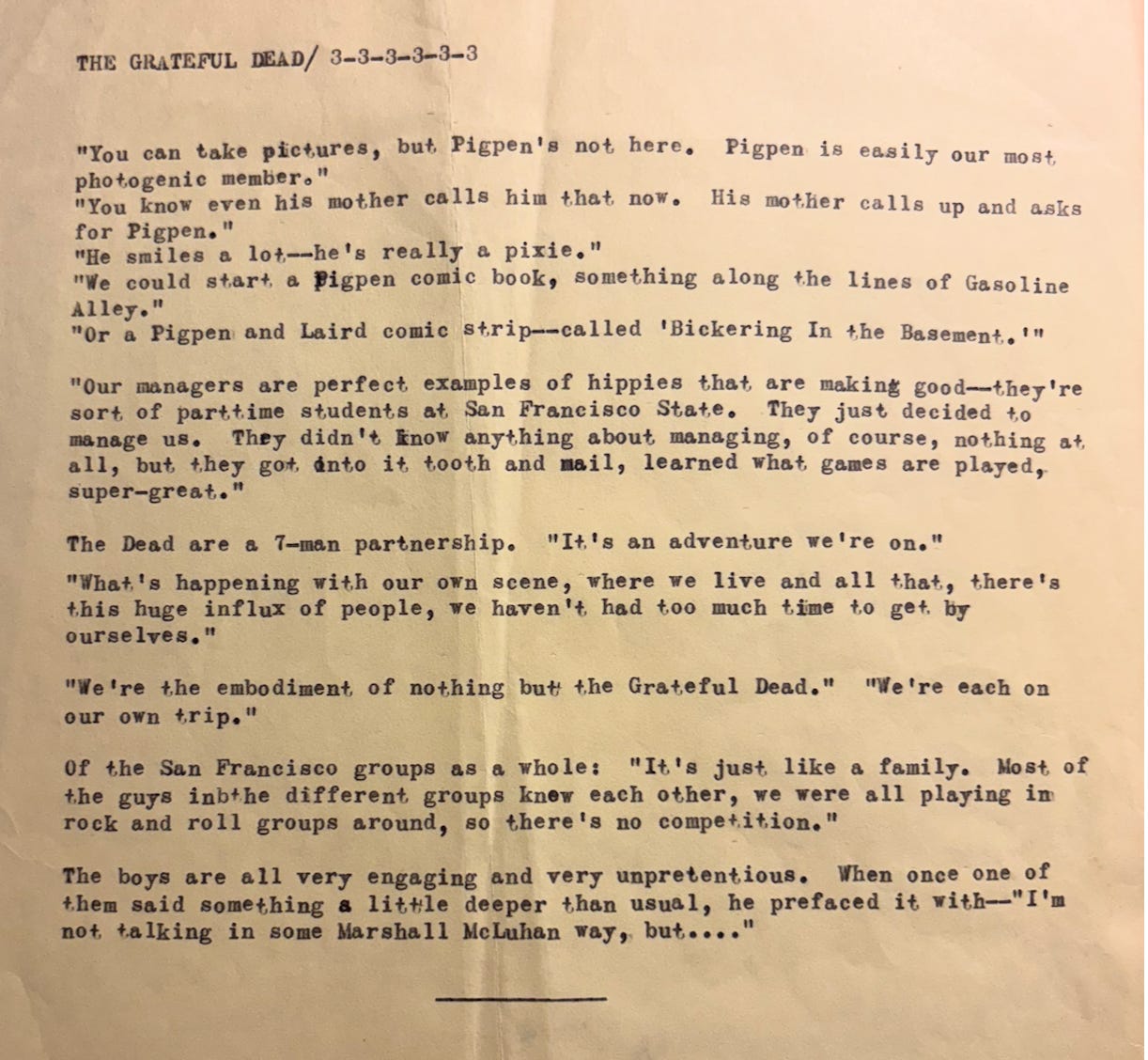
“You can take pictures, but Pigpen’s not here. Pigpen is easily our most photogenic member.”
“You know even his mother calls him that now. His mother calls up and asks for Pigpen.”
“He smiles a lot –– he’s really a pixie.”
“We could start a Pigpen comic book, something along the lines of Gasoline Alley.”
“Or a Pigpen and Laird comic strip –– called ‘Bickering In the Basement.’”
“Our managers are perfect examples of hippies that are making good –– they’re sort of part time students at San Fransisco State. They just decided to manage us. They didn’t know anything about managing, of course, nothing at all, but they got into it tooth and nail, learned what games are played, super–great.”
The Dead are a 7-man partnership. “It’s an adventure we’re on.”
“What’s happening with our own scene, where we live and all that, there’s this huge influx of people, we haven’t had too much time to get by ourselves.”
“We’re the embodiment of nothing but the Grateful Dead.” “We’re each on our own trip.”
Of the San Fransisco groups as a whole: “It’s just like a family. Most of the guys in the different groups know each other, we were all playing in rock and roll groups around, so there’s no competition.”
The boys are all very engaging and very unpretentious. When once one of them said something a little deeper than usual, he prefaced it with –– “I’m not talking in some Marshall McLuhan way, but….”