

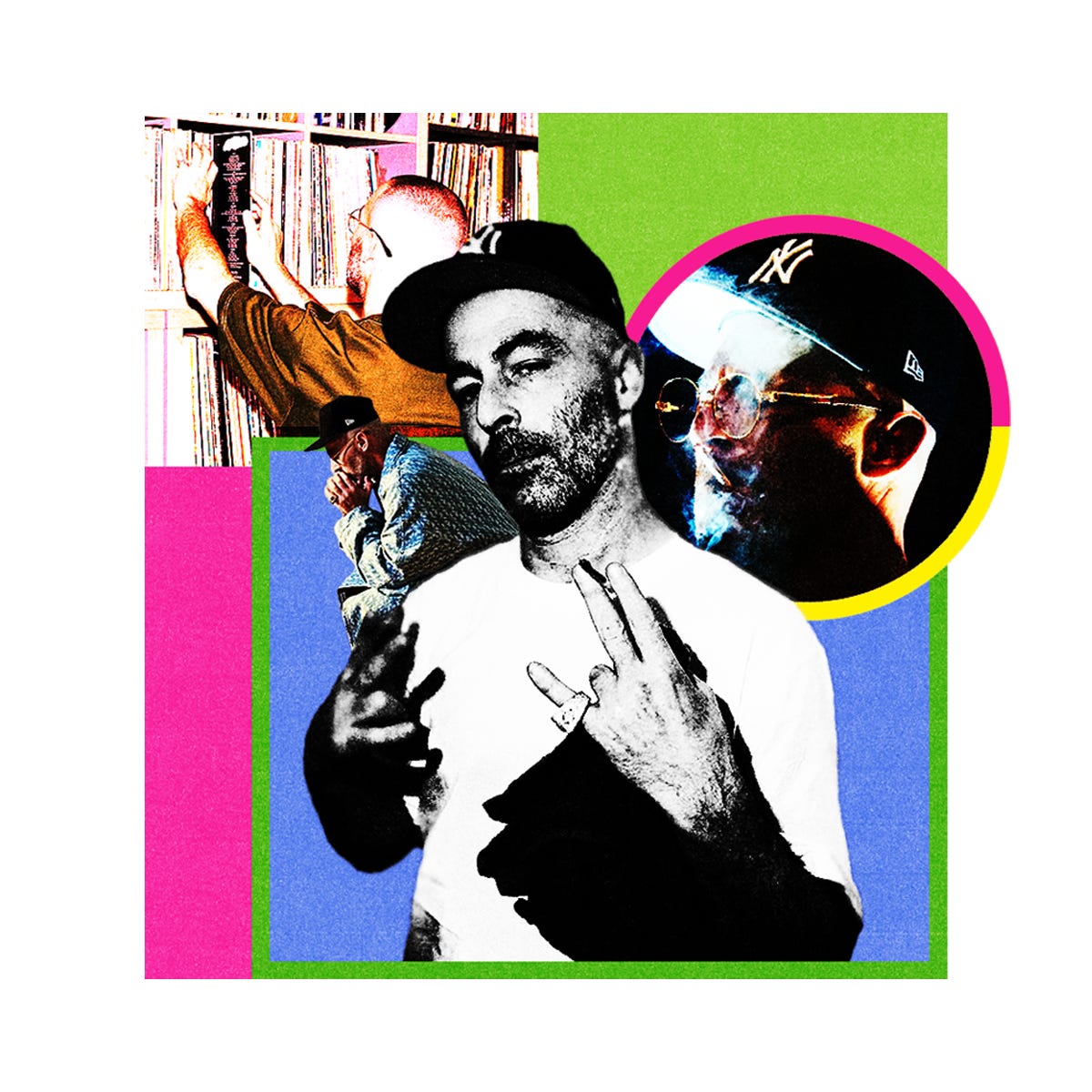
As of late, Alchemist has had the wind at his back. But like most artists, the road he took here was circuitous and occasionally unpaved. He still intermittently raps, which was the form that first drew him in to hip-hop; his earliest work dates to 1991 with the Whooliganz, where he rapped under the name Mudfoot alongside Scott Caan (then Mad Skillz). Their album was shelved by Tommy Boy, but the initial setback became an unforeseen entry point: It was during this time he met DJ Muggs, an assassin of souls and revered producer for Cypress Hill.
Al recalls being in the studio at 15 years old: “Being around Muggs was my first time with this shit. He saw a young guy who just got an ASR-10 and was really into hip-hop, and saw the value in me being around, whether it was my energy or just my willingness to help out; he eventually just put me in a position to do something greater. I was a sponge. I was quiet and knew my role. I just sat back and studied.” While Al was in the corner not speaking, Muggs went beyond offering drum machines and tips on sampling. He emphasized the notion of songwriting as crafting a full statement.
“It was more about details and how to put a song together and create the right vibe for artists, making sure you get the best out of them; where to drop the beat out to accent a rhyme and how to use that one sound effect in just the right place,” Al says of his mentor, adding: “Muggs is the mastermind. I took all those notes from him as a kid.”
Those notes, like a quiet storm gathering strength, became foundational for what was to come. In the mid-‘90s, after some key collabs with childhood friend Evidence (of Dilated Peoples), Al moved to New York. A big benchmark came with Mobb Deep’s Murda Muzik in 1999; tracks like “Thug Muzik” and the Kool G Rap-featuring “The Realest” made for a decisive arrival. “Havoc was someone who I also learned a lot from, especially during this time. He did stuff I never saw before, and he was always open to sharing,” says Al. “I feel like, over time, Murda Muzik has become one of my most beloved records.”
Momentum snowballed from there—work with Nas, Jadakiss, Ghostface, and more elites—while Al’s solo projects, including his debut (2004’s 1st Infantry) and Chemical Warfare (2009), showed his keen ear, as the former is considered by many to be one of the best producer-led compilations of all time. “Hold You Down” with Prodigy, Alla Ghee, and Nina Sky, made during this crucial era, remains a classic to this day. As the saying goes, true producers save the best beats for themselves, as he revealed with 2012’s Russian Roulette, a sophisticated blend of the ecstatic and the morose.
By the mid-2010s, he was becoming a near-monastic figure younger producers called Uncle Al. Work with the dearly departed like Guru, Prodigy, and Mac Miller highlights his intergenerational reach—a quality matched by DJ Premier, an idol of Al’s. “He’s the GOAT,” Al says. “I, and a lot of others, wouldn’t be here without him. Preemo was always supportive of me early on and just introduced me to everyone when I got to New York. He was never a gatekeeper. He was a supporter.”
With this Jedi council of mentors—Muggs, Havoc, Preemo—all of whom saw his promise and shortcomings early on, it’s clear why Al is where he is today. More recently, in what felt like a full-circle moment, Al and Premier sold out shows for their He’s The Preemo, I’m The Chemist world tour. “Seeing different generations come out for us was real special,” he says.
Al’s ongoing impact is best measured not only by longevity but by the breadth of artists who seek him out—from Armand Hammer and Griselda, to Earl Sweatshirt and 2 Chainz, to Erykah Badu and Kendrick Lamar. Mach-Hommy, Roc Marciano, Lil Wayne, Yasiin Bey, and countless others have also been added to his ledger. As much as there is to be said about the work itself, the most inarguable case for Al might be a simple list of credits.
Add to that more longform partnerships with Boldy James or Freddie Gibbs (2020’s Grammy-nominated Alfredo), and it feels like Al’s shaping new eras in real time. “A lot of the shit I do is simply based on timing. It’s like seeing a burning bush and reading the smoke and knowing to go left or right,” he says.
When asked how his decorated songbook and recent successes strike him, Al is typically stoic, but also hopeful: “I want to love what I do now in my 40s as much as I did in my 20s. As long as I have the energy and am still inspired. I feel like I’ll always be creative. To me, it feels like it’s starting to get really good. I’ve had waves in my career, but this feels like a really good one.”
“I just make the most of the moment, and it’s crazy to look back and think I’ve built this whole thing,” he continues. “They say when you’re on a run, that means that it’s going to slow down, like you’re jogging, but eventually you’re gonna walk. But I want to keep running because this pace is comfortable. As long as people give a shit, I’ll keep doing it,” he says, before reconsidering. “I’ll probably keep doing it even if they don’t.”
Below, in his own words, Alchemist details the stories behind some of his most beloved songs.
