


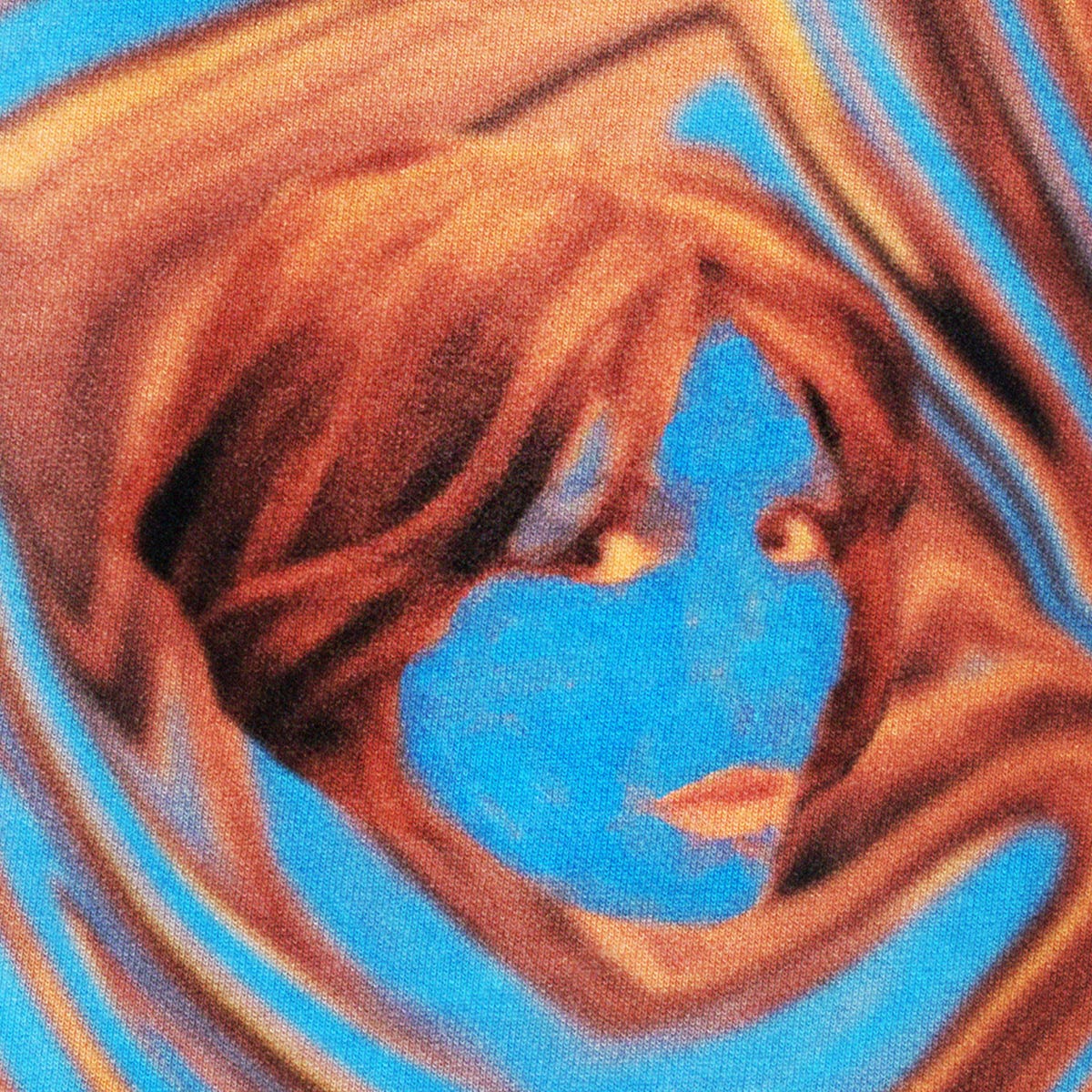
There’s a quote I think about a lot, by the writer Donald Barthelme. “What must whacky mode do,” he said, to a student, “break their hearts.” You can apply this idea to the music of Aldous Harding. Her work is funny, surreal, and a little bit sad, but it is often referred to as “oblique,” “difficult,” because while her music is funny, surreal, and a little bit sad, you can never put your finger on just why. Harmonically, lyrically. Here’s an example of what I’m talking about: “Weight of the Planets,” a song from 2019’s Designer, is full of all of these winking asides. I.e.- “glad I pulled the reins on this thing when I did!” but then the image is never filled out. We have no idea what she’s talking about. There’s something incomplete about her songwriting. But we, or I should really say I feel something inside of what she’s saying. Train on the Island, her fifth album, is whacky and it breaks our hearts, pro forma.
I want to push for the idea that a record doesn’t have to mean something. That the point of music isn’t always to decode it and extract meaning from it. That music can be emotionally legible without being confessional. And that distortion and opacity—a sensation of watching someone on the other side of an artificial waterfall in a family buffet restaurant—is often far more interesting and resonant than saying explicitly what one means. I’m thinking about the tugging feeling you get in the last two minutes of “One Stop,” which starts out sort of generic, chipper, wry, but then it festers and it blooms. And that moment on the song loops is a refrain that loops itself into other corners of the album—there it is again in the dirge-y “San Francisco,” the only thing different about it is some of the words, “I’ve never been a believer/I don’t cry when I’m told.”
The best moments on Train on the Island are the ones that are the most interior. “Venus in the Zinnia,” while pretty and sunny, is not a terribly interesting piece of music, it is a little too breezy, lacking in complexity found elsewhere on the record. It is melodically very straightforward, inoffensively psychedelic. What’s more exciting is the album’s title track, which builds into something weird and gorgeous. Harding sounds like she’s shouting, crying, and the keys are strident. “They’re Sicilians reaching over the clams,” she sings, describing her friends, then, at the song’s peak, adds “All my life I’ve thrown Olympic sand!” It’s a really strange image. But hearing her sing it, I can feel what she means. I think I know what she means. And you might too.
The music produces inside of you a private inventory of feelings. Like when out of nowhere, on “Worms,” Harding sings the Spanish word for composition, “la composición,” and then later in that same song, things get so weary. “Great things inside,” she sings, “Have sat long enough.” When she sings that song I think about paintings, a room full of paintings, sitting and collecting dust in a half light. I also think about private feelings, like sitting on a couch when you are unhappy. When the song ends, its weariness feels overwhelming. Like painting blue on top of blue.
Train on the Island was produced by John Parish. He’s best known for his collaborations with PJ Harvey, but my favorite record he’s worked on is Sparklehorse’s It’s a Wonderful Life. A very different record than Harding’s, it has to be said. But there’s some sort of spiritual alignment between the two records; a sort of frustrated, saccharine sadness. They’re both overstuffed. Elliptical. But the reason It’s a Wonderful Life is a record I love so much, and Train on the Island is a record that I am growing to love so much, is that its sweetness has bite. Train on the Island is emotionally open because it isn’t trying to tell you what it wants to say. It just is. And that is, it is a miraculous thing. Its incompleteness feels whole. It is music that implicates you. It transforms you without ever telling you why.

Cotdam what a cool piece. Makes me think of records only comprised of singles , but this is not that. An openness that allows the audience to fill in the gaps. Fragments , abstraction , pieces of an incomplete puzzle. More writings by Sophie, please !