

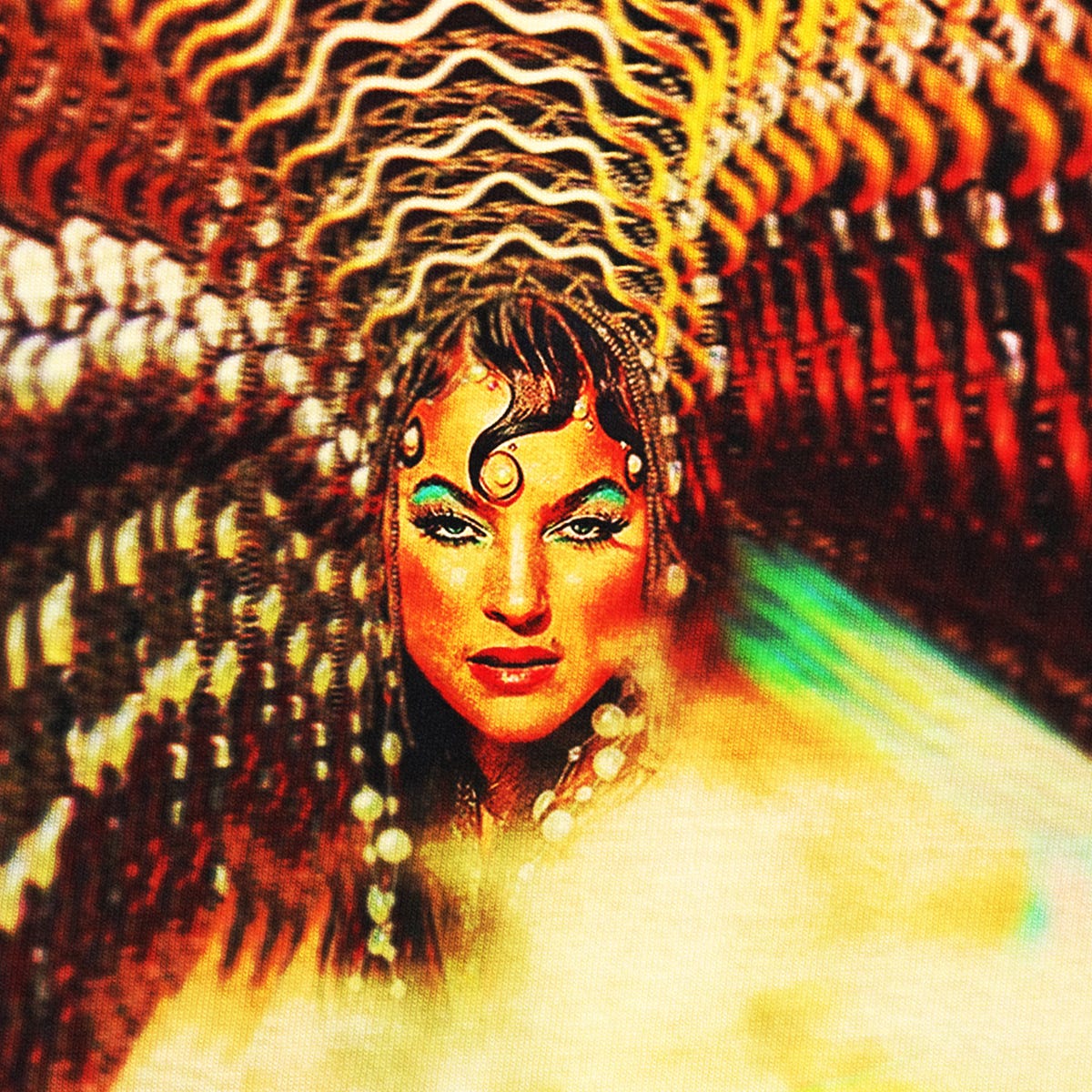
ALIA’s new album, Where the Echoes Bloom, could not have happened without chance. Two chance encounters—which immediately became love-at-first-sound experiences—led the multi-instrumentalist, composer, and dancer to pick up the wildly different instruments she now plays professionally. On a trip to Indonesia she discovered a 20-stringed zither from the Sunda region of West Java called a kacapi and took one home with her. Later, after seeing a live performance of a theremin, she was so captivated that she had to buy one. She studied both instruments deeply, developing her own voice and style. The two are as disparate as could be in their technique, sound, and cultural significance. Yet, the L.A.-based artist has found a way to make them part of the center of her musical identity.
ALIA’s curiosity about the sounds and histories of the kacapi and theremin reflects her diverse range of musical interests. She is at home listening to mid-century Exotica albums and performing Egyptian-style belly dance as she is recording the music of ambient and post-minimalist composer Howard Budd with harpist Nailah Hunter. Her interests extend outward from there to include Arabic music, gamelan, field recordings, and producing beats. On Where the Echoes Bloom, she used all the sounds and inspirations she had on hand to create an evocative, atmospheric, and wholly unique record.
On its first track, “Soul of my Soul,” ALIA plays a series of measured arpeggios on the kacapi that roll over vocalesque theremin and light percussion. She mixes traditional kacapi melodic styles with Western harp-like glissandos on “Crescent Sun.” If not for its fuller-bodied sound and different tuning, the kacapi could be mistaken for a harp. With doses of delay and reverb, ALIA gives the track an ethereal, otherworldly vibe. On “Crescent Sun” her father can be heard playing the West Asian frame drum known as a Daf. ALIA used many of his percussion recordings as samples across the album.
Exotica exerts a strong influence throughout. “Intimate,” “Endless Love,” and “Daughter of the Nile” illuminate what much of Exotica could have been, had it freed itself from the problematic tropes of tiki bars, hula girls, and the racialization of the Other. These tracks all softly breathe and pulsate. Time stretches and slows. A haunting not-quite-human-female-voice wafts over layers of synths, soft percussion, and kacapi. From the sparse, gamelan-tinged beat of “Jogja” to the Arabic percussion and dub elements of “The Thorn and the Carnation,” what comes through while listening to Where the Echoes Bloom is the vision of an artist who is not bound to any kind of musical or stylistic orthodoxy. Rather, ALIA uses the instruments and sounds that she loves—that, and making sure to take full advantage of the opportunities that chance can provide.
I caught up with ALIA over Zoom, where we talked about her journey from the violin and cello of her childhood to the theremin and kacapi, our mutual love of Yma Sumac, how a chance social media message led her to touring with a pop star, and the challenges of making music during the Palestinian genocide.
This interview has been condensed and lightly edited for clarity.
So your father is a musician. Was it a sure thing that you were going to be a musician, too?
No, actually, not at all. I grew up playing music. I played violin and cello, but it was something that was so normal for me that I didn’t really think of it as something that I should pursue as an adult. It’s hard to explain. For some reason, I didn’t even think of that as a possibility, even though it’s so obvious. It’s weird, but I thought about it as a normal part of my life though. I got into dance when I was in college, and so that became my main mode of artistic expression. I kind of stopped messing around with music and focused on dance for a long time. In my 20s, I thought “oh, I should take up music. Oh, it’s too late for me. I’m already on this dance trajectory.” And then in my late 30s, I got rid of that conditioning where it’s like, “oh, I’m too old to do it.” It’s so dumb. You know, we’re all so conditioned to think that if you make a certain career decision, you have to stick with that your entire life, you know? But I mean, in reality, dance is part of music. It’s another aspect of it. Once I started doing music, I thought, “oh my God, this it’s so obvious, I’m good at this, it’s in me, why did I never think about pursuing it before?” I think that when you grow up with something and it’s just so normal to you that you don’t think about it in a special way, the way that other people do, I guess.
Do you find that dance shapes your musical expression?
I still do Egyptian-style belly dance, so I got to know all of the various rhythms and Arabic music. I think that one of the ways that it is shaping me as a musician is the performance aspect of it because as a dancer I’m really into the visual part of it as well. I definitely think that plays a role. I’m developing my live show right now and I want it to be visually interesting as well. I think growing up around music I had that ingrained musicality, but dance kind of refined it even more and allowed me to connect to rhythms, especially with the style of dance that I did.
As you’re working on doing the live performance, have you started touring for the record yet?
No, not yet. I have my first gig after the album comes out in August. I will be playing Spacecraft, the small music festival that’s happening in Pioneertown outside of Joshua Tree. I am developing my show for that right now.
Is it just going to be you on stage, or will you have a band?
For now, it’s only me. I would love in the future to have a band, but I’m trying to figure out the best way to do it solo. I want to do more than just play along to a backing track. So I’m using Ableton to kind of build it all out and bring in some drones and do some loops. It’s going to kind of be a mix of improvisation and then playing along to some of the songs from the album and maybe variations of the songs.
One of the things that struck me on the album was the kacapi. I heard it and I was “okay, that’s not a harp, even though it’s being played harp-like. It’s not a guitar…” The sound is very rich. It’s Indonesian, right?
Yes.
How did you start playing it?
I stumbled upon it in my trajectory. My dad teaches world music at Southern Methodist University in Dallas. He has a summer program that brings kids from the college to Bali to study the music and the dance and the culture. I’ve tagged along with him to Bali and helped out with this program many times. One of the instructors in the program, Ade Suparman, teaches Javanese gamelan and he also plays the kacapi. I was mesmerized by this instrument. When I would see him play kacapi it would hypnotize me. I loved it so much and asked him if he would teach me, and he happened to have another kacapi with him, and he started giving me lessons. I brought one home and he sent me videos on WhatsApp of songs to learn, and then I went to Bali again and got to study with him more.
So when did you start playing the theremin?
It was kind of random. I watched this documentary called Theremin: An Electronic Odyssey that is about the history of theremin. When watched it I thought “wow, this is so cool.” I didn’t really know anything about the instrument. And then shortly after I moved to L.A. and one of the first events I went to was an event where Armen Ra, who later became my teacher, was doing a theremin performance, and I thought, “oh my god, I just saw that documentary and this instrument is amazing, I really want to learn this instrument” because I was really drawn to it. And so I ordered one online but it was so difficult to play. I had it for about a year before I really started to get serious about it because it was so hard. I started watching some YouTube videos and tutorials on techniques and I couldn’t quite get it down. I’m thought, “Oh, God, I suck at this!” I was able to book a lesson with Armen and the way he broke it down for me really helped to wrap my mind around the instrument. It’s not like a traditional instrument where there’s very specific techniques that you use to be able to play. It’s really more intuitive and he told me I was focusing too much on these very specific ways to move my fingers that I need to feel it out and make my own technique; don’t try to follow what someone else is doing exactly, because it might not work for you. And when he explained that to me, I was able to start playing melodies. It’s a very interesting instrument because you’re not grounded to it at all. You’re not touching anything. Playing it is so much by ear rather than—there is a little bit of muscle memory—but so much listening and immediately knowing if you’re on the right note or not and how to slide into the correct note in a way that’s inconspicuous.
The theremin on the song “Aquamarine Dream” is so haunting and evocative. Throughout the album, I kept going to look up who the singer was. I had to remind myself that it was theremin. But it has a rich human sound. How do you get that sound?
So on that song I actually used a talk box connected to the theremin to make it sound more human-like.
Oh! That’s cool.
I think I used it on “Daughter of the Nile” too. The talk box makes it sound more like a human voice, for sure. One of the people that I study for my theremin playing is Yma Sumac, the way that she sings and her vibrato. I try to emulate her vibrato on the theremin to make it sound even more opera-like.
That makes a lot of sense, because I hear the similarities on my Yma Sumac records.
Oh, I love her so much.
Me, too. When you were putting together the album, how did you map out how you were going to use all the sounds and instruments and styles and have them fit together?
You know, I kind of took it on a song-by-song basis. I had in my mind a style of song that I wanted to do and then I thought about what resources do I have that I can make this style of song, you know? I was listening to a lot of old Exotica records that use harp. I thought, “well, I have my kacapi, so I can use it for some of that layer.” And I like rich textures and textures that make you feel like you’re in a place. So when I was in Bali, I took a lot of field recordings of the frogs and the outdoors, and I knew I wanted to use those. That worked really well in “Aquamarine Dream.”
There are a few tracks that really reminded me of some Exotica records I have, even though I’m not crazy about the term.
I know, it’s so outdated.
So was Exotica a big influence on the album?
Totally. I’m very inspired by it. It’s a problematic genre, but the music is so beautiful. I love a lot of old exotic records, but I was listening to a lot of—do you know the album Songs of a Dead Dreamer by DJ Spooky?
I don’t know that album, but I know some of his others.
That album in particular takes you on a whole trip. It’s very vibey. I guess the genre is referred to as illbient. It’s kind of ambient, but there’s hip hop in it: but it’s very trippy with lots of sound effects and dub elements. So I thought it would be cool to bring in some of the old Exotica sounds, but then also bring in some of these psychedelic-like trip-hop, illbient elements as well. For a lot of the songs, that was the vibe I wanted to create.
How would you say that this album kind of represents you as an artist? Does it have all the main ingredients, or could you have made a totally different record and have it still feel like you?
I could have made a whole different record and felt like it was me. Part of the challenge when I decided I wanted to make a record was what direction to take it in, because I have so many inspirations and so many genres of music that I love. I’m actually working on new music now that sounds completely different than this album. It’s more Arabic-focused, and that was what one of my main things I was thinking for this album: “should I make something that is all Arabic sounds, or do this more Exotica style thing?” I tried to bring in some Arabic influences. The bass line on the last song, “The Thorn and the Carnation,” is a traditional Arabic bass line. I have some of my dad’s percussion that is Arabic style percussion. The music that I’m working on now is heavy Arabic beats. It’s not as gentle. It’s really drum and percussion heavy. There are a lot of genres that I would love to explore. There’s so much music that I love that I would love to explore making.
The press release mentioned that it was tough for you to make the record while the genocide is going on in Palestine. How are you able to balance that with making a beautiful record—is it just pushing it aside and telling yourself, “okay, I’m going to focus on the music?”
It was so difficult. I mean, that was probably the hardest part. I’m so consumed by what’s going on and wanting to stay aware. Obviously our devices suck us in and we get into these doom-scrolling loops. It’s been a big part of my life and really changed me as a person. One of the things I’m trying to work out and that I was struggling with, is that I want to reflect the times in my music too. For the most part, this album has such a different feeling than what is going on in the world. I wanted to pay tribute in some type of way. The first song is called “Soul of My Soul,” and I think a lot of people who have been keeping up with what’s going on would get that reference. It was referring to a man, Khaled Nabhan, and his granddaughter, Reem. Toward the beginning of the genocide he was holding her lifeless body in his arms and smiling and kissing her and saying “rouh al-rouh” (روح الروح) which means “soul of my soul” in Arabic. It was a tender and heartbreaking moment, and I think it really made people see, because so many people before October 7th didn’t really know much about what was going on there. They had this idea in their mind about Arab men being aggressive and violent and all of the stereotypes that America tries to socialize people to think. It made people see that Arab men are very tender and very loving and they love their families and they’re like us. That was a big moment. I named that song “Soul of My Soul” because I really thought it kind of encompassed that it’s beautiful, but also sad and melancholic, and it reminded me of them. So I dedicated that song to them. I think the genocide actually exposed so much about the entire world—about the hypocrisies of so-called international law and the brutality of the Western Empire, and the media lying, everything is on full display. It brought out some things about myself, and the ways that I think I fall short, and how I want to be, and seeing how these principled people live their lives, and thinking that, “oh, I need to be more connected and more principled and more dedicated to people and community.”
Did you feel a kind of responsibility or added pressure when making these songs?
I wouldn’t say that I gave myself added pressure, but I did feel a bit of responsibility that I should bring attention in some way to this thing that is happening while I’m making this music. I wanted it to be connected in some way. I didn’t try to force it, but it is something that I wanted to do.
Now turning to something completely different. How did you end up playing with Melanie Martinez?
She doesn’t have theremin on her records, but she had just stumbled across the theremin thought, “Oh, my God! This instrument so cool. I want a theremin player in my band.” So then they found me through social media and brought me on.
That’s wild!
I was not familiar with her and I got a message about the show. I did an audition and got the gig and then I’m playing Lollapalooza in Brazil, wondering what’s happened here? This is crazy. It was totally unexpected and took me on this wild ride that I did not envision for myself before. But it’s really, really fun and really cool.
From the concert videos I’ve seen, her shows are a complete spectacle with the elaborate sets and the costume changes. What is it like playing in such a big dramatic theatrical show to a packed stadium?
It’s a wild experience. I love Melanie because she’s a very conceptual artist. She has a vision for every little detail of the show. She comes up with all the set design and all the visuals and she’s very involved in the whole process and the costuming and everything. And so it’s really cool to be a part of something that’s so thought out in a detailed way and so conceptual. The wildest part is that she has this cult following of fans that are obsessed with her and they’re screaming every word and crying. It’s so crazy to witness. I think her album had come out the day of that show in Lollapalooza and everyone knew all the words already. They’re totally obsessed. It’s really fun and wild to see. I had never done any huge shows like that before. It’s a fun experience for sure.
Are you able to balance being on the road and playing her music with doing your own music?
It is definitely difficult. It’s really hard to focus and be in that mindset when you’re around so many people doing stuff. And then when you finally have time alone it’s hard to switch gears and focus on other work. I had stuff during the last tours that I wanted to work on. It was really hard to focus on the road, so I didn’t start even working on this album until after touring. We had a year off in 2025, I didn’t tour at all with her, and so that’s when I was working on the album. I have a lot of music that I want to do now that I’m in a groove with making things.