


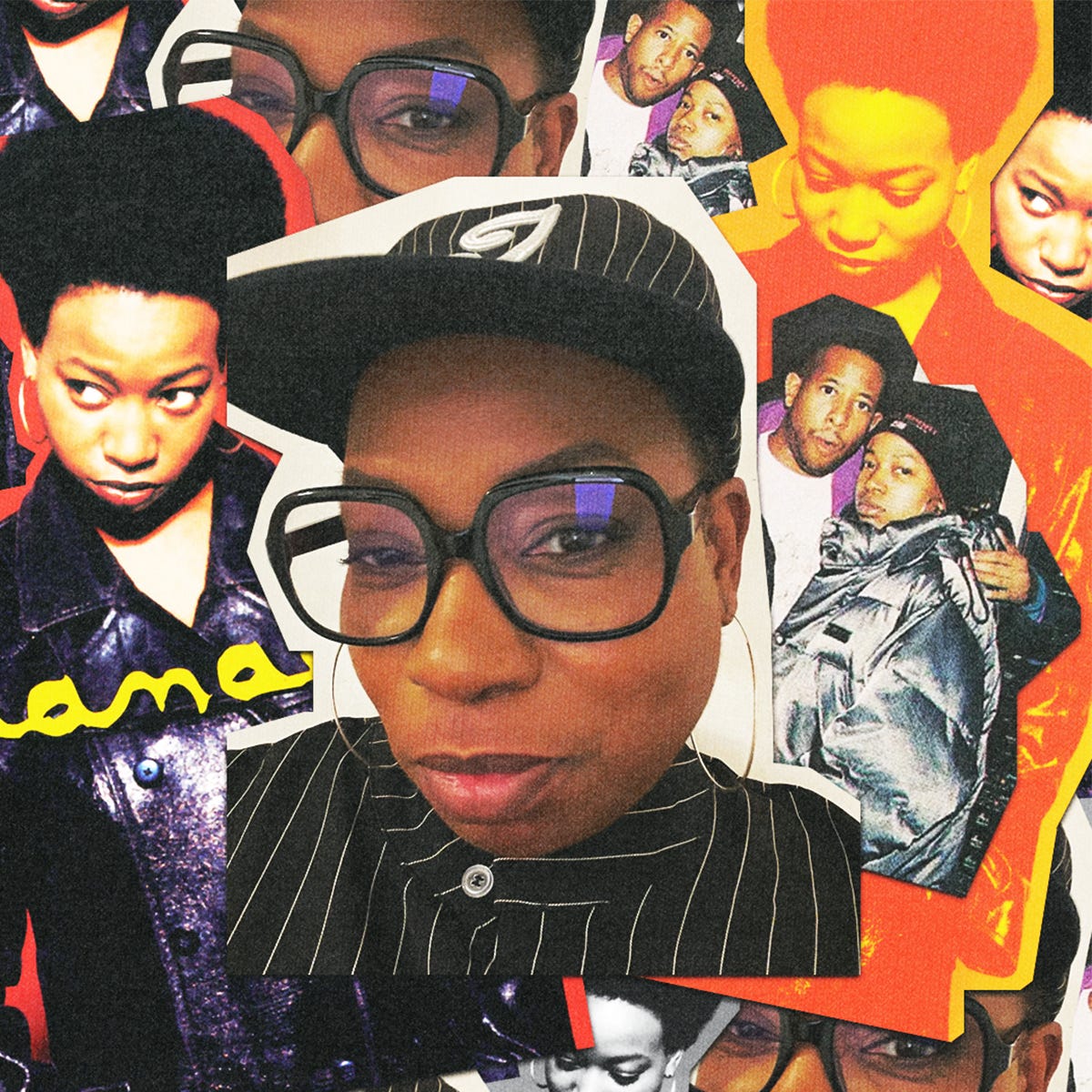
In 1996, hip-hop was approaching its maximum volume. There were blockbuster releases that embodied and litigated regional and stylistic differences: All Eyez On Me, ATLiens, The Score, It Was Written, Ridin’ Dirty. (The sensationalized feud between the East and West coasts would also claim the life of Tupac Shakur, just as he was emerging as a monocultural force.) Amidst that, and despite the existing—and persisting—structural barriers, women were able to inch into the genre’s mainstream like never before, with the likes of Lil Kim and Foxy Brown dropping marquee LPs.
Through all that noise entered Philadelphia’s Bahamadia. Kollage, her debut from that March, is a quiet, jazz-rooted LP that considers calmness a strength and manages to cut through the din by exercising restraint. Shaped by producers from multiple corners of the map—DJ Premier, Da Beatminerz, N.O Joe—Kollage is as boom-bap as it gets, but with a touch of experimentation that has helped it stand out even three decades after its release.
In a rare interview, I caught up with Bahamadia over Zoom to discuss her early years as a DJ, meeting James Brown, her breakthrough into drum and bass, J Dilla, the state of hip-hop, and 30 years of Kollage.
What’s your first memory of music?
My first memory of music would be, like, gospel, and some country and western I suppose from my parents and grandparents. Gloria Lynn and Mahalia Jackson were two people ingrained in my psyche coming up.
How did you get introduced to hip-hop?
I got introduced to hip-hop inadvertently. During the developmental stages of it, before it got coined, it was just an experience you had going to the dollar parties, and then the mixtapes—the actual cassette mixtapes, breakbeat tapes. And then just like, parties, park jam parties, playground parties, rec center parties.
Philly had a pretty significant hip-hop culture in the ‘80s. What can you tell me about the scene in Philly at that time?
In the ‘80s, a lot of the independent stuff was going on. I can remember Lady B breaking a lot of records on her show, and then the live performances is what I remember. There was this one cool club called After Midnight, and another called Wind Ballroom. But After Midnight had Roxanne Shante, Rakim, Biz Markie, Ultramagnetic MCs, all these different people. It was just so dope to go there and see them perform live, and it was so intimate and packed because it was a small underground club, so the stage was literally in the center of the dance floor. We were right there in arms reach of them and watching them do all their hits. You just had to be there. It was dope. In hindsight, while it was developing, I don’t think anybody fathomed that it would turn into what it has become, you know?
And you were a DJ first, correct?
I actually played drums first. I studied percussion for a stint in my youth, at Sediment House of Music. I believe Questlove went there as well. I transitioned from there because I was exposed to all the DJ culture and all that stuff in Philly. But I always wrote poetry and little short stories as a child. And then I got into my first crew, West Philly Sound Crew. I used to write all the routines for the MCs, but nobody would show up, and I knew all the stuff. We had a battle, and nobody showed up, so I wound up having to do all the MC parts. I did the DJ parts, too, and we wound up winning the battle because there wasn’t that many female DJs that scratched and stuff at the time—in the culture at all, but especially in Philly.
I always loved the breakbeat element, catching the breaks and stuff like that manually. That’s what really gravitated me towards DJing. And I was introverted, too, so I felt like I could speak with my music collection. But when I got a chance to touch the mic I was like no, this is it, because I got a chance to find a voice and not hide behind who I was and pull out a part of my persona that people don’t usually see in public.
Do you feel like starting with percussion and DJing gave you an advantage when you became an MC?
Yeah, actually. I have a singing gift too, so I feel like, all the patterns… just being musically inclined, you’re gonna apply a little bit of that knowledge. That’s the vantage point right there. But then you want to leave a little bit of the technical stuff out, because the music is internal, and so I think it would kind of alter what your natural sound and style could develop into if it’s too technical, you know?
I think the correlation with DJing is because it’s like controlling the room, right? It’s controlling emotion and tempo. I feel like doing the drumming is the same thing. It’s an extension, but an electronic extension of what the acoustic part would be. So they kind of went hand in hand how I processed it. Same thing with producing. I feel like producing is just an extension of being a musician, transferring from being a traditional musician to an electronic musician, to now just a montage of all those different experiences sonically, and you put it into one cohesive composition with the music. That’s why I love programming more on hardware than I would ever on software.
Agreed! Tell me about the Funk Vibe EP.
Well actually, my first breakout appearance on wax was on Epic Records. We had this MC named Han Soul from Philadelphia, who was, I believe the first hip-hop artist signed to Epic Records. We were under a similar production company, and he had a song out called “Imagination.” I was on the remix of that. Then from there, me and the same producer, DJ Rand, we did “Funk Vibe.” I found out later on that it was going to be connected to an EP with a different combination of different regional artists. My single was the breakout single. It started charting, and from there it garnered a lot of different established artists. Special Ed was the first artist that the song really garnered attention from. I was interested in working with him because I was always a supporter of his style. But when I found out that Gang Starr was interested, I just knew it was the right fit. The jazz element, the traditional hip-hop foundation, just the eclecticism of what Gang Starr represents, their forward thinking—especially with Premier. Fortunately for me, Guru saw the vision, you know? That’s how we wound up hooking up.
You had a pretty developed style already by the time of that “Funk Vibe” joint, but on Kollage I feel like you really came into your trademark laidback delivery—which of course is very reminiscent of how Guru used to rhyme. Tell me about what you learned from him, and how you came into that style in the first place.
I feel like I always had a conversational approach to writing, and that’s just one dimension of my style, you know what I mean? In terms of the cadence of what I do, that’s my signature style, but I have other styles. I actually started out rhyming over disco breaks and house music and stuff like that, so I always had a more progressive edge to my styles. You probably see different tones and approaches to the writing and pockets on the more progressive styles of music that I featured on, but I always kept the signature semi-monotone feel because I feel like being a woman in the industry, and in hip-hop period, our energy was needed to balance. I feel like a feminine energy is a quiet strength. So I felt like there was an opening for my voice.
So “Total Wreck” dropped in 1994, two years before Kollage, with that classic, jazzy Guru remix on the B-side. Given your association with Gang Starr at that point, what was the creative vision like when you were going into making Kollage?
Kollage was a montage of first takes. After “Funk Vibe” starting charting and garnering attention, I got the deal with Guru. The first song we recorded together was “Total Wreck.” You know how artists go into the studio and the record like 50 songs, and then narrow it down to the best ten to 12 songs, and that’s the project? Everyone song that I went on, every session that I went to, that was a song. One takes. Every song that I recorded was on Kollage, and I didn’t have any surplus. If you notice, you never hear about any B-sides or rares. I don’t have many of those because during the Kollage period, we didn’t have any.
I wasn’t even aware that was going to be the project. When we did “Total Wreck,” Guru told me to come up, we did the session at D&D, and then next thing you know he calls and says we’re doing a video. So I go up to do the video, and I’m thinking it’s Gang Starr—I’m making an appearance in a Gang Starr video. It was the video for “Total Wreck.” I’m like, “Wait, this is the single.”
It moved so fast. And then he dropped the Ill Kid sampler, which I didn’t even know was gonna be that. He had like, four or five different groups, including me as a solo artist. I just thought that each of us would get the same amount of time to record and shape our sound. So when I realized that I was like well, shoot, I got records and I have my own vision. I came back up to the studio for I think might have been the “True Honey Buns” session, and we did the intro and the interludes at that session.
I brought a handful of my own vinyl, and I sold it to Premier. I was like “OK, this is what I want for the intro, this is the beat for the interlude, etc.” And then Mecca from Digable Planets, she educated me about artistic freedom—that I had the right to articulate my vision to everybody, from the arts department to the way I had a right to be at the mastering. I was green, I didn’t know any of that stuff, and she showed me around. She was the first established artist who, aside from Premier and Guru, took me under her wing and showed me the ropes. Which I thought was very powerful, and I’m really grateful for her to this day. There weren’t many women in hip-hop, let alone the camaraderie being genuine. It was always performative, if at all. In my experience. So to have somebody that didn’t have a vested interest in you, that just respected your artistry, to do that? That was kind of unprecedented at the time.
It’s interesting you talking about how there aren’t many B-sides or unreleased joints—I’m a big collector of unreleased material, and I looked. There’s really nothing at all.
If you do find something, it’ll always be a mashup or people ripping vocals and mashing them together. There’s a whole bunch of that stuff out there, mainly poorly executed. I have a lot of different things that I’ve been sitting on from throughout the years, but I’ve never released anything officially. Before Jay Dee passed away, he was going to produce my next full-length album. He had begun starting to send me all kinds of beats, and I still have the disc that he crafted for me specifically. I still have it in storage. I would never dishonor his legacy. I told Ms. Maureen about it. Amp Fiddler, too—I got cassette beats from him too.
My life has been a dream creatively, but I’m introverted, and anti-industry. And my presence is visceral. So if you know me, you know me. If you know my legacy, and you were there, then you know. But I haven’t been like, “Yo, I was the one the one that did this.” I don’t toot my own horn, because I feel like I didn’t want to become a prisoner of celebrity or the fanfare that came along with the visibility. I just don’t feel like all that is necessary. If you have a huge platform, unless it’s purpose-drive, what’s the purpose of garnering all the fanfare and attention?
Rest in peace Jay Dee and Amp Fiddler. On the producer tip, Kollage is quite literally a collage of producers—you got Preemo on there, Da Beatminerz, Ski Beatz, and you yourself have some production credits. Talk to me about having that many minds in the studio and what those sessions were like.
Each session had its own identity, I can say that. The idea was to mirror Illmatic, and initially, I had hired every producer Nas had for Illmatic. But Q-Tip backed out at the last minute or something, and Pete Rock wasn’t available, so that’s how N.O. Joe from Scarface got involved. The Roots, too—they weren’t initially a part of the lineup either, but it wound up working out, with the hometown connection. And me and Malik B were always good friends outside of the music, I knew him before The Roots situation.
This was during the time that you would go to D&D and someone new would be there at any given day. One time I went there and Big L was outside. One time, LL Cool J was on the elevator. You know a deer in the headlights? Yeah. I don’t get starstruck, but he was just so towering. It dawned on me like “You made it, you’re actually doing this. This is not you looking at the back of The Source or MTV or any of that. This is your real life now.” It was humbling.
One time, we was in the studio, and Biggie was in the other room, and Onyx came to the session. Showbiz & AG, you just never knew who you was gonna see in D&D. This is the kind of of atmosphere that was going on in D&D. Beatminerz used to have two rooms in there. Then Ski Beatz was in there, I met him because he was working on all that Camp Lo stuff.
But each session was like that, though. Now, when I went to N.O. Joe that did Scarface and all the Geto Boys stuff, we flew down there to him. Lindsey Williams, who was the A&R of the project, we flew down there to meet Joe, because he wanted to work in his own space, and we wanted a different environment because the sound was so different, with all the live instrumentation.
Everything else was just boom-bap, boom-bap hip-hop. Go in, write the rhymes, listen to the beat. Premier is one of those types of people where he, in his sessions specifically, he would make the beats right there. Sometimes I would come in and he had the drums just running. When you laid the vocals in, he would craft everything else around it. It was crazy.
Cats like you and The Roots were kind of the representation of Philly hip-hop during that time period. What was going on with Philly rap at that time that the rest of the country might not know about?
I feel like the regional sound had never been highlighted until like, a Peedi Crakk came out. Or you look at the battle scene, like when Reed Dollars came out. This is pre-Meek Mill, of course. When Meek first came out, when “Rose Red” and all that was out, that was our regional sound at the time, because it had always evolved. It’s evolved now.
But [in the ‘90s] it was booming. There was a lot of different open mic events where artists could showcase themselves. Highly competitive though, and it’s still like that to date. And then the poetry scene and the hip-hop scene kind of merged together, because you had several staples events like the Black Lilies and different poetry and open mic events at all these different cool clubs and cafes. It was always diverse, always highly skilled—the average person that would come there, the might not even be taking their craft seriously, and there’s plenty of people I know right now that have smoked the average person, and you never even heard of them. This one MC named Hollowman, specifically. Especially during the DVD era, when him and E. Ness and all of them came out. It was a time. Those two scenes never really merged together, because that was more street-oriented, organic, barebones hip-hop. But then you had the more cultured artists that were seasoned from studio work and stuff like that. And then you had the Bahamadia and Black Thought and Malik B, who were versed in both those worlds, who was like a liaison in between both the worlds.
And specifically—I’m gonna speak for myself when I say this—I always had an understanding of how to walk that fine line between a purist approach to doing hip-hop, because that’s the core essence of who you are, if you’re an innate creative and talent. And the business of it, which is knowing how to craft actual records and projects, that’s a skill set that’s missing in the industry today because of the way we communicate and the integration between AI and the internet and of all of that, you know what I mean? So it’s disposable now. People don’t have to be developed, but I feel like that’s the vantage point that more seasoned artists have.
And that’s why I’m happy to see the resurgence—I don’t even say resurgence, because I’ve always known these people—Big Daddy Kane and Kool Keith, these people have always been working. They just haven’t been visible on the mainstream spectrum, but they have been working. So people are extra flabbergasted like, “Well they sound too good to be 50 or 60” or whatever and I’m like, “What do you mean they came back?” They were always working, they were always active in their craft, just not on your radar. But I’m glad to see it being more balanced now, because it looks like the current generation is more open to connect with the more seasoned artists. That’s all the genres I’ve seen, but specifically hip-hop though. Any other genre, like country and western, you would see Jelly Roll with Dolly Parton or something. All these people, they mesh together because they have a certain reverential respect and fear for the artists that paved the way for them. Whereas in hip-hop, it was always marketed as being youth-oriented and youth-driven, but the initial offerings of hip-hop came from adults, and I think that’s why it had so much substance and balance in it. Melle Mel, The Sequence, all these people from the pioneering stages, these people were adults when they were making music. They weren’t in their teens, so you’re gonna have a totally different perspective. But we’re in a different time now. These times are crazy.
Yeah, like you said, there was always this idea that hip-hop was a young person’s sport, but I do feel like that’s changed a bit. You look at someone like Kendrick Lamar, arguably the biggest rapper on the planet right now. He’s almost 40 years old. Nas had a legendary run the past few years. LL Cool J put out that album with Q-Tip a couple years ago. There’s been a shift in that idea. What do you think caused that?
I think it did a 180 because it started to eat itself, and so it’s gonna go back to the foundation at some point. It has to reset itself. It’s oversaturated, but now it’s a separation of wheat and tares. So wheat and tares look the same, but the real is gonna be what feeds, what can become the food supply. It’s edifying, it’s nourishing—as opposed to just filled, and just being popular, a flash in the pan. And it depends on the goal, too. Some people just look at it as a cash grab. That’s the economy we’re in now. Like the bitcoin dumps that were real big, and the NFTs and all of that, it was just a cash grab. That’s how it’s been approached.
The con to that is that we haven’t had anybody to preserve the historical aspects of the importance of community and the impact and tool that hip-hop is. We need those conversations to be had more consistently, or revisited, and we also need it to be more voices—the current voices and the voices from back then. There should be more of a balance in every aspect of our culture. We gotta listen to what’s going on in the youth. The youth are experiencing it. Hip-hop was always anti-everything that’s established and controlled. Segregation, all of that.
So even if you become an elder, or seasoned, or whatever you want to call it in this thing, in our culture… how are you gonna now be the thing that you despised the most? If the youth culture, if this is what they’re talking about, if whatever is going on in hip-hop right now is something that’s unfavorable or has moved away from what it’s core aesthetic was, who’s to blame for that? Who’s really to blame for that? If there are any reference points, instructions or guidance, or people reaching out that know what it was really about; if you’re not connecting to with youth to help with mentorship, then they’re gonna do what they wanna do, what they think is dope. And you can’t get mad at that.
I remember when I was a young buck and the elder people used to say, “That’s junk, it’s trash, it’s not going anywhere.” And now my generation has become that. That’s the whackest thing ever. I embrace the youth culture. They wanna know, they wanna connect, they just feel alienated sometimes.
Who are some young MCs that you rock with?
In Philadelphia: Tierra Whack, Lena L. Oh man, there’s so many. I may have to go ahead and say… Well, I can’t say Jill Scott, because Jill Scott matured, but she’s starting to delve more into her MC side. I’m glad she finally let her hair down and started getting on the mic. I think she’s been wanting to do that for a long time, but has been reluctant. I had an inside scoop about her working on her rapping stuff for a while now with Premier.
There’s so many different people. Some of the artists though, it’s just people that I see on TikTok, or I’m exposed to it from the youth that I work with—not even names people would know, because they’re just regional.I like BabyChiefDoit. I always liked what he represented. He’s just so fun and don’t care. He’s just fearless. Vel Nine is dope too, from the West Coast. Chyna Streetz is dope. Rome Streetz.
I like what you said about BabyChiefDoIt because, like you said, it’s just pure fun, and stuff like that always reminds of the really, really early hip-hop when they’re rhyming over those disco records. It’s not super lyrical, but it’s a party, and I feel like that’s one of the functions of hip-hop, you know what I mean? Those feel-good, party records. I think it gets misunderstood sometimes.
That’s exactly what it is. It just was a curveball, because nobody would expect for him, for that generation, to even reach back that far in terms of the sound, you know? It’s just a perfect marriage, I love it. I hope more artists do stuff like that, revisit. I’m starting to see that, though. NLE Choppa got that New Wave kind of sound too, him and Tyga. Everybody kind of delving into that New Wave sound. Mya has a whole new project out that’s dope too, on that vibe.
Yeah, there’s that Fenix Flexin song out too that has that ‘80s new wave thing going on. I’m kind of wondering if that might be the next wave.
And that’s what I’m saying, it’s a 180. Because after it ran its gamut, these more current, younger artists are doing this. So it’s like okay, now you had to either be exposed to that, or you went digging to find it. So if you went diggin to find it, then there you go, now this whole world is opening up. That’s why I don’t think people should stop. Even if you want to reinvent yourself, just figure out a way to articulate what you’re experiencing in current times. It’s not that hard. You know how to articulate what’s going on around you, right? Just from your own perspective. I don’t like to see when more established artists try to reinvent themselves, and they come back out and try to adopt a style that’s popular or current. People are not going to connect or resonate well with it because it’s not an authentic interpretation of what your perspective is. I don’t know how come that’s so hard for people to gather. I’m like, I see what you’re doing, but all you had to do was just get with some producers that could bring a different side of you out now.
Yeah, like when Nas linked with Hit-Boy, I thought that was a perfect marriage.
And that’s what I mean, the marriage between the generations. We all need each other, we need to connect. That’s the key right there, and being on the pulse of where you should be at. Because sometimes the misfits are quirky and they wind up working out, but their formulaic approach to connecting with someone like Hit-Boy… that’s exactly what the average person that support Nas, that’s what we would want to hear and see.
Taking it back to Kollage, do you remember any of the albums you were listening to for inspiration during the making of that record?
I mean, during that time, I rarely listened to hip-hop unless it was some progressive stuff. Mainly, I listen to jazz, obviously. Some soul, rare grooves, gospel. Nancy Wilson, Phoebe Snow. Con Funk Shun. A lot of stuff that you wouldn’t think a Hip-Hopper would listen to, I guess. Electronic stuff. I can’t pinpoint one specific album or anything, because it was just all a part of my sonic diet. I listen to a lot of stuff, and I grew up like that. I was exposed to a lot of different genres of music.
That kind of eclectic taste really shows up throughout your whole career. It makes me think about a year after Kollage when you were featured on that Roni Size joint “New Forms,” a UK drum and bass track. And that was two years before The Roots played with DnB on the “You Got Me” outro.
[“You Got Me”] was inspired by that song. A lot of people wasn’t even doing that. I think me and Redman, because he did a song with Goldie around that time, we were the only two that really was from the States and diving into that type of sound and experimenting with that stuff. But I’ve always been like that, I always felt like [drum and bass] was an extension of hip-hop. Anything progressively moving the culture forward, once you bring an MC to it, if you’re really a hip-hopper, it becomes hip-hop.
But yeah, Roni Size, I think that was the first drum and bass song that featured rap vocals on it. He won a Mercury Award for that jawn, which is like a Grammy out there. That was a crazy time. I didn’t even know that the song had gotten that big, dawg. I just did it because he heard my sampler for Kollage. I think he contacted Guru for me to be a part of the song. He was in New York and came to D&D. D&D had all the historical sessions. The track was up, I went right in there, wrote a couple of the lead lines, improv’d the rest, and was out. I went on tour after that, and after I came back, that’s how I started touring overseas. I started getting bookings at the electronic festivals with the DJs, Carl Cox and all them different people.
And then, James Brown, rest in peace. It was this festival called the Good Vibrations Tour in Australia. They did Perth, Sydney, all the populated spaces. He handpicked everybody he wanted to be on that tour. I didn’t even know he was aware of my music, and it was all DJ culture with James as the headliner. That could have been it for me right then and there, just the simple fact of even being in proximity to James Brown. It was crazy.
So did you get to meet James Brown?
Yes, I did. Actually, he was a friend of my grandparents. When they had the Chitlin Circuit, they’d have these competitions, and my grandmother sang and used to complete on the same bill with James Brown. My grandfather actually knew him, because they was from the same hometown. So when I told [James Brown’s] manager that, he came and got me. I went to the tent and met him. I was so humbled. I wanted to cry, I was so emotional, but I sucked it up. I was blown away. It was surreal, like everything was slow motion. Like a dream state.
That’s so cool, because hip-hop and drum and bass, they’re both built off the back of James Brown.
That’s what I’m saying. Even during this time, if you notice, a lot of people are getting the lifetime achievement awards. Lauryn just got one. All these different people, they’re getting their accolades. I think mines came in a different form, meaning that it might not be as out front, but it’s the experiences and the enrichment that I receive from experiences. I wouldn’t trade that for anything. I just didn’t fathom that it was gonna turn into that. I will be forever grateful that the Most High used Guru to see the vision to give me that shot.
But getting back to James Brown, for him to be on the pulse of what’s going on, for him to have the ear to actually know who to pick… Who would think that he would know who I was? He’s the original. Everybody was saying, we cannot believe that we’re doing this with him.
It makes sense to me that he was tapped in. I always thought of him as a futurist, you know what I mean? Like Miles Davis. He was always just looking towards the next thing.
Herbie Hancock is like that, too. So it would make sense. It was just like, a no-brainer for him. I was just shocked. So you know, it goes from that, then I go home, and then I’m at an open mic, the next thing you know, I’m off on tour with this person… It’s just so many different lanes I’ve been afforded from being open and embracing those sides of myself, you know? Being courageous enough to experiment and be myself in those spaces. I am humbled and blessed to still be around to see how things have evolved from when I first started to now. It’s so many dope women out now, the hip-hop spectrum is so diverse now. And I’m talking about the originals, because there are a lot of people that replicate people’s energy and stuff. Not talking about those, I’m talking about the authentic people, the spirit of hip-hop that’s really pushing the envelope, that are offering something a little different. Or if you can see or sense the influence, they put their own spin on it to push it forward. Those are the people that I resonate with when you ask me who is on my radar now that I listen to.
Given that we’re talking about modern hip-hop, 30 years after Kollage, how do you feel like it impacted the genre? How do you view your impact and legacy in general?
I feel like Kollage is a definitive work, first of all. And if anybody ever took the time to research its origin and the impact it has had, you will see that it’s been generational. I can connect it to so many different artists. And you know your own spiritual and creative identity too, and this has been going on for generations in hip-hop, since Kollage dropped 30 years ago. I still see it resonating today.
But when it resonates that long, and that wide, and that huge a span, you gotta take yourself out of the picture, because I think you would just be too arrogant to think that it was just about you and what you actually did. It’s bigger than you when it gets to being on that magnitude. It’s like, “OK, yeah, you were used as a vessel to impact and influence these people and help unlock who they were created to be.” But that’s the objective. I think we’re all supposed to do that, we’re all supposed to inspire people to be more of who they were created to be.
And that’s the Most High, that’s not even you, you know what I mean? I’m just humbled that I’m open enough to be out of the way so that spirit could come through and do what it needs to do. But I’m not the only one that has the ability to do that, it’s just that some people aren’t tapped in. The aren’t even aware. You grow into that knowledge and that wisdom, through experiences and processing, prayer, a lot of different things. This is life’s work. This is not a career path for me. I was created to do this music and do this. How many people gonna leave here and never find that? People like you and I are fortunate. I know you’re passionate about what you do. I didn’t know you were a DJ, though. I thought you were just a journalist.
Well I’m technically both. I don’t actively DJ anymore, but I did for a long time. I was Estelle’s DJ for a while on her Apple Music radio show.
Oh! Estelle was there at that James Brown tour. That’s where I first met her. It was crazy, we were all blown away. And unfortunately, that was the same year that Jay Dee passed away. We were on that tour. I think the second or third date, everybody was on stage and they had black bands on their arms, and I was like what’s the black band for? And they was like, Jay Dee passed away.
Wow, that’s how you found out?
That’s how I found out, yep. And we had the same management team at Timothy’s Entertainment. And RJ Rice who owned Barak Records, he used to be a mentor to me. I’ve been knowing them for a long time, Wajeed, all of them. Dwele. Fat Cat. And look what they grew into.
I just be thinking about it, like… You know how when you’re doing something, you’re not thinking, you’re just doing it. This is what you love to do. You don’t even realize sometimes you could be making so-called history. You’re not even knowing it, because you’re just doing it. You never stop to reflect on it, because you don’t sit there patting your back and making a fool of yourself. You’re moving forward. But if you ever rest and start reflecting on that you’ll be like… wow. And the only time I do it is when I get interviewed, which is rare.
Yeah, I was trying to find interviews with you to prep for this, and there’s really not that many. Is that an intentional choice?
Yeah, I feel like you just have to warrant my time. I’m a private person. And I like rest, and I don’t like performative stuff, and the only time I’m really interested in conversing with somebody about the artistry or culture is when I have something to say, or intuitively, I know that I should. I felt like this was a time for me to do that. Energetically, I felt like this was the right one. I don’t feel like playing an industry game, I never played it.
All of these spiritual aspects you’ve been discussing, how do you feel like it comes through in your music?
Oh, well, everything is spiritual. It’s either on the light side or the dark side. How it comes through in music is honesty. It’s in everything I do, because it’s everything that I am, you know? There’s a difference between being spiritually aware and being religious. So i’m religiously disciplined to create, but I’m spiritually inclined to do it because that’s what I’m supposed to be doing.
To close things out, what about Kollage do you want the world to know? How do you want it to be remembered?
It will be remembered as a definitive work that had an indelible mark on world culture.