

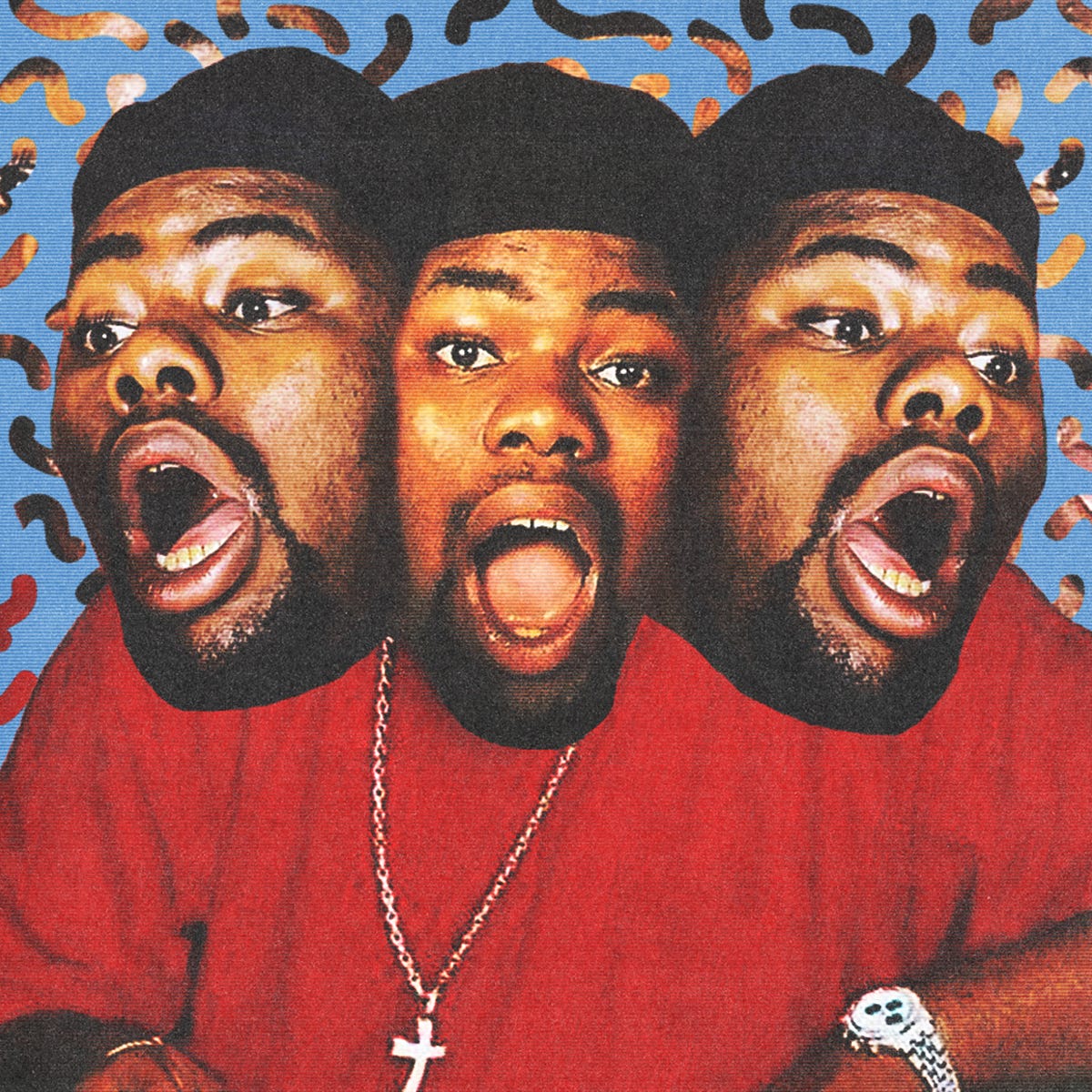
[Ed.- A version of this interview ran in Wax Poetics Japan in early 2015; this is the first time it’s been published in English.]
In the classic 1986 Dutch documentary Big Fun in the Big Town, director Bram Van Splunteren captures New York City in a vibrant state, with hip-hop wedging its way forward between dilapidated buildings and sirens, somewhere between being misunderstood and exploited as a novelty. The film is rich with footage of young, soon-to-be titans — Doug E Fresh, Grandmaster Flash, and L.L. Cool J, among others. It’s unmistakably colorful, a time capsule of the palpable fun and innocence of mid-’80s hip-hop innovation. Despite the reported drug use, violence, and overall discord in the area, Splunteren immersed himself in the neighborhood, was a true fan of the culture, and treated hip-hop as high art before most even considered the notion.
Midway through the film, in a jam-packed nightclub in Harlem, we see a tall, skinny beatboxer with an enormous grin named Biz Markie. His hat says Biz Markie in big letters. He does a bare-bones stage routine with young phenom Roxanne Shanté. Despite the cramped club, the crowd is effusive, partying while police and security nervously stand by. When Roxanne pauses her verse, Biz continues to beatbox as the camera zooms in and just sits. The crowd goes wild; he’s captivating.
What we see here are amazing teammates from one of the all-time deepest music collectives — the Juice Crew — but we also see a young Biz Markie about to embark on the world.
Born Marcel Theo Hall, Biz grew up in Egg Harbor Township, New Jersey, and moved to Long Island in the early 1980s. It seemed like a perfect time and entry point for a big character like Biz; rap was young yet rapidly developing with varying styles and newfound aesthetics. He was always into music, and while his first forays were as an MC, his later career would flesh out more components of his explosive personality and acumen for entertaining. With a knack for making music with his mouth, he later served as the Juice Crew’s clown prince: wholesome, funny, relatable.
The Juice Crew was the precursor to Wu-Tang, a collective helmed by a single superproducer (Marley Marl) and a stable of MCs with wildly different strengths and personalities. Key members included Big Daddy Kane, Kool G Rap, the aforementioned Roxanne Shanté, Masta Ace, MC Shan, and others. Says Biz: “We were just all young, having fun. We liked being around each other, too. We didn’t even care about fame or record sales then.”
As the crew sold more units and made a name for themselves outside of New York, Biz’s rep grew larger— as did his small frame. He’d later follow the rubric of other self-deprecaters, like the Fat Boys, turning appearance into endearing punchlines. Though his subject matter was arguably never profound, the songs were catchy; their choruses sung with a refreshing lack of self-awareness. He never hit a perfect note, but he’d go on to release enormous singles with Marley Marl.
After his debut, Goin’ Off, which featured great ones like “Vapors” and “Make the Music With Your Mouth, Biz,” he released the song that would be tethered to his whole legacy, “Just a Friend.” The song used a Freddie Scott sample that remains undefeated to this day; its piano clinks known across generations a few seconds in. For the video, Biz is lovesick and heartbroken, wearing a powdered wig, playing the piano like Beethoven. It was a massive hit and really bolstered his crossover appeal.
Though the music on his albums had always been sample-based, his next release, I Need a Haircut, halted his momentum due to a lawsuit served by Gilbert O’Sullivan for the use of an unauthorized composition.
Biz’s version, similarly (perhaps too similarly) titled “Alone Again,” was just another song about his lack of ladies and weaknesses as a playboy. It sampled “Alone Again (Naturally),” a song that Irish singer-songwriter Gilbert O’Sullivan made in 1972. The landmark lawsuit altered the structure of how rap music was made and sold, forcing all samples to be cleared in advance, constricting creativity and rendering the field available only to those with huge financial backing. With a corporation like Warner Bros. on the losing end of such a major court case, Biz’s records were eventually pulled from shelves.
Biz’s cousin, Cool V — who appears on most of his early records — was also served a lawsuit. Biz soon became the face of illegal sampling. Though he later mentioned in interviews that it was just a business altercation and that he was never personally shaken, the lawsuit marked a shift in his career.
The next album was a tongue-in-cheek stab at his tribulations called All Samples Cleared! His sense of humor remained intact, though record sales receded. Members of the Juice Crew during this stretch branched off into different directions and solo careers. And besides a few cameos on each other’s albums, group members became more and more like affiliates as the ’90s moved on. Even Marley Marl’s release, In Control Vol.1, felt more like a compilation than a cohesive group effort.
There are pictures of the crew posing in front of Marley’s jet, but it also featured younger members like Tragedy (also known as Intelligent Hoodlum), which really signaled a changing of the guard.
Throughout the 1990s, Biz’s reputation transcended that of a rapper and became a cultural figure, a personality whose guest appearances punctuated other people’s projects. The Beastie Boys were fans, asking him to appear on Check Your Head (1992), Ill Communication (1994), and Hello Nasty (1998). Biz, at this point, was already a legend and seemed universally beloved. He was even sampled on “Anybody Seen My Baby,” a 1997 single by The Rolling Stones.
Though he was widely known mostly for his rap songs, Biz was also a DJ throughout his life and career. Stories of his record collection had become almost mythological. He boasted extremely rare vinyl like the supposed one-off, 12-inch single of “Take Me to Mardi Gras” by Bob James.
James, a jazz keyboardist and arranger for the CTI label whose songs such as “Nautilus” had been sample fodder for years, has said that a version with omitted bells is “highly unlikely but possible.” Biz’s version supposedly has the iconic bells at the beginning of the song omitted, making his version even more stripped down with solitary drums. To this day, the validity surrounding the record still confounds. Biz definitely says it’s not an urban legend: “I promise, I swear I got it!” he said.
Once the 2000s arrived, Biz was doing corporate gigs and cameos in Jay-Z videos. He revealed that he was a big toy collector with an expansive collection of action figures and gadgets. He made appearances on the popular, hip-hop-centric children’s show Yo Gabba Gabba and was featured in movies like Men in Black II. He was on reality shows like Celebrity Fit Club, and his famous saying “Oh snap!” entered the pop culture pantheon, with many a t-shirt run made in his likeness.
Hip-hop doesn’t create renaissance men anymore, but it seems Biz Markie was truly one of the first multi-faceted rappers to be gifted with the ability to be good at many things. To this day, he still keeps a sense of humor about him, still makes faces into the camera for laughs, as exuberant now as a beatboxer as he was on Big Fun in the Big Town.
Below is our conversation (taken from a series of chats conducted between 2007 and 2010) where he bounced back quick responses that covered his history, beginning from his first memories of hip-hop, to his heyday with the Juice Crew, to some of his later experiences with reality TV. He even addresses the curious Bob James record. With humor and ease, Biz recounts a career that, to this day, nobody can beat.
You famously rap, DJ, beatbox. Of all those, which was the first that you remember doing and why?
Beatboxing. I mean, I was a kid, and that was just the first thing I took up when it came to hip-hop. I didn’t think about, I just sorta did it, ya know?
What are your memories of New York when you were just a young beatboxer?
