

[page]
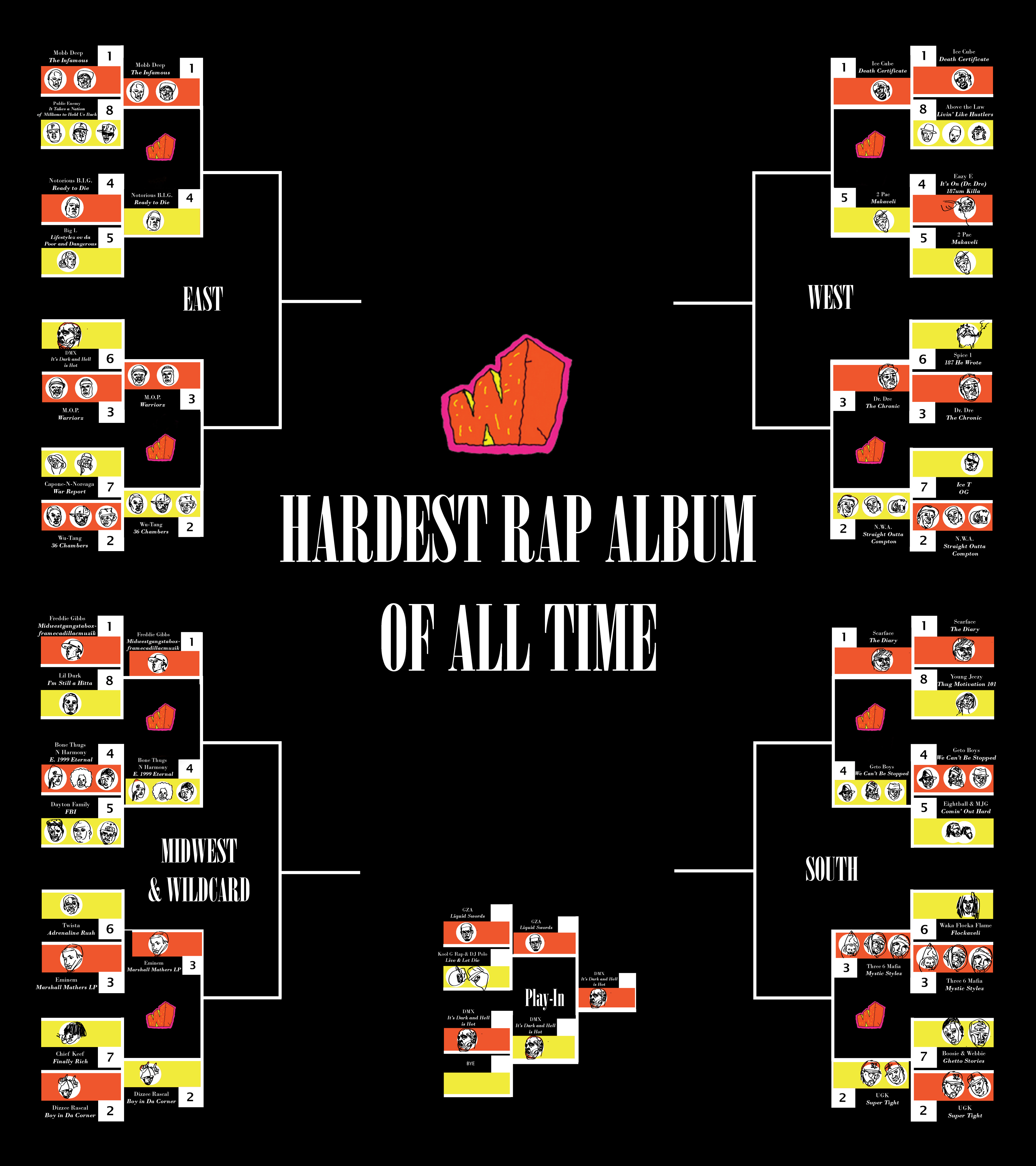
Welcome to week 2 of Passion of the Weiss's "Hardest Rap Album of All Time" bracket. Let’s get right to it: You guys went chalk with the voting, so I believe that means that we did a great job with the seeding. The one notable upset in the bunch is Tupac’s Makaveli beating Eazy E’s It's On (Dr. Dre) 187um Killa and I suppose I can understand the choice, given how many of you probably lack father figures just like Tupac did—but that’s a discussion for my Twitter timeline or the comments. Catch me at either location. I’ll give you guys credit for picking Dizzee Rascal over Chief Keef. It was closer than I would have liked it to have been but it all worked out in the end, so I’m proud of some of you. And while I understand folks picking Three 6 Mafia’s Mystic Stylez over Waka’s Flockaveli, I can’t suppress my disappointment in the fact that Flockaveli is out of the tournament already. That was my dark horse finalist. Admit it, 85% of you dickheads haven’t even heard Mystic Stylez. I’d put that shit on my Mayweather v. Pacquiao tickets. It’s all good though. Before we get into the next round, I’d like to briefly address some of the “overlooked” suggestions you guys threw in the comments/on Twitter: Killer Mike: none of his solo projects have ever been hard enough to make this bracket. The Run The Jewels stuff probably could, but it’s relatively new and it doesn’t really fit any of the regions cleanly. I guess we could have thrown it in the Midwest/Wildcard region but 30 muthafuckas thought this shit through and none of us thought of Run The Jewels, so take that for what it’s worth. Das EFX: get ancient, gimmicky ass NYC Migos the fuck outta here. M.O.P.: You’re really gonna complain about Warriorz over To The Death as if every M.O.P. album isn’t the same shit anyway. Shut the fuck up. Onyx: not a bad call but Sticky Fingaz went on MTV and lost a celebrity boxing match to a white nigga in 1998, so you can shut that shit right up too. Redman: really? That’s just stupid. That’s all I’ll say about that. Clipse: occasionally, Pharrell and Chad laced fools with some hard shit but all those synths and percussion flourishes don’t scream hard to me. That undercuts Clipse’s claims to this bracket, despite the snowy subject matter. Group Home: Livin’ Proof is great. Might be DJ Premier’s best work throughout an entire project. Lil’ Dap and Malachi were clearly hard as fuck too. But they REALLY sucked at rapping. Like for real. So no. Trick Daddy: dunno man, his albums always had one or two sunny ass moments that kinda took him outta the running. Plus, he’s all on Instagram talmbout “Eat-A-Booty Gang.” That ain’t it. The Lox: probably could have made the list with We Are The Streets in place of any of the lower East seeds but instead of describing 15 different ways to beat Diddy up on wax, maybe they should have just done that shit. They just rapped and called Timbaland for a single. The Styles got all mad during a traffic incident and threw a buncha napkins at someone's car. Fuck that. The only omission I regret is Tim Dog. Either one of his solo albums could have done some real damage. Then again, most of you didn’t hear about him until he was on Nightline for swindling silly old broads or after he died. So whatever. I’ve rambled enough. Get to voting and make sure Eminem doesn’t make the next round. That would be embarrassing for everyone involved in this shit—besides me. - Mobb Deen ICYMI: Bracket Introduction Over the next few rounds our writers will talk about the albums that were hard enough to make the bracket. Up first is: Public Enemy, Big L, The Dayton Family, Lil Durk, Scarface, Young Jeezy, Ice Cube and Ice T. Click on! (if you see links to 10 pages immediately below, only pay attention to the first five—still working out design kinks. Try refreshing your browser to get it to five page links. Thanks!) [/page][page]

Vote: East Semis - click here to vote 'til Wednesday at 5:00 p.m. PST

“So don’t step to this ‘cause I got a live crew / You might be kinda big but they make coffins your size too / I was taught wise / I’m known to extort guys / This ain’t Cali, it’s Harlem nigga, we do walk-by’s.” Spite incarnate, Big L's music was forever shadowed by death. Every other line was a blast of threats aimed at enemies, doubters, competitors and anyone who had something to lose. Lamont Coleman was undermining parent's attempts to raise well-adjusted children, years before Shady gripped a chainsaw. L splattered his bars with an encyclopedia of offensive content and spat them with enough malice to traumatize a Juggalo. Who else would end a song by shouting out murderers, thieves and people with AIDS? Coleman's debut was the only full-length album recorded during his short life and he named it in direct opposition to television show Lifestyles of the Rich and Famous. As someone who had no time for caviar dreams, Big L was the quintessential disaffected youth. He was too poor to afford a conscience and rarely paused between dome cracking bars to reflect on social issues. Cold angst permeates throughout the record and as a fan of horror films, L relished playing the villain and shocking the listener. While other emcees claimed the means justified the ends, Lamont laughed off constraint and poisoned eardrums with comparisons to the devil. The power of Lifestylez doesn't just lie in dark imagery though. Big L was a paradigm of technical ability with internal rhyme schemes and caustic wit. “I got styles you can't copy bitch, it's the triple six, In the mix, straight from H-E-double-hockey sticks.” Coleman’s lyrical bloodbath was also backed by D.I.T.C’s production and the album knocks front to back. Unfortunately, Columbia couldn’t predict suburbanites enjoying jokes about killing nuns and found Illmatic’s conscious spin on street-life was easier to market. Big L was dropped a year later and gunned down before he could record a proper follow-up making this project a haunting reminder of the realities of Harlem in 1995. — Jimmy Ness
Nothing scares the Powers That Be more than an educated minority with a predilection for militancy. To date, there has been no better audio representation of this fear than Public Enemy’s It Takes a Nation of Millions to Hold Us Back. Between the intelligent and righteous wrath of Chuck D, the crazy street antics of Flavor Flav and the paramilitary madness of Professor Griff and the S1Ws, Public Enemy was the band most likely to scare the shit out of your parents and politicians alike. Amped on beats by the inimitable Bomb Squad production team, the album somehow managed to be both an aural attack and a funky groove simultaneously. Sure, everybody and their brother was sampling James Brown at the time, but P.E. eschewed the rubbery bass lines and went straight at you with the scronking horns and aggressive guitar licks. Kicking off with a snippet of a live European gig showcasing alarms and Prof. Griff warning the world that shit’s about to get real, “Bring the Noise” remains one of the greatest opening salvos of any album in any genre. “BASS! HOW LOW CAN YOU GO? DEATH ROW. WHAT A BROTHER KNOW?” is the cannon fire that starts this 60 minute march through the ghettos of their minds. Topics run the gamut from the crack epidemic (“Night of the Living Baseheads”) to trash television (“She Watch Channel Zero?!”) to media beefs (“Don’t Believe the Hype”). Whereas other “hard” bands were just beginning to figure out what “gangsta” meant (N.W.A. notoriously received a copy of It Takes.. just months before drafting Straight Outta Compton themselves, and the Bomb Squad would be called in to take control of the boards for Ice Cube’s AmeriKKKa’s Most Wanted, P.E. was suggesting that the masses (or at least the disenfranchised portion thereof) get their shit together and overthrow the government. Fuck running your block, Public Enemy wanted to change the goddamn world. It gets no harder. — Chris Daly Vote: East Semis - click here to vote 'til Wednesday at 5:00 p.m. PST 1 - Introduction 2 - East Semifinal 3 - Midwild Semifinal 4 - South Semifinal 5 - West Semifinal [/page][page]

Vote: Midwild Semis - click to vote 'til Wednesday at 5:00 p.m. PST
F.B.I. usually stands for “Federal Bureau of Investigation,” unless you’re in Venice Beach, buying a kitschy t-shirt. Then it stands for “Female Breast Inspector,” a recession-proof job if there ever was one. Of course, if you’re Flint, Michigan’s Dayton Family, it stands for “Fuck Being Indicted.” Flint is widely known as a rusting, industry-less, largely abandoned shit hole—Dayton Family, named for a particularly crime-ridden street in the city, never tried to disabuse listeners of that notion. The group, comprised of members Bootleg, Shoestring, and Backstabba, debuted in 1995 with the hard-as-nails What’s On My Mind? A spot on an early No Limit compilation followed shortly thereafter, but Backstabba was imprisoned for 11 years, which member Bootleg claims was partially a result of him rapping about his misdeeds. He was replaced by Ghetto E for their second album, 1996’s F.B.I. F.B.I. is much in the vein of the Southern gangster rap sound of the era: mostly sample-free, relentlessly pounding, and endearingly tinny. The mid-90’s is the sweet spot of hardness and occasional self- and sociopolitical reflection; alongside cocaine, this is what the Dayton Family traffics in. On “Posse Is Dayton Ave.,” Bootleg raps: "In institutions, drug abusin since my younger days / Motherfuck a 9 to 5 my gangstas told me crime pays / I was 17 back in them days, I couldn't spell diploma / But I could tell you bout good weed and crack cocaine aroma / Niggas my age not gettin paid, I thought that was dumb as fuck / Why y'all in school, I'm stealin bags of shit off Pepsi trucks." Shortly after the release of F.B.I. a perhaps overly poetic bit of irony struck—Bootleg himself was imprisoned for three years, further derailing the group’s momentum. The group reformed after his release, but F.B.I. remains the group’s pinnacle. If only he hadn’t been fuckin’ indicted. — Torii MacAdams
Drill was a moment, but also a deluge: The scene produced waves of mumbly garbage rapping over cheap trap retrofits. Rising above the din was Durk’s I’m Still a Hitta, a collection of 14 songs, with, hooks and verses and stuff. Bad rappers use autotune as a crutch, but Durk has one of the stronger melodic senses in rap, so the effect for him is complementary, not corrective. “Rite Here” and “Jack Boy” are melodic gems of the highest order. “I Get Paid” turns what should be the stupidest hook in the world—“money/money/money/money/I get paid”—into a frenetic earworm. I'm Still a Hitta’s cover is a pile of coke and a nine, and “L’s Anthem” is an aural nightmare in the best way, but to be perfectly honest, I’m Still a Hitta’s excellence doesn’t lie in its hardness. It lies in its sense of fun. No wonder Durk came out on top. — Jordan Pedersen Vote: Midwild Semis - click to vote 'til Wednesday at 5:00 p.m. PST 1 - Introduction 2 - East Semifinal 3 - Midwild Semifinal 4 - South Semifinal 5 - West Semifinal [/page][page]

Vote: South Semis - click to vote 'til Wednesday at 5:00 p.m. PST

“Off brand niggas can suck a dick, cuz they can’t fade me.” In 1994, no one could fade Scarface, be they on- or off-brand. The Diary is the apex of Scarface’s hardcore continuum, the culmination of a hell raising half-decade which began with Scarface joining the renamed Geto Boys (no “h”) in 1989. The Geto Boys immediately drew the ire of Tipper Gore, Bob Dole, and their pearl clutching cronies at the PMRC with the group’s debut Grip It! On That Other Level. That said, it’s not hard to shock a woman who’d likely deny having ever farted and a man whose waxen personality complimented his oily skin. Their follow-up, We Can’t Be Stopped, featured Geto Boys member Bushwick Bill on a hospital gurney, his eye destroyed from a failed suicide attempt. The same year, Scarface’s Mr. Scarface Is Back debuted. Its cover: a shotgun-heavy Mexican Standoff. The Diary was released in a year laden with great rap albums, and it’s to the album’s credit that it wasn’t critically overlooked. Scarface dialed back a tiny bit of the wanton violence, and further emphasized a mix of social awareness, street reportage, and B-movie gore. “Hand of the Dead Body,” featuring Ice Cube, a chorus from Devin the Dude, and production work from Mike Dean, directly addressed gangsta rap’s perception by the mainstream media. "David Duke's got a shotgun / So why you get upset cause I got one / A tisket a tasket / A nigga got his ass kicked / Shot in the face by a cop, close casket / An open and shut situation / Cop gets got, they wanna blame it on my occupation." The equally classic “No Tears” is outwardly violent, the type of song to court censorship, but its hardness is derived from its verisimilitude. The chorus-less song opens with Scarface leaving a funeral, removed enough from the occasion that the tears have dried. Like the cycle of black-on-black murders particularly prevalent in the early 1990’s, the song ends with Scarface vowing “You can cry but you'll still die/There'll be no tears in the end.” Scarface has nothing to offer but something approaching the truth–if you can’t take it, you’re probably Tipper Gore. — Torii MacAdams
Gangster rappers used to show you their neighborhoods, extol their hood credentials, and weave crime dramas. Young Jeezy largely didn’t do any of those things and it made him hard as fuck. Thug Motivation 101 represented the new order in post-50 Cent gangster rap, or as it came to be known, trap rap. Jeezy is the trap. You know because he says it. You know his punchlines are funny because he adlibs laughter. Any salient details are incidental. Liberal arts students hated it (until they found out they could compare Jeezy to Upton Sinclair), but apparently the dope boys went crazy. TM101, known otherwise as the Principia Trapmatica, appeals to Freddie Gibbs, ScHoolboy Q, and the kids in the Good Kid, M.A.A.D City skits, because Jeezy shovels brag raps that double as drug dealer axioms. Take any line on the album and it’s an ice cold Instagram caption in 2015: “You better call your crew, you gon' need help. / Whole car strapped, and I ain't talking seat belts.” Then Jeezy leans into a mean adlib. Every idea on the album is expressed in the title. It’s aspirational, but not in a Bad Boy, Roc-A-Fella, or MMG way. TM101 is distilled street shit, purified of narrative and character and Jeezy is a paragon of hardness. Also, Snowman is a pretty fucking hard nickname once you get over how dumb it sounds. — Evan Nabavian Vote: South Semis - click to vote 'til Wednesday at 5:00 p.m. PST 1 - Introduction 2 - East Semifinal 3 - Midwild Semifinal 4 - South Semifinal 5 - West Semifinal [/page][page]

Vote: West Semis - click to vote 'til Wednesday at 5:00 p.m. PST

“Here’s what they think about you…” Ice Cube has been an avuncular movie star for so long that it’s no longer particularly salient to point out that he used to be the hardest. Cube’s acting career has been trading on the reputation he gained from being America’s most wanted rapper for so long that his rap career feels illusory—a different man might as well be wearing the skin of O’Shea Jackson. Death Certificate is Ice Cube at his absolute hardest —an impressive feat in a catalog that contains three other classic albums. As a songwriter and rapper, Cube has never been more flammable with a track listing that looks like a bandolier of incendiary grenades strapped to the rapper’s chest..“Steady Mobbin,” “No Vaseline,” “The Wrong N***** To Fuck With” are amongst the many, many classic songs on the album. Death Certificate is the type of dangerous, ice cold album that allows you to pimp Coors Light and kiddie movies two decades later without seeming corny. It’s the synthesizing foundation for Cube’s entire persona—the nostrils flaring, eyebrows curling radical that threatened to kill Uncle Sam, burn down the corner stores of disrespectful shop owners and dig your daughter’s nappy dugout. All while remaining unquestionably true to the damn game. — Doc Zeus
In their 2006 essay “The Making of an O.G.: Transcending Gang Mentality,” the Death Row inmates-turned-gang scholars Steve Champion and Anthony Ross argued that a true Original Gangster isn’t just any old gang member who claims seniority in a set, but a community role model who exhibits “commitment, struggle, intelligence, integrity, and wise counsel.” By that rubric, Ice-T definitely makes the grade and that’s clear enough on this 1991 opus. In it, Ice shows off his street bona fides while at the same time delivering devastatingly precise sociopolitical analysis (“New Jack Hustler,” “Escape from the Killing Fields”) and linguistic provocation (“Bitches 2,” “Straight Up Nigga”). Though police brutality and institutionalized racism are his main targets, he also uses his clear, elegantly simple rhymes to attack the music industry, sending up the “sex sells” mantra in his “What About Sex?” skit with Evil E and dismissing rockist politics with the debut of his “black hardcore band” Body Count. Production-wise the album has its dated moments—the gunshot samples in “Home of the Bodybag” sound more like somebody smacking a filing cabinet with a stick—but beats like the Black Sabbath-sampling “Midnight” draw out the tension. Coming out during a volatile period in American history, right after the Gulf War and the release of New Jack City and a year before the L.A. Riots, O.G. serves as a dose of brutal truth and a “Fuck you!” to a system in dire need of change. — Peter Holslin Vote: West Semis - click to vote 'til Wednesday at 5:00 p.m. PST 1 - Introduction 2 - East Semifinal 3 - Midwild Semifinal 4 - South Semifinal 5 - West Semifinal [/page]