


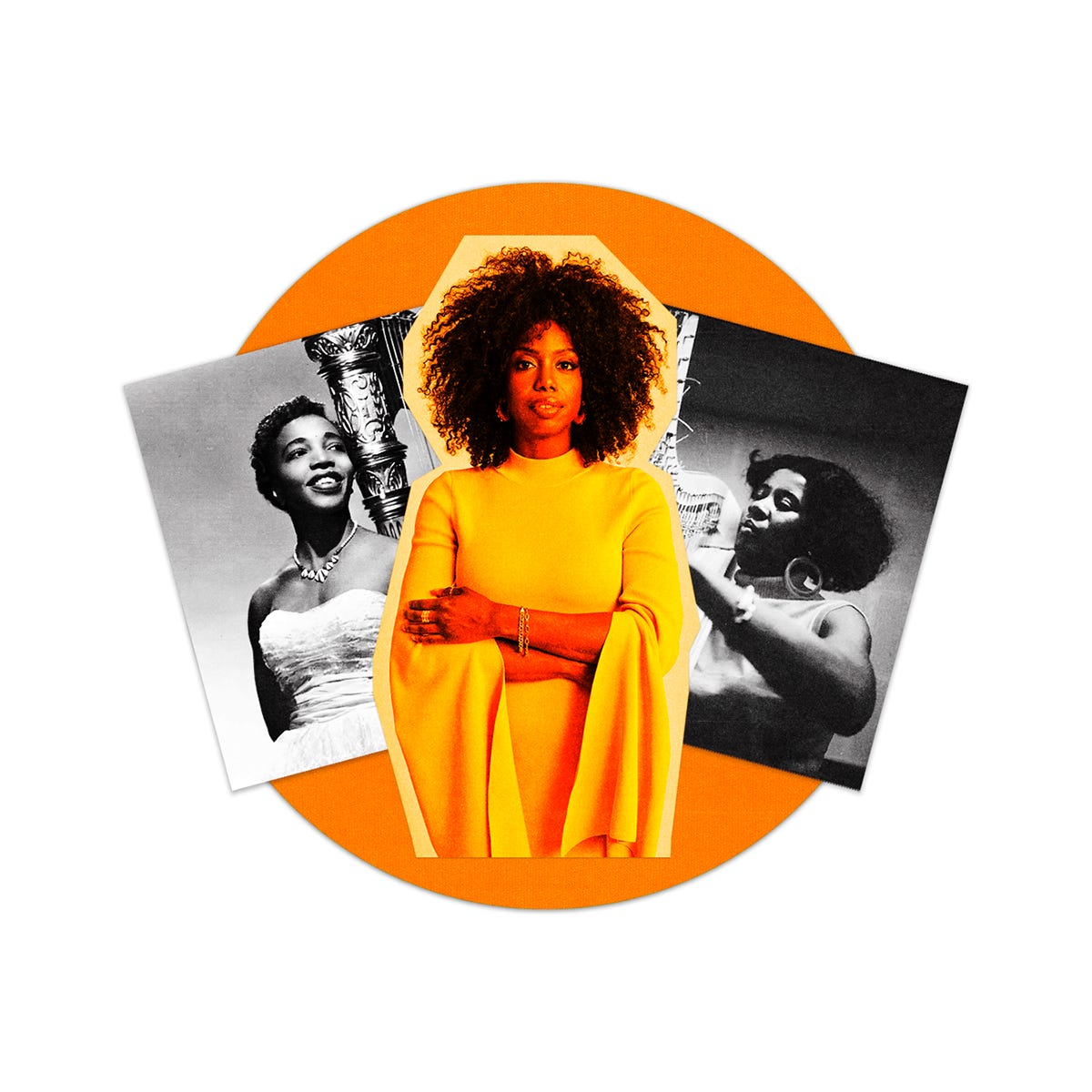
Brandee Younger is obsessed with Alice Coltrane. She has been for most of her life. Today, Younger has Coltrane’s harp sitting in her home studio. She never takes it out of the house, and plays it every single day when she’s not on the road. It’s how she communicates with Coltrane and summons the spirit of the spiritual jazz queen who had a profound impact on her life and career.
Younger grew up on Long Island and in high school, she yearned for that communication. But the internet wasn’t there to help at the turn of the millennium. As a freshman in college at The Hartt School in Hartford, she’d write Coltrane letters, professing her admiration for how she played the harp, how she lived her widowed life following John’s death, and for generally being an inspiration to the budding harpist. But she never sent the letters, because they couldn’t capture what she’d want to say to her hero perfectly enough.
And while Younger was never able to get those words across to Coltrane, a phone call from Alice’s son, saxophonist Ravi Coltrane, gave her an opportunity to do so in a way. When putting together a band to play a memorial at St. John the Divine in Uptown New York City following Alice’s passing in 2007, Ravi tapped Younger as the harpist.
“He called me for that memorial and I did a couple backflips, but I got nervous,” Younger says, sitting across from me at a cafe in Montreal. “We didn’t rehearse, I hadn’t played the music together, but I knew all of it in my ears. And I was really put out there, with legends: Cecile McBee, Reggie Workman, Charlie Haden, Jack DeJohnette, Jeff Tain-Watts, Rashied Ali, Geri Allen, Steve Wilson. It was my first introduction to the Ashram singers too. I was in grad school and it was the pivotal moment in my life. She had influenced me in so many ways, even just by being a Black woman and playing the harp. Period. I guess that’s when I finally met her.”
Younger is arguably the foremost modern day jazz harpist (as if being entrusted with Alice’s harp wasn’t evidence enough). She’s performed and recorded with people like Robert Glasper, Moses Sumney, Makaya McCraven, Ravi Coltrane, and Lauryn Hill. She has also released eight albums as a bandleader, including 2025’s Gadabout Season, on Impulse!
The night before we meet, Younger played a set at Montreal Jazz Festival supporting Gadabout Season; it was stunning. On the modest, brick-walled stage of Studio TD, she led a trio with bassist Junius Paul and drummer Allan Mednard as elegantly and forcefully as I’ve ever seen her. She’s been a key figure in my Montreal Jazz Fest experience for the past few years, dazzling with McCraven and Shabaka most recently. But the night before was very much her show. Her latest original compositions are as accessible as jazz harp has ever sounded. And the melody to the album’s title track was very much still stuck in my head while I was sipping my morning coffee as Younger showed in.
Talking to Younger feels like reading a biography about Alice Coltrane’s life. The same goes for harpist Dorothy Ashby, whose music Younger has also revered and interpreted throughout her career. When it comes to decorated harpists, Coltrane and Ashby form an interchangeable 1A and 1B of the most impactful to ever play the distinctive instrument.
Like the title to Younger’s latest album’s title suggests, she is a true gadabout. Often going on tangents about Ashby and Coltrane’s tendencies on harp, sharing anecdotes about each and how their output has surfaced in pop culture ubiquity.
“Seeing how often she’d take a pop tune and do covers, it gave me permission to be like, ‘Okay, so I can do this cover here,’” Younger says of Ashby. “Marvin Gaye, Stevie Wonder, whatever I’m listening to. I appreciate listening to what she does, not just on an improvisational level, but on an arrangement level.”
I sat down with Younger over coffee and croissants on a sunny, late-June Montreal morning, to talk about Coltrane and Ashby’s most essential output. In Coltrane’s case, some of the songs don’t even feature the harp, but Younger has interpreted many of those for the instrument since. She is no doubt a disciple of the greats. When you hear her music today, it’s clear that she’s meant to carry the legacy of the instrument that Coltrane and Ashby started. In short, there’s nobody better doing it on the harp right now in jazz and all its permutations.
Alice Coltrane, A Monastic Trio [1968]
The album cover of A Monastic Trio trio, which has a Chuck Stewart photo of Alice with a harp on it. She chooses to feature the harp on this cover and you gotta realize that shortly before his death, John Coltrane went to the Lyon & Healy showroom on 57th St. and ordered the most epic harp that the company made at the time. It’s this 18-karat gold leaf Lyon & Healy harp; nothing but the best for his wife. So they take a year to make it, he dies, and then the harp shows up. So imagine her choice to put this harp, this beautiful gift on the album cover. It’s sad, but it’s also a love story. I think about how she opened the front door and there’s a big ass harp on the stoop.
Look at the track listing of the album: “Gospel Trane,” “I Want To See You,” “Lovely Skyboat.” These are all in my opinion, a form of grieving, the process of it, but also accepting those things and like, the beauty of the other side of it. The spiritual existence that we’d all want instead of going nuts because your husband just died and you got four kids by yourself in the middle of bumblefuck Long Island. It’s Suffolk County, where I’m sure that when John went to buy the home, they were redlining: “These are Black people that are a bit more affluent, let’s put them together so that they’re not getting in the way.” Their neighbor was Black and this was not a Black neighborhood. It’s Huntington. They were without a doubt sectioned off.
“I Want To See You” resonates with me from the title alone. It could be a God reference, but you know this is John. So what does that tell you? She misses him. Even if I’d never heard the song before, it almost sounds like she’s crying. Because you can only imagine what a single woman at this point with four kids. And it’s not like he was sick for years and you knew it was gonna happen. He wasn’t old. He was 40. And if you’ve read the book, Monument Eternal by Franya J Berkman, it documents her deep spiritual journey and her output after he died.
Alice Coltrane, “Blue Nile” [1970]
On Ptah The El Daoud, “Blue Nile” is the song that turned me out. It’s harp and flute turned upside down. We love a harp and flute duo, very traditional. But you’ve got Pharoah Sanders and Joe Henderson playing flute, yet it’s panned. Pharoah’s in one speaker, Joe’s in the other, with Ron Carter on bass and Ben Riley playing drums. This was the first time I heard the harp in context of the rhythm section and it made me see the possibilities of the instrument. It was swinging and soulful. And what she chose to do, she did her glissy thing [as in “glissando,” where you glide from one pitch to another], but it wasn’t in this free way. It was rhythmic and her technique of glissing, with the double finger gliss is how you get that sound. So when I heard this in high school, I didn’t understand that she was glissing through her blues. So I said “What is this?!” and “I want to do that!“ Shortly after that first moment of hearing it, I was on my high school trip and I was waiting in line to meet [trumpeter] Don Cherry after a jazz band competition and I literally said to him, “Hello Mr. Cherry, do you know how I can get in touch with Alice Coltrane?”
Alice Coltrane, “Turiya & Ramakrishna” [1970]
That is my favorite song on Ptah The El Daoud, hands down. It’s got nothing to do with harp. There are a few songs that are like timeless classics and that’s one of them. I found it on the Priceless Jazz: Alice Coltrane compilation in high school. The first track was “Blue Nile” and the second was “Turiya & Ramakrisha.” It was something I never attempted to play on harp at first. All those twisty turns don’t translate well on harp so I was intimidated because I didn’t want to embarrass myself. I didn’t start to play it until five or six years ago when I got the balls to change the key so I could do some of those twisty turns, and basically just arrange it so it doesn’t sound super cheesy on harp. It’s a special tune, and not just ‘cause Solange famously put it on her playlist—someone told me years ago that Solange’s iPod is the most valuable thing on the earth—although her putting it on the playlist introduced a lot of people to that song. People are writing lyrics to it now.
And It was also featured in Atlanta, [S2 E8] the scene where Paperboi, on the anniversary of his mom’s death runs into these fans that acted like they wanted to buy his music and then they beat him up. As he’s walking down the train tracks right before that encounter, the whole song plays. Mind you, you need approval from the estate to use their music and they really don’t do that. So her daughter Michelle and the family must’ve really seen something in Atlanta to allow that to happen. And it made all the difference in the hands of the right artists. So there’s something about authenticity with Alice. Like… Spike Lee initially wanted to name the Mo Better Blues movie A Love Supreme and Alice was like “nah.”
Alice Coltrane, “Prema” [1978]
This one’s a digger—on the live album, Transfiguration. There’s a tone deaf interview Mariah McPartland does with her where she’s like, “Oh John Coltrane’s wife, let’s play ’Naima’!” But Alice handles the interview with so much grace, and she plays a solo version of “Prema.” It’s meditative, but not fall asleep meditative. All of her meditative music, it brings you somewhere. I’m not that deep of a person, I’m very much on this earth. But “Prema” is special. So “Prema” on this recording is about the band’s string section. It’s life changing and beautiful.
Dorothy Ashby, “Afro Harping” [1968]
This is the title track to my key album of hers, but I think that’s everyone’s. Most hip-hop heads know Dorothy Ashby through her albums on Cadet. Those are the funky ones that Richard Evans produced. So that’s like Afro-Harping and The Rubaiyat of Dorothy Ashby. This track has funky, Afro-Latin grooves under everything. I read somewhere on Wax Poetics that Richard Evans’ whole thing was to make Cadet the most Black art label. He wanted the sound to be very, very Black. So they actually released a reissue of Afro-Harping with some outtakes on it and it was cool to hear Charles Stepney and what they were doing in the section.
Dorothy Ashby, “Games” [1968]
This is one of the few songs I’ve played out to the point where the band’s like, “Can we not do this anymore?” We can’t play “Games ”or “Blue Nile” anymore really, because we’ve done them both inside, outside, up, down and around. “Games” has a really cool flute. And I believe it’s something that she wrote for a theater company that she had in Detroit called Ashby’s Lyrics. She did the music and her husband wrote the plays. But she’d recycle some of those songs for the plays for her albums. This is one of them and probably my favorite.
Dorothy Ashby, “Soul Vibrations” [1968]
This one’s also off of Afro-Harping. Richard Evans wrote it and it’s an A-Minor groove. It’s like one chord, maybe it goes to another, but it’s so fucking groovy. I recorded a version of this one on my album Wax and Wane. Casey Benjamin produced it and I love it. Casey came in and was like, “We’re gonna change the changes.” And I was alarmed at first, but he was confident and changed some notes here and there and I love what he turned it into.
That’s probably one of my proudest, favorite tracks that I’ve done. It’s old, but whatever, I love it. I like how she can improvise over changes. It almost sounds like a guitar, harp and piano combined. She doesn’t shy away from doing a glissando. But then everything’s not a glissando. She’s really playing a little bebop harp. So a song like “Soul Vibrations” that’s like one chord, I’m like, “Please teach me how to improvise over one chord!” to just hear her ideas. And then to hear the ultimate Cadet takes, I appreciate what she was doing even more.
Dorothy Ashby, “Wax and Wane” [1970]
The Rubaiyat of Dorothy Ashby has “Wax and Wane,” which I named an album after and did a version on my live album. I love her “Wax And Wane.” It’s got like an African 6/8 groove happening underneath. It’s got a vibraphone and again, she’s improvising over a chord. Which is different from her earlier albums where she’s playing over the changes of standards and standard-like songs.
Brandee Younger, “Gadabout Season” [2025]
When I first talked to my band Allan [Mednard; drummer] and Rashaan [Carter; bassist] I said, “Look, I want this to sound fun. Like chipper, quirky, be a weirdo!” I made a playlist for Allan, who’s a straight shooter, of songs that made me feel happy and bouncy. It included Thundercat’s “Funny Thing,” [sings it], “Games People Play” by the Spinners. “Green Light” by Andre 3000 and John Legend. “The Whole World” by Outkast. Basically songs that are making me feel good. I’m sending these as references and he’s like, “Well what beat do you want?” and I was like “I don’t want a beat!” so I wrote down characteristics that they all share. So I’m sitting down with the guys, and said that we want octaves in the bass. Jump up back and forth, same note. I don’t know if it’s half note, eighth notes or quarter notes. But let’s just play around with it. So that’s how we ended up with “Gadabout.” I wanted space. But I wanted it to feel quirky so that it can build to something. But I really want it to represent my personality. I am…. a cheeseball [laughs] and am very proud of it. And I wanted the album that’s filled with all of these emotions that aren’t necessarily happy. I wanted it to lead to this place of happiness. That was important for me, to embrace your inner gadabout.
