

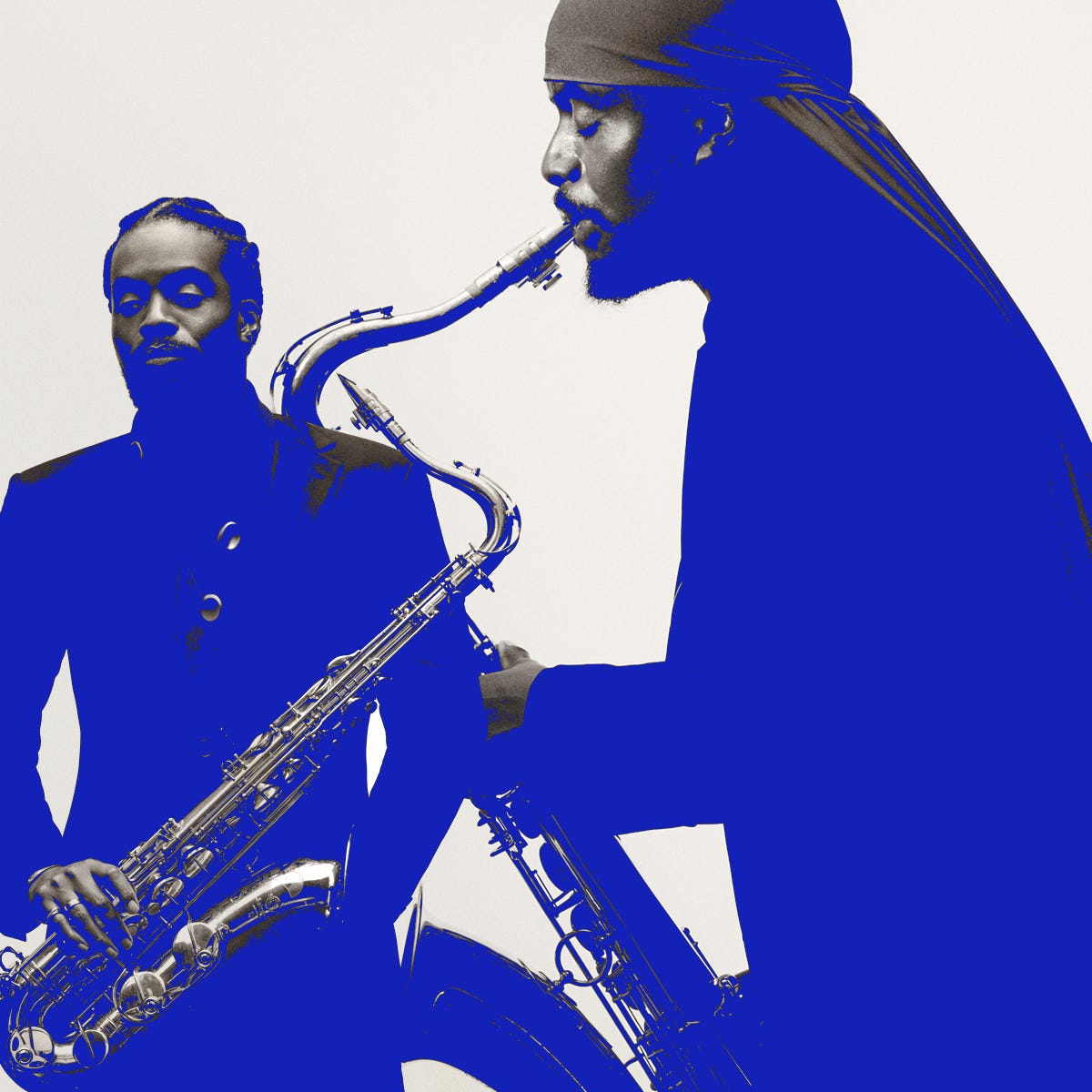
Art via Evan Solano
Staley Sharples says that writing is telling yourself you’re worthless and a God at the same time.
His moniker is an acronym for “can’t keep to reality.” London-based multi-instrumentalist Bradley Miller works through lush and expansive instrumentation as cktrl to mine the depths of his personal experiences. Releasing a series of critically acclaimed EPs from 2020 to 2022, cktrl generated a co-sign from Beyoncé with a feature on her visual album Black Is King, along with gigs composing for Dior and Virgil Abloh’s Off-White runways. But within this success, Miller found himself yearning still for broader means of self-expression. spirit, his debut album, captures Miller’s deeply personal and unconventional evolution.
To understand the present of spirit, we need to look back 10 years to Miller’s buzzy NTS DJ residency and a 2015 Boiler Room debut. In spite of his accolades, Miller wasn’t finding the community he was hoping for through music. Then, the pandemic happened. Clubs shuttered, community spaces withered, and Miller took the silence as a moment to search for a renewed sense of purpose. Connecting his background in electronica, classical, and jazz, Miller formally launched his multi-faceted instrumental project cktrl with the 2020 single “Robyn” on UK label Touch N’ Bass.
Classically trained as a saxophonist, clarinetist, and pianist, Miller’s sound is just as much influenced by his Jamaican and Montserratian heritage. Barring a few tracks aided by Hans Zimmer’s go-to collaborator Tom Bailey, Miller mixed the majority of spirit to help crystalize the intangibles of falling in love with a record.
“Whenever you hear a sound system playing, you'll hear the bass, a little bit of the highs from the distance. You can't make out what the song is, but as you're driving past it, it starts to come into what it is, and then you go past it again and it comes back into that,” Miller says. “I just love that feeling. How I've mixed the album is very much for that. Even the tracks that are heavily orchestral, they're still mixed like a reggae song. That's what also brings out more of the feeling in the music.”
Community is spirit’s driving force, with the words of bell hooks, “healing is an act of communion,” pulsing through the album. The songs are a triptych of pages torn from his diary, tracking the emotional flow of Miller among the seasons of his life transpiring during the making of the album.
“The process happened in three stages,” Miller reflects. “I made something in April, which ended up being called ‘April,’ those were the first tracks that were made on spirit, then I made some more music in November. In between April and November, everything I made didn't fit what was going on with spirit. In November I kind of got back into another groove, did some sessions with my friend, and then in February, I did another set of sessions, and it just came together from that.”
In the three-year wash of time between releases, Miller laid the foundation required to turn his vision for spirit into a reality, building a new team of management and publicists to help him execute his next chapter. “This album has brought so many people to the table that it's kind of crazy,” he remarks. “When you find people who actually believe in you, make you feel valued, and great, and find ways to make your ideas come alive, it's amazing. It's been a blessing, everyone who's come into my life.”
cktrl and I spoke about his debut album, the power of live performance, self-expression, and his dream venue.
https://open.spotify.com/album/5wEy1LKkVbEEKnyk9Ql5Ke
Congratulations on your debut album, that has to feel amazing to have that out in the world.
cktrl: It does. To hear you say it as well, it’s making it more real.
Your music is so based in feeling, which is something that I immediately connected with. It’s funny you say talking through things and putting them out into the world helps, because your music is instrumental [and therefore wordless]. I wanted to touch on your name cktrl (can't keep to reality)—if you're putting your thoughts and feelings out into the world, into reality, what is your connection with unreality? What does that mean to you?
cktrl: I guess I'm childish. [laughs]. I’m not really a serious person in life. Too tough. With music, I use what I’m going through to create the feeling, but once I start I’m getting lost in my little dream world of making. That’s why it’s very embellished and decorated in places, and it feels like you're able to just wonder. Like a soothing wonder. I’ve always cherished that about my music making process, because I can get lost in it, even if it’s started from something that was not causing me to do my best.
Was that something that your parents kind of facilitated in you? That sense of wonder and play and curiosity?
cktrl: Yeah, it’s very silly in the house. Growing up, no one was that serious, to be honest. I was very fortunate, I don't have many siblings, it’s just me and my sister. She’s my older sister. so it was just her and I and my parents, but we're all best friends. Collectively, and individually, we're all best friends. You can always take the piss out of your best friend. Everyone’s always roasting each other all the time, and that's just how it is. You love them, and you know it. It’s still like that to this day, I swear.
Did you grow up with a lot of music in the house?
cktrl: Dad had a lot of records, [and] so did Mum to be fair. If she was ever doing anything, she would have music on, and [it was the] same with dad. As I got older and got my own little sound system, Dad and I would have little sound clashes and stuff as well.
What’s your earliest memory of enjoying music?
cktrl: I feel like, just seeing the joy it like gave my mum, she would just sing something and like—not well, she can't sing still—
The song is in the heart.
cktrl: I can't even remember what song it was, it was a soca song, and she was dancing around and loving life. Music can really give you all the feelings that you need and just pick you up. I remember like maybe, half an hour before that, she wasn't that happy. You know what I mean? That song really turned it around.
I'm super curious as to how you pulled off that underwater shoot for your album cover.
cktrl: You and I both. I'm just so glad that I never have to do it again. As much as I prepared for what I was going into, I still wasn't prepared for what I was going into. It was really one of them ones.
My friend had an idea and I was like, I can't really tell him no. We got an email asking, “are you comfortable in water?” My manager sent me the screenshot, [asking] what am I saying, are you comfortable in water? I can't swim but I didn’t tell them that, I told them it's cool, and just make sure there's certain precautions in place, so if it does go left, there's someone that can save me. Only myself, my manager and my sister, who was on set as well, knew that I can't really do the swimming ting like that. I didn't tell anybody else, so they weren't panicking, they were carrying on as normal, like I had it under control basically.
So they just dropped you in the tank?
cktrl: They dropped me in the tank, [and] put some weights on me to keep me down there. There were speakers in there so I could hear the direction of what I was supposed to do, so I was just doing the best I could with what I was being told, and trying to, like, keep oxygen going. Put it this way—if I didn't play my instrument, I would've died.
Sacrifice for the art. The result is incredible. This underwater shoot touches on the ways in which nature has pulled through all of your creative and your projects—at one point, you mentioned you want your music to feel like a tundra. Is that something you still resonate with?
cktrl: I think so, to an extent. What I really want it to be, more so than anything, is an answer for people. Say you've had a rough week, or you're having a rough time, you can put that on and de-escalate everything that's going on. I'm big on people being able to find their center, and their grounding. The gift of instrumental music allows you to center yourself, rather than trying to relate to lyrics sometimes, or someone else's story as best you can, or even someone's opinion, and you're trying to see how you can relate to that opinion as best you can. You don't have to do that with instrumental music, it's just solely about your own experiences.
Seeing as you play a wind instrument, it's all about the breath. You initially started your journey on a different route in the DJ circuit, and again, so much of that is instrumental, and a form of connection. To be in a room with people and experience sounds and rhythms together.
cktrl: It's the best feeling as well, because it offers a similar thing, just that different frequency and tempo. You can do the same thing on a dance floor that music does for people at home as well.
Do you see yourself doing a hybrid show with a DJ set and instrumental performance?
cktrl: I’d like to play my own afterparty [after a cktrl show]. I couldn't DJ before I played. Don't want to risk it. That might throw me off.
What's your show prep look like?
cktrl: It’s kind of ridiculous, actually. The bigger the show, the more ridiculous it is. I'll rehearse coming up to [the performance], but then a few days before, I'll stop doing that, because I'll try and save my lip and mouth muscles so they can have a little recovery before the show. The rituals are really weird. If I've got a DJ set, I'll travel to the venue in silence. But if I'm playing, I'm listening to dancehall, like the most crazy party mixes that are just insane. Everything's really high energy. That will even be running backstage as well. When I go on, as I'm playing I'm also calming myself down, as well as everybody else. That's how I come into that stillness for the shows, because everything else has been a bit mad leading up to it.
It speaks to the way you expend your energy.
cktrl: If I was listening to my music or things that I've put out, or other like, slow, still things, and then had to perform it, it would just get a bit morbid, a bit too much. Some of the music is very heavy to perform, because you have to get back into that place to be able to convey the feeling of the piece, so I'd rather have complete distance from those feelings until its time. There's been times where, mid-show, depending on what song it is, I could be overwhelmed with emotion and I’ve still got half an hour left [of the show], so you need to play for the rest of this ting, otherwise it's a mess. I don't really talk at shows or anything like that, so there isn’t a little respite where I can get my composure back.
You've gotta just keep playing. Sometimes, I'm really mindful of that before shows, because I know that has happened before, where [I’m] sobbing on stage in front of other people, and then I’ve gotta find composure again to finish, because I know I’m nowhere near the end of the show, but I’ve gotta get there. After that happened, I've just done other things beforehand so that doesn't happen [again]. If I feel it happening, I can take 4-5 bars rest and then start playing again with some composure.
You're channeling these experiences for the audience, but you're also feeling everything. You have to give yourself an emotional pause.
cktrl: A hundred percent. When I first started performing this music, I wasn't really aware of that. For example, if you're playing by yourself and you're going through it, you're just at home innit, and it's fine. If you're recording a take or something, and you're happy with it, after that you're not playing anymore, you're just editing it. You're not as emotional as when you're playing it. There’s a degree of separation happening because you're not playing anymore, you're just listening back and editing it. You don't really realize what forces are going to act on you during an hour-long performance.
My earliest shows were definitely a mess because I didn't really know how to separate myself from the music, I didn't really have that skill. It's all been coming with the experience of doing more shows and understanding what happens. I remember when I did Colors, some years ago. The interview went fine, we did a couple rehearsals, and then we started playing and recording it, and I'm literally just in bits throughout my whole Colors set, but I couldn't do anything about that at the time. I didn't have the necessary tools to deal with it in a different way at that time.
You're using your physical body to create the music, so everything that's going on inside or mentally, it's all going to come out into the performance. When you are playing live, do you ever deviate from your setlist?
cktrl: It depends. It’s kind of spontaneous sometimes, to be fair. Sometimes you don't want to do certain songs, but then at the same time I might feel bad not doing it if people paid their money and they might really want to hear that one. I still consider it, but I might do a shortened version of it. It did happen—it’s just not as long as you remember it being. This is the life we chose, so sometimes you just gotta play that music.
What’s a dream venue for you to play?
cktrl: I'd love to do a show outside. You know, where you put on your own show in the mountains somewhere, and you have a great sound system up there. What I love about mountainous places is that sound travels round the mountain as well. So if someone's playing music over there, you can really hear it, and if you're a little bit further away, you can hear the reverb trails of it, but not exactly what it is. It’s something that feels nice. You might just feel bass from somewhere, but you can't make out what's happening in the higher frequencies. I like that kind of thing. And if you're curious, as you start to get nearer, you start to hear what's playing properly.
Those are some of my favorite memories of Jamaica in general. Whenever you hear a sound system playing, you'll hear the bass, a little bit of the highs from the distance. You can't make out what the song is, but as you're driving past it, it starts to come into what it is, and then you go past it again and it comes back into that.
I just love that feeling. To be that sound source playing to a crowd where that could be happening is really cool. How I've mixed the album is very much for that. People might not end up playing it very, very loud. How we consume music now, through laptops or headphones, there's only so much frequency response you get from that. Even the tracks that are heavily orchestral, they're still mixed like a reggae song. So you've got that much bass in the strings, and all the lower frequencies in the album are pushed in the same way, it's like the same frequency number and values that I used, so that's what also brings out more of the feeling in the music. That's what kind of makes it so unique, just in the way it's mixed.