


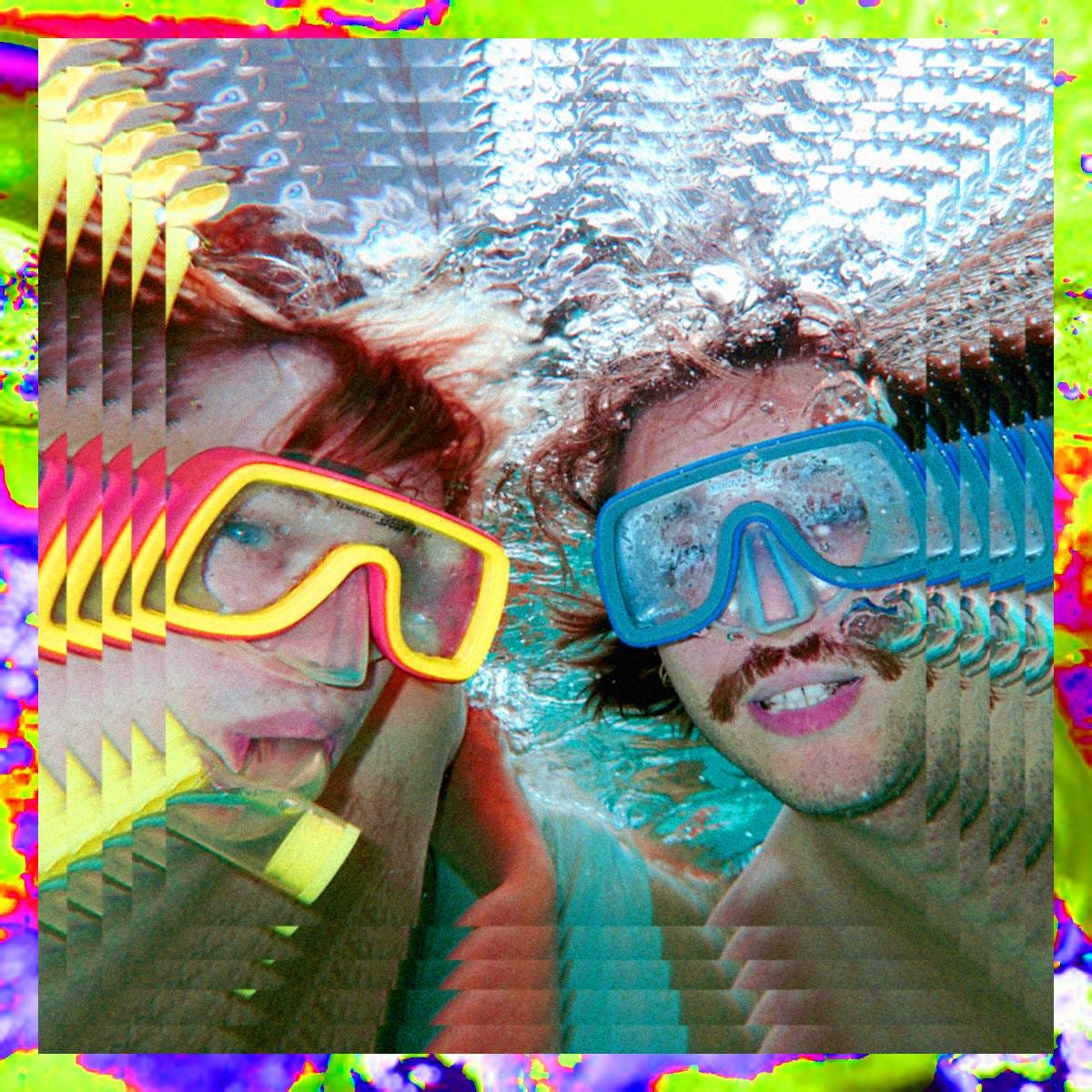
Art by Evan Solano
Donate to the Patreon. Support independent media or else it won't exist.
The fact that someone is always watching SORCERER on Letterboxd gives Will Schube faith in humanity.
If you’ve ever felt an insatiable desire to take in a set at a jazz club suffocating in cigarette smoke while simultaneously listening to a Four Tet mix in your bathtub, I’d like to introduce you to Crystal Sting. The duo of Kurtis Perrie and Bjorn Kriel, nascent figures in Toronto’s scrappy underground DIY scene, make experimental electronic music that is equal parts heady, playful, and deeply philosophical, like if Steve Reich’s Music for 18 Musicians were a Tim Hecker DJ set. Throughout their debut, Bubblegum Aquarium, there are moments of delirious pop joy (the El Guincho-inspired steel drums on “Splash Party”), buzzy and brainy ambient activations (“Suburban Atomizer”), and intelligent spins on hedonistic dancefloor bangers (“HD Umbrella”).
Perrie and Kriel both grew up in the town of Kelowna, British Columbia. The lone experience they remember having in Kelowna was bonding over Destroyer’s Kaputt as teenagers at a local record shop. It wasn’t until years later that their musical lives took shape as they both moved to Toronto: Kriel departed for the CN Tower in 2017 to study jazz piano performance at the University of Toronto while Perrie followed a few years later. As Kriel was getting deep into the weeds of jazz theory, eventually growing obsessed with mallet percussion (the vibes in particular), Perrie worked at a studio, learning audio engineering and immersing himself in electronic hardware.
Their two different educations coalesced with Crystal Sting, and by 2023 the pair began to gel. “Kurtis started getting really into modular synth stuff around the time that I started getting really into mallet percussion,” Kriel says. “That was really when we started to discover something that was working live and also sounding cool that we were both really excited about.”
To explain how, exactly, Crystal Sting recorded Bubblegum Aquarium would take a masters degree I don’t have, but let’s give it a go: Bjorn plays melodies on the vibraphone, which Kurtis captures in live time and thanks to some nifty software, instantly sends them back to his bandmate to manipulate, also in live time.
“Bjorn's playing different kinds of melodic instruments and then I'm recontextualizing them with my system and resynthesizing his playing, putting him in this world to improvise in, and do this, call back sort of thing,” Perrie explains.
Kriel hops in, though his explainer is also too heady for my pea brain: “It’s almost generative in a way. The sound starts when I make a sound and then it comes back to me in this new sonic world and it becomes this sort of infinite loop of existing in the world while also creating it at the same time.”
Literally, I do not know what either of them are talking about, but Bubblegum Aquarium undoubtedly feels like a brilliant album (out now on POW Records, of course), like Four Tet remixing Joel Ross or Darkside bringing a hologram Milt Jackson on the road.
Check out our conversation below, where we get deep into the Toronto jazz scene, aquatic vibes (the feeling, not the instrument), and the blend of playfulness and intellectual rigor at the core of their work.
Is Crystal Sting the main project you two are focused on right now?
Kurtis Perrie: I wouldn't classify it as the main thing. We both have so many things going on that I wouldn't say any of them are the entire focus. It’s certainly an important thing and it’s something we want to continue doing. We do shows every once in a while, that kind of thing.
Bjorn Kriel: What constitutes our musical lives is that no one thing really feels like the main thing, but any one of the things that we do is liable to take a lot of focus at different times based on who's interested and what shows are coming up. When Jeff and the POW crew reached out to us and had an interest, that definitely lit a bit of a fire for the project and for us to put more of our backs into it, so to speak. Part of the really fun thing about doing a lot of projects is it sort of feels like Crystal Sting exists within a community of musicians and people that we're inspired by in Toronto. Kurtis is working on some music with a friend of ours named Harry Bartlett, who's this guitar player now based out of Nashville. He's someone I went to music school with, who I've been playing with for years. Now, Kurtis has linked up with him.
Kurtis Perrie: We find a lot of ways where we’re collaborating. We were doing this before we put out any music under Crystal Sting. We work in a specific way where we’re still staying in a lot of different areas too, with friends and with our personal projects. It’s just a friendship.
Did you two go to the same undergrad?
Bjorn Kriel: No, we both grew up in Kelowna, British Columbia, but we didn't really become friends until we had both moved to Toronto. We had met a few times, but I did my undergrad at U of T for jazz performance, and Kurtis just started an electrical engineering program.
Kurtis Perrie: I’m in year two of a program for electrical engineering technology. I moved to Toronto for music five years ago just because I had a lot of friends from Kelowna out here. I worked in a studio for about a year and a half and was an audio engineer. I was producing my own music as well. I was starting to realize that I didn't want to pursue audio engineering as a full career, so I applied for school to get into product development in music. Around the same time, the studio I was working at burned down, actually, so it was a good time to change things up.
How did POW find your music?
Kurtis Perrie: They found us through my work. I put out a record three or four years ago now, and I think Sean Mishra found it because I had a track featured on Four Tet’s Spotify playlist. He gave me a call out of the blue, and we just started talking without any idea of where it was going to go. I would send him beats once in a while. We made this project in two weeks last summer. It felt like a good thing to put out with POW.
Oh, so it was finished and y’all thought it might be a good fit.
Bjorn Kriel: Yeah. I played on a couple tracks on Kurtis’ project Work. We had done a bit of live stuff and a few little recording projects here and there — just figuring out what the best arrangement of our workflow of electroacoustic improvising would be. Then, Kurtis started getting really into modular synth stuff around the time that I started getting really into mallet percussion. This is now just over two years ago. That was really when we started to discover something that was working live and also sounding cool that we were both really excited about.
Did you grow up playing percussion?
Bjorn Kriel: I actually didn’t. I was a pianist when I was pretty young. I started playing piano when I was about five years old. My grandma was a bit of a concert pianist, so she gave me lessons and then I got really, really deeply into rock guitar from ages 10 to 14. That was my whole life. I was playing in bands, writing songs, doing all that. Then I started to get into hip-hop a little bit, which sort of brought me to jazz and jazz piano. That was when I was 14, 15. Getting into jazz piano was really the advent of my musical life, the beginning of the trajectory I feel like I'm still on in a sense, where I pivoted my craft into becoming a jazz musician. The first half of my degree at U of T, which I started 2017, was studying jazz performance on the piano.
In the summer of 2019, I had some philosophical disputes with some of my professors, and I wasn't really seeing eye to eye with the mission statement of the program at that time. I dropped out, which ended up working out very well for me because the next few years would be online music school with the pandemic, and that just would've been total bullshit for me. I finally came around, ‘I actually do want to finish my undergrad.’ I had just worked one too many days in retail and it was time to go back to studying the blade, so to speak. Vibraphone and mallet percussions have always been a huge interest of mine with the kind of music that I'm into, especially a lot of the 20th century minimalism, like Steve Reich is a huge, huge influence for me. Midway through my degree, I just asked the program, ‘Hey, there is a vibraphone in the building. I know there aren't any people in jazz doing vibraphone, but will you just let me try? Just put me in any ensemble.’ I don't know when I'll have access to this again. I just got super, super obsessed with it and now it's a huge part of what I do in my musical life outside of school as well. I've just started my masters in mallet percussion, jazz performance.