


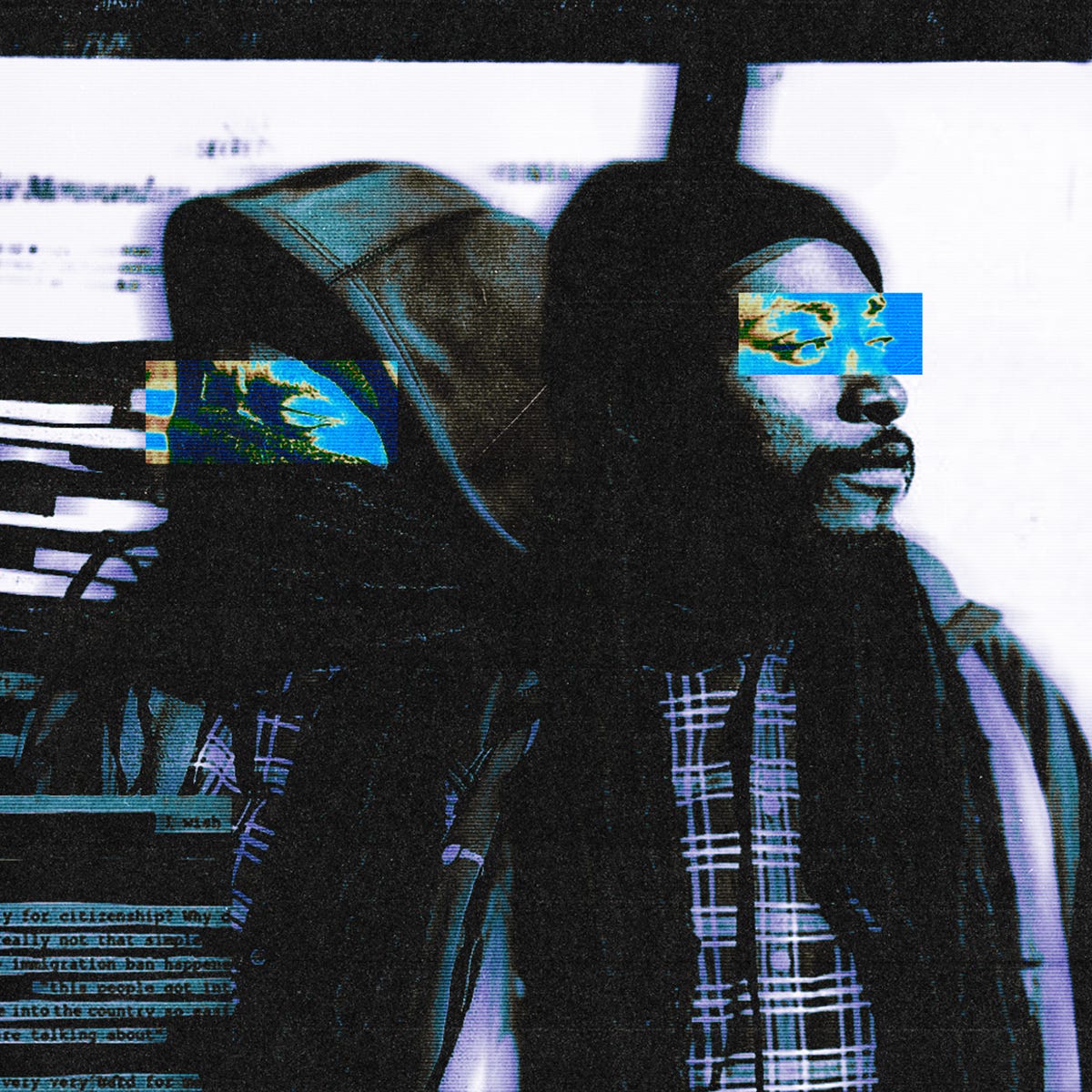
Contrary to every “market force” or piece of ill advice, Curly Castro has learned not to rush. For the last decade and a half, the Brooklyn-born, Philadelphia-based rapper has channeled the lineages of those two cities (and those of his West Indies roots) into muscular, conceptually daring hip-hop, both as a solo artist and in a variety of collaborations, most recently with fellow Philadelphian PremRock as ShrapKnel. Yet despite his seeming everpresence, YAPHET, which is due out tomorrow via Backwoodz Studioz, is his first album as headliner in half a decade.
Some of this is explained through the sheer volume of personal hardship Castro has faced. In the intervening years, he’s undergone major surgery and been given a cancer diagnosis; he suffered the death of not only his father, but his infant daughter. And even once these periods have been weathered, there’s the uncertainty about whether they will ever yield art that feels formally complete and appropriately cathartic. “It takes me a while to crystallize personal, actual autobiographical things to go into my music,” Castro says. “So a lot of these songs—especially some of the real emotional ones—I actually did try to write other songs.” But the subconscious bleeds through: the failing respiration on “I Couldn’t Breathe, If I Wanted To…” and the doling out of his Earthly possessions on “Last Good Will” sound as if they bubbled up, magmalike, from deep underground.
Yet YAPHET, which takes its name from the Blaxploitation icon Yaphet Kotto, is almost uniformly high-energy. Produced entirely by Milwaukee’s Locust, it spans decades, styles, and corners of the globe, tethering scraps of autobiography and shards of cultural ephemera to irrepressible drums.
Our conversation has been condensed and lightly edited for clarity.
Can you tell me about how you arrived at the title—not only naming it after Yaphet Kotto, but reducing it to his first name in all caps?
I’ve always admired Yaphet Kotto. I just thought, who could be Blacker than that? You know what I’m saying? So he’s big, he’s Black, he got a nice booming voice. And so I make my own superheroes. Some people like The Hulk, I like Yaphet Kotto. I always felt like I could name something [after him] and it’d have nice overarching idea, have little Blaxploitation hints, and just live as an idea from the time period I come from. And I just think it’s an imposing word.
When I think about Blaxploitation filtered into music, I think about the stuff RZA was sampling for Ghost. But I hit play on this album and was just bowled over by the drums.
Now the music was always important with Blaxploitation films. Music was in there. And I think it’s a matter of, even if it was serious, there was a little dash of fun, like in the Sidney Poitier and Bill Cosby joints. I think also I had to do some reverse engineering. When I grew up, I took the term too literally: I saw Blaxploitation, I just kept seeing exploitation, exploitation, exploitation. So I skipped them. I remember not liking Dolemite. I was just like, “They’re making fun of us.” I didn’t know these were our Black superheroes in the ‘70s, real live heroes that we had on alternative media. It wasn’t super mainstream. This is underground. I’m in the underground now. That’s what it was. And so I had to reconfigure thinking about it and really appreciating them and going back to watch them and see them for the gems they are and the stars who emerged from that, whether that be Richard Roundtree, Pam Grier, and the like. I had a whole methodology for this record: The plan was watch a Blaxploitation film, listen to one of the beats Locust sent me, and write the song. That didn’t work out. I was sitting there, I was four movies deep, I had no bars whatsoever. I said, OK, this is enough. Let’s just make some songs. And I think I made “SuperDOPE” and “Cheese N Bread Riddum,” and then that got me rolling.
And then when I rounded it out, when I finally had the full plate, I was like, “Oh, there’s still Blaxploitation elements in there.” There’s still attempts to be a superhero. I always grew up wanting to be that. I always felt like I was a mutant. My mom would agree [laughs]. You know what I’m saying? And so I just went with that. And then also doing that, my facets got facets. I’m multifaceted. I started revealing some personal items and personal issues and things. And so I think it gives a good glimpse. If you want to know what Castro’s about, this tells you a little bit about my childhood, my adolescence, my adulthood, and possibly my afterlife.
You cited “SuperDOPE” and “Cheese N Bread Riddum,” which are the second and third tracks. So that’s setting the tone really early. But there are not many albums where someone sequences a posse cut as the first song. Thematically, “Black Don’t Crack” [which features Fatboi Sharif, Blueprint, Brian Ennals, SKECH185, AJ Suede, and billy woods] does such a good job setting the table, but it’s still an unusual move.
Well, there were two reasons for it. The first one is that last record, Little Robert Hutton, begins with three, three-and-a-half minutes where you don’t hear my voice at all. There’s scratching, and then there’s some vocal stylings from my partner and his friend and things of that nature. And then I come in rapping. And I remember some of the reviews would make a note to that. They was like, “Oh, that’s so bold,” or whatever. And I read that and thought, “Oh, that’s cool.” And it wasn’t purposeful to be that long before you heard my voice, but I said, “This record, no, we doing something.”
As soon as it starts, boom, you hear me rap. And then the song evolved into the posse cut. We were doing old school call outs and things of that nature. There’s a lot of sonic callbacks in the record, so people like that type of stuff. I wanted to start with a bang as opposed to last time where I kind of creeped up on you. And then—this is Locust’s genius—the record is sequenced chronologically, sonically, in the sense that you hear the old-school drums in the beginning, then you hear ‘90s stuff, then the futuristic sounds toward the end. And so that was his idea. And so “Black Don’t Crack,” the way that we use those drums, the Billy Squier drums, that was the most old-schoolish joint. So I was like, “Alright, that’s going first.”
You mention it was Locust’s idea to sequence the album this way. How did your relationship with him develop, and how did you decide to do a single-producer record?
So Locust is really cool with small professor, and everybody knows small professors and Wrecking Crew, that’s my DNA. And so eventually through smalls, Locust had pitched me some beats. And at the time I was working on Little Robert Hutton and I had that as a multi-producer record. But I used three of his beats, the most beats of any producer. Every other producer has two beats, if not one. I used three of his beats and I was like, “OK, this is going to be my secret weapon. I’m going to keep this guy myself.” And he fit my sensibilities, he kind of knew what to send me. He wasn’t just necessarily sending me ShrapKnel-type beats or Castro-type beats. He was sending me some real fire. So I was like, “Alright, I’m going to keep this guy in the tuck.”
And then eventually that didn’t work because he produced for woods and Fielded, “Windbreaker,” he did a couple more joints for other people. So it was burgeoning. But any time I was working on something, I had to get Locust, get them four joints that nobody else gets because it’s me. And then he approached me and said he wanted to produce a whole project. He’s very malleable and he takes instruction well in the sense that I can co-produce—I can give him straight up ideas and he can manifest those. He’s very good at taking the little ideas out of my head and making them into a beat. And he’s really good at, if I have a beat idea in my head and I describe it to him, give him a couple of days, and it’ll be like he pulled it right out of my brain.
What’s an example of one of those beats on YAPHET?
Oh, so “Enemy-Minded” is literally three seconds of a Common interlude. I always had this beat in my head from this Common album and I always wanted to make it a song; it’s real, the beat is fading out. Or “Cheese N Bread Riddum”: If you’re familiar with reggae in any sense, sometimes it’s things called dubplates, and a beat gets really popular. And so what they’ll do is there’ll be 20, 30 versions of songs over one beat, one tape, one CD. And this is one of those classic beats. If you close your eyes and remember the ‘90s, you’ll always remember hearing this beat. It was killing for one year. I don’t know which Reggae Gold it was on, but I always wanted to do a song to it. So things like that that were ideas that I’ve always kind of held onto.
Obviously you’ve been writing raps for years and years, but recently the ShrapKnel records have gotten a lot of love and attention. How is the creative process different for you when you’re working on solo material?
I don’t think me nor [PremRock] really have to consciously do it because it is just inherently different. My solo songs are different than Prem solo songs, and then it’s different in the third angle, which is ShrapKnel stuff. Even on those records, we never approach the same topic the same way. And that’s why our songs work out. So we can have the same exact words, same exact destination, and we’re just going to get there differently. With our solo records, we have totally different identities. We just work differently. Most of Prem’s solos, he likes to be on there a lot—he doesn’t do a lot of features sometimes. And then my solos is always people all over the place, things of that nature. My heritage might be a little bit more Black Powery, a little bit more Barbados in there. I’ll sprinkle it in ShrapKnel too, but it’s definitely different blade work. It’s very definitely different pen work and different approaches.
What do you find yourself getting better at now?
Well, as far as working on this album—I want to shout out iAlive, that’s my engineer. And big up Willie Green who mastered it. But when I worked on solo records, I pretty much always do them at iAlive’s. I’ve been to three, four versions of his studio, so I just want to pick him up and for the great work he does. I think I’ve just come to a good plateau. It’s been a lot of years, but I can crystallize, like I mentioned before, my ideas, and I think my instincts are worth playing out. So whether that be an old-school sensibility that I’m going to pull to the future or something present that I think should be said, I think I worked out a nice poetic way to express it. So I’m settled in my style, which took a while. You know what I mean? I’ve tried many different ways. I’ve been in a lot of different outfits, taken on a lot of different masks on some faceless man, Game of Thrones shit. I’ve worn a lot of faces, but I’m really confident in my approach and I trust my instincts.
If you can take me back a little bit, the trying on different masks and whatnot, do you remember the moment when you first were like, “Oh, no, I’m writing as myself now”?
I think it was maybe in my mid-20s, because I also got into spoken word a lot. And doing that practice, I think you can be a little bit more barebones. You can be a little more vulnerable. You don’t have to be as structured to the rhythm and you can play a lot. You have a little more space to play around with what you’re trying to say. And again, it’s less structure, so I can just do different type of songs. I could do a haiku or whatever. And I think that allowed me to be like, “Alright, let me try out me.” I remember also around this time I did my first solo song. I never wanted to be a solo artist. I wanted to be a fucking hype man, wanted to be fucking Flavor Flav. I wanted to be Freaky Tah. I felt like I had the energy and good memorization where I could get on stage and just hype what you got. And that was really my goal. I love that position, the fucking Spliff Stars and shit. I love that.
But eventually I’m writing with my friends and I’m writing just as well as some of their stuff they were doing. I was like, “OK, I think I could be an MC now, full-fledged.” And so once I got into that, I always liked to play my position. I was a certain, sometimes a set it off guy or I was the—not off-beat, but off-kilter guy. “Castro will do something a little different in his verse than everybody else is doing.”
And I played my position, but it was also stifling because there was things I wanted to talk about. Let’s just use Little Robert Hutton: I couldn’t do that with the groups I was in. And so I would always have those things and just stash them and just hold onto them and never thinking about a solo song because I’m in groups of four or five. All you got to do is get your verse together, do your part and handle your business and hold up your part of the bargain. It’s very different than creating whole songs. And I think I made a song called “Frankenstein,” and that was my first song by myself with no influence, not writing with my boys or anything like that. And I was like, “OK, I could do this solo shit.”
On this album, you have this whole underground ecosystem, guys who are peers of yours all the way down to shemar and Fatboi Sharif—there are multiple generations of the rap underground on here. What does it feel like to slide into more of a mentor role, at least on occasion?
Oh, I didn’t even think about it that way. That’s dope. I mean, well, I can start with the second part first. When it came to shemar and blackchai and Sunmundi, I approached them like, “Hey, I have a different fan base than y’all. I don’t want to expose y’all to that. My platform might be a little larger than what I got going on. And so if it’s possible, can y’all all feature on this joint and we can get a crack?” And that’s why I called it “New Mutants.”
I’ve gotten older and been rapping forever, so being a mentor, I’m not against that. I like to see young cats with a good hip-hop head on their shoulders, and I don’t want people to have to go through the pitfalls I went through if I can help them out with a word of wisdom here or a little piece of advice there. Also, I’m really proud of the company I keep. I mean, I think when you have really good swordsmen around you, your blade has to be sharp.
Were there older figures in your early career who did set you right when you needed that?
I Could say yes and no. I could have used a little bit more mentorship. In my era, there was a lot of feeling around in the dark. Some things were secret society type shit. Nobody knew how this worked or that worked. We were just kind of trial and error and shit. But then I’ve also had cats that would straight up look me in the eye at vital points coming up in this game and like, “Yo man, your shit kind of sucks right now. Shit.” I remember somebody, a good friend of mine looked at me said, “Yo, man, this shit sucks.” He wasn’t dissing me, that was his opinion. And I remember thinking, “Oh, I don’t want anybody to ever say that to me ever again.” And they haven’t.
Earlier you were talking about how sometimes when you have a big heavy thing, you’ll try to approach it in art and it just doesn’t hit right at first. But here, in the final version, you approach some very tragic events in a very direct way. What was the process like of getting there?
I mean, again, some of it was led by the sonics, and then I cross-pollinate that with ideas I’ve always had. So if we could take “I Couldn’t Breathe, If I Wanted To…,” the breathing part was inspired by this old poetry group I used to roll with. They were some cool cats, and they had this one poem about giving birth to a poem or whatever, and they would trade off doing Lamaze breaths. And we’re guys, so we don’t know if we’re doing accurate. One would do it while the other one was doing their poem, and then they would switch. And I always thought that was fascinating as a sonic element to hear that breathing in the background. And then I thought, “Oh, I always had crippling asthma, so there’s a way for me to bridge my problem with breathing coming up with my daughter’s problem—ultimately dying of breath, literally.” And so it was like, “OK, this might be the time to say that.” So it was very organic in terms of the raw elements, crisscrossing and coming up with the Venn diagram of the song. And then again, the last song, I tried not to write, tried to write something else, tried to write just whatever, just flexing and shit. And it just kept bringing me back to: This would be a time to let people know when my earthly possessions are going to go when my time’s up. Like I said, the album’s set up with a timeline, and that’s the period, you know what I’m saying?
Or like an ellipses.
Yeah, that could have been the name of the album.