

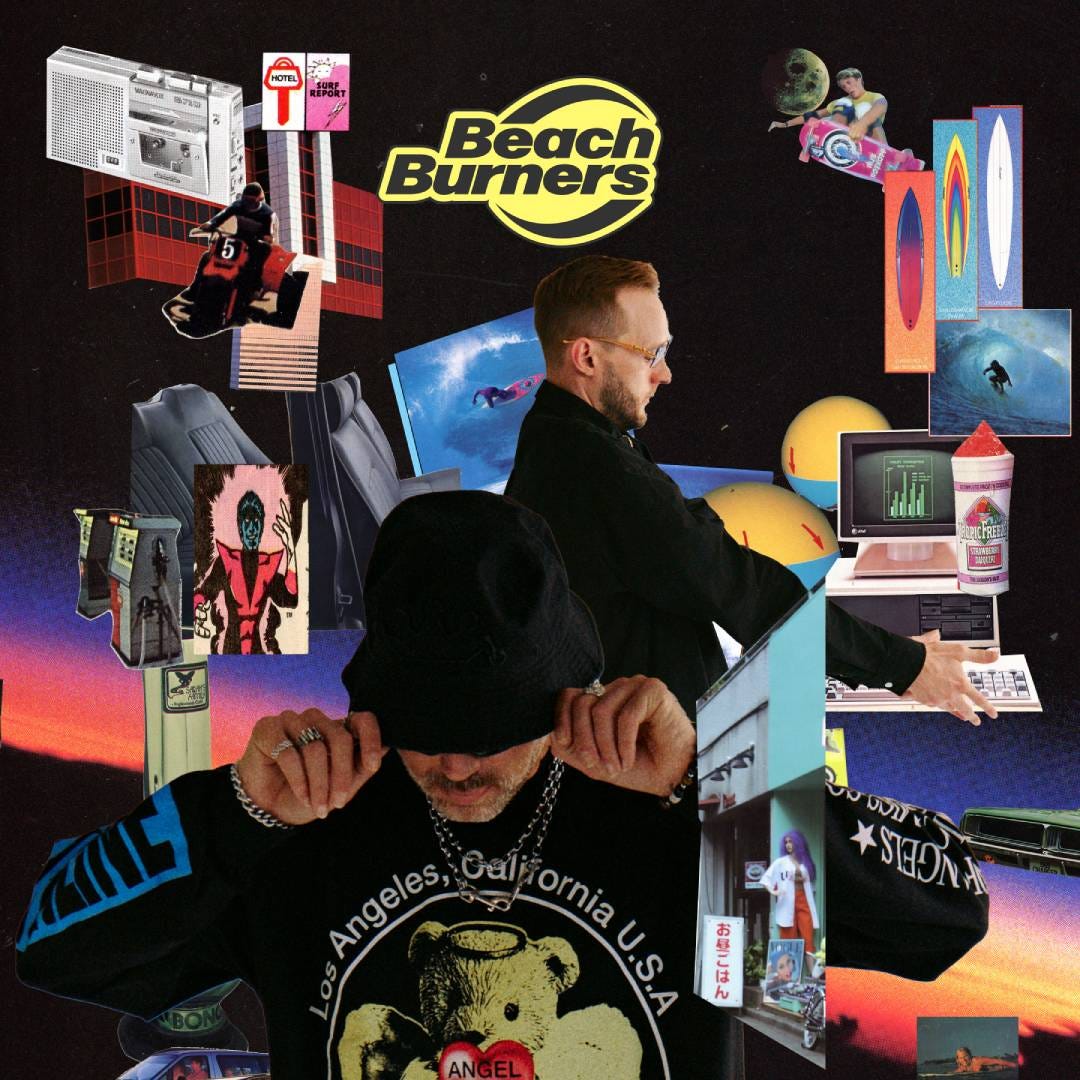
Art via Dewey Bryan
Kevin Crandall still misses Rudy Gobert in a Utah Jazz jersey.
You probably best know visual artist Dewey Saunders for the psychedelic collage art on the cover of Anderson .Paak’s Venice and Malibu. Or maybe you recall his work designing the trippy cover of Future's The Wizrd. But a lesser known fact is that in the late 2000s, before .Paak, Pluto, and Turnstile came calling for album art, Dewey was writing raps over Roots-inspired beats in a shared apartment in Philly. An art deal for Ray-Ban’s holiday campaign brought Saunders out to Los Angeles at the end of 2018, at which point rapping took a backseat to making art with rappers, but the rhyme bug never went away. In the last half-decade, the California sun baked Dewey’s writing into the crisp low-rider smoke anthems decorating Beach Burners, his new LP with fellow L.A. transplant, DJ and producer Earoh.
Beach Burners is a breezy album best enjoyed with the tide lapping at your ankles and a gas station ayahuasca popsicle in-hand. Sunburned and enveloped in weed smoke, Beach Burners could easily soundtrack a remake of Baywatch—one of the “spiritual television programs” of the album. “Buzzin” sees Saunders smoking cilantro-infused spliffs over a beat that would be right at home in a “Welcome to LA” cutscene on any ’90s cable crime drama. Images of backroom high-stakes blackjack and joyrides in a Maybach fill the track, emphasizing the get-money-and-show-that-shit-off spirit that runs through Beach Burners. The video pushes the lifestyle hustler image, showing Saunders and Earoh slide through with all manners of shady characters (queue Chuck Inglish as Jerry Quarrell), making slick handoffs of Ras G vinyls, Beach Burners merch, and some pills for good measure. It sounds and looks immaculate.
Earoh and Dewey first linked at an art show of Saunders’ in 2019. The two built up a strong friendship over the pandemic, with Earoh working as a model for Saunders’ fashion brand High Comfort in 2021 and dropping a mix on POW to soundtrack the shoot. A couple years later after seeing a call for beats put out by Saunders, Earoh slapped together a pack and sent them over that same day. A few demos and some more writing in 2023 turned into an EP, which turned into Beach Burners two years later. Once an artist cutting his teeth on the L.A. DJ circuit, Earoh currently stands as the key sonic architect of the Beach Burners aesthetic: his production helped shape themes of love, drugs, and cliffside sunsets.
Despite the retro push Saunders and Earoh have going on throughout the LP, their multimedia approach to Beach Burners is contemporary as hell. The album is paired with a zine, and word is they’ve got an exclusive weed strain dropping soon. I sat down with the producer-emcee duo ahead of their release to chop it up about this approach and all things Beach Burners. We talked about the project’s mythos, their individual journeys to Los Angeles, and their favorite beaches.
(This interview has been condensed and lightly edited for clarity.)
https://open.spotify.com/album/3DcR65NEKEfdXhms0giayA?go=1&sp_cid=a5bb3bb5b0529768539edb26c5fcdd2e&utm_source=embed_player_p&utm_medium=desktop&nd=1&dlsi=8fcb08483578493c
Both of you are transplants, right? What brought both of you out to LA and how did y'all first connect?
Dewey Bryan: Earoh DJ’d one of my first art shows in LA. It was at the Urban Outfitters Gallery in Hollywood. It was 2019 and I had a whole weekend filled with programming, and I think we did terrariums and he DJ'd the terrarium workshop, and then we became homies.That was 2019. I moved to LA in 2018 after working with Anderson [.Paak] and the Free Nationals and just a bunch of LA clientele. It just makes sense to be in town, to be close to where the action was. Unfortunately I had just missed some legendary happenings. What was that big party that…?
Earoh: Oh, Low End Theory.
Dewey Bryan: Yeah Low End Theory had just ended right when I got to LA. I was like oh man, bad timing. But yeah it was 2018 and I really just did it for the art career and to see what other connections I could make. I was working with Turnstile as I was moving to LA. We put out Time & Space right when I moved to LA, and then I worked with them on a bunch of more stuff. Then ended up working with Future in 2019 as well. That was a very LA story in a way, coming out here and working with more mainstream artists. Just ramping up the art career to heights that I would only dream of before. Almost that typical LA story, but…I'm not bored with art, but now we're doing music.
Earoh: For me, I moved to LA New Years of 2016, and I had been living in Seattle and Portland beforehand. I grew up in St. Paul, Minnesota, went to school in Portland, and then after college I started to get into making beats. That reinvigorated my love of DJing. I've been DJing since I was 11, so it was kind of one of those things where when I moved, I just didn't have a means to take all my stuff cross country.
Pretty soon some years had gone by and I realized through working with a few people in Portland that I need to do this. This is something I really need to get back into. Then also realizing I should start making beats—this is something I've wanted to do for a long time, but never had the means to. Never had a laptop, etc. That all kind of made sense to me around 2014, 2015, and I moved out of Seattle on not a whim, but more of “if I'm gonna do something with this, I need to do it now, because otherwise I don't quite know what my options are.” I had sort of exhausted certain avenues that I thought had traction, and it became very clear to me that DJing in the Northwest and doing hip hop in Seattle or Portland is just not really feasible. It's just not really a scalable market there for various reasons. So, I decided to move to LA and really only knew two people: a kid I went to college with, and Jeff [Weiss].
I only knew Jeff through emailing; I hadn't even written for the site yet. But, it was one of those things where I would come down for a week at a time, and I would try to get a meeting with him. I eventually ended up having another meeting that led to us meeting. I figured let me try to do music journalism, and then also actually try to DJ. I moved to San Francisco for a couple months and I started DJing there, and then just kept it going. It was kind of like, as I went south, I just continued to try to drill my feet down and be like, “okay, now I want to do this, I want to do shows, go to these bars, go to these hip hop nights,” et cetera.
That helped me get to LA and cut my teeth in the Chinatown scene, because that's where I was living at the time. That opened up a lot of doors, man. 2016, 2017, I was just going to shows, like Dewey said Low End Theory. The BackbeatLA scene was popping in Chinatown. The Beat Cinema scene was popping in Little Tokyo, so I would just go to those events, pull up and either talk to people, or play, or figure out a way to get on. That gave me a lot of confidence to be like, okay, this beat I just made should be played out loud. And realizing also, okay, this beat I made is not good, and it shouldn't be played out loud. It gave me the intro to LA.
Were you releasing your own music at that time as well, when you came down?
Earoh: I had just started doing that, yeah. I started releasing beat tapes in 2015, so I was kind of right fresh into doing that. I think I'd released two or three beat tapes. I released one when I was in San Francisco—that was my third beat tape. So I had started to do little releases on my own.
It was cool because I didn't know what else to do, you know? Put my beats on my Bandcamp and make beat tapes. I was following the suit of a lot of guys that I looked up to: Simon, Shlømo, Clams Casino, Sango, all these different beat makers and producers and shit. That was my light into doing that. I would get little reviews and stuff like that. I wasn't reaching out to any writers at the time, so it was a nice little reminder that somehow, someway, people are hearing this.
And then Dewey, at this point, you were kind of all in on your collage work and stuff at this point. You had made music before in the Dewey Decibel era?
Dewey Bryan: Yeah I was actually making music before art, but this was a long time ago, honestly. I've been a recording artist since 2008, that's when I released my first album. I was in with a bunch of people that were working at The Roots Studio at the time. My roommate and producer, Rick Friedrich, ended up working with The Roots and writing “The Fire” with Dice Raw, and worked on like six of the joints on How I Got Over. Blu was on a couple of those, too. That was the scene I was in. I was mainly making music and doing artwork for our music releases back in 2007–2009. The music was at the forefront for me for a long time and the art was kind of my day job in a way.
When things ramped up in 2015 with Anderson, I had a project that I shelved and made a conscious decision to see how far we could go with the art thing. The music desire and dream never fully went away—I just knew that the art was a more feasible thing since Anderson was giving me an open door to work with him. I just walked through it. I wanted to see how far I could take it. But I was still recording music the whole time, just not releasing. I kind of had an identity shift when we came to LA with my name and everything. I changed my music name to really just my real name, Dewey Bryan, and started thinking about music differently.
Beach Burners, this project with Earoh, is just different than anything. It’s the kind of the music that I always wanted to make as far as production that was sounding like the stuff that I heard in my head my whole life. I really didn't start thinking about music seriously again until two years ago when I was working for Nylon Magazine. I was just stuck in this corporate gig and needed to figure out something to do to stay sane, and Earoh had already been sending me beats and I had already been writing for a couple years and just trying to figure something out musically.
I'm really picky with production. When you work with people that produce for The Roots for your first group, you become really picky with shit. I came from an environment where everything was like live instrumentation chopped up on MPC and just masterful shit. All my old shit almost sounded like The Roots, because it was the dude working on The Roots. So, when Earoh sent me beats it was like a breath of fresh air, because his stuff was hitting in such a different way. I just missed the trap movement completely; that wasn't my production style at all. When I finally heard something that wasn't that, or wasn't just boom bap, or rinky-dink shit, and you could tell there was depth in his work, I was like, “oh man, I think there might be something here.”
Earoh: Yeah, it's dope, too, because there wasn't a template. In terms of what I was trying to get him to hear, I didn't really know at first. I just knew he was looking for beats, and I fucked with Dewey, and I was like, oh, this could be sick. I have all these beats. So I would send him stuff, and it was like we had to work backward to understand—what are we trying to do here? A lot of times you'll send somebody beats, and usually if they're not hittin’, you won't hear it. You'll just know through the silence that nothing's happened.
Dewey Bryan: The back and forth curation for the beats was a really interesting thing because he would have one or two beats that had the actual sound for the album, and we would just try to delineate what that sound was to determine what are the factors that made that a Beach Burners song.
It really all came down to these esoteric descriptions of late-night Weather Channel jingles from the 80s. These infomercials for juicers I would see. I come from South Florida—that's where I was born and raised. There is this AM radio kind of vibe that I was trying to describe that he was really capturing through this smooth jazz kind of vibe and a lot of the tones that he was using on some of these beats. So, whenever I would hear that, I'd be like, oh my god, that's it. Let's make more of those. If you listen to songs like “Real Chop” or “Westside” or “Buzzin,” they all kind of have a similar tone or density.
Working with Earoh has been interesting because I like rapping over weird, smooth jazz, drumless instrumentals I've found, and it's been so cool to be able to ask him to take drums out of a beat. I've never had the liberty to do that with producers before, because that's kind of ballsy—to ask, “yo, take the drums out.” What are you nuts? But it really worked, and we used that for the outro. We've also been watching movies some fucking fiends. Recording samples and really exploring this sampledelia aspect of stitching some audio recordings to make a narrative happen. Obviously Madvillainy is the template for that, but looking back at Paul's Boutique or even Big Audio Dynamite, the way they're using samples in a way that no one was using them before was just interesting to us.
Earoh: Yeah, completely. DJ Premier, Madlib, fucking Cypress Hill, bro. All those touchpoints are directly the roots. It’s nice to have somebody who appreciates that and the live aspect. What Dewey was looking for, I was able to find it there.
How did you come to figure out what the cohesive Beach Burners mythos would be across all the art?
Dewey Bryan: When we first started the project, the EP artwork was very different and I was just trying to figure it out. My time at Nylon Magazine really helped me as far as branding and making something cohesive and believable. Branding is about creating an illusion, and all those pieces have to add up together to make that illusion airtight. Because the album is called Beach Burners, we're in LA, and I have 200 of these vintage surfer magazines, diving into this vintage surf culture imagery was a way for me to define the album in a way that made sense conceptually and visually. We're using some old-school hip-hop imagery, but it's mostly surf imagery and thinking about the world through an MTV kind of lens.
We wanted this project to feel timeless, like it could have come out in 1997. That's why a lot of the visuals are on camcorder and just have an analog feel. I think that art direction within the music space is about translating how sounds look. These twinkly, synthy sounds that Earoh is using, what do those look like in the artwork? And also, how do I continue my personal collage practice, but push it in a new direction that is informed by the music, the lyrics, Southern California, and just the album in general? People have been reaching out about the rollout. I think it's working, and it really started off with just a couple of reference points. I made a mood board. I made a style guide. These are all things that I was doing at my job at Nylon that helped me think about the project visually.
A brand is made up of all these different elements—you have typography, you have a color story, you have a photography treatment, you have an illustration treatment style. What does the merch look like? What is the messaging? What's the copywriting? All of that stuff is basically coming from me with Earoh's approval, and it's literally an exercise of what I want to be doing for other artists.
Earoh: To add on to that I would say the visual part, that's Dewey's bag. That's where he's really found a way to excel even more aside from just the music. I feel like a big part of that world that he's been building is also tied into High Comfort. The timing of High Comfort’s launch is interesting in this whole timeline just because we kind of started kicking it more once he'd launched High Comfort, and I think that was just natural.
It was 2021, pandemic era, and we were just sitting around. We wanted to do shit, so we would just go link and go to parties, go to shows, go to record shops, shit like that. I ended up modeling for one of the High Comfort shoots and we did a mix for that and put it on and we dropped it with Jeff on POW, et cetera. But that world of High Comfort, I understood super, super well because I live in Santa Monica, so I'm next to the beach and go do this shit all the time. Not even to flex, but how I stay sane is go to the beach and bike and swim and shit like that. For me, this is not only my literal backyard, but this is also the shit that I'm doing in my daily life, trying to make art and be a normal person at the same time. So that was a big, big part and influence of how our shit kind of came together—what Dewey had already built with High Comfort, and me just seeing it and thinking “I have a sound in my head that kind of goes with this,” and then later that tapers back around and it’s like, “oh yeah, this is in the universe.”
Dewey Bryan: The sound of the lifestyle dealer.
Earoh: [laughs] Yeah. Shout out the Lifestyle zine, man.
Diving into the album a bit, you both put out shit on Twitter that was just hype about getting the Blu feature—how’d that feature come about?
Dewey Bryan: Blu was on The Roots album that my buddy Rick produced on, but we didn't really connect. We were connected before I moved to LA, just on some art stuff. He hired me to do a cover; it never came out, but we've been working together on the art tip. And then I was an extra in one of his music videos. I've kind of been using my design skills to barter some verses and stuff. It's like, I'll design some stuff for you if you get on the album, and it's really been helpful. Being a notable designer has actually been the only way this project has been possible. The Chuck [Inglish] feature, Eligh, just calling in all the favors and calling in homies that make sense to be on the album, that are also a dream come true type of thing.
But the Blu thing, that was wild. He liked the song a lot, and he came with it. I was like, “Blu, you bodied this thing.” I remember him saying back, “I had to, your verse was insane. I had to come with it.” That was a milestone for me, just as a rapper looking up to these people for a long time—being on the same track, on the same level. I don't feel like any of these people are washing me. I’m learning a lot from what they're doing on the album, but I'm holding my own. It feels kind of wild to say that, you know? It's me and a bunch of pros, and that means I'm a pro too.
Earoh: Yeah, that was crazy news, just to get that. I think the turnaround was pretty quick on that, too. I want to say you had messaged me, like, “yo, might get a Blu feature” or something to the effect of that and it was within the next day it was already done and he had sent it back.
Dewey Bryan: He bodied it. Yeah, he was waiting because he was sick, and he was like, “when I'm not sick anymore, I'm gonna record.” And he is a master. He took the concept and he conceptualized it, turned it inside out, and juggled with it, and I was like, oh, that's how you write a verse. That dude showed me how it was done. And then we pulled up on him at his listening party and got the green light for him to be in the music video, so we're gonna try to do a music video with Blu. A lot of this stuff might be post-release. We've been cooking and we have a lot of visuals in the chamber, but we also want to go really hard with the post-release drops—even splashier videos for the rest of the year if all goes according to plan.
How important are those videos to the mythos of Beach Burners?
Dewey Bryan: I think “Buzzin,” to me, is the perfect encapsulation of the album just as far as wanting to nail that Beastie Boy “Sabotage” reference with all of our eight shady characters. It just added to the lifestyle dealer thing and it made it cinematic. I wouldn't have it any other way. I'm so grateful that that video came out the way it did, because I think it's just such a strong way to start the project. That was our first single. That was our first visual, and I'm not seeing other people put out videos that have that much narrative structure. There's a lot of hot shit going on, but I'm really proud of the story and the short film aspect we were able to pull off.
Earoh: I would agree, and it's also funny, too, because that was the first song that we knew was Beach Burners. Before that it was still kind of shooting in the dark to a degree, and that was the first one Dewey was like: more of this shit. If it sounds like this, I want to hear it. So it's also ironic and cool that that's the first song on the album and the first video that we did. Feels very true to form.
Dewey Bryan: Set the bar kind of high. A lot of the videos that we put out aren't going to be short films like that. I mean, we had Chuck English acting as a character named Jerry Quarrell. It was a miracle we even pulled this thing off. Jeff Weiss is in the video; this thing is crazy. We bought a stack of Lifestyle Dealer zines from him. It all ties in, and that's what I love about it. Translating these transactions that are usually drug sales into buying zines or selling records. Some of it was illicit, but most of it was music items, and the tape at the end was the Beach Burners tape. It was really fun to switch the contraband into musical imagery and just play with that concept, too. There is a couple levels of things happening in that video, and I'm super proud of that.
Also an interesting thing that we went for was the vertical ratio, which is something that I don't see a ton of people doing. Full vertical video. I had maybe two or three conversations with the director before we shot, and I was like, “how do we do a vertical video?” I want this to fill up screens; I just don't want the little strip on the screen. It was a big decision—he never shot like that before, and it changed the way we shot the video. Everything had to fit in the middle. I've been shooting a lot of the Beach Burners content all vertical, just because we're in a social media world.
With the album cover—It's such a sick shoot. I was wondering what beach you took that at?
Dewey Bryan: It was in North Shore, Oahu.
Oh shit, really? Tell me about how that came about.
Dewey Bryan: My girlfriend and I were out in Hawaii last summer for a friend's wedding, and I had this idea for the photoshoot in my head because we were already working on visuals, even though this was a year ago. I had this idea of a glowing figure on the beach, so I ordered this 3M suit from, like, London or some shit right before the vacation. We're literally in Hawaii for a week, and we're just having a blast. We're not working on the album shit at all. It's the last day of the trip, and I'm like let's shoot the cover.
Kristina Bakrevski, she's a professional photographer. She shoots a lot of live events, just really dope portraits and stuff like that. She understood what we were going for. At first I was running past the camera, trying to create this 3M glowing blur. I'm in the suit sweating my ass off, all sandy and kind of pissed off. I'm like, this is not working. It's like the last minute before the sun goes down, and I just stand there in the water. She's hitting it with the film camera, with her regular digital camera, and the flash is hitting the 3M suit and creating this glow. So the cover is an in-camera shot—no Photoshop or anything. The only thing that is done to it is just light editing or whatever. It really came together at the last second.
For my TikTok followers we made this really funny video about how the cover came about. I made up the story of how we got mugged by a surf gang and I smuggled into an Indian wedding. Our Mustang got stuck in the mud, but the last day we made it happen. It's really fun to play up these stories a little bit. Some of the stuff did happen, but if you play it up, like “oh yeah we got mugged by the Trouble Club!” It fits into the Beach Burners universe a little bit.