


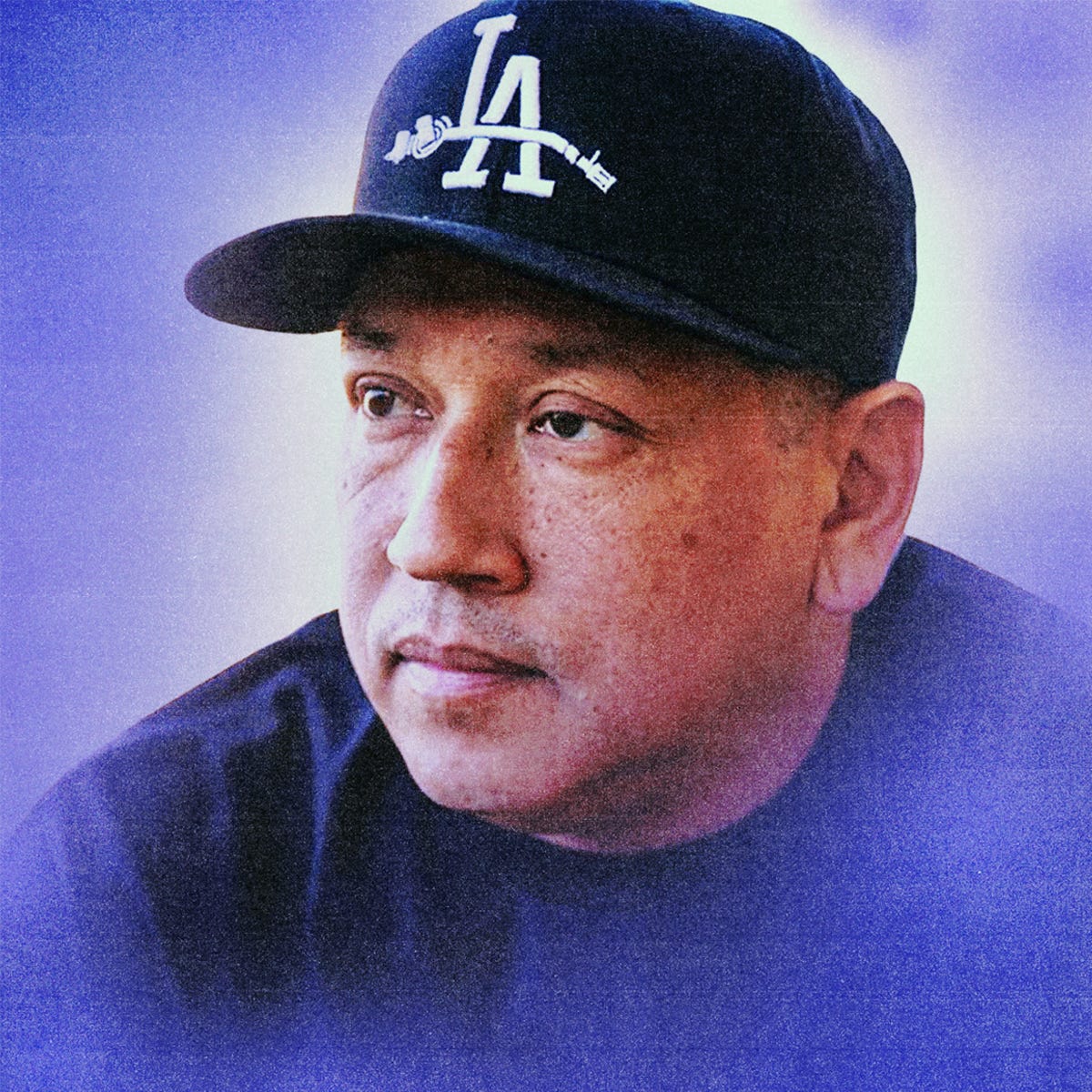
Released in November 1992, “Nuthin’ But a ‘G’ Thang” became G-funk’s immediate and international sensation. But for as many people, places and things as it put on the world’s stage—Compton, Long Beach, Death Row, Dre, Snoop—there were also threads it left dangling. Who would’ve thought, when Snoop told us to chill ‘til the next episode, we’d have to almost all the way to a new millennium to get it. And even then, we’d be given something that traded whiny synths and deep bassline for something popper. Us G-funk diehards are still waiting for the original to be released from the vaults in CDQ.
Then there’s Snoop’s passing line (“Perfection is perfected, so I’ma let ‘em understand”), somehow a footnote in a song that is anything but. The line references a little-known Long Beach collective called Perfection that kicked off around 1986. Headlined by Filipino DJ Glaze, who enlisted some of his junior high and high school pals, Perfection started performing at L.A. haunts like The Roxy and Good Life Cafe, where Jurassic 5 and other legends got their start.
A collective about ten members strong, Perfection eventually brought in the most popular LBC rapper at the time, which in the late 1980s was not one Calvin Broadus but Shawn Antoine Ivy, aka Domino, best known for hits like “Sweet Potato Pie,” with thumping DJ Battlecat production. Glaze tells me that Domino eventually defected from Perfection, leaving a young Snoop to collaborate with the group on the diss track “Let Em Understand Perfection,” circa 1991: “This is the year for Perfection, my motherfuckin homies, to put their shit on the map and finally get their fucking snaps,” Snoop declares in the opening verse. A year later, he doubled down with that additional quip on “‘G’ Thang.” But besides a handful of other early ‘90s songs eventually released on The Lost Tapez (2004), that was the end of their artistic partnership.
“I didn’t know Snoop was gonna blow that big…. I don’t think anyone knew. If I knew that, I’d still be with Snoop,” Glaze tells me with a laugh.
Glaze describes those early days of West Coast hip-hop as an arms race. Raw talent like Snoop’s mattered for sure, but it was also about who was able to snag the latest MPC3000 and master it the fastest. And while Snoop and Warren could turn to Dre for mentorship and advice, Glaze laments that his own version of a mentor, KDAY L.A.’s longtime maestro, Tony G, didn’t emerge until ‘94.
By that time, Perfection had retooled as Foesum, made up of Glaze, MNMsta, and the late T-Dubb, who passed away in 2024. Thirty years ago, in fall 1996, they released their seminal album Perfection on Penalty Records/Tommy Boy, a G-funk classic whose original pressings still fetch hundreds of dollars on eBay. If you want to know how high Foesum were flying that year, start with “Listen to the Sound,“ a Kool and the Gang and Isley Brothers mash-up that ranks among the finest uses of synths in hip-hop history. Then move to the smooth and contemplative “In the Wind,” featuring crooner Bo-Roc from The Dove Shack'; round it out with “Ultimate Collaboration” and “Who Got Ya Back,” which show the more lyrical side of the group.
Foesum released several albums thereafter, always staying loyal to that original ‘90s sound that too many others left behind. That loyalty found its audience overseas, particularly in Asia and Europe. In 2025, some four decades after they began, Foesum released Two Thousand Twenty Foesum.
I connected with Glaze, where he spoke with me about the vibrant early days in the West Coast scene, what it meant to be a brown pioneer in hip-hop, the particular strain of G-funk Foesum developed, and how they leveraged eBay and Amazon to ride a second wave of popularity abroad long after the subgenre’s commercial peak.
I’d love to hear a little bit about the beginning. How did you get started in hip-hop in those early days?
I started DJing back in, what was it, like ‘86? I was in ninth grade. We had artists and stuff come to the school. We would pay a dollar or 75 cents to go check out this DJ. And so we would be there and everyone would be dancing, but I would just be watching the DJ and listening to the music.
There’s a group called Boo-Yaa T.R.I.B.E, a Samoan rap group that came to perform. And there were a lot of shows going on around town where we would see people like Mix Master Spade, N.W.A, and Eazy-E. So we used to see all these groups perform.
We were mainly DJs, and we only really played hip-hop, along with scratch music—“Planet Rock,” “It’s Time”—stuff like that. We were like KDAY [radio] fanatics and then that’s when we decided, you know what, we can make our own music.
We bought a Roland 808 drum machine in Hollywood or Universal City for like 500 bucks and we all pieced up to save for that. We asked around like, “Who’s the dopest rapper in Long Beach?” And at the time, everybody said it was Domino. So he came into our group and we treated him as kind of the main MC. T-Dubb was related to The Twinz and so they used to rap, too. And Snoop happened to be best friends with the Twinz, so that was kind of our relation with Snoop.
We performed at this place called The Good Life and at the time were messing with a producer named DJ Hardtop. He had some groups he was working with including Freestyle Fellowship, Volume 10, the dude who did “Pistol Grip Pump,” and also Unity Committee, which would end up being Jurassic Five. We released a compilation album and it had a lot of those guys and everyone eventually kind of went big to some extent. We actually got Snoop to perform with us at the Good Life, too.
Do you have any memories of the first time you met Snoop?
I met him one time at Poly High [Long Beach Polytechnic High School]. He was there freestyling and stuff. Then there was a time The Twinz brought him to my house to record, just to get him on tape. And at the time, I really didn’t even have anything great to record him on. So I just had him stand in my room and just freestyle on the microphone. My plan was that I would have him rap to an instrumental and then maybe try to put the beat together after the fact. The first time I had met him, I didn’t think that Snoop rapped all that great. I thought he was cool. He had some styles, some dope lyrics. And he did the singing type stuff.
“Lodi Dodi.”
Yeah, that kind of thing. At the time, he was using a lot of slang in Long Beach that we weren’t even familiar with. So he was creating his own style, basically. And we were kind of learning from him too.I still felt my group was better and that Domino was even more polished. This was like ‘89, 1990. There was another rapper coming out of Long Beach that came directly out of VIP Records. His name was Radio and his producer was DJ Slice. He, out of everybody, was amazing.
Remember, it wasn’t just about how good you were. It was also about what kind of record you could make, what was the quality like. Is it going to be a record that could compete and be on the radio? The dude Radio, he had a full studio, drum machines and all that. So I think they were further along. But that was back in 1990-91.
So take me back to that time. What was going on at that time when you recorded “Let Them Understand Perfection?”
So like I said, we were working with Domino. At the time, a lot of the New Jack Swing stuff was starting to come in with Teddy Riley. So I feel like Domino was trying to do more of that. His plan was that he would do his own thing and then come back for us. We weren’t really happy about that. It felt like he was leaving us. So that’s why we wrote that song. And then we had Snoop narrate that song for us.
The beat was from a Grover Washington song [“Knucklehead”], right? Then there’s King T’s record, [“Played Like a Piano.”] And so we had told him, can you flip this? Our producer, DJ Hardtop, was kind of an R&B guy. It was almost like going into a studio with someone who only does classical music. It was too clean, lots of reverb. That’s why, if you listen to that song, it sounds a little crazy, even though it’s dope.
What expectations did you have coming out with that song? Did you think it was going to maybe put you guys on the map?
Nah, not at all. I always knew we had good lyrics and that we were good rappers. But we had no idea how far we would go. Our goal was just to put out our record. I didn’t know Snoop was going to blow that big. I don’t think anyone knew that.
So Snoop kind of went his own way. He was already with Warren G. They started recording their demos, and then that’s how that whole story with Dr. Dre started. I think that eventually was always going to happen because of the relation with Warren. Not to take anything from Warren, Warren was dope. He kind of got a lot of insight from Dr. Dre as far as what to use and how to put stuff together. Unfortunately, we didn’t get that. I didn’t have a mentor like that until I eventually met Tony G who showed me how to use a drum machine. He showed me how to use the SP-1200. He showed me how to use a MPC3000. So that really came later, maybe ‘93 or ‘94.
So, fast forward a little bit to 1996 and Perfection. How did your first full record come about?
As soon as I learned how to use the drum machine, it was kind of on and poppin’. I used to go through records like crazy. I think at the time I had like 25 crates of records. And I would just dig in and find little pieces of samples and loops and break beats.
Then we were able to come up with our own sound and style. But we had a lot of influence from, of course Dr. Dre, Ice Cube, Warren G, and QDIII. Those are all the producers that I looked up to, and I love their music even till today. You know, all of that G-funk and West Coast hip-hop, that’s kind of what we wanted to be. We wanted to be known as one of the greats from the West Coast.
How do you think your particular G-funk sound is different than a Dre or a Warren G? Were there any particular kind of notes you were trying to hit with your own style?
So if you listen to our first album, we don’t stay in one lane. There are some groups where they’ll do a rough song, music that gives you an adrenaline rush like Xzibit or Tha Dogg Pound. But then there’s the mellow side of it, kind of like Bone Thugz. 2Pac, he does both. He can do a “Dear Mama” or a “Keep Ya Head Up” and then he can do a “Hit ‘Em Up,” just kill everybody. So that’s kind of what we are. I feel like we try to cover all bases because there’s different sides to us.
We don’t walk out of the house and act a certain way every day. But at the same time, it doesn’t mean you can just come up and disrespect and act like we won’t do anything. We grew up in the neighborhood just like everybody else. And that’s what our music is, it’s all the different aspects of just living in L.A. You can enjoy yourself and have fun, but at the same time you gotta be on the lookout, because you never know when something can pop off.
What about some of your guests featured? I’ve spoken to Nanci Fletcher several times for stories and we even met up in New York. I didn’t even know she was singing on “Whowouldofevathought.” And then of course there’s Bo-Roc.
It was funny, I had met her because I was DJing for Domino. We ended up touring and we did a few shows, BET and MTV. And she was a dancer, so that’s how I met her. And I didn’t know that she was like the one of the main singers for Dr. Dre. When I found out I was like, “oh man, this is crazy, like fate.” We had to use her because she sings so beautiful.
As far as Bo-Roc, T-Tubb had a really good relationship with Bo-Roc. And we knew The Dove Shack from being with Warren G and the Twinz. He sang on both albums. And the song he did on the Twinz’ Conversation, “Journey Wit Me.”
Yeah, man, that bass guitar is crazy.
To me, man, that is one of the dopest records ever. I know a lot of people love Nate and stuff but Bo-Roc has always had his own style. To me, it’s like a smoky cigar. When you sing, it just makes you feel like you’re in a little hideaway, a speakeasy or something.
I just wish that he got the props that he deserves because he’s such a great singer. That’s why we used him.
I totally agree. So one thing about you guys is that you’ve continued to put out music well beyond the height of the G-funk era. Why did you guys keep going with it, even once the huge spotlight had kind of moved on?
We’ve always been kind of self-contained and independent on our own. That’s the thing that kind of cursed us in the beginning, but also benefits us too because we’re not having to rely 100 percent on a particular producer, label, or artist. So we didn’t get blessed with people who could get us to that next level. But at the same time, we know the process of recording ourselves, putting a record out, putting an album out, learning how to promote it, doing our own merchandise, distributing it, getting it out to the internet and overseas.
One thing that was cool is that your music was so popular in Japan and Europe. I remember in college in the mid-2000s a lot of the stuff I got from you was from there. Can you talk a little bit about why it spread so far?
You have to remember that in those countries, all that music is considered an import to them. We would get hit up from Taiwan. We would get up from Poland. So they have to work a little harder to try to find it, to try to get it. And I feel like for those countries, it kind of puts us at a more even level with everybody else. It leaves it to the listener to determine what’s good and what’s not, rather than a radio station that’s programming you and saying, “this is dope.”
Can you talk a little bit about being a brown pioneer in West Coast hip-hop and sort of the legacy of that?
I mean, I never looked at it like that. Because where I grew up, it was pretty diverse. Mnmsta is Black and Mexican. We grew up with a lot of Latinos, Samoans, white people, and Asians. But it just so happened that my friends were Black. They introduced me to soul music, to R&B and it was life-changing for me. So the color thing was never really there. Because if you like the same music I like, we’re brothers already.
We had a Japanese dude on our street who also loved a lot of the funk stuff. So he introduced me to Zapp and Prince. T-Dubb and his brother introduced me to Morris Day and the Time, Rick James, Teena Marie, George Clinton.
We used to just be on our bikes in our neighborhood, and someone would have a radio, and we would be listening to all that old school music. So that kind of became the backdrop to what we did. We loved how that music sounded and how it made us feel. And so that’s kind of what we put in our music.
