


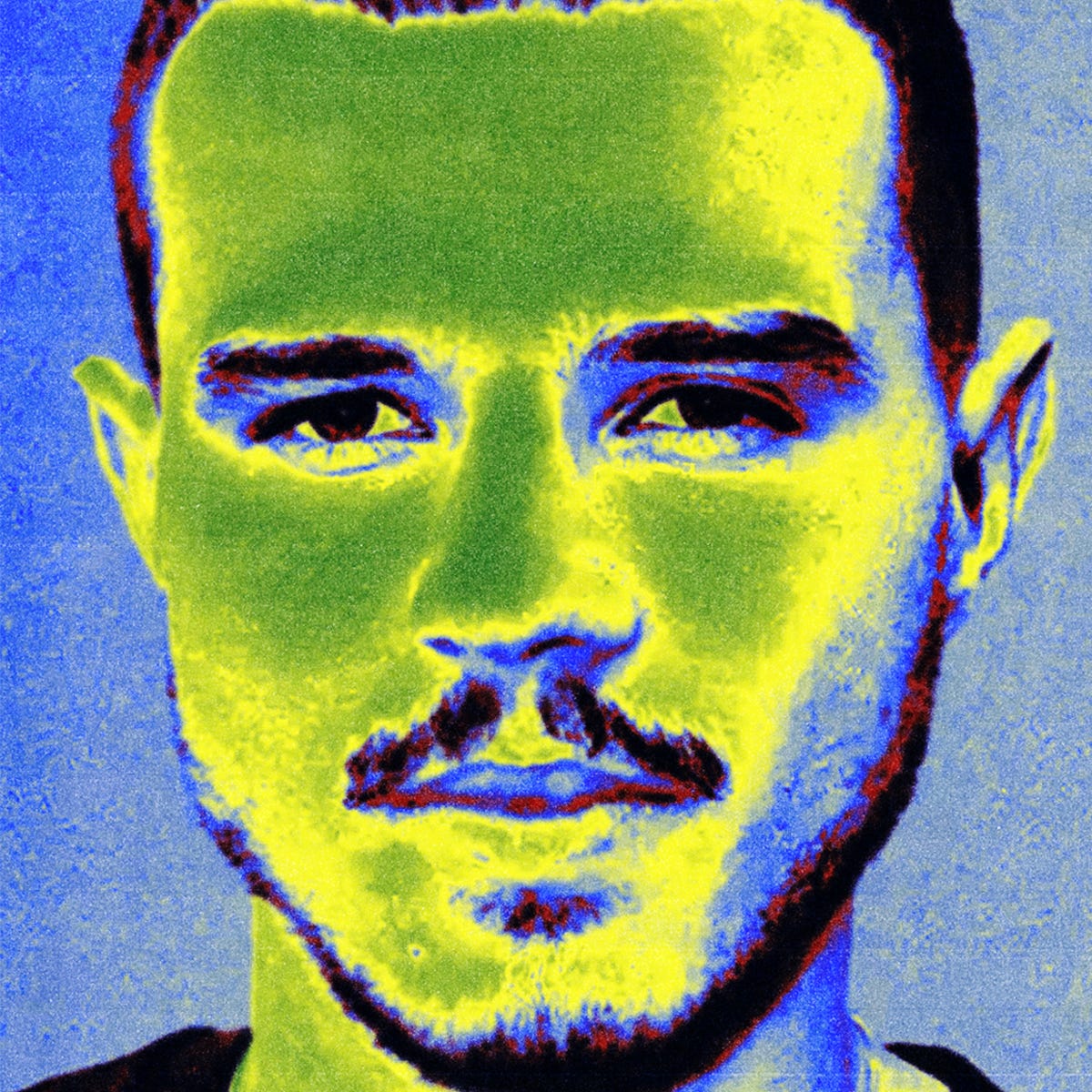
Jarred Beeler is an electronic music producer best known for his work as DJ Plead. Under that handle, the New Jersey-born, Sydney-raised, and Berlin-based musician has spent about the past decade flooding club nights and home-listening systems alike; survey enough adventurous ravers and you’re bound to find someone who’s gotten soaked in sweat listening to one of his cuts.
Beeler, who is half Lebanese, has described his early constructions as a way to reckon with that side of his identity, and his material bears that out: His drum programming is slippery, million-limbed and informed by the sounds of the Levantine world; it’s the sound of someone who grew up listening to footwork and wedding music and the L.A. beat scene, all bundled up in something that feels inimitable.
That said, Beeler’s material isn’t all so white-hot. In 2020, Boomkat Editions released Relentless Trills, Beeler’s first LP under the DJ Plead handle. Here, he shot ambient dub, mahraganat, and dabke into a kaleidoscope. The record turns dancehall rhythms a bit arid, cranking the drums down until the whole thing feels a bit like a fever dream. It isn’t not dance music, but it’s not peak-time material, either—and, in retrospect, it reads like a sign of things to come.
Six years later, Beeler’s returned with Please, his follow-up. “I almost feel embarrassed, sometimes, by people listening to it,” he shares in a conversation with POW. “I feel quite nude.”
It makes some sense. Here, he’s gone in all manner of directions, producing material that feels a bit like a photonegative of his club records and DJ sets. Where he frequently plays out UK garage, dubstep, and UK funky records for headlining slots, Please is instead a collage of zero-BPM maqam melodies, waterlogged dub, and purgatorial neo-muzak. The record is both queasy and self-assured; it’s the sound of an electronic-music lifer going ever deeper into the unknown and coming out the other side just a bit different. “I’m used to releasing tools,” Beeler says. “There was an element of somebody having to draw this out of me and force me into this spot. I’m happy to be there, but it is uncomfortable.”
Beeler sat down with POW to talk through it all: Please and Relentless Trills, tokenization in a dance-music world with an incomplete atlas, the sadness of weddings, processing genocides, found communities, and much more.
This interview has been edited and condensed for concision and clarity.
What’s some of the first art that you remember really connecting with?
I think it was Billy Rae Cyrus: Just watching music videos on TV. There’s Toni Braxton and Queen, too. I do remember vividly watching the “Achy Breaky Heart” video clip. I remember being wowed by that. That’s the first music I remember fully experiencing.
Where and when am I right now?
You’re in whenever that song came out in Sydney, in a suburb called Dundas, in my parents’ house. I would have been very young. [googles “Billy Rae Cyrus”]
“Achy Breaky Heart” was ‘92.
I might have had a memory in 1992—maybe at the end of it, because I was two years old. But, yeah: That’s my first musical memory other than my mum singing me lullabies. That’s my first impression.
Was music a big part of your home life growing up?
Yes and no. I don’t think it would be true to say it was the main feature of our family. Me and my mom and my sister would sing a lot together, and stuff like that. Mom would play quite a lot of music. It was quite a big thing, in a way, but it wasn’t something that was part of my identity.
I guess my parents bought me a cassette recorder, and I got a guitar really young, because I really wanted a guitar. I was focused on music in some way at that age, and my parents helped me do that. But it wasn’t, like, a Jacob Collier household [laughs]. Music was just a regular thing, like it is in every family.
How do you find your way towards electronic music?
I found my way to it by making it as a late teen, I guess, on FruityLoops out of curiosity. Before then, I’d just been playing guitar and jamming out with some friends in high school. I don’t remember exactly what drew me towards electronic music in the first instance, but I started making little beats—hip-hop style. I was interested in the L.A. beat-scene sound of that time.
Brainfeeder and so on.
Exactly. And Dilla, and 9th Wonder, and stuff like that. I guess I was trying to make that kind of stuff in FruityLoops. That was my first foray into that world. A couple years later, I got more into other types of dance music, but it was from a nerdy perspective as opposed to a club-kid energy: Less from the doing and more from the hearing. The thing that really made me switch modes was hearing DJ Nate—Chicago footwork—for the first time. It changed the way I thought about electronic music, I think.
How so?
It changed the way I thought about rhythm, and drum programming, and tempo, and the use of vocals in this really abstract way. It was the first time I’d heard hypnotic music in that way. Footwork can drive you to this, sometimes, uncomfortable space, but I remember being really blown away by it. I started making electronic music with the characteristics that I found in Chicago footwork.
Were you deliberately making that style, or trying to pull those ideas elsewhere?
I definitely tried to make Chicago footwork [laughs] but nothing really came of it. I tried to make it, but what remained from that experience of hearing it and trying to emulate it was the little elements that stayed with me: Part of the philosophy of making it.
I’m caught on the idea of approaching club music as a headphone-focused thing. I read your material as especially physical; maybe it’s the density of drum programming, or maybe it’s the drums you’re using, or maybe it’s the ways it’s tied to wedding musics. Now, when you’re producing, how do you think of the physical environment?
I definitely feel the physical aspect of it is very important. I need to feel it. I want to be dancing in my chair or something. When I listen to the eight-bar loop—it usually starts like that—it has to hit. I won’t progress through the track if that section isn’t really attacking me in some kind of physical way.
I should also mention that, in the beginning of my introduction to electronic music, I also started a band with Lavurn [Lee, a.k.a. Cassius Select] and Marcus Whale. It was called BV. It was only live for years, and we would make electronic music to play live, and they would do vocals over the top. It was in bars, pubs, clubs, and these queer events that happened in Sydney and Melbourne. I think that’s where I figured out how to make dance music, and also how to make dance music in a really stripped-back way, because there were vocals on top of it, and it was just for live [performances].
It had to be functional.
Yeah. I was also very self-conscious, because I was in the room with Lavurn, who I still regard as one of the best musicians I’ve ever met, and Marcus Whale, who I think similarly of, so I always felt a little on the back foot. I had to learn pretty quickly. I think that’s where a lot of the function, and the body aspect, comes into it. It wasn’t DJing; it was playing these songs live, so it had to have a different force to it.
You probably want something that’s a bit more mutable.
Exactly. We were doing this for years and years, and eventually, I did my own thing from that project. The DJ Plead project is very much from the original band that I was in. I learned a lot making music with these guys. I think a lot of what you’re describing comes from there.
As a brief sidebar: You talked about coming up in that queer nightlife scene. Does that color your work, or was the location of those performances coincidental?
It definitely had a big influence on me. Just seeing those performances—at that time, vogue music was very big, and there were lots of great parties that we would play and attend. I’m not identifying as queer, but me and Marcus were very privileged to be allowed into that space. I feel like that’s the greatest privilege I had at that moment. From being in that environment, I did associate [dance music] with queerness. That’s a huge part of it. I am a huge fan of these parties and events. It was so fun to play them. I miss that.
Have you been able to find something like that in Berlin?
I’m not going out so much [laughs]. I’m really, really selective when I go out. Recently, I played this Einhundert party. There’s a lot of Baltimore club music being played at these parties, which I really enjoy. It was really great to play one a few months ago. When I’m lucky enough to go out, I like to go to parties that play this kind of music, for sure. But I couldn’t tell you that I’m going out loads and going to all these parties, because it’s not true.
In an interview with Crack, you described your music as “a way to prove to yourself that you are Lebanese.”
I stand by that.
Talk to me about that.
That was four years ago now. It’s still true, I think, to a degree. But maybe I’m making music that doesn’t sound like that as much any more. I still am. That was definitely true at the time. At the time, I was in Lebanon, and I was dealing with this feeling of being an outsider in my own culture. I’m half Lebanese. When I was experimenting with making this kind of sound, it was, in a very real way, a way of me feeling Lebanese. And it’s been such a nice experience to be embraced by my fellow Arabs, and to have my music played by Lebanese and Egyptian DJs—a lot of time, in the queer scenes there. It’s an extremely beautiful experience.
I do feel I have successfully done that, in some ways. I have successfully made myself feel a part of the culture. It’s particularly painful at the moment, because Lebanon is being attacked by a genocidal state.
This quote is nice; it makes me feel emotional. It is true. But am I still doing that? I don’t know. Maybe I’m in a different part of my life; maybe I’m a bit older now, and that kind of thing is not as important anymore. I feel like, in my younger years, I was wanting to find my identity: being half-Lebanese and trying to figure that out. [I was] seesawing, in a way, between cultures. But maybe that’s less a part of my everyday life now than it was.
To whatever extent you’re comfortable: Do you need to talk about Israel at all?
I don’t know where to put my rage about Israel. I feel, often, that I’m at a loss for words about this. I feel like words don’t do justice to the anger that everybody’s feeling about this, especially being in Berlin, which is essentially a Zionist state. It feels really awful. I feel like everybody has been in a state of perpetual anxiety for the last three and a half years, and it doesn’t feel like it’s getting any better. I feel like we’re not progressing in any way, and looking at the news in the UK and such at the moment, I feel like we’re not making any progress. I don’t know what else to say. But I’m livid, you know? I really can’t articulate myself very well on this topic. I’m sorry.
A while back, I interviewed Special Guest DJ.
Legendary. He’s such an amazing character.
We spoke about his latest record at the time, and we spoke briefly about Gaza. He said one of the tracks was, in part, a way to channel anger and frustration at what was going on there. Do you feel a responsibility to speak to any of that in your work, however abstractly, or do your personal life and creative portfolio exist separately?
The record I’m about to put out is filled with sadness and anger that I can’t really articulate in words. That’s a big part of the way this record is written: A lot of these tracks are deeply emotional. A lot of that emotion is the sorrow I feel for Palestinian and Lebanese victims of Israel, and the anger I feel towards Israel, and Germany, and the U.S., and the United Kingdom—everybody who backs this enterprise. I feel like there is so much of that in this record. I think about this every single day. Every day, I’m making music, and it pours out of me. I don’t really have much of a lexicon, if I’m honest, to talk about my emotions. I don’t feel like I’m very good at that. So, oftentimes—I know it’s such a cliché—it does come out in the melodies that I am making, and in the mood that I set.
You’ve described growing up with music that’s “sad yet celebratory.” That makes me think about crying-in-the-club stuff; I think of deep house; I think of vocal trance. There’s a ton of potential range within that descriptor. Does that sad-yet-celebratory idea still ring true for you?
Big time. I played this live set recently, which had some old and new stuff, and some songs from the record. Two people cried; one of them was Lebanese. A lot of people described it as being “sexy and sad” [laughs]. But that music does have elements of that. Lebanese wedding music has all of these elements: It’s celebratory; it’s sexy, in a way; and there is melancholy to it. There is sadness to it. I guess a wedding is all of these things, in a way. There is a big element of sadness to a wedding.
I can think of the idea of putting one part of your life behind you, but what sadness are you thinking of?
That, and there’s an element of saying goodbye to your child, or your sister or your brother, who’s getting married. There’s some saying goodbye, in a way. Because, often, they would move away. In Lebanese culture, they would leave your family home when they get married, so it is a profound moment. It’s not just a celebration of love; it is somebody leaving the house, somebody leaving their family.
That is very much a part of the music that I make. On this record, there are all of these potentially conflicting emotions you might feel. It’s still very much a big part of my sound, or the sound that I’m aiming for.
I know you’ve described Please as something you feel kind of vulnerable about. Is this where that’s coming from?
The vulnerability is: If you listen to the record, I almost feel embarrassed, sometimes, by people listening to it. To me, the songs are really raw, and they are filled with all this emotion that I was talking about. There is a candidness to the music, which I normally hid behind with dance music, because [dance music] is way more functional. I’m way happier to just send out dance music to people, but sending this record out, and having them hear it, I feel quite nude. I feel quite exposed.
These aren’t tools.
These aren’t tools. You have to listen to the song and hear what I did on the keyboards. It does feel like a different mode for me to be in, and it feels uncomfortable. I don’t normally like to feel vulnerable, or to expose a part of myself that’s quite gooey [laughs]. I think I’m used to being understated. I’m used to releasing tools. I’m comfortable in that; that’s where I feel comfortable and secure. Joakim [Haugland, the founder of Smalltown Supersound], who curated the record, encouraged me to release this kind of music. He pulled some of these tracks out of the depths of my demo folder and encouraged me to release them in that state. There was an element of somebody having to draw this out of me and force me into this spot. I’m happy to be there, but it is uncomfortable.
If you’re comfortable sharing this, did Joakim tell you what he heard in the demos? What drew him to them that you weren’t so sure about?
He’s very convincing. He’s referencing obscure records, because he’s an encyclopedia of music, really. His art form is running a label. This is his calling. He’s a real obsessive; he’s a head’s head. He’s obsessed with track curation, track listing, and making perfect records. So I trusted him.
When he was trying to convince me that these tracks were worth putting out, he was referring to a lot [of records]; he was providing a zoomed-out and zoomed-in perspective on what the tracks might mean. Sometimes, I would have doubts, and I’d say, “This doesn’t feel good,” and he would provide real-life examples.
What was your next record going to be?
I had made a full record in late 2023, early 2024. I had it in a demo stage, and then I listened to it, and I decided it was bad. I could see through my intentions, and what I was trying to make with the record. Some of the tracks ended up on this album. I did want to make a record like this, in a way, but what it required was someone coming in to help me figure it out, and to help me distance myself from it, a little bit, so that I could see it as something a bit more opaque and see it as an object as opposed to something I’ve curated and made myself.
I think I got too close to it. Weirdly, I almost sent it to Joakim two years ago, but then I didn’t. I stopped myself, because I didn’t like it. I didn’t think it was good. But my intention was to make an album sort of like this.
Talk to me about the relationship between your DJing and production practices. Are those sides of your work in conversation?
I think there are crossovers, but they are kind of distinct.
With my DJ sets, I’m trying to make people dance. The UK funky and dubstep [in my DJ sets] and what I’m making on Please and Relentless Trills cross on the venn diagram with dub. Maybe that is a good link between them, but they are quite distinct. They have different purposes. My DJ sets are tool-y, and a lot of the time, they’re not particularly atmospheric, whereas the music I’m making is quite atmospheric. Sometimes, I’m frustrated by that distinction; I sometimes feel like my DJ sets are too dance-y or functional. Maybe I could bring some of this atmospheric element into it.
Do you feel pressured to do a “DJ Plead set,” which means you do dance music?
Yeah. My relationship with DJing is very complicated, because I didn’t grow up doing it. I’m a producer, first and foremost. I came into DJing through this band that I was a part of, but I became a producer, and you get booked by DJing. I’m still learning how to DJ, I would argue. Even after ten years, I still feel very green.
I am also a people-pleaser, and I’m playing in the nightclub, so I want to make people dance.
There’s an implied form.
At least, I make that form for myself. There might not be. Sometimes, I lack confidence about DJing. But maybe those two parts of my process are quite distinct. I wouldn’t say the dance music I produce is incongruous from Relentless Trills and Please. There’s similarities there. It’s just more humid.
Some of the DJ sets—it depends on what mood I’m in. I can get atmospheric. I just don’t get the opportunity to do it that much; I would like to do it more. But
You should see if the Dripping folks would book you for an oddball ambient set.
Mine and [Baby] Leo’s set from last year was pretty weird. It’s very dancey, but it gets pretty freaky.
Here’s another angle on pressures. Do you ever have any fears about self-tokenization? I think about the broadening, but still extremely shallow, ideas about “world music” in club circles. I would imagine many people in the crowds you play to don’t know much about Lebanese-adjacent musics. There could be this idea of, “You’re the hard drum guy.” Is this a concern for you at all?
I think it was. When I started playing out, I’d be mostly playing my own productions, and Lebanese music, and edits of Lebanese songs. I had this sound going for a while. Then, at some point, I felt like I was doing that too much. Out of curiosity, I moved my DJ sets into other directions a bit more. I was concerned about being tokenized or pigeonholed, about being stuck in a space. I’m not sure if I’ve successfully brought myself out of that yet, but I think I have pretty free rein to do things in a DJ set. I’ve gotten myself to a spot where I could play 160, or I could play 120—percussive chuggers. It would all make sense for me, on some level, to do it.
It was happening a bit more, back in the day, where people would say, “I was hoping you’d play more Lebanese music.” That would often come from a Lebanese person. But, nowadays, I don’t do it at all—not consciously. I don’t want to do the same thing over and over again.
I did have a moment where I was like, “Oh, God, if I continue to do this and lean into this zone of being a Lebanese dance-music sounding guy, I’m stuck here, and it’s going to be really frustrating to play out, even though my interests have moved elsewhere.” I did have that moment, but I’ve not thought this about myself in a while.
It did come up in curating this record, though. We didn’t want it to be full-blown. Relentless Trills was very much in that Levantine-Arab world. There’s elements of it on Please, and the way I make melodies and rhythm intrinsically have that sound. That’s how I grew up making them; I’m just used to doing that. But the idea was to move a little bit away from that world: To not make it a full-blown album that’s influenced by that, but to have other sounds in it.
Talk to me briefly about your relationship with East Coast club and footwork. That’s not a connection I had made until you brought it up earlier today. I’m curious to know if you feel like you’re in conversation with that stuff.
Yeah [laughs]. I’m very interested in that kind of music; my favorite DJ sets are often people like OSSX and stuff from Jersey—which is, incidentally, where I was born. Maybe I have it in me to into East-Coast club.
It’s quite subtle, but in some of my dance music, a lot of my drum fills are inspired by the Chicago footwork fills, with their toms and high-end. I don’t think I’m having a dialogue with that scene, though: I’m just extracting from it [laughs]. I’m buying the music and playing it. I’m not collaborating with anybody in Chicago—I wish I was.
I know you studied engineering in university. Do you consider music your job at this point?
Yes.
When did that shift happen?
It happened, at first, in 2019, and then COVID-19 happened, and it restarted again in 2022. I’ve been doing music full-time now for four years if you don’t include 2019. I’ve been very privileged to be able to do this. It does come with its drawbacks. Doing this thing that’s very ego-driven—I do feel quite vulnerable all the time, because I’m performing. The rat race of it all gets to me sometimes, but, ultimately, it’s a really nice place to be.
Sometimes, I wake up and I can’t believe that this is my reality. I get to be in the studio and make music. It feels ridiculous. I’ve been saying for years, though, that things may come to a slow-down, and I’ll get a job and go back to a regular thing. In some way, that would be a relief: To have a routine and regularity. Something that I do for money that doesn’t require me to market myself [laughs]. But it’s great. I’m very grateful.
I’ve had very cheap rent for the last two years here in Berlin. Without that, I don’t think it would be possible. I think that’s probably the main thing about me having this career: It’s based solely on having cheap rent.
Talk to me about Sumac. How’d that come about? What’s next?
I started it with T. Morimoto and John Watts in 2018. We’ve been doing it for ages, but it’s kind of slowed town. Tom’s a lecturer at university in Sydney, and John has a child. I should do more with it. The idea was to release stuff from our own catalogues and from friends of ours who we find to be really talented but don’t yet have an outlet for their music.
Obviously, for some artists, it’s different. We released that Viiaan record recently, and she’s had a pretty established career.
I was really stuck when I saw her there.
It was great. We’re friends. We have other releases in the pipeline that are taking a lot of time. One of those is an ambient record by Big Ever that we’re trying to get him to finish. There’s another one by Laverne, at some point. We’re really patient with it. I like to get involved with running a label and curating the record a little bit. Not to the same extent that Joachim did with me, but a little bit. I like that process. I like to be a bit more active with the label stuff, because it’s really fun, and it’s nice to release music by friends, basically. I’m really proud of the catalog so far.
The Logic1000 record—she’s blown up to be a massive star. I think me and Tom and John should take some credit for that [laughs] because we really pushed her and Tom to get that record done. It was a labor of love, and it helped start somebody’s career.
There’s lots of things to be proud of with that label, and that Lavurne album we did a few years ago is one of my favorite albums of all time. I’m really grateful to have been involved in that. I’d like to release more weird stuff—it’s just a matter of finding the time to do it all.
What is something you recently came to learn about yourself?
I need to move out of my apartment in November, so my cheap rent adventure is coming to an end. For a lot of reasons, including the Zionist reason, I need to get out of Berlin. I recently went back to Turin, where I’ve spent quite a bit of time. The friends of mine there said, ‘You should move here.’ I told my housemate I would move to Turin. My housemate and his girlfriend said, ‘Oh, damn. We were hoping you’d stay in Berlin.’
This month, I haven’t played many gigs, but I’ve been floating around, and I felt emotional, and a bit sad. I think I’ve realized this month that I’m really grateful to have my really close friends around, like Lavurne, and Daniel, my housemate, and Jacky, his girlfriend. I need them, I realized. I was like, “I’m independent. I’m flying around the world. I’ll just move to Turin.” Then I realized this month, “Hold on.” I’ve felt quite sad, and it helped that they were around. I realized how much I needed to have my friends around. I thought I was way more independent than I actually was.
I guess I’ve decided to stay in Berlin. I’m quite emotionally independent, most of the time, but I’m very dependent on people.
It’s a very lucky thing to have found that community.
Yeah. And to have it 10,000 miles away from home, or however far I am from Australia.
Is that still home to you?
Yeah. That’s where my family is. Eventually, I’ll move back there, for sure. But, in this medium-term outlook, I should stay in Berlin, around the people who love me and who I love.
What’s next?
Currently, I’m back trying to make dance music after many years of not doing it on my own. I’m getting back into it. I’ll be doing live sets for the album, and potentially a follow-up EP with off-cuts from the album. We’ll see what Joachim says. But that’s it. I don’t really think that far in the future. I want to get really excited about DJing—about playing new music that I’ve made. It used to get me really gassed. I’m really focused on trying to do that again. I’m not even close, but that’s the goal.

Cool interview !