


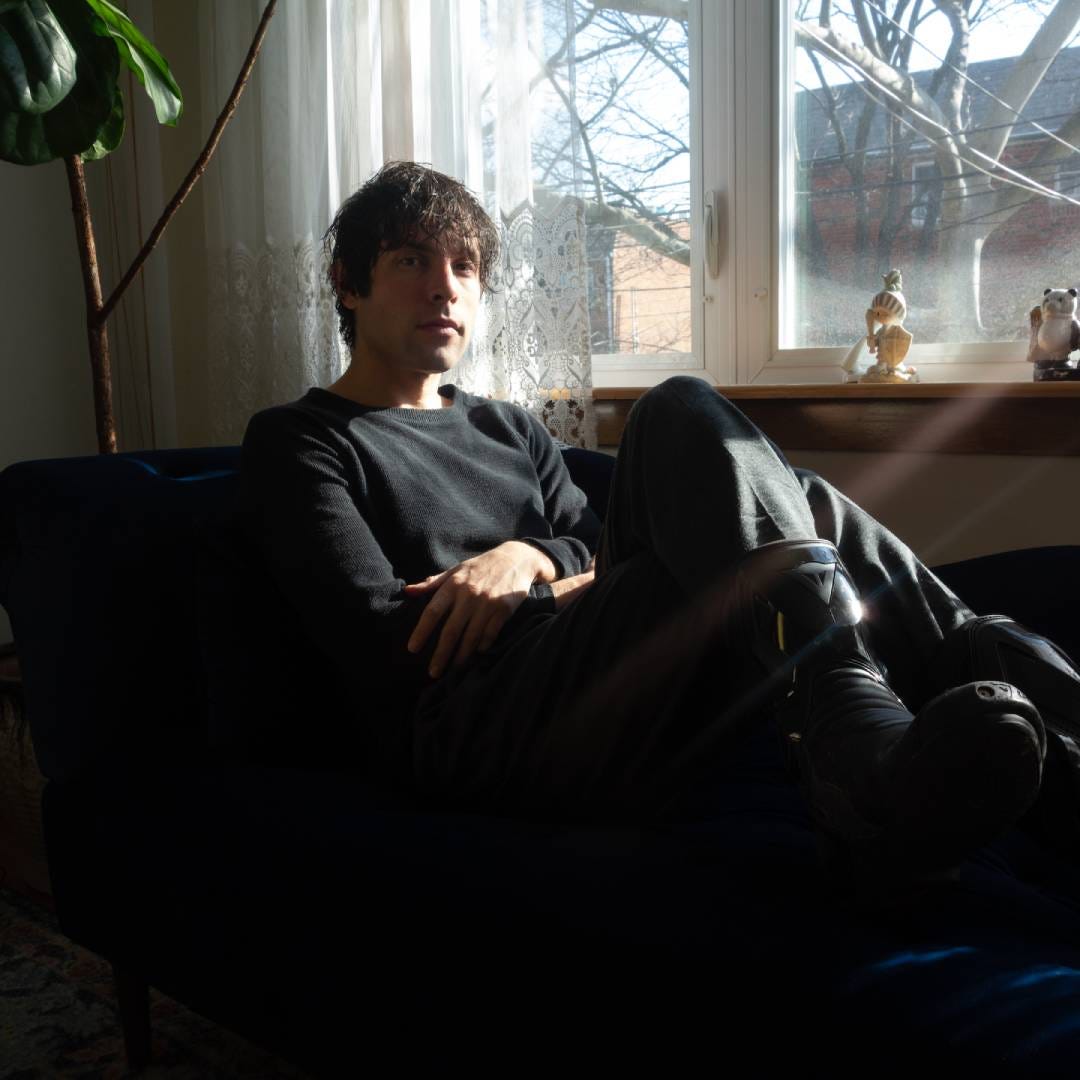
Photo by Michelle Yoon
Michael McKinney understands the cultural importance of Kreayshawn’s “Gucci Gucci.”
Brian Piñeyro, a.k.a. electronic-music producer DJ Python, has spent the past two decades shedding his skin. Under a handful of aliases and a variety of side projects, he has explored countless corners of contemporary electronics. He is enamored with downtempo, dembow, UK club music, and ambient records. As one half of Natural Wonder Beauty Concept, he helps sculpt pop music purpose-built for dreamstates; as one third of Sangre Nueva, he cooks up club-night barnburners whose sounds stretch across oceans. Nominally, at least, he splits his time between London and New York, and you can hear both places in his style: his productions often swing in a way reminiscent of UK soundsystem music, and his everything-goes approach has plenty of practitioners on this side of the Atlantic. Piñeyro’s best work makes the inherent differences between disparate genres invisible.
In 2020, Mas Amable, which was named Resident Advisor’s album of the year, saw Piñeyro covering the decks with a mixture of sand and stardust. The album wafts first as an Ibizan chillout compilation, but scan ahead a bit, and you find rough-and-ready reggaeton tooling. One of Piñeyro’s main goals is to produce tracks “technically made of weird building blocks” while maintaining cohesion. His approach to zonked-out dembow music won him popular acclaim, anticipating the global rise of “Latin club” music.
To be blunt, despite a flood of gigs and interest, Piñeyro’s simply not interested in adhering to one formula. After his 2020 breakthrough, he branched into sort-of-trip-hop, miles-long techno tools, and who-knows-what DJing. Reflecting upon the evolution of his taste, Piñeyro tells POW: “I have more confidence; [when I’m DJing,] I feel more able to play ten-minute songs, or some Johnny Marr instrumental. I’ve gotten more adventurous.”
No kidding. With i was put on this earth, his latest solo EP, Piñeyro pushes ever further into parts unknown, revisiting the ethos that’s powered his projects since the start: mellow electronics paired with a kitchen-sink approach to style and genre. Every left turn is filled with grime, techno, and a grab-bag of chill-out room tools. In a career defined by swerves, the EP is also remarkably tender, playful, and bleary, like a hug delivered after a particularly poignant night out.
In April, I sat down with Piñeyro, digging into the ideas behind his latest release, his approach behind the boards, his relationship to travel, and the value of tenderness. Midway through our conversation, the producer summarized his driving philosophy: “I see the function in club music to be really elated, or to be really sad, or to be really hard. For me, depth is way more important than intensity. I like songs that create spaces for you to feel the things you want to feel.”
(This interview has been condensed and lightly edited for clarity.)
How are you doing?
DJ Python: I’m good, I’m good. Just getting adjusted to being back in New York.
You got back in pretty recently, right?
DJ Python: Yeah—yesterday.
Must be a beast jumping between those time zones so much.
DJ Python: It can be, for sure. It’s all good, though. You're American, right?
Yeah. I’m out in Minneapolis. I tend to like to start things by checking in. You’re getting back from abroad; you’re getting resituated in New York. What’s going on in your world?
DJ Python: I was in Paris for a week and then Milan for a week. Now I’m home and tired. Trying to get back into my routine, I guess.
Are you full-time with music now?
DJ Python: Yeah.
Congratulations.
DJ Python: Thank you. I worked a full-time job until two years ago, and now I’m just doing this.
Must have been a hell of a thing to jump.
DJ Python: Yeah. I waited until it seemed safe. But I did have to move to the UK to get insurance.
I’d like to roll the clock back for a second: what’s some of the first art you remember really connecting with?
DJ Python: [laughs] It’s gonna sound funny, but probably Donnie Darko at 13. I think it’s a really good teenage-angst movie. I watched it at a time where I felt very similar to the character, I guess. It also has an amazing soundtrack. I don’t know how rewatchable it is, but you should give it a go. It was also one of the things where it’s a movie that doesn’t make any sense, so to my teenage brain, it was like, “Since it doesn’t make any sense it must be genius.”
How’d electronic music find its way into your life?
DJ Python: When I was, like, 12, I heard Ricardo Villalobos’ “Fizheuer Zieheuer,” which is, like, 40 minutes long.
https://www.youtube.com/watch?v=H8_BAoVwoaM
Like all of them?
DJ Python: [laughs] Yeah. But it’s a very long one. I also heard Calibre’s FabricLive [mix]. I was really into that stuff; then I got into Perlon and liquid drum-and-bass. When I moved to Miami, there were hints of electronic music: The Faint and Justice and Ed Banger. Stuff like that. I always really liked minimal, drum-and-bass, and reggaeton. Miami bass was really big when I lived there. In New York, there were big sonidero parties—like, chopped-and-screwed cumbia parties. I’ve been lucky to live in cities that embrace different kinds of electronic music, if that makes sense.
I was going to punk shows and noise shows. A lot of these shows had, like, Fuck Buttons and James Ferraro and Skaters and Emeralds and stuff like that: where it’s kind of electronic, but kind of not—synth music. I really liked Tangerine Dream and the krautrock stuff.
How’d you find your way to Miami?
DJ Python: I lived with my grandparents and then I moved to Miami to live with my mom at 13.
So: you’re getting interested in this stuff. You’re going to noise and electronic shows. You’re getting into synth music, broadly speaking. What led you to start making it?
DJ Python: When I was, like, 14, I got a groovebox, and I just started making that kind of music. I was also in bands—punk, free jazz, noise.
What’s an early Brian track sound like?
DJ Python: Maybe Ratatat? You know. It’s very melodic.
So those interests in minimal and such—that wasn’t quite what you were exploring?
DJ Python: Nah. I didn’t know how to make it yet—it was too hard. I tried to make jungle, but then I realized I needed a sampler for that.
When is this?
DJ Python: This is probably the mid-to-late 2000s.
The earliest stuff I know of that you put out was either as DJ Wey or Deejay Xanax. The earliest I’ve found is 2015. What happened in that decade in between?
DJ Python: That’s when I was in New York, and I met people who would put the records out. That decade in between, there’s lots of noise and punk records. It’s just not stuff I like to talk about. There’s a lathe cut with me and my ex from 2008.
When do you move back to New York, then?
DJ Python: Whoa—let me see. 2013?
What people and parties are you getting involved with that lead to you putting this stuff out?
DJ Python: I was going to Bossa Nova Civic Club a lot. Drumsheds, a DIY venue, was popping. At that time, it was way more limited; I feel like, now, there’s so many clubs. But, yeah, Bossa.
Is that how you hook up with the Incienso folks?
DJ Python: [Co-founder] Anthony [Naples] moved into where I lived; that’s how we became friends.
[Piñeyro moves from his phone to his laptop]
Can you hear me?
Yeah, I got you. Good to see your face.
DJ Python: Yeah, you too.
Before we get too deep into the Python stuff, what lines do you tend to draw between your aliases? I’ve gotten the sense you’re leaning into Python or other collaborations recently.
DJ Python: The DJ Wey stuff was just an initial thing that I stopped doing. Xanax was about a friend, so it’s not about me. I do like doing the Luis thing, which is for my grandpa. I don’t know—Python just hit more than others for whatever reason.
https://www.youtube.com/watch?v=y4aVB4a2bJM&list=RDy4aVB4a2bJM&start_radio=1
As in it hit for you or as in it caught on?
DJ Python: Yeah, it caught on.
So it makes sense to lean into it.
DJ Python: Yeah. I kind of have to now. I can still do stuff with Ana [Roxane], but she’s working on her own records.
Do you have an LP on the way, then?
DJ Python: Yeah. I think next year we’ll probably write something.
The past few years of your official discography have been super defined by hooking up with other people. You’ve got Natural Wonder Beauty Concept; you’ve got your [Lot Radio] shows with Ana Roxanne; you’ve got Sangre Nueva; you’ve got your work with Ela Minus. How has collaboration come to inform your work?
DJ Python: It’s just all homies. It just makes sense. In between all that stuff, there’s a million solo DJ gigs and records too. I think, with electronic music, people making music on the computer can only go so far, for the most part. If you have friends who are like-minded, I think it’s cool to make stuff. For the Sangre thing, it’s me and Kelman [Duran] and Yeshe [a.k.a. Florentino]—we’re all friends, and we were all doing something similar, and we thought it made sense for us to try to do something together.
Let’s take Natural Wonder Beauty Concept as an example here. You say that making music by yourself on the computer can only take you so far, so where else are you trying to go?
DJ Python: We have Ana’s voice. Ana’s a classically trained singer and a classically trained pianist, but she doesn’t know how to produce drums. We both have different tastes, so [it’s] seeing where that goes. Ana’s been in bands forever, and I’ve been in bands forever; it’s just fun to make music with other people. The only thing we talked about with that record was that a lot of people are starting to make revivalist trip-hop music.
Who are you thinking of?
DJ Python: I don’t want to name names, but think of all the trip-hop you hear now that sounds like trip-hop from the ‘90s. We were like, “Let’s do this but with different tropes”: let’s use trap beats, not break beats, that sort of thing. That was the main idea with that project.
You talk about growing up on club-adjacent sounds. Was trip-hop something that moved you in the past, or is this relatively new?
DJ Python: I’ve always loved Portishead and Everything But the Girl. There’s a lot more obscure stuff that I like a lot too; there’s that LA compilation, and Tricky. I love all that music, but I hate revivalist music, to be honest. I think there’s two camps, for the most part, with music: revivalist or extremely contemporary, and people follow those formulas. I find it to be pretty boring for the most part.
Both of those camps or just one?
DJ Python: Both. I feel like one person sets a blueprint for what contemporary sounds are, and everyone does that. Not with every kind of music—I’m talking about more top-shelf indie-ish music, I guess.
But then people come around and make something really unique and beautiful. I really love OTTO; I think he does stuff that’s unique. I don’t want to be a part of that revivalist or “how futuristic can I make this” [sound].
If you’re interested in neither revivalism nor “contemporary,” what is your mindset? Do you have a term for what you’re trying for?
DJ Python: I want to mix tropes and create something new-ish. I guess the reggaeton thing was that at a certain point in time; now it’s not, because a lot of people do it. With the new record, that track with Jawnino is a grime song with a Radio Dept. beat, and that’s kind of odd. The thing with Isabella [Lovestory]—she’s a reggaeton singer, but it’s a downtempo, almost Gorillaz-ish beat. With the instrumental song, I wanted to make an electronic-music song that sounds like it’s played by a band. I don’t know if you DJ, but you can’t DJ it, because it’s not in eighths. It’s five bars, then eight bars, then eleven.
So it’s a pain to blend, I’d imagine. I’ve not DJ’d; I ought to.
DJ Python: You don’t have to if you don’t want to. There’s enough of us in the world.
Yeah—I just write about the craft often enough that I ought to have a greater technical familiarity with it.
DJ Python: Yeah, give it a try. It’s not hard. I don’t mean that in a [disparaging] way. I think taste is the most important part.
How would you say your taste has evolved over the years?
DJ Python: When I used to play records, I felt like I was stuck with a certain time-frame. A lot of music that comes out now just comes out on Bandcamp. I’ve always liked playing all over the place in terms of tempo or genre; I’ve never been one to lock in, or to be a “this song sounds like it’s the same for two hours” type of DJ. I don’t know how much it’s changed beyond just getting better. I just want people to have fun and for there to be moments of excitement where people are a bit surprised. Now I have more confidence; I feel more able to play ten-minute songs, or some Johnny Marr instrumental. Maybe I’ve gotten more adventurous.
That makes me think of your Essential Mix, which, at least to me, is really explicitly all over the place.
DJ Python: I don’t know if I’d ever DJ out that weird. [laughs]
I’m curious: do you see your DJing and production as related practices? It sounds like you’re describing your productions as moving away from DJ tools.
DJ Python: I’ve always liked mixing tropes. The first tropes I decided to mix—reggaeton and more Euro-centric dance music—was a little bit more obvious, especially now. But, at the time, it wasn’t obvious. If you’re a casual music listener, it’d be great if you could listen to the song, which is technically made of weird building blocks but sounds like a normal song. Then if you’re more invested in thinking about music, you can pick apart the parts that are coming together to make it.
It’s about picking drum tracks versus liking the breaks.
DJ Python: Yeah. You know, with the Jawnino track, the beat is very grimy, and there’s a grime rapper on it, but there’s country guitar on it, and there’s strings you might hear on a Radio Dept. record. It’s a weird song, actually, the more you listen to it. But I think it’s immediate-ish, I hope.
https://www.youtube.com/watch?v=c7z4kmgEKdE&list=RDc7z4kmgEKdE&start_radio=1
It’s a funny record for me. It’s all pretty immediate, and it works on a gut level, but as soon as I zoom out, I realize it’s composed of a lot of unusual sounds.
DJ Python: What do you think of the record?
I think it’s pretty strong. I love the directions you’re going, and I love the sense of play it’s got.
DJ Python: Do you wish it was closer to the older productions?
No. I prefer it when producers go down their rabbit holes. I’d much prefer you explore to you being the “deep reggaeton” guy. So, how’d you hook up with Jawnino? What was that like?
DJ Python: I really like that song of his—“It’s Cold Out.” We started talking, and then I put out 40, so we became friends through that.
https://www.youtube.com/watch?v=dFquRphSUy8
I’m curious: you asked me if I wish you were doing something closer to what you used to be doing. I think about what you used to be doing, and it’s “Latin club,” whatever that means. I realize that’s been something of a buzzword for the past few years. Is it an idea you’re interested in engaging with at this point?
DJ Python: Yeah. I think I’ll still play out music like that. On the next release, there’ll be some music that’s along those lines. In my opinion, the Isabella [Lovestory] thing is a Latin club track. But I’m interested in expanding on the idea.
I wonder what’s gonna happen with that kind of stuff since things are so trendy. My goal with DJ Python, early on, was to make the tresillo and dembow breaks like Think breaks: to have it be in sample packs. I could it being that the Latin club calms down a bit but that those sounds get more incorporated into dance music. It’s thought about less, you know? But it’s there.
I’ve gotten the impression, over our conversation, that you try to move a little counter to what’s hot at the moment. Is that fair?
DJ Python: With the reggaeton thing—it just wasn’t a thing. The reason for stopping isn’t because it’s a thing now; it’s because people who are from places that aren’t the United States or Europe should be getting more shine.
In terms of the revivalism of downtempo—I’ve loved downtempo forever, you know? My previous records are downtempo; they just aren’t using breaks. It’s not against the grain; I just don’t like revivalism. Chasing current things—it’s just not something within me, I guess. And I like reinventing stuff. I’m not the most classically gifted, but I think I have interesting ideas, and those ideas don’t require a certain type of training. For lack of a better term, it’s more of a philosophical approach to music. It’s not being against [reggaeton]; there’s just enough people doing what’s cool.
Also, I like other kinds of music. In a more jaded—not jaded, but—I’m signed to XL now. I don’t know how far I’ll get just making Latin club music.
Did you start to feel boxed in, in some way, by expectations of what a DJ Python record should sound like?
DJ Python: No. The recurring theme through my music is the emotional palette. I guess some of it has that drum programming—which doesn’t always include tresillo or dembow breaks, and it’s weird and glitchy. That’s something that’s recurrent through my records, but the mood, I think, resonates most with people.
Talk to me about intimacy. I’m thinking about the writing you did for the latest EP, which is very explicitly about beauty, tenderness, and gentleness in the everyday. What are you chasing emotionally in your work?
DJ Python: I think it’s that, for the most part. SOPHIE was really good at “we’re gonna make elated music, and we’re gonna make it as elated as possible.” She did that to a level that’s ridiculous—it’s very impressive. I think, for me, the songs and experiences are way more subtle, and tender, and loving, and not as obvious. If you took away the names of all my songs, you might now know what they’re about, but I think you could feel something. I don’t like pointing at things, because I don’t think that’s what real life is like.
What do you mean by that?
DJ Python: I see the function in club music to be really elated, or to be really sad, or to be really hard, because you’re in a club, so you’re seeing intensity. When it comes to music, for me, I think depth is way more important than intensity. I like songs that create spaces for you to feel the things you want to feel—without being told what to feel.
The way you’re describing that makes me think of ‘90s ambient-techno.
DJ Python: Kinda joyful, kinda melancholic. That’s real life, in my opinion. Maybe you’re happy; maybe you’re confused why you’re sad; maybe you’re confused why you’re happy. I think that’s mostly what it is. I don’t know. Being in debt is stressful; falling in love is nice. The day-to-day stuff—it’s really nice out today. I’m in a weird mood.
Forgive me if this is too personal—are you doing okay?
DJ Python: No, no, no! I’m good. But thanks for checking. I didn’t mean it as a call for help. I just think most of us feel this way.
Do you find yourself explicitly trying to chase this in-between state in your work, or do you find it’s something that happens more naturally?
DJ Python: I think it just happens. It’s not always personal experience; it’s stuff that I hear. I don’t live anywhere. I haven’t been anywhere for longer than six days since December 2nd[, 2024]. I’m never anywhere. I’m a very transient person. With transience, when you meet someone—if I meet someone in Marseille, and I’m gonna meet them for a day, and then I meet all their friends for a day, because they know I’m leaving, they open up so much because there’s so little at stake. Sometimes those experiences can be very intense or involve a lot of depth.
I’m curious about this idea of transience deepening relationships so quickly.
DJ Python: I think you have to learn to discern the difference between intensity and depth. These moments are intense; does that mean that it’s deep? Not necessarily. I’m sober; I don’t know if you do drugs. But I see this in clubs where everyone does the same drugs: they feel really intense emotion, and they’re all on the same emotion, and it’s an intensity. I don’t want to be someone who’s saying that’s not depth, but it’s intense.
But transience definitely does give you extremely intense experiences. People really do open up to you. The amount I know about some people who I don’t know is ridiculous. It’s unnatural.
Do you think moving so much informs your art?
DJ Python: Yeah. It’s really expansive. I get to hear a lot of different local scenes and crews. I think I’m really lucky I get to move around so much because I get to pick and choose stuff.
Is there a scene or community you feel particularly tied to?
DJ Python: Probably London, because they’re so collaborative. Jawnino’s a grime rapper; Organ Tapes is an extremely eclectic songwriter; and I’m a producer, and it’s very easy for us to make music together. Even going to shows, you’ll see an indie band at a grime show or a dance show. Whereas, in New York, I feel like it’s more siloed now. If you like techno, you go to techno shows. If you like indie, you go to indie shows.
You’re not gonna see an indie band play Basement.
DJ Python: Even crowd-wise, too. London, I guess, has a culture of collaborativeness ingrained within it.
I could see that being something that clicks with you. There’s an old interview of yours where you say that good DJ sets feel like you’re finding out a really deep secret. What has your own material taught you?
DJ Python: What secrets do I learn from my own material?
Yeah. How do you surprise yourself?
DJ Python: I’m an idiot, dude. [laughs] I guess it’s that you can bring people to elation and deep feelings for a while, and they’ll stick there, and they kind of want to stick there. It just takes a while to get them there.
https://www.youtube.com/watch?v=-zRH0IRHI0o