

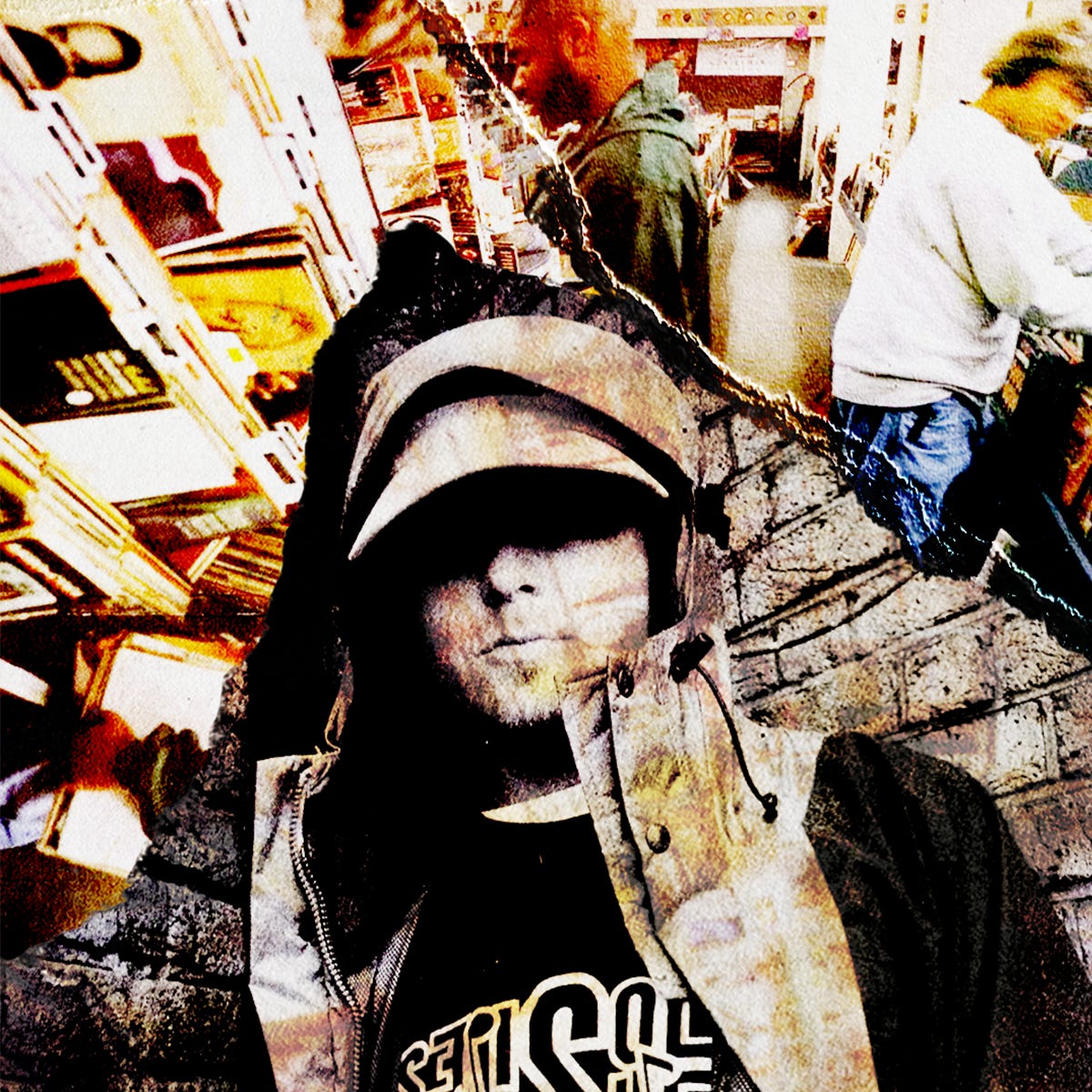
The night I discovered DJ Shadow’s Endtroducing….. is imprinted on my mind forever. I was 14, had coincidentally discovered weed earlier that year, and was hanging out at a friend of a friend’s house where I probably shouldn’t have been. I remember laying on a crusty couch, 29-and-a-half years ago, while someone I had just met slipped a CD onto the tray of an Aiwa boombox. Once the album’s intro track cooled, the keys from “Building Steam With A Grain of Salt” hit me like nothing I’d ever heard before. This was hip-hop, but it also captured elements of everything else my burgeoning brain had been gravitating to. The shwag-addled euphoria washed through my body as the drums kicked up. It was one of the earliest moments in my life that I can remember asking a homie a soon-to-be fundamental question: “Yo, what is this?!”
By the drum and bass pulse of the epic “Stem / Long Stem,” I’d heard enough to know that I needed my own copy of this joint, stat. I’ve long held that Endtroducing….. is the backbone for everything I’ve listened to for the past 30 years. This statement is independent of being hipped, at some point, to the idea that it’s considered to be the first album ever created entirely of samples: My connection to the album wasn’t based on the unprecedented nature of its construction, but on the end result of the output. Every production always felt so timeless. From jazz and hip-hop objets d’art to jungle breaks, Björk to Italo-disco to David Lynch, it roped together the music and pop culture ephemera that would then be woven into my fabric.
This same notion holds true for DJ Shadow (née Josh Davis), who is quick to clarify that he never intended to make an album entirely of samples. “I was just trying to articulate that sampling is a legitimate art form,” he explains on a video call. For much of its life, hip-hop has had to defend this manner of creative expression. Using fragments of the music that defines us to create new productions isn’t stealing—it’s the ultimate exchange of knowledge, preservation of history, and show of respect for the music that came before us. Shadow deserves as much credit as anyone for getting that point across.
This year marks the 30th anniversary of Endtroducing…..; In September, Shadow began a tour that presents the album in ways it’s never been heard before. To even begin to make the live show a reality, he unearthed and repaired the AKAI MPC60 MKII sampler that he used to create the music, and was finally able to craft unique mixes of it that have become the jewels of the performance. The restoration process almost didn’t happen; he told POW about getting some high-profile help he had with it along the way.
In this comprehensive conversation below about Endtroducing….. and more, Shadow talks about finding and connecting some of the more recognizable samples from the album—he’s a major cataloguer and, unsurprisingly, can recall the precise moments when he first came across each David Axelrod album. He elaborates on the relationship between him and Mo Wax label head James Lavelle as a crucial one to some of the biggest choices he made for the album. He recalls the first days of forming the SoleSides crew in Davis, CA, as well as reflecting on the legacy of Blackalicious’s Gift of Gab, who joined him three decades ago to record his vocals for “Midnight In A Perfect World” at Dan the Automator’s mythical San Francisco studio, the Glue Factory.
But what stands out the most in this conversation is Shadow’s dedication to hip-hop. His ultimate goal was to further the possibilities of what the artform was capable of in one of its most fruitful creative periods. “I wanted to bend the samples to my will and make it all really musical.” Read on below for our conversation with the man who listens to samples thousands of times over and over again before using them, is a crate digger of the highest order, and is still trying to clear samples that he put on a record 30 years ago.
This conversation has been edited for length and clarity
I think a big question that a lot of people arrive at when they’re pondering Endtroducing....., and this grand label of it being the first album ever constructed entirely of samples, is about how you even thought of that concept to begin with. What’s the genesis of the idea of producing music based entirely off of samples?
Well that wasn’t my plan, in the sense that I didn’t know until after the record came out that that’s what people were saying about it. I grew up on sample-based music, so it never really occurred to me. I was never waving a flag while I was making the record saying, “Oh, I’m gonna make the first album ever made with all samples.” The idea was just trying to further the conversation about what sample-based music can be. I was trying to articulate that sampling is a legitimate art form. I wanted to do it right, and contribute to the lineage of music that I was invested in.
How did that statement evolve after Endtroducing…..? Were you thinking of other concepts when you released Preemptive Strike and then especially on The Private Press?
Well, Preemptive Strike is an outlier in the sense that it was a compilation that I put together of stuff that had come out in the UK, and I knew that at some point, it would be repackaged in the US. So I just wanted to get out in front of it—and that’s why it was called Preemptive Strike. But my next real album was Psyence Fiction with UNKLE. And the idea there was just, “Okay cool, I’ve done an album solo, now, let me apply the same aesthetic—and not limit it to just samples, but also work with all these different singers.” I learned a ton, obviously, doing that record. And then with The Private Press, knowing that it was really my follow up to Endtroducing..... in most people’s eyes, I just tried to take everything that Endtroducing..... hinted at, and built on it exponentially. To that effect, I had two MPC 3000s chained together, so that I had almost unlimited sample time and sample resources, and the programming was much more complicated, developed and sophisticated. But I wouldn’t say there was necessarily a grand statement with The Private Press. It was always about trying to grow as an artist and grow as someone trying to find their way in music. I didn’t take music classes or lessons, so everything I do is always by ear and just by having my own ideas about how things are done. I’m always trying to learn and add to that.
I’m sure this has come up a lot in the past, but as far as sample clearances back then go, how long did it take you to eventually clear everything from Endtroducing.....? What was that journey like?
When I delivered the album, which was in, I think, June of ‘96, the business affairs department was like, “All right, make a list of the samples that you think we should clear.” And I’m like, “How many do you want?” And they go, “Why don’t we start with eight?” So, I wrote down what I felt were like the eight essential samples to clear. I could have gone on and on and on. I could have done 20, I could have done 40. But yeah, I gave them eight. And they said, “Let’s just start with these.” I didn’t hear anything for around six weeks, so I checked in as the record was getting ready to come out pretty soon and asked if they wanted more from me. But they told me those eight were plenty. As a result, we just cleared those eight initially, and then everything else after. Honestly, the process continues to this day.
I’m assuming that’s why something like the whole “What Does Your Soul Look Like?” suite probably took the longest? Trying to stream it over the years was like a slow drip. All of Preemptive Strike really. You could get one of the four-part tracks, then others wouldn’t go up for years and it wasn’t until recent years when everything was available.
I honestly haven’t paid attention to DSPs so much, but what I can tell you is that there’s there’s a lot of other records that’ve had similar arcs in terms of being delayed going up on DSPs, or going up, and then taken down, or then replaced in a different form or whatever. It is what it is. In a perfect world, everything would be cleared, and everybody would accept a percentage of the song based on the actual amount of bandwidth that it occupies in the song. But, unfortunately, we just don’t live in that type of world. People want, like 125 percent of 100 percent, and it makes it difficult. You do what you can.
Through the clearance process, was there anyone you maybe ended up maintaining a connection with over time? I always think about the Syl Johnson story with Wu-Tang, and how it ended up being an amazing resolution for that man at the end of the day, right? They changed his life. Do you have any stories similar to that?
