


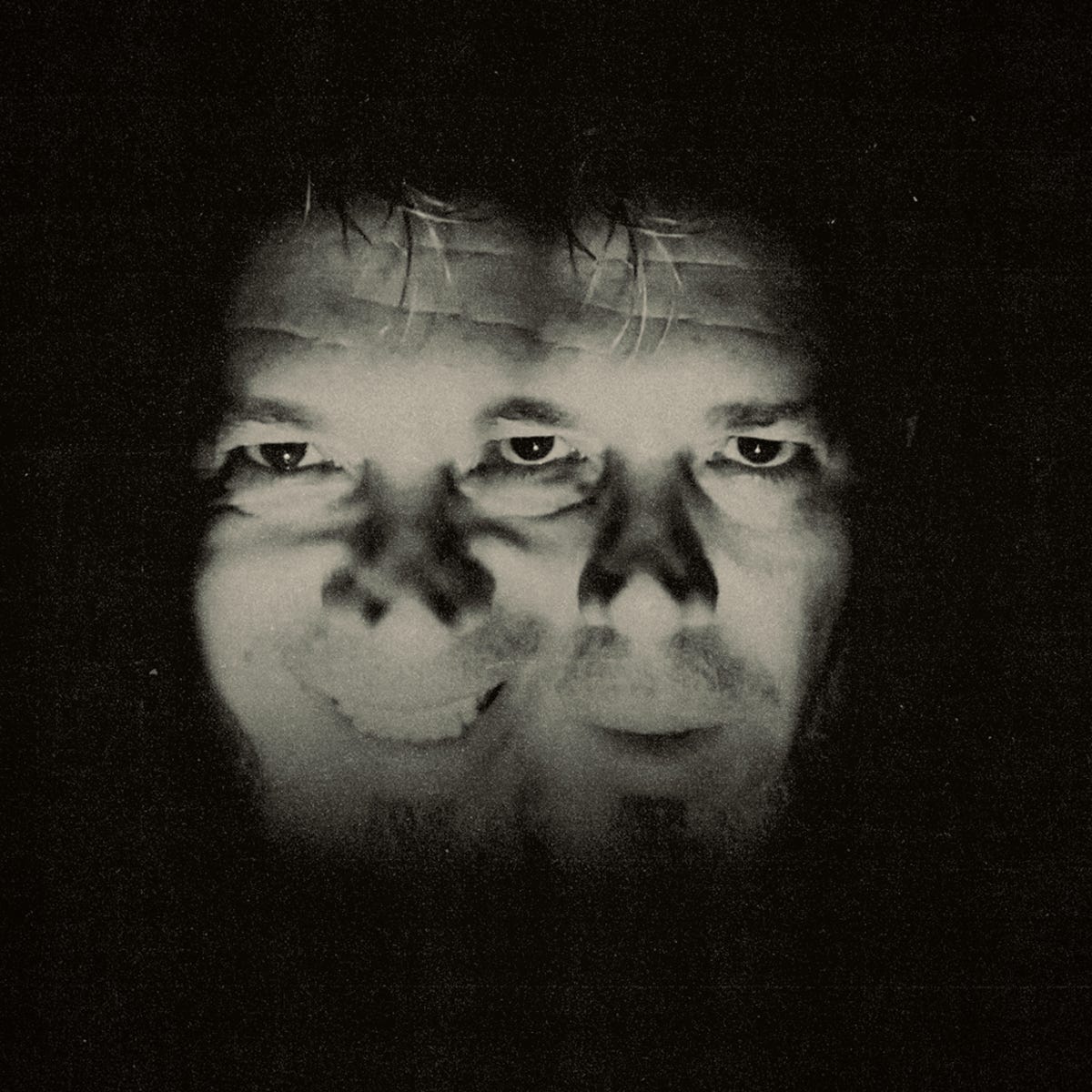
I’m in New York and doseone is at his home in Santa Fe and we’re talking about Sumerian tablets over a wifi connection so clean it sounds as if the 49-year-old avant-garde rap legend is sitting right across from me. “Upright apes have been thinking about this shit for so long,” he says, referencing specifically a poem whose sentiments recur throughout sighting, his new album with Louisianan musicians Wino Willy and Zetroc, and generally our impulse to make sense of the Big Bang, original sin, and all its tiny, violent reverberations.
It’s been 30 years since the man born Adam Drucker co-founded anticon.; across those three decades he’s released roughly 30 records on his own and as part of various groups, all of which push rap into odder shapes and more uncertain territory. The son of artists, Drucker grew up mostly in New Jersey and Philadelphia; last decade he moved to the Southwest in part to pursue a career scoring video games. But this move into middle age has, if anything, more intuitive and less rote with his creative process. sighting, as he describes it, is in part an exercise in becoming a conduit for the ideas and images that might move through you, as if a jolt of electricity or a paranormal chill.
At times, the new album—scaffolded by Wino Willy’s drums and Zetroc’s audacious instrumentation—is uncomfortably dark, but it is never universally so. “My dad could tell I was really mining my darkness and trauma to make art,” Drucker recalls of a period in his adolescence. “And he was like, ‘Hey man, you got to take all these grays, these darks, you got to make a new white. You can’t be like Rothko and kill yourself beautifully on the floor. You can’t use you all up. That is not what the art wants. That’s not what anyone wants.’”
And so sighting seems to come out of the same ether that birthed folk tales and indigenous art in the region going back centuries. The aperture is open and the work ethic anchors it. “I do not experiment for experiment’s sake,” Drucker says, “but I make music for music’s sake, and that means I work on the fringe. And with the fringe, there is always another day of work.”
Our conversation has been lightly edited for length and clarity.
I’m also from another part of the country, but I live in L.A. now, and I love the desert—it has a real romantic appeal, but it also feels like you’re on another planet.
Yeah, you could see how someone came up with all that skinwalker shit. You pull it from the turf. And that’s a big theme for sighting—the sighting thing came as I went to make art about the record. These days I finish the very last song and then I start making the art, and then I title it. Generally in that order. So I just was listening to all this dark music we made and I was like, “Oh man, I want to do… not really Bigfoot sightings, but these dark wendigo kind of watchery things. And then that brought me to sighting, and thinking about how the whole thing is being a vessel, really allowing imagery to develop and not be fettered by me or my personal politics or the world’s politics. I’ve always loved the occult. I listened to fucking Coast to Coast on tour. Late at night, you would throw in George Noory and all that shit. It skews kind of Christy for some reason these days, but all of that anomalous information is way more interesting to me than who won the World Series in 1957. [Ed.- The Milwaukee Braves beat the Yankees in seven games.]
It’s interesting to talk about that tension between feeling like a vessel for things and actually exerting your own politics or worldview. When do you feel that divide coming up in your writing?
Well, so when I do channel the world per se through me, it is still these days very imagery-forward. I think sometimes I’m doing language things, like if these words are playing well, but it took a lot of concerted effort to move past ideas starting in my head, and getting a gut feeling about something, things actually hitting me, where I stop in my tracks and start the writing there. And that was this dedication to figuring things out: not being a factory, listening to whatever signals I pick up. I’m certainly not a hippie, but I’m picking up fucking signals. And it’s all sorts of things, whether it’s from Twitter and the wrong side of history, something will trigger me, you know what I mean? Something that I’m truly intrigued by and inspired by, whether that’s a peer and something they made, or skinwalker tales about the Southwest, whatever the fuck it’s going to be. On this record, it’s very distinct images of going through.
I had a cancer scare. Everyone who worked on this record had something non-positive in their life while we were working on this. I got a colonoscopy; I did this home test thing, came back full-blown positive. So they put me in this litany of shit. And then lo and behold, I had nothing. Because I live in a place that is swollen with the elderly, I had to sit for six months and just be with my mortality. I didn’t have cancer, so there’s a worse version of the story. But also [Zetroc], his whole apartment burnt down. So there’s quite a few nasty sonnets about health insurance and being priced out of your existence, and then that being woven very tightly with more brutal depictions of a Kodiak bear mauling you in the open night, and letting all those things touch.
So for me, the joy is to abandon the reality and go into imagery and then do vice-versa. So the whole record is. The cool thing is it’s doing it within the songs. I don’t think that—not to bag on Hamilton—but I don’t need a fucking plot. I don’t need a plan to really paint with what it is that comes to me and comes through me. And then, when I’m in the vocal booth, I’m just channeling the music. So it’s a fun process. And then both Zet and Willie are just brilliant, man. My favorite artists pretty much are ones who are naturals. They have the gift. Everyone has to do the thousand hours, but both of them really have a way of being completely original without forcing anything or trying to do something. And this record became a bed for all of us to do something we haven’t done before.
Maybe this is different for you being the child of artists, but when I was a kid and I would read interviews where artists would talk about theme or structure emerging from their subconscious during the process, and I though they were lying. And then you start making art and you go, “No, that is kind of how it happens.” Do you feel that you’re significantly better at allowing that process to happen now than, say, 15 or 20 years ago?
Yes. So that is the long arc. That is not musculature that develops. It is really this. This kind of comes from [the poet] Galway Kinnell, but actually comes from my lived experience. Galway Kinnell had this documentary thing where they’re like, “Why do you break your lines so weird or uniquely?” And he’s like, “Well, there’s a cat and if the cat scratches the back of my hand, I break the line. And I don’t control the cat.” I always thought about that. And then I realized that actually getting out of the way and allowing an amazing poem to take place because you’re running the pen is more like how you see people who are good around animals. There is a way in which you’re not trying to disturb what inspires you or whip out your phone and fucking scan it. Literally, you can scare the moment away.
And the thing I learned over all these years, which took a million repetitions, is that just knowing when I have a really good poem in me and when I have just the head or tail of a line or stanza, just a node. And when you have a really good poem, you just get this feeling like, I’m fucking up if I don’t stop and sit and let it happen. And that has been the secret to my success. There’s a real getting out of the way of—especially with rap—not only just all the tropes, not only all the people who have rhymed every word in the universe before you, but really all the things you’ve done before. And it’s hard. I don’t got to tell you, being a shadow of your former self is the number-one killer of good art.
We’re talking a lot about being conduits and being the person holding the pen and whatnot, but there is a formal intervention into the impulses you feel and the signals you receive. When you’re writing this record, did you feel like on a technical level, anything was going particularly well?
I felt the pull to this darkness thing, like this is going to be a work of darks and that’s okay. I’m not really here to give people song progressions anymore, and I’m also not here to give you good-mood music. So it’s really what we were making, what we kept bringing one stone after the other with the color of the music we were making. So I just followed that and let that happen. And then the other thing was—this is kind of tacky—but a long time ago on Twitter, I think it was Ghostface, but somebody was talking about nobody does storytelling in rap anymore. And I love Ghostface. But I literally was like, “Man, what is storytelling in music besides a book on tape,” all this stuff.
So I started thinking about that, and then I started writing these fables, and they generally sit inside me as one image until there’s a second image, and then I started writing them. And that was something I let out on this record for the first time. I’ve written a few on another piece that isn’t out yet, but this came out first, and honestly, people are reacting really well to “Born With Thorns” and “Shadow As Bread.” I’m definitely not making any punchlines about modern basketball players or anything to latch onto. You got to follow me and buy what I’m selling. And then those weirder beats that Willie was giving me, I was like—not that I felt like he was challenging me to do it because he didn’t know that I was thinking about these things—but it just kind of came out of me. Then when Zet stepped in and started adding more musical analog, non-repeating layers, I was like, “Oh, this is perfect for a fable that grows in intensity and is musical, but isn’t a lecture.” I don’t know, trying stuff. I think that mixed with the other things the record does, which the fables also do, is be brutal, almost violent, dark, but not tacky or whatever. It’s not horrorcore. It’s not intentional like that. It’s actually painting in swaths, and then going back and adding deliberate stitching between things.
What you were saying earlier did also remind me of Lynch though—specifically his fixation on forgetting ideas that you neglect to write down, which he always insisted would make you want to kill yourself.
When Willie sent me these first few beats, before Zet was on board, two of them were set to Eraserhead scenes. He was thinking about sending them to Sharif, and it never happened. And then there were more beats, and when he gave them to me, I went to Seattle—I’ve been to all the original locations for Twin Peaks. I’m a fucking dork for that. Anyway, I saw the Eraserhead clips and I was like, “Yeah, this is my man. I can’t go anywhere near Lynch.” And he dies while we’re doing it. I kept it in my palm; it’s not like if you listen to a song in reverse, it’s all the words in the Lost Highway script. I can’t do it, but I love him. He is what we were talking about earlier, “Get yourself out of the way.”
So in what aspects of the process—I’m talking big-picture process, on a career level as much as a song level—do you most want to insert yourself?
I learned from Steel Tipped Dove when I did All Portrait, No Chorus. He said “If you’re not making lifelong friendships while you’re making albums, you are sadly doing it wrong.” Because AI can do that album, man. If your gig was just the part that can be farmed out, what are you doing? Grow, find your people. I think there’s this thing in indie music that when done poorly, it’s disgusting. Some of the Kanye stuff where he’s like, “Fly in all the young talent and let me drink their blood and then kick them out and I’m going to be better”—that’s really bad. But opening up to a bunch of people you’ve never met because you love their art and then having the balls to get in the room no matter what generation or era or zip code you’re from and make stuff is best thing in the world.