


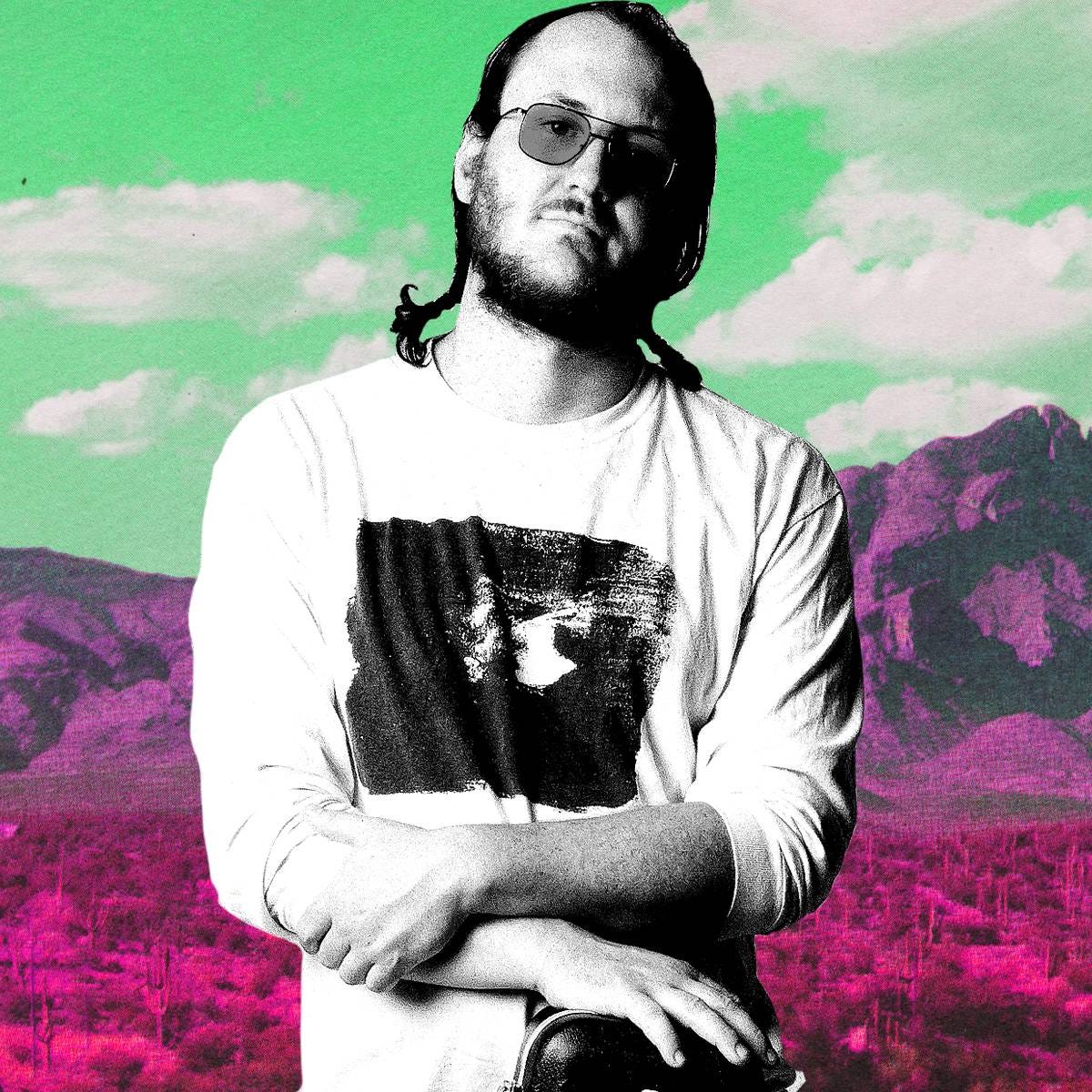
Art via Evan Solano
Ross Olson is still waiting on that Folk Implosion “natural One” mixed with “Stupid Girl” by Garbage mash-up.
When I reach Dougie Poole on Zoom, he’s sprawled out on his porch, taking in the hillside views from his East Los Angeles residence. A self-described homebody, Poole’s enjoying some downtime before heading east in the coming days for the second leg of a tour that began in early July.
Since 2016, Poole has forged a brand of country music that’s equal parts celestial and plaintive. Early on, he operated as a band of one, playing multiple instruments, mastering production from home, and performing sets alone. Eventually he’d fill out a proper band and recruit collaborators, but that original, singular sense of craft still runs through his music.
Poole’s first blush with recording traces back to Providence, Rhode Island, where he attended Brown University. There, Poole played in the group Cool World and hung around brothers Andy and Edwin White from Tonstartssbandht. These were acts who specialized in noise, channeling it through transmissions of punk, psychedelic rock, and ambient droning. It was the first time Poole saw a DIY approach up close: instruments recorded straight into iMacs, lofi flourishes from tape machines, bedrooms doubling as studios.
This philosophy shaped Poole’s early artistic output. “It never occurred [to me] that you could just start now and just make stuff yourself and those could be powerful and complete and moving works of art on their own,” Poole tells me.
At first, Poole tried his hand at making similar noise-infused experiments. But he gravitated to writing country songs, a genre rooted in straightforward storytelling and extracting deep emotions from the mundane. Growing up in New York City, Poole wasn’t exposed to many traditional country tropes. At home, though, his parents played folk music around the house, and he loved the country-adjacent pop hits he’d hear on the radio. He discovered the Grateful Dead, whose country covers led him to old-timers like Marty Robbins and Merle Haggard. When Poole started writing his own songs, country’s rigid guidelines offered a framework he could follow and subvert.
In 2017, Poole released “Don’t You Think I’m Funny Anymore,” a lamentation on a relationship turned sour. The backdrop of the video is the middle of nowhere, and the continuous panning makes it feel like we’re taking it in from the back of a shoddy tour van. Multiple Dougie Pooles appear, each sporting a burgundy suit and playing an instrument heard on the song. Kaleidoscopic graphics flicker in the background. Over a fluttering synth melody, the track announced Poole’s arrival as a do-it-all cosmic cowboy.
In the years since, Poole has established himself as one of indie rock’s most effortless songwriters. He writes about things that fuel millennial angst: discontent in the internet age, half-hearted dating, and working thankless jobs. “Beth David Cemetery,” from 2023’s The Rainbow Wheel of Death, is named after a grave site in Queens where several of Poole’s relatives are buried. “And if memory serves, there’s no hors d’oeuvres till the services are done,” Poole croons.
Between tour stops this summer, Poole released At Tubby’s, a live record in the tradition of country troubadours performing in cramped, backroad venues. Beyond re-imagining his music, Poole dubbed the recordings from the set through a tape machine back at home. He used modulation and delay to add a studio-grade polish to the performances’ spontaneity. The results are a skeletal haze of warmth and twang. Absent are the synths from his early records and any sort of percussion; songs unfurl through pedal steel and electric guitar streaks. While the studio version of “Claire” swirls with daydreamt psychedelia, on Tubby’s, it’s guttingly sparse, a ballad of longing and emptiness over acoustic arpeggios. Meanwhile, “Los Angeles” follows the outlaw spirit of Waylon Live. Poole’s cool baritone floats across the galloping groove as he weighs uprooting his life with a cross-country move.
I caught up with Dougie to talk about recording At Tubby’s, DIY art, New York versus LA, and studying creative writing in college.
I was at your show in LA [in August]. It was an awesome show. I feel like I’ve heard a few different variations of your songs to this point. The studio recordings, the stripped-down versions from At Tubby’s, and then the louder, electric renditions in concert. Do you like taking these songs and re-imagining them in different ways?
Dougie Poole: Yeah I do. I think my introduction to music was more playing around with sounds. I really liked home recording. Before I ever started songs, my creative process as it related to music was just kind of playing around with sounds at home. There’s just like little things on Ableton or guitar or whatever, and I think songwriting came for me as a way to feed that, if that makes sense. Playing the same tune over and over in the same way, I think there’s advantages to it. But it has felt to me - especially in the context of touring - that it just keeps things interesting for me and for the band, and exciting for the band to have new angles and new ways of approaching the same tune. It only works for some tunes. Some tunes don’t hold up that way. It’s a fun process of exploring and finding new sounds.
Were the stripped-down versions at Tubby’s reflective of how they were written and recorded in the studio? Or was it kind of working backward off the studio versions?
Dougie Poole: It’s case-by-case. Sometimes I’ll write a song with the guitar and sometimes I’ll write a song by chopping together samples and Ableton or whatever. And then a song will sort of reveal itself that way. Then if you’re lucky, it goes backwards. There’s no one direction, I don’t think. Arrangements, a lot of time they depend on budget. How to keep the tour, like, how to keep it…
Like as efficient as possible?
Dougie Poole: Yeah, and where we’re at in the cycle. If it makes sense to rent a van, we’ll rent a van. But on those tours I borrowed my mom’s car. Yeah, there’s just gonna be three of us in the car, and you know, there’s no drum kit. There’s no bass player. It’s just kind of whatever works. It’s sort of a dance, trying to find something that feels right and something that works, you know?
Is it extra vulnerable as a singer playing with a three-piece band without a drummer or bass player?
Dougie Poole: No, not for me. I started out playing solo; I had backing tracks. I wasn’t like a natural bandleader. I would just make my tunes at home and I would play behind them live. I started playing by myself. I spent a lot of time learning how to do that in different ways. With backing tracks, and then later, just me and a guitar which is how I do it now, just cause it’s simple. But no, sometimes it almost feels more vulnerable with a band because it’s like here’s the big production of everything it could be, you know? I don’t know if vulnerable is the right word, but there’s a comfort to having a limited palette that you can work with. The more pieces you start adding into that, the more complicated that it starts to feel.
So your background, you did pretty much everything yourself, right? From playing instruments to recording and producing?
Dougie Poole: That’s how it started. Then gradually I started working with more people. I would use pedal steel samples because I didn’t know any pedal steel guitar players. I would do it in my room because I didn’t have anybody offering to pay for studio time for me or anything like that so I would just make it myself in my room. I kind of learned how to make music from people who did it that way. That’s just how I learned how to do it.
I think it’s a great ethos of not making any excuses and just learning how to do it yourself even if you don’t have the resources.
Dougie Poole: I think that’s part of it. I think to a certain extent now it’s really easy to find the resources. And you know, you can always have more gear or more studio time or something. But people make great music in their bedrooms all the time.
https://youtu.be/-W685tU7HqE?si=TGQ3gf35ZUhA0rZi
As a music fan growing up did you start with classic rock and then got into more country and folk music from there?
Dougie Poole: Yeah, sort of. But also the internet happened pretty early on. My parents listened to folk, but also pop. We had a Milli Vanilli tape in the car that we listened to all the time. Annie Lennox tape. I was all over the map from the jump. The people in my family didn’t go looking too hard for music. They had the things that they liked and I think we absorbed what came to us, which I think it is for most people, and that’s reflected by the popularity of Spotify and the streaming services. It’s like a passive experience. You’re served a large platter of options and you kind of just take what versions of what you’re served. For them it was less of an experience of going looking, and for a long time I wasn’t looking. Maybe I don’t even really go look. The people showing me music now are the people who really go looking. It wasn’t necessarily classic rock to country. I have early memories of Shania Twain and The Dixie Chicks in the car. “Achy Breaky Heart.” It’s more what’s popular and what comes to you. I didn’t have people showing me indie rock or experimental music. It just wasn’t in my world. I did MTV and the radio. That’s where I got most of my stuff, basically until I got to college.
Do you remember the first country song you heard that really captivated you as a young listener?
Dougie Poole: You know, it was probably a Dixie Chicks tune or Shania Twain. I guess I’ll say “Goodbye Earl” or something. We had those Dixie Chicks CDs in the car. Around that time in my life, I was probably around 11 or 12 or something, I would always listen to Weird Al. So we’re wanting to put on the Dixie Chicks and I would sort of kick and scream, but eventually it sunk in. Those are great songs. Probably something before that. I remember being aware of “Achy Breaky Heart” when it came out and trying to figure out what the words were. I was probably like four or five.
I read that you’re a Grateful Dead fan. Did they kind of open the door to more cosmic and psychedelic Americana stuff?
Dougie Poole: I wasn’t thinking about it all that much. I think what really appealed to me about the Grateful Dead when I was a kid was the idea of - and I never did this - but like running away from home and travelling across the country. I liked jazz when I was pretty young too, and I think the spirit of improvisation. It’s never been something that I personally could do but it really appealed to me. Also, The Grateful Dead, just like jazz music, what they’re doing is reinterpreting popular music. I think that appealed to me about it too. I think my interest in looking for different sounds and stuff didn’t kick in as much until a bit later. The melding of country music and kind of psychedelia - you know, I hadn’t really considered that, but I guess it started with the Grateful Dead. It really wasn’t something that I set out to do. I was just looking for things that sounded cool to me, and then it was like, country songs were what came out.
Was going to college kind of a formative musical experience for you? I know you played in the band Cool World and were around Tonstartssbandit?
Dougie Poole: Yes. Sean [from Cool World] and Andy [from Tonstartssbandit] came from Orlando, and Nick [also from Cool World] came from Philadelphia. Orlando – I think at the time had this and may probably still do – had this kind of thriving noise music scene. And Philly obviously always has really great stuff going on, and of course New York does too. I just wasn’t hip to it. But then I got to college and saw these people making music. Like Cool World recorded their first tape – they played their guitar and drums just straight into an iMac microphone. Andy and the Tonstartssbandit guys, they grew up with tape machines and stuff. It didn’t even occur to me that you could make your own recordings and those could be completely realized works. I don’t know what I thought happened. I think maybe I thought you play enough open mics that whatever Jimmy Iovine sees you and puts you on. It never occurred [to me] that you could just start now and just make stuff yourself and those could be powerful and complete and moving works of art on their own.
Did you kind of embrace that imperfection, maybe that rough mix aspect of doing it yourself?
Dougie Poole: Yeah. I mean for a long time I couldn’t even really tell. I knew it was different sounding than the radio, but my ears didn’t know what compression was or EQ. I could just hear that there were lots of layers and cool stuff going on and it doesn’t matter if it’s not well mixed. You can still hear it, you know? Gradually, over time, now that I’ve done it more my ears have gotten more sensitive, but when I was 22 I couldn’t have told you the difference between a ween record that they recorded on their four track and a ween record that they recorded in a fancy studio. Those things didn’t really even occur to me.
You were just captivated by the sound and the heart of the music?
Dougie Poole: I guess so. Maybe that does come back to the Grateful Dead. I still think it sounds like shit, you know, by most conventional standards. A lot of times that’s what will jump out to me.
https://youtu.be/XdSZ1VFnusk?si=QnHgyza-42YAIajH