

Why Are YouTubers Doing the Police's Job?
Four years after Drakeo the Ruler's murder, official answers are scarce. Donald Morrison takes a closer look at the online sleuths attempting to fill—or exploit—that vacuum.
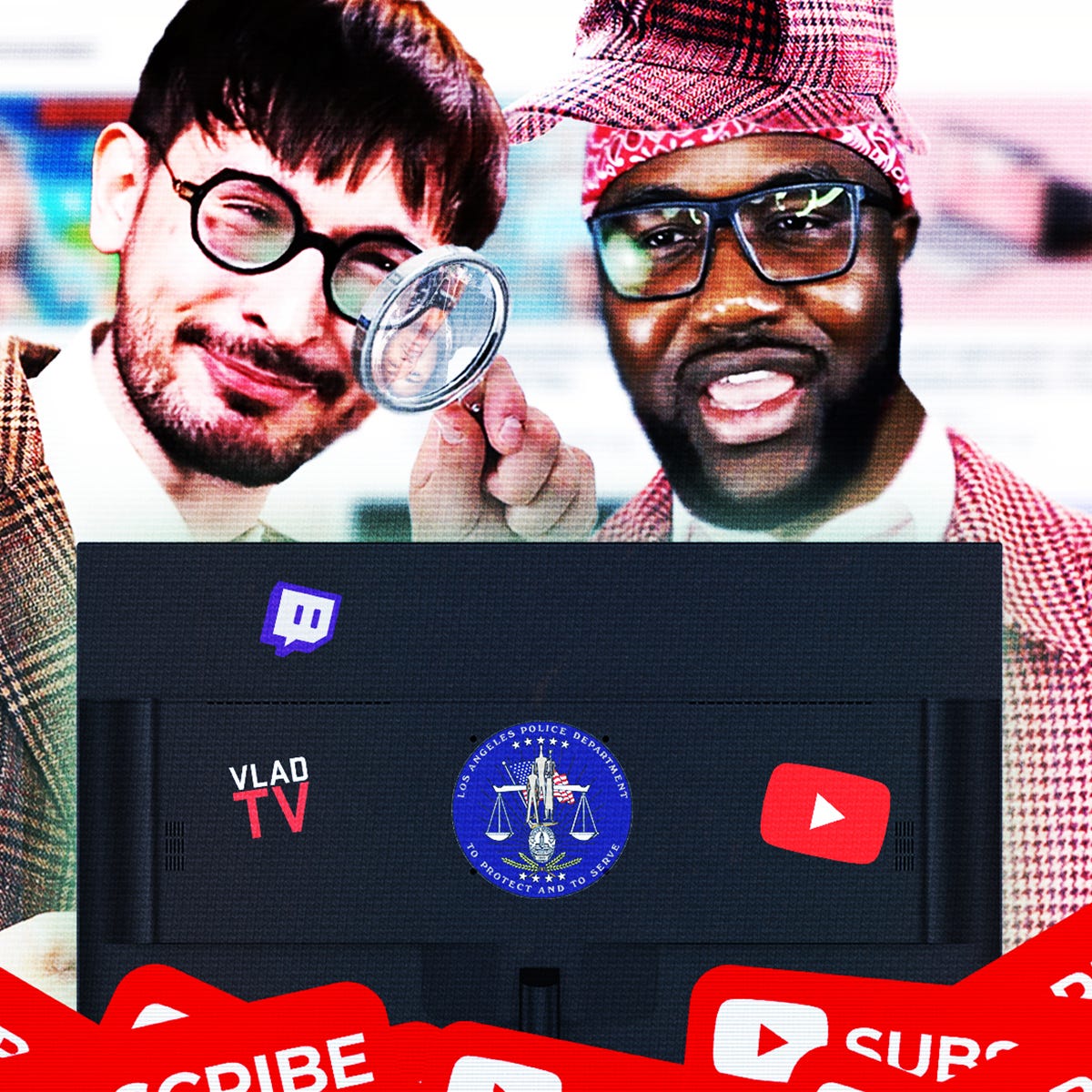
Art by DJ Short
More than four years after he was fatally stabbed backstage at a Los Angeles festival, Darrell “Drakeo the Ruler” Caldwell’s killing remains officially unsolved. But the case lives on in a parallel universe of YouTube streams, Instagram reels, and forum threads that insist the streets already know who did it. The gap between the formal investigation and the online “case” has become its own story.
But for me, this isn’t just another case file or true‑crime curiosity. I was backstage with Drakeo and his crew the night he was jumped and murdered. I watched the chaos unfold in real time—something I’ve made clear online, where I post under my real name. And in the four years since, not one detective has called to ask what I saw.
That silence has spawned its own kind of obsession. Without answers from the people who are supposed to deliver justice, I’ve been left replaying that night in my head, following every scrap of news, dissecting every rumor. What makes it worse is that the only “investigations” most people see now come from an army of L.A. rap streamers and internet sleuths who seem more interested in salacious thumbnails and super‑chats than the truth. They posture like homicide detectives, which is absurd in and of itself, but are in reality some of the most nefarious clout chasers on this corner of the internet.
So when I write about this case—about security failures, about who knew what and when, about names being whispered on streams, in YouTube videos, or on Reddit forums—I’m doing it as someone who was there when Drakeo took his last steps as a free man, and who still hasn’t been given a real chance to help fix what went wrong.
The Night of the Festival
On December 18, 2021, Drakeo arrived at the Once Upon a Time in L.A. festival in Exposition Park as a marquee performer on an otherwise nostalgia‑heavy lineup featuring West Coast royalty like Ice Cube, Snoop Dogg, The Game, and YG, among others. Backstage, instead of industry camaraderie, he walked into a security vacuum. Multiple accounts describe a chaotic scene where his small entourage was suddenly swarmed by a large group of men after some kind of confrontation, the details of which remain disputed. I can say I witnessed what appeared to be more than 100 people in red sweatshirts and dark clothing swarm Drakeo’s crew almost the moment they arrived.
Video from that night doesn’t show a fight; it shows an ambush. Dozens of ski-masked men, in primarily black and red clothing pouring through what was supposed to be a secure backstage gate, swarming Drakeo and anyone near him, swallowing them up before security or police can do anything. In the chaos, someone drives a blade into Drakeo’s neck. He’s rushed to the hospital in critical condition and later pronounced dead.
I saw him lying on the concrete, motionless, ringed by police bicycles that officers had rolled into a makeshift barricade around his body. Jeff Weiss, who brought me the festival, and I drifted in circles, useless, waiting for an ambulance that took close to ten minutes to arrive. At an event of that size, where the standard, insurance-mandated policy is to have medical staff on site, the delay felt less like bad luck and more like a system breaking in real time.
From the beginning, those closest to Drakeo rejected the idea of a spontaneous brawl gone wrong. To them, and myself, the scale and coordination of the attack looked like a targeted hit staged in an environment where security was either dangerously lax or willfully negligent.
Police Investigation
Jurisdictionally, the stabbing fell under the California Highway patrol authorities, who have had jurisdiction over Exposition Park since 2014. This was a high‑profile homicide with cameras, witnesses, and a packed backstage area, a case that should have generated quick movement on suspects. But the official response has been defined more by silence than public action.
In the months and years that followed, no arrests or charges directly tied to the killing were announced. Occasional media check‑ins, including pieces as late as early 2025, framed the case as another example of a slain rapper whose murder remained unsolved while family and fans waited for answers. Officials offered the standard explanation: complex case, ongoing investigation, limited ability to comment.
The lack of visible progress has to be read against Drakeo’s history with Los Angeles law enforcement. Before his death, he had already become a symbol of overreach and culture‑war policing. Prosecutors previously tried to connect him and his Stinc Team circle to a 2016 killing, treating the crew as a criminal enterprise and attempting to use his lyrics as evidence against him. He spent years in and out of custody fighting charges that many observers considered dubious. When he ultimately beat the most serious counts, supporters cast it as a rare victory against a system that had decided he was guilty by association and his artistry alone.
That history shapes how the public interprets the present investigation, or lack thereof. In their view, the same institutions that once invested enormous energy in putting Drakeo away seem curiously sluggish when tasked with finding who killed him. Whether that perception is fair or not, the contrast fuels suspicion: If detectives could mobilize statewide resources to chase a trumped-up case against a rising star who taunted them, why is the public record so thin when that man is assassinated in plain sight?
The Civil Battle Over Security
While the criminal case stagnated, its civil counterpart moved faster. Drakeo’s family filed a wrongful‑death lawsuit against Live Nation and other entities tied to the festival, reportedly seeking tens of millions of dollars in damages. Their claim is direct: The promoters and security contractors failed in their basic duty to keep performers safe.
The complaint leans heavily on video and eyewitness accounts that paint a picture of wholesale failure. A backstage area that should have been tightly controlled instead appeared porous, with large groups able to flood in. Security presence at the moment of the attack was described as minimal to nonexistent. Once the fight broke out, there was no rapid intervention to separate parties or protect the talent, just chaos.
To Drakeo’s family, the civil suit serves as a path to financial accountability for the son and brother they lost. It’s also a surrogate forum for truth‑finding in the absence of a transparent criminal process. Through discovery, depositions, and internal documents, their attorneys hope to piece together who had access, who was warned about tensions beforehand, and whether anyone flagged Drakeo as a specific risk.
But civil litigation has limits. It can expose negligence, miscommunication, and profit‑driven corner‑cutting. It is less likely to definitively identify who wielded the knife in a crowd of attackers. So even if the suit lands a large settlement or a damning verdict, it may leave the core question—who killed Drakeo—unanswered, at least in the evidentiary sense. The case is currently slugging its way through California State criminal court, and appears headed toward either settlement talks or eventual trial unless it’s quietly resolved off‑record.
Streets Are Talking: Online Rumors
Over the past month, YouTube channels and Instagram pages that live at the intersection of the L.A. hip‑hop commentary and street gossip have pushed a new wave of claims that “the killer has been found,” originally kicked off by No Jumper alum Poetik Flakko, a man who posts hackwork videos about legal battles and tabloid scandals at a staggering clip, the like-and-subscribe equivalent of an ambulance chasing attorney. So take his words for a grain of salt. In the narrative pushed by Poetik Flakko, as well as other independent content creators, podcasters, or semi‑connected figures, claims that “the streets” have supposedly known who killed Drakeo since the night it happened. He repeats a theory that has been spread within the L.A. rap community and gang circles for years which ties the hit to certain Blood sets and to YG’s camp.
On YouTube, one creator lays out a sharply detailed “setup” theory that pins Drakeo’s killing on YG, his bodyguard Gloves, and a security guard tied into the same Blood‑side ecosystem. In this version of events, YG doesn’t just show up at the festival to perform—he arrives with an oversized entourage of Blood affiliates, while Drakeo’s backstage passes are capped and his movement tightly controlled. Gloves is cast as the middleman, the guy who works hand‑in‑glove with security to make sure Drakeo’s crew is outnumbered, allegedly funnels hostile hitters backstage, and, in the most explosive claim, actually hands out knives to the mob that eventually rushes Drakeo. The guard is painted as the inside man, a paid‑off gatekeeper who looks the other way or actively clears the path. Put together, the videos and rumors sell a clean narrative: YG at the front of a masked crowd, Gloves arming and organizing it, security opening the doors. None of it has been confirmed by police or a court, but online it has been circulating as if the case is already solved.
Without direct access to the videos or any supporting documents, those claims are impossible to verify. An interview with Poetik Flakko was supposed to clarify things—but it never happened. On April 5, 2026, he told me that he was headed to North Dakota and would check in once he landed. Since then, nothing but silence. Which raises a fair question: What exactly was he doing in North Dakota in the first place? Was it a dodge—of reporters like me? The cops? The Bloods? Or just another thread in a pattern that’s becoming harder to ignore?
What is clear is the larger dynamic at play. In the absence of hard facts, online culture doesn’t leave a vacuum—it fills it. Where official channels default to “no comment,” content creators step in with detail and confidence, weaving together old feuds, alleged affiliations, and carefully chosen screenshots into narratives that feel too specific to question, and just believable enough to stick.
In that process, rumor ossifies into “fact” for portions of the audience. A claim repeated across enough streams and thumbnails: “we know who killed Drakeo; police won’t move,” starts to feel like common knowledge even when it rests on anonymous sources, street lore, or outright speculation. For some, the very absence of arrests is taken as proof of a cover‑up, not a sign of a stalled or thin case.
Between Evidence and Belief
From an investigative standpoint, the Drakeo case now lives at an uncomfortable intersection of law, liability, and lore. On one side is a homicide officially labeled unsolved, with a family pursuing civil remedies and a public paper trail that suggests inertia more than urgency. On the other is a vibrant, often reckless ecosystem of digital storytellers convinced that they have solved the case, or that the case was solved long ago and buried.
Both realities can contain partial truths. It may be the case that law enforcement has strong leads but insufficient admissible evidence to charge anyone. It may be that certain names are widely whispered in L.A. but impossible to prosecute without witness cooperation that will never come. It may also be that institutional indifference plays a role when the victim is a controversial rapper with a fraught history with the same agencies now tasked with finding his killer.
Watching Drakeo bleed on the concrete, as Al Green sang “Tired of Being Alone” on a stage nearby and sirens wailed somewhere far beyond the backstage fence. The whole scene felt unreal, like two different worlds had been spliced together, one where a soul legend crooned for a festival crowd, and another where a young rapper lay dying behind a line of police bikes in the dark.
Every new rumor cycle forces me to relive those minutes in slow motion. It’s infuriating to see streamers spin that trauma into content. Constantly debating angles, naming names, chasing clicks, while the people with badges and case files move at a pace that makes gossip feel like the only form of “justice” available. It shouldn’t be on YouTubers and forum posters to fill the silence; if investigators had moved faster, been more transparent, or simply done the basic work of talking to witnesses like me, maybe this case wouldn’t have been left to the algorithms. Instead, we’re stuck in a loop where the streets talk, the internet speculates, and those of us who actually saw what happened are still waiting for someone in power to act like Drakeo’s life—and his death—truly mattered.