


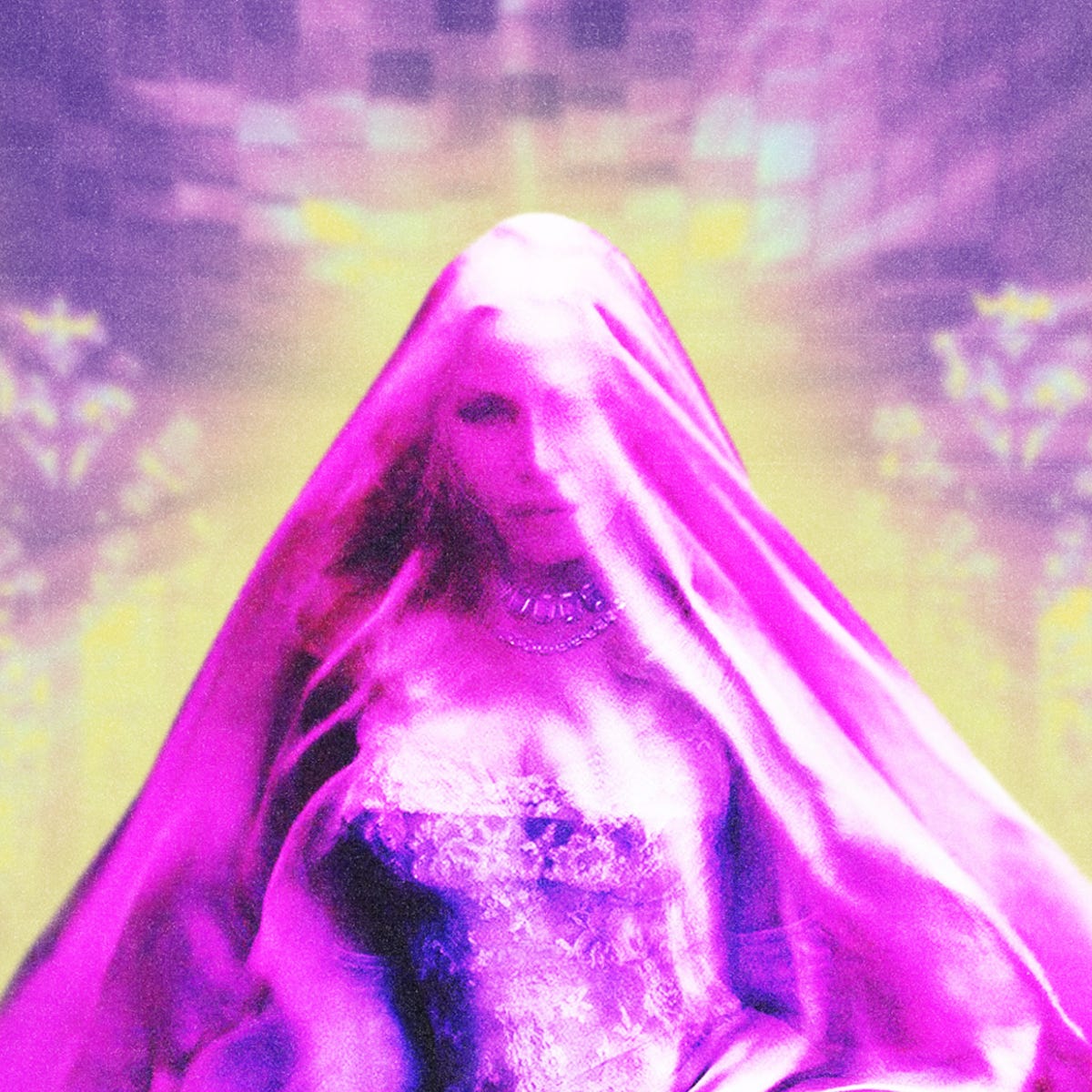
How sexy is a pop star really allowed to be? Not very, if recent controversies about the male gaze are anything to go by. Serving cunt must be completely asexual to be socially permissible. Sabrina Carpenter’s album cover was derided for outfitting the singer-songwriter in a leash being dogwalked. Charli XCX’s “Wink Wink” music video seems like a response to these kinds of criticisms—putting jilling off back into the zeitgeist. But even Olivia Rodrigo’s babydoll dresses have titillated naysayers and prudes who say she’s feeding into Lolita fantasies.
As always, Madonna was ahead of the curve. Her 1992 BDSM-heavy coffee table book Sex featured watersports, nipple piercings, leashes, and plenty of power play. The uproar was instant. “Madonna has overstayed her welcome,” Spin proclaimed–a sentiment that would echo for decades. “Did I say something true? Oops, I didn’t know we could talk about sex,” she slings on the slinky “Human Nature” before saying “I’m not sorry. It’s human nature.” The video features Madonna all tied up.
“She’s out to desensitize us and demystify sex,” Vanity Fair wrote in a long-form profile the same year Sex was released. She gave a now infamous quote that feminists across the board, including bell hooks, would object to: “I love my pussy. I think it’s a complete summation of my life…I wouldn’t want a penis. It would be like having a third leg. It would seem like a contraption that would get in the way. I think I have a dick in my brain. I don’t need to have one between my legs.”
In the years since, Madonna has championed the power of femininity and a post-genital expression of sexual fulfillment. Carnal ferocity and erotic aches can come in many shapes and forms. She heads to the dance floor to find transcendence, not just lust. Madonna’s sexuality has never solely been for the eyes of men, though. If it were, she would’ve stopped making music a long time ago.
It’s not surprising, if it is funny, that Grindr has been a primary sponsor for Madonna’s new album. Confessions II serves as a spiritual sequel to the diva’s last great album: 2005’s Confessions on the Dance Floor. Even when Madonna has stumbled, her gay fans have lifted her up—buying and streaming even the flops and uneven singles. After a legendary run—from “Like a Virgin” to “Vogue” to “Ray of Light”---she started to stumble after the earthly 2000s. American Life was widely panned and her turn towards bubblegum pop and EDM on albums like Hard Candy, MDNA, and Rebel Heart were seen by many as a washed up woman holding on to her youth too hard. 2019’s experimental Madame X was hard to parse for mainstream audiences—too many collaborators and not enough hooks. These later years provoked many questions. Why are there so many songs with Nicki Minaj? Was EDM really a necessary reinvention for someone who had already so thoroughly conquered dance music? How many ballads has she really nailed? As a teen I remember hearing “Give Me All Your Luvin’” and finding it thoroughly forgettable. Like many, I had been indoctrinated into the Madonna hate. She had somehow been both prolific and ignored by the mainstream even while performing at the Super Bowl and kissing Drake on stage.
Everyone, except the gays. Now, nostalgia be damned, everyone is ready for the pop star’s comeback. The album, which resulted from a scrapped biopic, has garnered critical raves from Shaad D’Souza at Pitchfork to fawning interviews with Graham Norton and Bob the Drag Queen. Madonna’s back, the chorus cheers. And she is. The album is an infectious summation of her career to date. The epic music video that premiered at Tribeca Film Festival is a star-studded celebration that even lets new actresses play the role of Madonna. Julia Garner, who appears in the visual album, was originally slated to play the star in the scrapped biopic.
Yet the dance-turned-megastar seems happy to turn the praise around. “Everyone here is a work of art,” she sings on “Danceteria,” a stand-out pulsing track that name checks Keith Haring and former boyfriend Basquiat while describing how Madonna got her demo played at the titular club. It’s the closest thing she’s written to a biography and it’s an infectious manifesto for the power of the club. Her melodies are sharper, her phrasing more direct than on fuzzy albums like MDNA or Rebel Heart. “Everybody get up and dance,” she demands, simultaneously bringing to mind her first single—”Everybody.” These callbacks are an essential component to Confessions II’s success. The slinky, groovy single even ends in Madonna humming Lou Reed’s “Walk On the Wild Side.” It’s one of many interpolations that works to her advantage, like “French Kiss” on the cool, icy album opener “I Feel So Free.”
Club music and its aesthetics were a big part of the first Confessions, so it’s nice to see Madonna return to her roots. Both records relied heavily on the production of Stuart Price, who’s never steered his queen wrong. There is still nothing like walking around the city listening to “I Love New York,” “Like It Or Not,” or “Get Together.” Her music, from the sunny Kabbalah on Ray of Light to the sweet sunshine of Music alternates exuding a soft femininity and a powerful, barreling womanhood. She has, at this point, gone through so many reinventions that she’s practically invented the blueprint for female popstars.
The Guardian noted that the best interview with Madonna has been Mel Ottenberg’s for Interview Magazine because it was the most “gay.” Pandering to her fans has never been Madonna’s strong suit, but here she does seem to be giving the gays what they want. She seems more comfortable with playing Mother.
“School” seems to be the origin of a meme going around about an older woman finding you on the dancefloor to tell you all the life lessons she’s learned. It’s a role she’s played since the Truth or Dare documentary where she tries to help her dancers balance work and their private lives, all while dealing with her own family struggles. “Please someone teach me something I don’t know,” she begs on the disco-infused techno song. “School is in session,” a voice croons before Madonna raps over a house beat. This exemplifies the carefully dialed recipes throughout the record—taking cues from Europop, drums and bass, synth and clashpop, and trip hop. Some songs tend to blend together, but at its best the album reminds us what the queen of dance can really do.
As the album winds down, Madonna turns inward for some real confessions including “Fragile,” a moving song reflecting on the passing of her brother Christopher and their tumultuous relationship. Yet while going into the pain, she doesn’t lose her musical focus. It’s the kind of pain that requires dancing through. The Arca co-produced song “The Test” finds Madonna and her daughter Lourdes singing about their bond and the threat of the tabloids. “I’m not the same when I’m hanging on your coattails,” Lourdes sings. Their voices melt together gorgeously. Lourdes’ voice is smokey and thrilling, a bolt of light that re-energizes the record before the final song.
“Everything fades away except for you,” Madonna sings on the album closer “LES Girl.” It sounds more in line with indie sleaze than the rest of the club-centered record, but it’s a haunting guitar-centric lullaby about growing up in the city as a woman and falling in love with smudged eye liner and cherry red lips. I’ve already seen girls posting about crying their hearts out to the song’s gentle narrative of innocence and experience.
Our society enjoys writing off the sexuality of older women. The cherub who sang “Material Girl,” “Papa Don’t Preach,” and “Like a Virgin,” has become a mother with adult children. She’s faced grief and loss and undergone surgery. She’s still dancing in Times Square, but she isn’t quite delivering the same showmanship that someone like Sabrina Carpenter brings when the two perform their duet “Bring Your Love” together. It’s an interesting choice for a successor—yet their early careers revolved on fun, frothy, sexy hits. “Espresso” could easily have been a big song in the 80s. Few have had the longevity that Madonna has. Her stamina is inspiring. A workaholic who can still dance her ass off on stage.
Where would be without Madonna? Would we still be so touchy about sex if she hadn’t tried to teach us? She reminds us that the things we take for granted—the erotic, the dance floor, techno—are “thresholds.” What we do with these rituals is up to us.
