


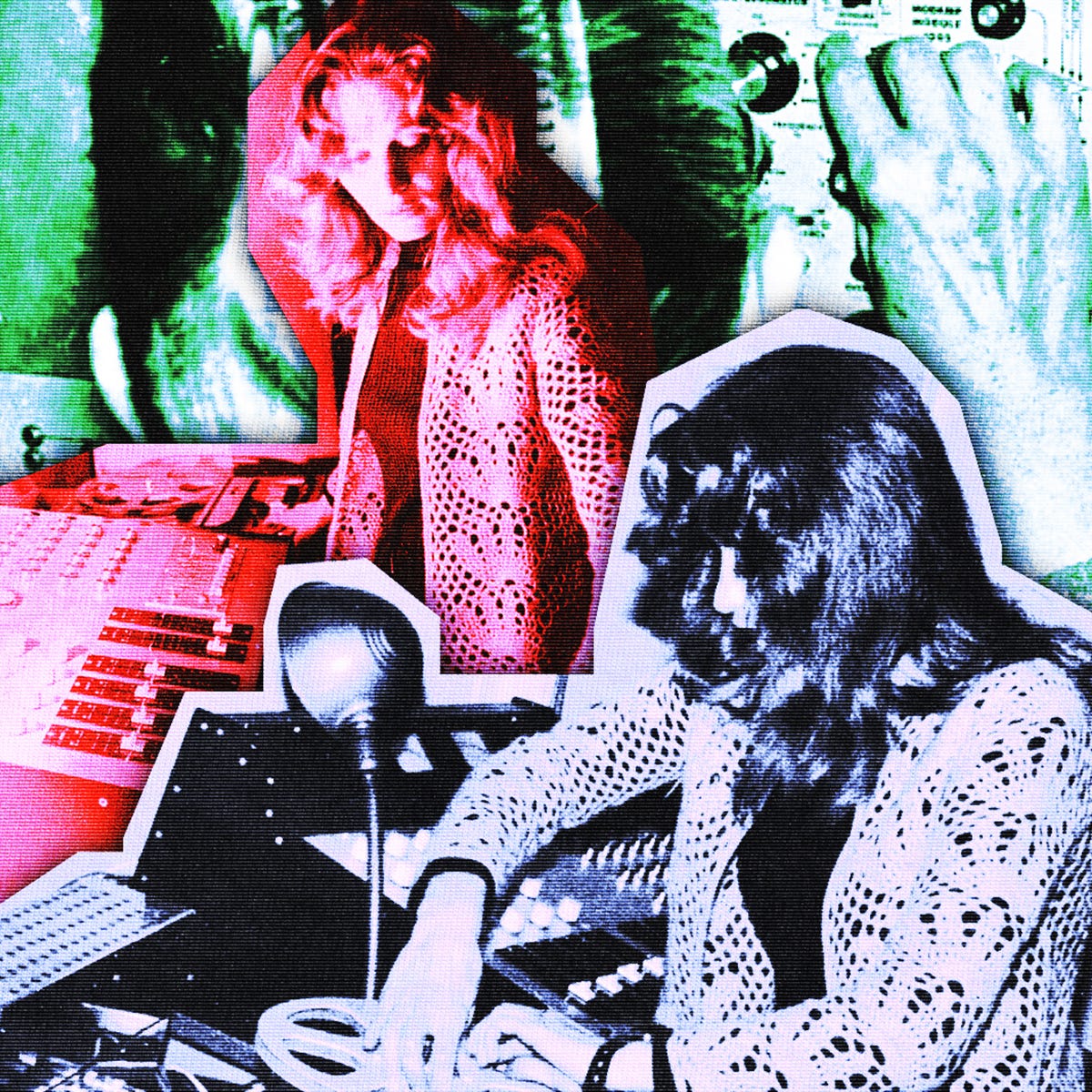
It felt like it was never going to happen, but was always just a delusion. Death takes everyone, a tired parent leading a child away from the window. Éliane Radigue was a French composer born in 1932, primarily creating feedback and synthesizer works in the 20th century, pioneering minimalism and musique concrète, before setting a clear demarcation point and creating an incredible body of acoustic work for numerous instruments and specific performers (often protégés or collaborators) over the past 26 years. She passed away in February at the age of 94.
I don’t know exactly when I first heard her work, but I believe my introduction was Quatuor Bozzini’s twin recordings of “Occam Delta XV.”
I sat down in the oldest chair in our living room, sunken and cheerfully haunted, and put on the peeling white headphones my old roommate had given to me. Despite at least one recommendation against it, I listened to both performances back-to-back. Each one made me cry; I’m not certain why. The infinitesimal perforations spreading across the sound’s spherical surface like mournful snails broke into my psyche and depressed the reset button. The opaque guise of stasis did little to betray the wonders occurring beneath. It was like seeing fireworks for the first time, shrunken down to the size of my palm and resonating twice as much. A graciously donated knife was slipped between the neurons of my auditory cortex; the droning strings shivered, the harmonics appeared to grow shrill.
Listening to “Occam Delta XV,” Trilogie de la Mort, or virtually any of Éliane’s other work, transforms one into a fish who has never known anything other than the sea, asking, “What the hell is water?” The invisible peace of a lake, slightly buffeted by a Western wind, ripples vanishing before you realize where they occurred, false inertia giving the sun’s rays a surface upon which to dance. Her spirit was always one with the water, hence the various deltas, oceans, and rivers that marked the titles of nearly all of her acoustic pieces.
Naldjorlak was a rare exception, continuing to combine her sound propositions with her decades-long practice of Tibetan Buddhism. In Intermediate Spaces, an extended interview with musician and writer Julia Eckhardt, Éliane explained that it comes from the Tibetan term for yoga, “naldjor,” meant to “reflect the union of body, speech, and mind.” Her faith and her music were rooted in an understanding of natural, endless, universal impermanence (anicca). “The ephemeral is found in everything that lives.” The turbulence of existence, whether a great and violent wind roaring across the waters or a gentle capillary betraying a hint of hidden volatility or a simple vibration, remains constant and true. Éliane’s oeuvre is dedicated to summoning that everlasting uncertainty without expecting to capture it—the listener is challenged to behold this wavering, reflect upon it, and perhaps internalize part of it.
Éliane begins her 2008 essay “The Mysterious Power of the Infinitesimal” by writing:
In the beginning, there was the air’s powerful breath, violent intimidating tornados, deep dark waves emerging in long pulsations from cracks in the earth, joined with shooting fire in a flaming crackling. Surging water, waves streaming into shimmering droplets… Was it already sound when no ear was tuned to this particular register of the wave spectrum in this immense vibrating symphony of the universe? Was there any sound if no ear was there to hear it?
The wind then turns into a breeze, the base of the earth into resonance, the crackling fire into a peaceful source of heat, water, the surf against the bank, cooing like a stream.
Life is there.
Another level, another theme begins.
Each body of work, regardless of form, is an exploration of the nature of the irresolute, an indefinite ontology of sonority. It is anti-improvisatory, systematic, and intimately planned, either in solitude or in intensive, personal collaboration with the musicians for whom the piece was composed (i.e. the entirety of the OCCAM OCEAN cycle). Despite the specious assumption that it is music for meditation, usually based on the deep spirituality of her ‘80s and ‘90s compositions, or as a catalyst for personal reflection, based on its stereotype as static or droning, Éliane’s music is rather a canvas for deep listening, to borrow the term of her fellow-traveler, Pauline Oliveros. The goal is removal of the self from the listening experience.
Many pieces had printed scores; some were meant to evoke journeys through the unfamiliar, the mystical, the intermediate, and through the totality of birth, life, and death. Trilogie de la Mort represents the zenith of Éliane’s melted intersection of path-following and wandering (I am likely showing my bias by continually referring to Trilogie—it is my favorite Radigue piece and, I would argue, her 20th century masterpiece). Each movement guides the roaming listener along its flickering trail.
The first movement, “Kyema,” passes through the six gateways (bardos) of Tibetan thanatology—Life, Dreaming, Meditation, Dying, Dharmata (suchness, or the essence of things as they are), and Rebirth. The second, “Kailasha,” is a chaotic imagined circumnavigation of the titular mountain, a site of pilgrimage in the Gangdise Shan range of the Tibetan plateau and a natural mandala representing the cosmologic connection point between the physical and spiritual worlds, as well as an evocation of paradoxical modern visual art, collapsing volumetric space in upon itself and weaving meta-liminality into the trilogy writ large. The final, “Koume,” is a magnetic tape mimeograph of overcoming death, past form and space. Rooted with one foot in Buddhism and the other in the Catholicism of Éliane’s youth, it proffers sacred harmony as a means of moving beyond Saṃsāra and into eternal liberation.
Death is not an end, it is a passage, a doorway to duck beneath while stepping across the threshold. Despite the outpouring of grief over the last couple of months, there has been a greater celebration of a lifetime spent in dedication, unraveling as much of the Fates’ thread as possible without ever expecting to arrive at some approximation of “understanding” or an “end.”
