


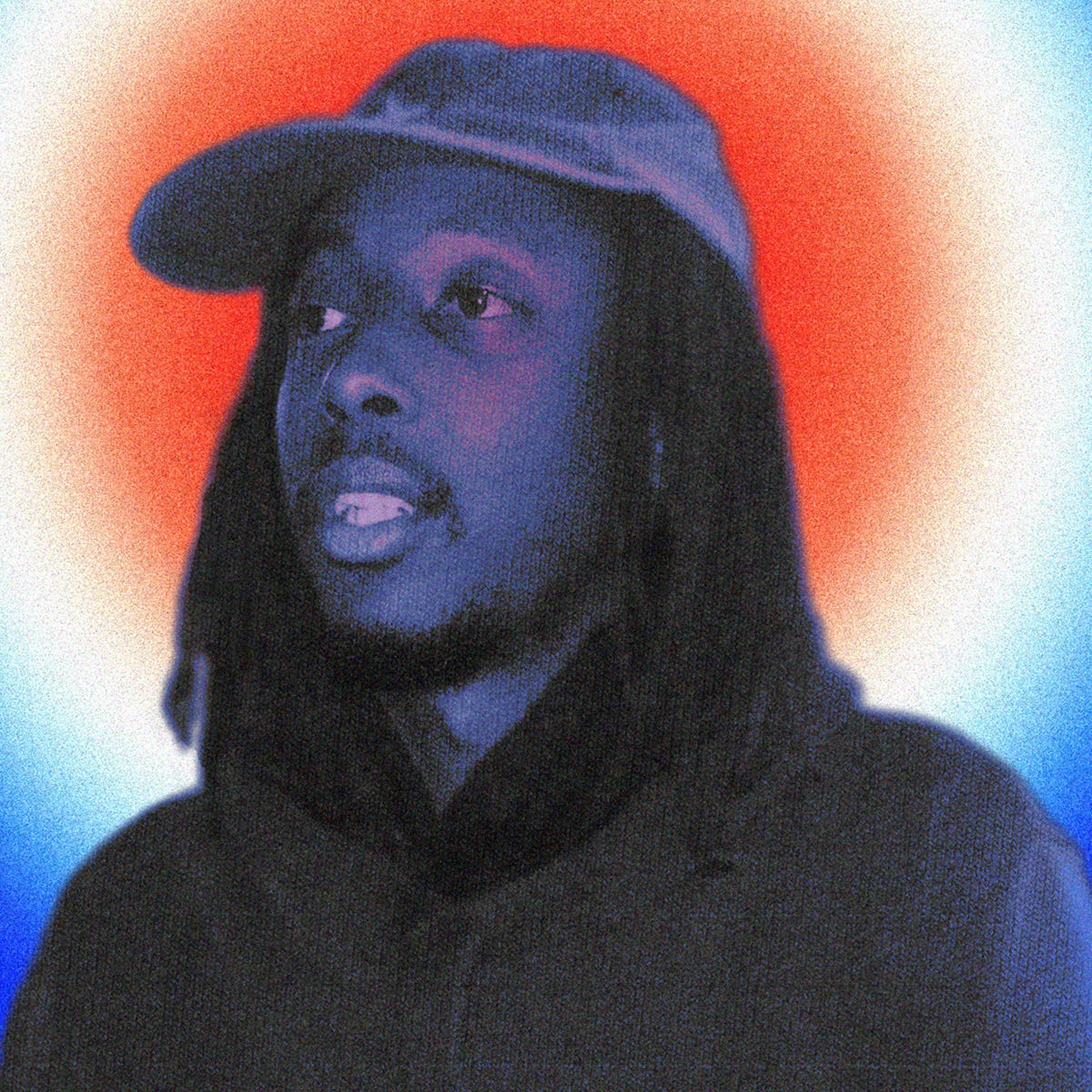
I had finally found out how to contact him. It had been three days since I learned the concussive news that masked ICE agents had swarmed my brother-in-music, Frankie Jax No Mad, outside his home. As if it were the same thing as paying for parking or ordering lunch from my couch, there was an app I had to download to get ahold of detainees at the Northwest ICE Processing Center, where he was in custody following a warrantless arrest. I did so; filling out a login, providing a photo ID, transferring funds to add communication minutes, and submitting the request for an online visit. Then I watched it remain pending for two hours.
About 72 hours prior, as I sat in the ever-swollen traffic of the 110-S, on the way home from a family friend’s celebration of life, my close collaborator and confidant nahhphet first called me to inform me of the crisis that befell (or the state threw upon) our mutual homie. At the time the only thing else that was known was of his detention somewhere in Tacoma, Washington. As I would learn later, Frankie Jax No Mad, née Baraka Njenga, had been leaving his apartment in East Portland with his partner Bailey to get groceries for the weekend, when a car blocked the driveway apron separating the parking lot’s sidewalk from the street. Thinking it was an unaware or entitled driver, they put their Toyota in reverse, only to be met with another car blocking their rear. When the masked men burst from their vehicles on either side and immediately began yelling for Baraka to exit or face a smashed window, he acquiesced to their threats and filed into the backseat of their unmarked vehicle, ultimately headed just over the Washington state line.
At the start of 2025 he had moved to Portland, Oregon after 10 years in Los Angeles, when the high cost of living for the Kenyan-born rapper-producer, event curator, and label head had become untenable. In fact, until last October his extra clothes, video game consoles, and artistic and creative impedimenta were still stored in my garage as he found his bearings in his new city. So that fall we decided to coordinate a west coast tour with our friend Rich Jones, with the express goal of ending in L.A. to enable Baraka to retrieve his belongings. Indeed, following the success of that artistic and logical sojourn we made, it seemed that he was finally settled in the Pacific Northwest, having landed in an artistic community where he was set to make as much of a mark as he had in Los Angeles.
Until last week, with all its surreal and plangent surprise.
I first met his gangly self in 2018, under the low lights of Silver Lake’s Cha Cha Lounge, a bar around the corner from where I lived as a preteen. A mutual friend introduced us; I remember Baraka walking across the sticky floor toward me, extending a dap, and telling me how much he liked my music. I met his hand with mine and looked at his baby face with two thoughts in my head: One, This guy’s lying. No one listens to my music, and two, He’s definitely underage.
But I was wrong: He had listened to my music, immediately asking me to play his event series later that month; and he was only two years younger than I was in those pre-COVID days marking my mid-20s. Eventually, I learned of his fledgling days, like being an 18-year-old on a student visa at the Musician’s Institute in the 2010s, moonlighting with his rap mate Apollo Naps in the pay-to-play ticket sale okie doke that is the rite of passage of every local rapper. Indeed he had cut his teeth as I had: in the margins of the margins. Those were times when, in the wake of Low End Theory’s shuttering, events like his Not Evil showcases, the long running Leimert-based Bananas monthly, and the occasional mixed genre bill, loosely held the rap scene together, with all of us relying on a lot of duct tape, glue, and musical ingenuity to keep an organic, alternative underground rap ecology alive. Immediately I recognized his penchant for dredging the streets of the L.A. basin for names and talents completely unbeknownst to me; and immediately we became friends.
During his time in L.A. he expertly filled the vacuum of DIY rap shows with his Not Evil residencies at venues like Coaxial Arts, The Stowaway, The Love Song Bar, and Human Resources Gallery. He expanded his Not Evil Records and its roster of left-field L.A. rappers and producers, at one time having a years-long partnership with Alpha Pup Records. And even from Portland he continued his Dublab DJ residency, with his particular crate-digging, artist-platforming magnanimity front and center. Yes, in this city he was an east African pylon of the arts, putting money in the coin purses of many a local artist (myself included), while continuing to stand solidly upright on the infirm ground of our many potholes (even as solid income and employment was shaky for an immigrant in one of the nation’s most expensive cities). But I knew why he wanted to take his talents to Portland.
Sitting there on Sunday May 17th, a day removed from the public announcement of his detainment by the Trump regime’s dollar store brown shirts, I waited to hear his voice, refreshing the Getting Out web page and then the app to my pending online visit request. The fourth seed Cleveland was blowing out the top-seeded Detroit in a second round Google-sponsored NBA playoff game 7 on Amazon Prime. That proved no distraction from the for-profit communication interface that bid me wait. I checked the GoFundMe his partner had started to help inform the general public of his incarceration, and saw the donations pouring in. Although some had been answered, questions remained. However abducted by the Amazon-Web-Services-and-Google-Sponsored ICE agents he had been, Baraka had thankfully not been impossible to find, disappeared, or worse (as many have unfortunately been in ICE custody). Still, there was no news of a hearing or charges brought against him.
I was one of legion who wondered exactly what state he would be in.
The first thing he asked me through the garble of the Northwest ICE Processing Center phone was “How was tour?” No, not even the illegal, roving outfits of Immigration and Customs Enforcement lackeys who had preyed upon him could sway his art-first M.O. A bit incredulous at his initial words, I nonetheless told him about my first time performing internationally with Open Mike Eagle, and I could hear in his responses his tell-tale tendency to relish in the successes of others. However, there was a bitter taste to regaling tales of my artful travels while he sat two states north in detention.
He said the facility felt safe and not outwardly violent, that he was simply unoccupied in feeling the long stretches of time go by, and that with his fast metabolism he needed to make sure he ate enough at the meal times. And as a matter of fact he did that then and there. It was funny, after days of waiting to hear from him, I did not expect him to hang up on me and tell me he’d call back after dinner. But he did just that, and shortly after we resumed our conversation. Whether in tacit acknowledgement of the surveillance undergirding our call, or his real feelings of the best of his circumstance, his infectious positivity continued to warble through my speakerphone, even as he recounted how masked agents had bum-rushed him a few days before, in what had all the signs of a targeted operation.
As I write this and word spreads of his story, with musical luminaries such as Quelle Chris, Daddy Kev, and Mike Eagle adding visibility to this injustice, he remains in custody at the Northwest ICE Processing Center. To my knowledge, he awaits a hearing scheduled on the 28th of May. Even in his good spirits (sending me messages about a bizarre FM radio station he managed to find on his radio or reading Murakami’s Colorless Tsukuru Tazaki in the facility’s library), it remains to be seen what further proceedings will take place and how much of the increasing donations in his name will be sufficient to cover legal fees, money for his commissary, and the costs of his absence from his new home. For his new life in Portland with its vibrant DIY rap and beat scene is put on hold, with his cat, his apartment, and his music equipment needing stewardship for however long the state sees fit to run its opaque impedance of the head of Not Evil.
Though we are in a quieter phase of this administration’s previously bombastic ICE invasions (such as the L.A. incursion I wrote about last year, or the “Operation Metro Surge” in Minneapolis which resulted in two dead civilians, in addition to the man killed in L.A.), it is estimated that ICE still continues to arrest 900 people each day, with arrest and detention quotas remaining in (their deranged) place. Baraka Njenga, professionally known as Frankie Jax No Mad, is one of the countless people still being arrested without warrants or officer identification, one of many individuals ultimately transferred to be detained for indefinite periods in facilities like the one in Tacoma, Washington (or those with much worse conditions).
This is the story of one instance, very close to home, an unfortunate battery in the back of everyone close to the charismatic Kenyan multi-hyphenate, charging us with the energy to mobilize our artistic network, its knowledge of legal resources—and, in the end, our money to seek his release. As I forewarned in my previous writing about Trump’s illegal deployments of troops to enforce ICE’s actions, I suggested that “[e]veryone would have to take things personally, whether or not they wanted to, whether or not harm touched them today or tomorrow or the next day.” I think in my community we finally are, but it feels as if we still need something more than our pool of resources and voices in these compromised social media algorithms.
ICE’s assault on law-abiding immigrants and citizens is not some incidental sum of moral quandaries; it is the terminus of our presidential accelerationist-in-chief, who has wiped away the polite veneer of a government that has spent decades spouting bipartisan platitudes about democracy and human rights and the preciousness of an international rules-based order, all while violating them at home and abroad.
Yet in the face of this hypocrisy, people like Baraka Njenga have chosen and continue to choose to make a life here, contributing vitally to the culture of a city known the world over for its leftward hip-hop. He has given the invaluable gift of art to all of us, and we are giving back our love and what we can materially muster up to challenge the most vicious articulation of unchecked state power. We all know as he raps on “NO RELATION” that it’s “not just hype” and Frankie will be “back like Frankenstein with a lightning strike”; that his story will not merely be a cautionary tale; that we are giving everything we can while still hoping for true sea change for all those subject to these American-made calamities.
If you are able, please donate to Frankie’s GoFundMe.

Fuck Donald Trump
Fuck all these Republicans and fuck Trump voters too.