

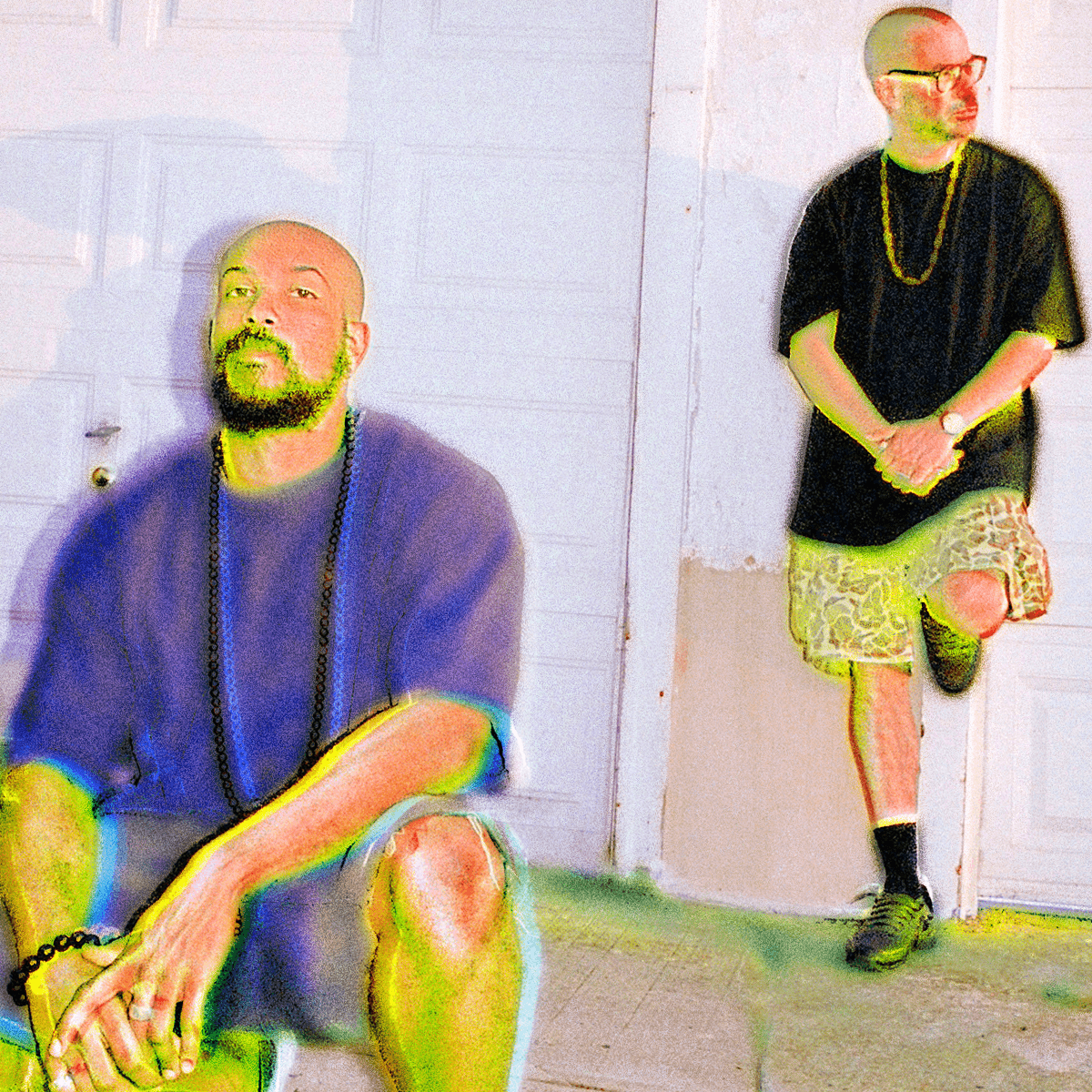
Art by Evan Solano
Son Raw might blow up but he won’t go pop.
I first met White Plains NY-via-everywhere rapper Gabe Nandez at his homie’s crib on Montreal’s Saint-Laurent Boulevard in 2015. We immediately connected over hip-hop, living around the world, and how he’d ended up in my hometown. This was the era when MTL was really coming into its own in terms of beat culture and English language hip-hop, and I thought Gabe was the illest cat I’d ever heard locally. DJing around town and trying to push the city’s nascent rap scene, I’d hung out on a lot of couches next to a lot of aspiring rappers, but this was one of the rare cases where I thought we’d got one: a real talent that could break through the noise of the late blog era. Little did I know that he’d smash through that local Montreal ceiling almost immediately, re-centering himself in his true home of NYC to impact underground hip-hop’s ground zero.
In the decade since our first connect, Gabe has built an incredible catalog of rap music, from the trap-meets-beatless fusion of Diplomacy to the rhythmically intense Seven, to a new school flip on the soul beats of last year’s False Profit. Smart and reflective but also hard-hitting and roughneck in equal measure, Gabe’s is a body of work that’s grounded in personal experience without ever losing sight of rap’s hardcore roots. Now, in his biggest look yet, he’s teamed up with underground legend Preservation for Sortilège, a collaborative album for Backwoodz Studioz. It’s the sharpest distillation of Gabe’s vision yet: winding and discursive, and as impactful as a roundhouse kick. Preservation’s beats offer the richest canvas for Gabe’s rhymes to date.
Preservation has been a major contributor to the current underground hip-hop boom in his own right, thanks to his focus on internationally-sourced samples, drums that hit low in the mix and a cinematic emphasis on texture and grit over upfront melodies. Starting out with ’90s experimentalists Sonic Sum, Pres has built a career providing tailor made beats for some of hip-hop’s most iconoclastic artists, from Yaasin Bey (FKA Mos Def) to Mach-Hommy to billy woods to an extended collaboration with Brownsville’s Ka (Rest in Power) as Dr. Yen Lo.
Both Pres and Gabe are well-travelled artists at the vanguard of hip-hop. They’re cats able to take rap into dynamic new spaces without ever losing sight of what makes the genre so special and how its origins provide a road map for the music’s future. The duo aren’t just rapping and making beats for a living: they’re intimately tapped into hip-hop’s subterranean zeitgeist. As such, Sortilège is a record in conversation with the scene’s longstanding innovators: Marci, woods, and Earl. And still, the album remains deeply personal, a travelogue by two men with a duffle bag’s worth of stamped-out, tattered-up passports.
Ahead of the album’s release, we chopped it up about everything from Muay Thai to The Lox, Backwoodz to bangers, Sortilège’s place in the catalog and how to balance go-for-broke bars with more conceptual joints.
(This interview has been condensed and lightly edited for clarity.)
Usually, I'd ask what made you guys connect, but as a listener, it felt pretty clear to me. You both have a passion for underground East Coast hip-hop, but parsed through a very international, multicultural and multilingual lens.
Preservation: I didn't know about Gabe until woods brought him onto Aethiopes. He played me something and I went, “oh, he's dope.” We worked out that track, spoke on the phone once or twice, but then he came through to the Aethiopes release show. I was in NYC DJing with Deadly Dragon and Gabe came through on the humble. So, I sent him some music and he sent it right back. That’s always the key to opening the door. If someone’s sending back stuff immediately, it’s serious. So, then I sent more, he sent it right back again, and then he came down to New Orleans. That's where we really got the bulk of the record done. It was pretty much finished last summer, 2024, and then, we touched it up early this year.
Were you mostly recording together?
Gabe 'Nandez: Nah. I started recording in New York and had sent a good amount of joints before I came through to New Orleans. It was maybe a year after that link up, I think. When I was down there, we didn't record anything, we just kicked it. Made beats, spoke, just building.
Preservation: Putting songs together and ideas.
Gabe 'Nandez: But when I came back to New York, I recorded the rest of it.
I feel traditionally, when people used to make albums, just because of the limitations of studio time, it had to be done quick. Then you had that era where everyone was just sending MP3s. But now, a lot of artists I've been speaking to like hitting that best of both worlds situation: you connect in person, but then have the time and the space to craft each side without having a time pressure.
Preservation: I think I always like creating something together at some point. If it can't be the whole thing, which is sometimes difficult, especially when you're in different cities, at least a little connect, person to person. Because you're really able to feed off each other as far as ideas. So, if there's a little of that, I think you can really tell the difference. With woods [on Aethiopes], we weren't really able to do that because it was still coming out of the pandemic. We were in the same city, but it was harder at that point. But we were still having a lot of communication, every day: hashing out ideas. It wasn't just me sending him something and him sending it back. But yeah, I'd rather have some kind of meetup at some point. It makes a world of difference on the record.
For Sortilège, I really like the album, but it's a little challenging to speak on because it's not as if each song has one single theme, in most cases. But there are a lot of ideas that come back both musically and through the bars. When you guys were figuring out what this record was going to be for you, what were some of the things you were discussing?
Gabe 'Nandez: Really in terms of the thematics, I don't remember having a conversation ever... Actually, wait–that's not true at all [laughs]. “Muay Sok,” for example, Pres was like: “Oh, you train Muay Thai. Right? You should write a song about that shit.” And I was like, damn, I should. So that's one of the more focused tracks thematically and that was definitely workshopped.
But then the tracks that feel more [the opposite], some of those I had recorded before that trip to NOLA. I was just sending him shit back and trying to make sure it was dope. That's all I was really thinking about: let me make sure I'm spitting, which I always do, but for me, the stakes were higher here, in a good way. I just felt that instinctively, I had a fire to really show up. My writing style is very much like that. It's very much themes, generally speaking, more so than “this song is about this.” It's interesting you say that, though, because one of the first ideas I had for the title of this record was Proverbs. Not in the biblical sense, but in the sense that these felt like reflections, psalms, timepieces. I really feel like this record, through my journey, is like a stamp. It’s the culmination of the journey I've had through writing on different projects.
Preservation: I think, as a producer, it's important to see what the artist wants to talk about. Here, Gabe was like: “I want beats and I wanna spit!” So, aiight, let's do that. Also, let's try to maybe hit some topics. I think storytelling is important as far as a whole piece. I think it's a lost art. Not to reference Aethiopes again, but woods in the middle of making it, we were making songs and he hashed out the idea of the whole. Then I started giving him [beats] that gave him those canvases to be able to speak to what he wanted to talk about. Here, it was more individual. I was going through Thai 45s, and a lot of the ideas like “Ball & Chain” came out because of what the track inspired. We put it together in a way that’s like a book. It tells different chapters in his life.
Coming out of Aethiopes, which had a very defined vision, how does it feel to start over again and figure out what’s next for you?
Preservation: It's always gonna be its own thing, but Gabe and I spoke about it. There is definitely a connection with Aethiopes, because we met through it, he was on it, and it has certain sonics in common [with Sortilège]. I feel like woods and Gabe do have a slight similarity in their backgrounds, their travel, how they’ve lived in different places. So that kind of influences some of the sounds that I might bring to the table. I know Gabe’s got roots in Haiti and so there was a track that didn't make the record, pulling from those crates. I like to kind of go all around the world, pulling things. I was looking for [records] that were from Mali. I think it felt like a continuation, but it's a different person so it's a different record. I wasn't trying to make some kind of partner for that album. But it did have a feel. Right? We even spoke about it. I don't know if you guys wanna add on to that, Gabe?
Gabe 'Nandez: It's true. It’s like a distant cousin. Even two of the beats that are on this album were gonna be on Aethiopes. “Spire” and “Lotus Flower.”
Preservation: Well, “Lotus Flower” no. They're kind of from the same source, but two different beats. woods picked “No Hard Feelings” instead. “Spire,” he was really considering.
https://www.youtube.com/watch?v=7j_Y3wx0O7Y&list=RD7j_Y3wx0O7Y&start_radio=1