


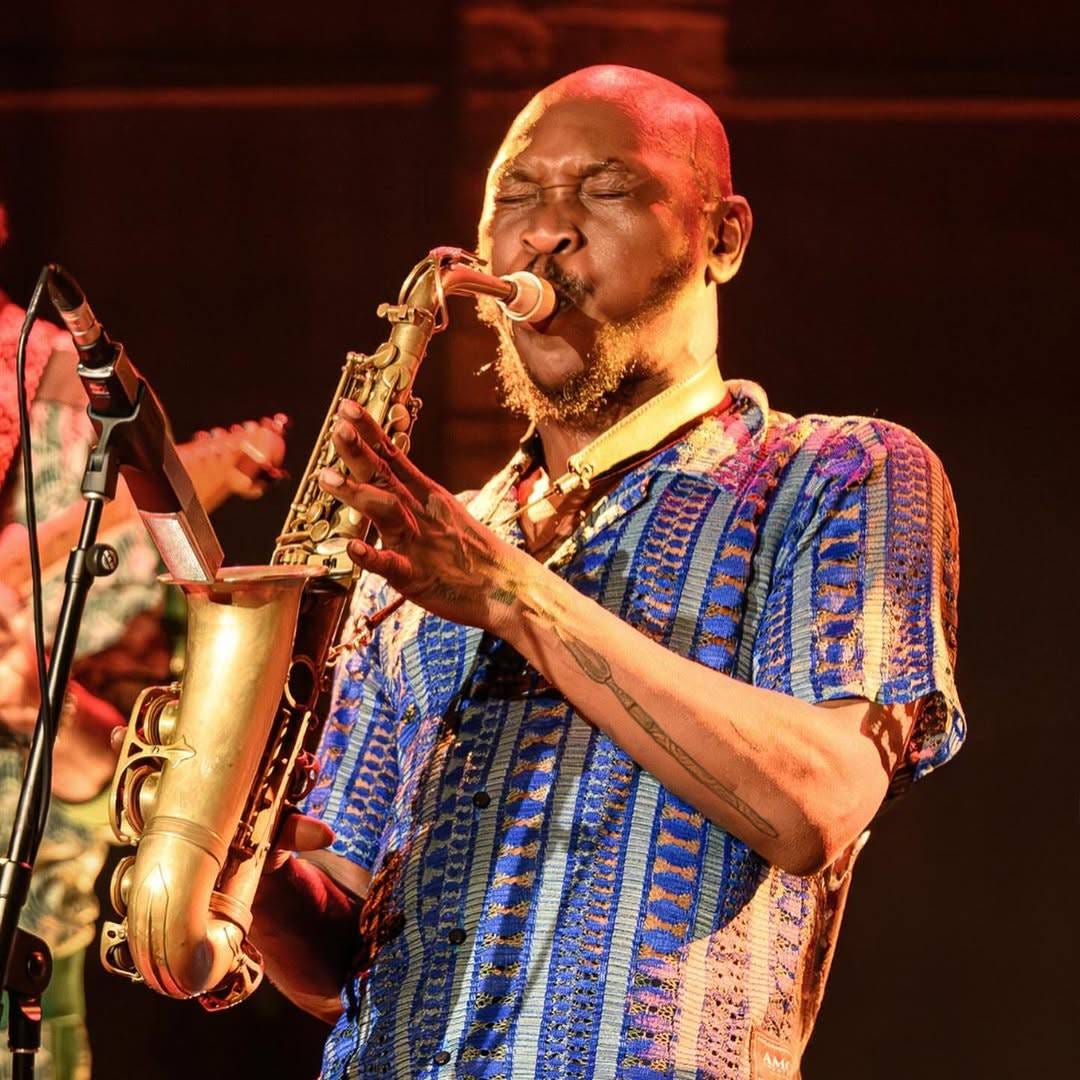
Image via Dave Specter
When the music world lost Fela Kuti nearly three decades ago, over a million people packed the streets of Lagos to celebrate his genius. Eventually, the coffin wended its way to the New Afrika Shrine where family and friends paid their final farewell. The event would also spark the patrilineal succession from Fela to his youngest son Seun, who became the head of his legendary band, Egypt 80.
At just 14, Seun took the reins of the greatest Afro-beat collective ever assembled (their only rivals being Fela’s earlier Africa ’70 outfit). By then, Seun was already considered a seasoned performer, having shared the stage with Fela since his pre-adolescence. You can find footage of a 7-year old Seun being introduced at Afrika Shrine by Nigerian activist Femi Falana for Fela’s album launch for Confusion Break Bones in 1990.
Egypt 80 (fka Koola Lobitos, Nigeria 70, and Africa 70) released four records under Fela but has since put out several others, including Many Things (2008), From Africa With Fury: Rise (2011), Black Times (2018), and Heavier Yet (Lays The Crownless Head) (2024). The band is well-known for their unforgettable, high-energy performances underpinned by a blend of jazz, funk, highlife, and rock.
Last year, Seun Kuti & Egypt 80 put out Heavier Yet (Lays The Crownless Head), executive produced by another artist known for blending music genres, Lenny Kravitz (via Milan-based independent label Record Kicks). The record’s six tracks showcase Seun’s dedication to preserving his father’s legacy and his transformation as an artist/activist. “T.O.P,” for instance, stands for “Things Over People” and calls attention to how society values money and success over its people.
In late 2020, Seun resurrected his father’s socialist political party, the Movement of the People, to enact change in his family’s home country of Nigeria. And even more recently, Seun has voiced his frustrations with the global class struggle, and how the elites continue to put pressure on the divide between the working class and the underprivileged around the world.
On Heavier Yet (Deluxe Edition), Seun Kuti & Egypt 80 tap into the energy generated by the first record, amplifying Seun’s strong sense of responsibility to his country and its people. In keeping with his father’s approach to developing a shared language through mutual understanding, Seun connected with a number of politically outspoken artists featured on the deluxe edition, including Kamasi Washington, Posdnuous of De La Soul, and French-Caribbean multihyphenate Adi Oasis. The album contains both original and reimagined cuts, each of which convey the importance of resilience within revolution while cautioning those who side with the Afrobeat movement against the dangers of compliance and getting caught up in the political maze with no exit.
While zipping across time zones in the US on a massive tour with stops at Coachella and the New Orleans Jazz & Heritage Festival, Seun took a few moments to relax and chat with me over a Zoom call where he spoke passionately about his father and what his time with Egypt 80 has meant to him both as an artist but also as the son of such a renowned figure in Nigeria’s musical and political history. – Lara Gamble
As the youngest son of Fela Kuti, who is regarded as the genre's original architect, what is your earliest memory of Afrobeats?
Seun Kuti: Wow! My earliest memory has to be watching my dad play at The Shrine. You know, the energy of the room, being there. That has to be like the earliest memories I have of the music itself.
How old were you around that time?
Seun Kuti: Probably like 5 or 6. I just remember going to The Shrine with my mom and watching them perform. By the time I was 8, I was already on stage, as well. So, it all stemmed from that.
You’d already entered the formal ranks of Egypt 80 at the young age of 8, so it should come as no surprise that, in fulfillment of your father's wishes, you took on the role of leader at 14 after his passing. Did you feel prepared to take on this role at the time, and was it something you wanted?
Seun Kuti: No, not really. You know, it wasn’t in fulfillment of his wishes. People always say that. It wasn't a ‘wanted’ kind of thing or even prepared. I’d just always been in the band. When my dad died, I just felt like what I could do for him was to keep the band alive because I knew, when he was alive, his band was very important to him. In fact, he’d say his band was the most important thing to him in the world. And my dad was such a great dad to me. It was a way for me to just honor his memory.
I didn’t even know that it would be all what it is today. I just kept playing with the band. It wasn't really about taking over. I just wanted to play with the band and keep the band going, you know. And that was the energy. The people that stayed to play the music - that's the energy we had. It was just a way for all of us that respected and honored Fela so much when he was alive to do something for him in return, even if it was after his passing. I feel like, for once, he needed me.
How has the group’s sound evolved under your leadership in years since?
Seun Kuti: I wouldn't say that I’d put a finger on the how, but I know it has been a process of my own development as a musician and also my growth as a human. I always want my art to reflect where I am at that point in my life - my musicianship and my humanity. I want those two things to be what is really projected from every album I make.
Egypt 80 played four back-to-back shows last month at the Blue Note Jazz Club in NYC as part of a massive US tour that included stops at Coachella and the New Orleans Jazz and Heritage Festival. Are you pleased with the response to your new material?
Seun Kuti: Of course, it's been great. It’s been more than I expected. We played in LA last night, and it was sold out. Everyone has been showing us a lot of love and energy and passion. I don't know how to say thank you to all the fans that have come out so far on this tour. It's been really overwhelming for me to see all the support. Yeah, that's the word I was looking for - to see all the support for the music, for me, for the band. It's an exciting time.
Your set at Coachella this past weekend was labeled a “legendary performance” where you opened with “Everything Scatter,” a hit song recorded by your father. How does it feel to still uphold his legacy on stage in front of thousands after all these years?
Seun Kuti: Well, I think it's because I'm his son that it seems like something special I do, but there are thousands of bands that play my father's music. They open with it, they close with it. Fela is a well-referenced musician, even outside of our genre. Artists sample and use his music. I think, because he is my father, I have to always have that honor and regard and respect for him on a personal level.
But I think I also do it from a musician's perspective, to cover a master as a performer. It's something most great bands do to pay homage to a master of the genre. For me, it's more than just him being my father. I’m just in sheer awe of the man's musicianship, but I still play his music, so that the world can hear and experience this shit.
Last month, you shared "Stand Well Well (Grand Stand Version),” a reimagined interpretation of a standout track on the Lenny Kravitz-produced album Heavier Yet (Lays The Crownless Head). How did the collaboration with you and Pos of De La Soul come to fruition?
Seun Kuti: Oh, well, it has been a long time coming since I met him a long time ago in New Zealand. I met the group. I know when I said ‘New’ that you were expecting New York. But we've always been in touch, even when we did the experimental Fela Soul project….I've always had an affinity towards the group, even as a kid. De La Soul's music was something I grew up listening to. I think I'm one of the few people that know that ‘posdnuos’ is ‘sound sop’ spelled backwards.
Sound sop. Yup.
Seun Kuti: Hey! What's up? You know.
De La Soul is one of my all time. Their 25th Anniversary show at Irving Plaza in 2014 remains the greatest live show I’ve ever attended.
Seun Kuti: They are really great, so I've always had that affinity for the band. It's interesting to have the opportunity to make music with Pos. When I spoke to him about the idea, he was like, “Okay, call me, man.” I had just talked to him about music, so I sent him the music instead. And he was like, “Yeah, I get you, man. I get you. I see what you're doing.” And we just went from there. He sent a verse, and we did the rest. I want to use this opportunity to say, “Big up” to the man. He was really graceful about everything.
What was the vibe like touring with Lenny in Europe earlier this year?
Seun Kuti: That I need to do whatever he is doing when I’m 60. Whatever he’s on is what I want to be on when I'm 60. That’s all.
You and Adesuwa Aighewi joined Santigold on her Noble Champions podcast to discuss Nigeria’s political landscape and explored what actual transformation of the systems redefining Black realities could look like. During the interview, you said, “A nation cannot grow above the consciousness of its people.” Why do you think, even in the year 2025, so many of us cannot grasp the importance of unity in diversity?
Seun Kuti: Well, I don't think a lot of us cannot grasp it. It's only a certain group of people that cannot grasp it, and they tend to be rich, powerful, and white. So, I don't think it's everybody, most people, or anything like that. Most of us can understand that. That's the life we live every day. But, you know, they can be alienated and disconnected to the level of self-alienation from their own human experience.
I don't think the majority of people can afford to live like that. So, we experience unity and diversity all the time. It’s how we can exist. It’s how we can eat. It's how we can buy anything in stores. It's how we transport ourselves. It's how we work. It's how we make a living. You can't afford this madness that the elites can afford.
I think there's also a lack of political education and awareness. It is a concerted effort on people who have been politically educated. It's a global thing to dumb down the population, and this is what you get. You know, fascism is the immune system of capitalism. Also, the fact that the right wing is so strong globally shows that the people are waking up.
So, it's a double-edged sword. The power of politics and the politicians are different from the power of the people. I think with their power they can get the Trumps and the Bolsonaros and this madman now in Argentina, and the Putins. All these mad people.
It is different from the power that people are about to wield. I think what we are seeing now is an education on how not to be. And if anything, I believe humanity is lessened by a lot of these yahoos, out of the motherfucking RSF in Sudan, Kagame in Rwanda and the Congo. I can go on and on. The list is endless.
I think humanity is just going through a learning curve. We are going through a preparation to see how not to be, to see what could be, and we can understand the importance of being our best self. This is the lesson of this epoch, the lesson of this age. Every nation in the world is seeing a true reflection of itself, so it can know how not to be.