

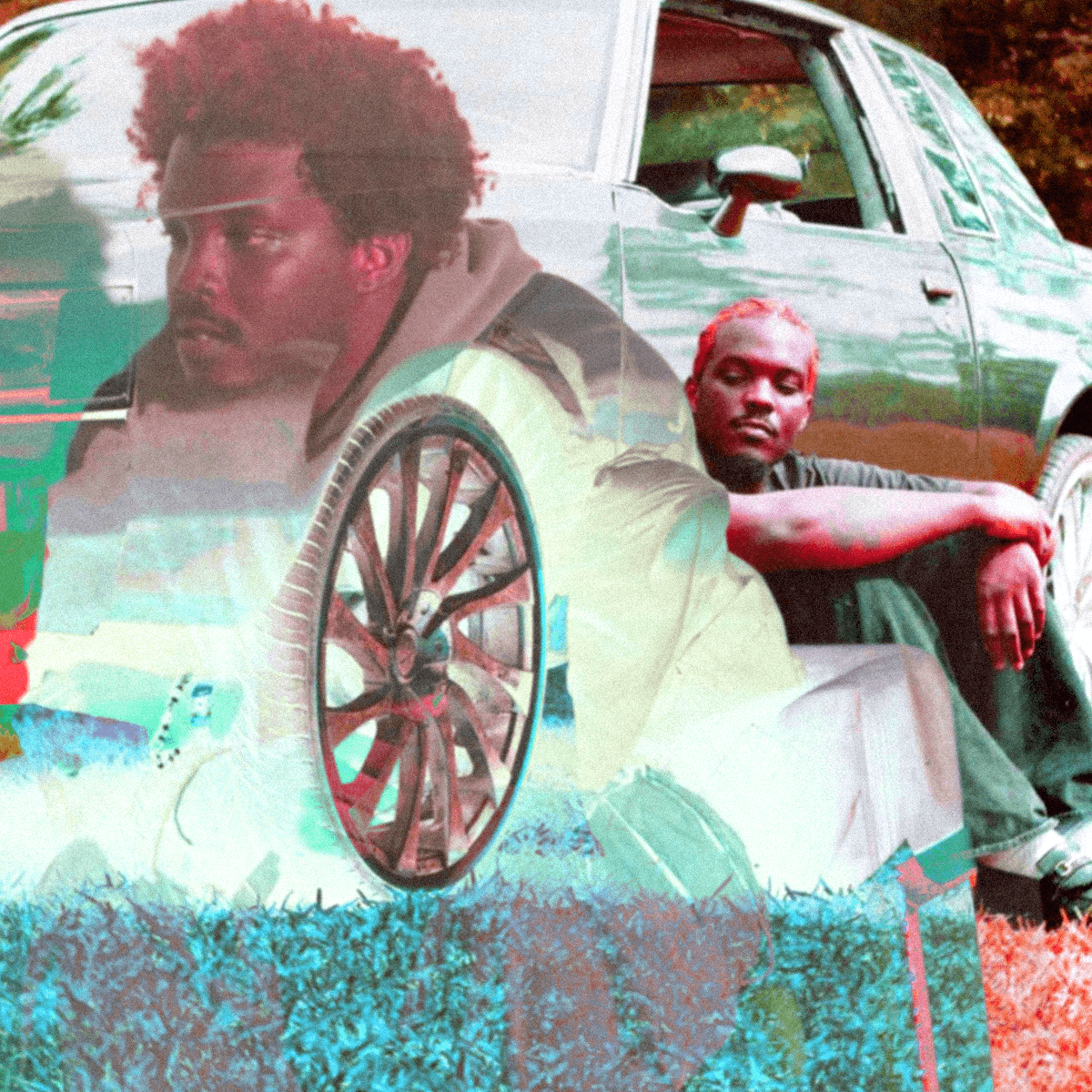
Art via Evan Solano
Ant shall bring disaster to evil factors.
For what feels like forever, Bronson Israel Jones has been biding his time in the sticks of North Florida, detached from the eyes of the entertainment industry, training for his moment. Testifying over soul samples chopped, screwed, and overlayed with the blues just like momma used to make, Israel Jones’ newest album, Go With God isn’t just one of the best rap records you haven’t heard this year, it’s a studied dedication to the storied Southern culture that molded him.
In Jones’ mind, culture is found in the organ swells of Ridin’ Dirty, the technicolor skies backdropping 454’s swampy citrus raps, the glint of countless gold teeth. It’s a distinctly black Southern culture that’s been pimped and paraded to the masses for generations, watered down to its easiest to replicate ideas for C-Suite reptiles looking to stay warm in a pile of cash. The South and Jones alike have always had “something to say,” but getting people to hear and respect the more profound thoughts comes with fighting through the noise of greed and copycats. For Jones, protecting this culture became a responsibility, one he’s trained to uphold his entire life.
At five-years-old his parents’ eyes lit up as he held performances of original songs in their living room. Come high school, rap battles both online and in the physical became crucial sparring sessions, building an obsession with language and how to weaponize it. When he entered poetry circles as a young adult, the weight and starkness of the real world was transmuted from soul crushing to empowering with every couplet.
Looking back on this incubation period, Israel gleams, speaking of how his art has evolved. “At first I had no substance, but once I got it, I was addicted to it,” later adding, “it’s grown into this tree of therapy, not just for me but it lets me act as a vessel for others. I can speak for myself, my community, my family, whatever is on my heart. I feel like an alchemist in that sense to take things in real life whether it is from five or 15 minutes ago and turn it into lyrics.”
Dozens of artist showcases, countless bedroom studio sessions, a label with college buddies turned family, and a myriad of projects, solo and collaborative, were born from his artistic curiosities: Knee Deep, Blacc Boys Don’t Cry, The Sun Shines On Us All, Bigga Purpose EP, Good Time!, Safe + Sound EP, Feels Like Forever. Each is a labor of love transported to you live from a muggy nowhere zone, a flyover space where hearts still beat and many stories could have been left unsung. Jones had become the conduit for these sacred tales; every verse represents a slice not just of his life, but every soul in his homeland served raw and uncut.
Over the course of his newest LP, Go With God, that sense of duty to put on for the people and culture of his beloved corner of the country is executed with biting calls for respect, shoutouts to Trick Daddy and Aphrodite, and a distinct vision of love and growth all his own.
“Get Free!” is a daring rewire of UGK’s “Diamonds & Wood” into a sparky acceptance of life’s waves, jittering at a frequency Pimp C would never dare hit for the risk of creasing his gators. “On Behalf Of The South” is a combative sketch of the cultural influence and the bastardization of the 3rd Coast’s many creations that challenges Common’s “I Used To Love H.E.R.” for rap’s greatest personification. Plus, the soothing poetic side gets room to stretch out on “Got My Heart,” an intimate idyll to women everywhere (though Georgia, Texas, and Florida women hold a special place) cruising through your speakers at 2MPH.
But preaching to the choir could only get him so far: “I felt like there was nothing left for me to do back home. I’ve accomplished everything I could do in Gainesville. The scene is monopolized by greedy people. Tallahassee, I did everything there. It was time for a new chapter. On ‘Get Free!’ when I say ‘I’m so tired of the South,’ like yeah, I’m tired of living here, but also I’ve done it all.”
Go With God doubled as Jones' love letter and hearty goodbye to the South before migrating to the Northeast so his down-home gospel could hit more ears. As he floats through newfound industry circles, guest speaking at colleges and linking up with other Southern transplants in The Big Apple, the passion never ends, just shifts into expansion.
Over the course of an hour, I was lucky enough to Facetime Jones and speak about his story so far, classic Dirty South LP’s, and his creative process.
https://open.spotify.com/album/2MjZyxK02A2XuQ66aTLQT1
I read you grew up in Gainesville, did you live there your whole life?
Israel Jones: These days I just say I’m from North Florida. I went to high school in Gainesville, but my family’s from Starke, FL which is a small town, and I really lived in Waldo, FL which is an even smaller town. I went to college at FAMU so people think I’m from Tallahassee, and I just don’t disagree. If they say Gainesville, same thing. Depends on who I’m talking to.
How long were you at FAMU for?
Israel Jones: From 2018 to 2023. I was supposed to graduate in 2022, but if I did I never would have met the rest of Brick Road. It’s kind of destiny.
How did Brick Road Records come about?
Israel Jones: I met Giahni [Bosquet] at a listening party I was holding at my crib for a mutual friend. We hit it off, and were just casual friends over the course of a year and some change. Every time we’d see each other around it was dope, he’d always give me song recommendations, show me beats, that kind of stuff. The first time my music was ever played on the radio actually was thanks to him. He asked me to send him a song because he was up at the student radio station.
When you make music with rappers though you get used to the, “Oh man, we gonna work! We gonna work!” but at the top of 2023 we finally got together to make music. We immediately became real friends in that process, and later he invited me to a video shoot, which is also how I met Derrick [Taylor]. Literally the next day after the shoot we met Trent, and it was on. It’s kind of a fairy tale the way everything came together.
What birthed the name Brick Road Records?
Israel Jones: We went through so many phases. Derrick really came up with it, off some Yellow Brick Road, magical, destiny thing. Plus it just sounded good off the tongue. It really came from Derrick's mind.
When I go back to your solo stuff before the Brick Road project, I hear something very raw and vulnerable. Is that therapeutic aspect of making music what drew you to rapping in the first place?
Israel Jones: I’ve always been rapping, since I was like five. BS’ing around remixing my favorite songs so my family would sing along. It wasn’t until I was 11 or 12 did I start recording. From 11 to 17 it was all battle rap and Lil Wayne inspired. All punchlines, trying to be the best rappers. It wasn’t until my senior year of high school did I start going through things and maturing a little bit. I started adding substance and it became therapeutic.
By incorporating friends, family, relationships, all that life into your songs, do you ever have to deal with blowback in your personal life?
Israel Jones: I don’t know. I’ve matured with my writing so I don’t say names much anymore. I know Drake has always been a big proponent of saying names, and he has this cool interview talking about that where he says like, “Hey, it’s my life. It’s my truth.” I get that, but at the same time if I can say something in a creative way that doesn't give all my business out, I think that’s good writing. Sometimes the best writing is what’s real. I don’t lie or gossip, so sometimes that might come up if you were a part of my life at one point.
And with that honesty comes confidence, which with the battle rap hunger really makes you stick out even amongst your crew, who are all super talented. Is displaying that emotion something that comes natural or is it a conscious choice?
Israel Jones: At first I had no substance, but once I got it, I was addicted to it. I felt I needed every song to be sad. It wasn’t until I was 18 or 19 where I found the balance. It’s something I think that comes with being a better writer. After writing nonstop and finding your voice it gets easier. Sometimes you do need to just rap with no structure though, and I'd tell any rapper that. Just bar up to test your brain and see where you’re at. Even if you’re not doing Lupe Fiasco type raps and you’re out here rapping like Bossman DLow, just rap. Just find bars. But, I know what beats call for better now, so it’s not a problem anymore.
Do you have any authors or other writers that you go to to sharpen your pen?
Israel Jones: I just got done reading The Spook Who Sat Next To The Door by Ivan Dixon. The way he wrote his imaginary and described Chicago? You could really see and feel the cold wind in the city. I’ve been reading Rick Rubin’s book too. What I've been taking from his writing style is how he’s not trying to be an author with big words or be super witty. It’s very straight to the point, and I’ve been trying to add that directness. I love Navy Blue too and he’s the exact opposite, always flipping something simple into something complex. I’ve been listening to a lot of Yasiin Bey lately, 3 Stacks, Kendrick of course. Earl is the fucking king.
Earl’s verses make me burn a whole afternoon on Genius.
Israel Jones: Bro! And the cool thing about Earl, and I’m very similar in this way, is he’ll write sometimes for himself in a way that only he’ll understand. That’s my favorite thing about writing. You as a fan might not understand it, or it might just sound cool, but only I know exactly what’s going on. It’s cool because fans can hear it and pull a whole different meaning.
As you hear your songs back over time, do you find new meaning in them too?
Israel Jones: A lot of my stuff comes from real life, y’know? The things Bronson Jones goes through, Israel Jones writes about. Sometimes I don’t fully understand what I’m writing about at the moment, but I know I need to get it out. I’m not always caught up to what my artist self is writing. Like my artist self might already have the answer, and wrote the answer in a song 3 months ago, but in my real life I'm still doing the same things. Then I'll listen back like, “Damn I wrote the answer months ago.”
It’s like your subconscious speaking to you.
Israel Jones: Exactly. It all comes in time.
What was your goal in creating the Go With God? Were these just the best joints on the hard drive or was this a focused idea?
Israel Jones: At the top of 2024 I wanted to lock in and make the most Southern album ever, because I knew I was about to leave the South. It was like my goodbye. I also feel like we’re missing more regional sounds in rap. For the South to be so dominant in rap, I feel a lot of Southern artists were following a formulaic sound. 15 years ago you had Andre, who didn’t sound like Lil Jon, who didn’t sound like Ludacris, or T.I., or Gucci, but they’re all from Atlanta.
I’d say as a Florida artist, we have that. Luh Tyler, 454, Niontay, me, Doechii, Denzel Curry. I feel like Florida is one of the last places without a defining sound as a group. When I set out to make this, I wanted to make the most Southern album possible, while also showing Florida niggas can rap. That we always could and you gotta pay attention.
I get it, I grew up on Plies and Rick Ross, but we also are lyrically dense. But at the same time I can get on some ghetto shit too. I wanted to find a way to put it all together, and put on for the South as a whole. I got clips from Pimp C, Bun B, Trick Daddy, all on the album. It’s all intentional.
My boy Tris talks about albums that are “In The Clouds.” Like holy grail albums that define a place or time. Like for Atlanta forever it was TM:101, that album was the Holy Spirit for Atlanta for like a decade.
Israel Jones: Like The Chronic for California.
Exactly. Florida has never really had one, in the sense of being all encompassing of everything we got going on. Like Teflon Don? Not really, because if anything I feel like Kodak defines the sound of Florida, yet he’s the opposite of Rick Ross. But, he’s not all encompassing either.
Israel Jones: Yeah Ross doesn’t really sound like Florida. It’s too majestic, or like Atlanta-ish in my mind. Maybe we can go with Port Of Miami, but if anything ours is Institution. I love Rick Ross, he’s probably pound-for-pound the best rapper to come from Florida, even though I love Kodak. Even though I don’t know if we should. *laughs*
I agree with all that. Though I’d say this album, Go With God, is that proper mix. It’s not all glitz like that Miami, Ross, and Khaled sound we’ve been known for, or fully Kodak street music, it has that North Florida country sauce in it, it has pieces of it all.
Israel Jones: That’s for sure intentional. I love South Florida, Broward, all the colors of that. Unless it’s Jacksonville though, nobody cares about North Florida. I say I’m from Gainesville and people laugh, and Gainesville has one of the biggest colleges in the state! Imagine if they saw where I really grew up? The dirt roads, the small rural towns with less than a thousand people. But it’s still Florida. It has a sound, and a heartbeat, and I tried to encompass all that as much as I could.
I saw Thelonious Martin was involved in the album who’s a super legend to me. How did you link up with him?
Israel Jones: My dog Trav [@godbringmepeace] helped executive produce the album with me. He knows him somehow and got Thelonius to listen to my music. He [Thelonius] hit me about a year ago when we were dropping Feels Like Forever, and has been sending me beats since. We got some more music on the way too.
I grew up on Skyzoo, RetcH, G Herbo, Mac Miller, all that, listening to Thelonius without even knowing. It was a moment of “I wouldn’t have these beats if I didn’t deserve them.” It helped reaffirm myself as an artist. I’m supposed to be rapping on these, and that I needed to start carrying myself like that too. Definitely a bucket list moment.
You have a small list of collaborators on Go With God. What’s your mentality when it comes to collaboration?
Israel Jones: I’d love to work with more people, but I’ve always just been this way. Especially on my albums because I’m following a storyline. You can see the evolution from project to project, song to song. I’m trying to tell a story in chronological order. Some people listen casually and think “Oh he’s good at just aligning these tracks” when I’m really following a story in my mind.
It’s hard to trust a rapper I don’t know to execute on that story. When you see someone rapping on one of my albums, it’s typically someone close to me. Someone I don’t gotta explain too much to. I’d love to open up and collaborate more, but we’ll see.
You’ve spoken a lot about having this tight, family and community of people. Is that something you’ve always sought out or was it natural?
Israel Jones: It’s something that was really gifted to me. I was a loner in doing music alone for a long time, and that’s really hard. As much as we praise independence, hustle culture and doing everything by yourself, it’s hard. To do a whole album, writing, recording, releasing, visuals all that is tough. I was gifted this found family, and ever since I’ve been cherishing and pouring into it. I remember how hard it was before that, how much better it is now.
You’ve been doing music for so long, since you could talk pretty much. Is your family back home supportive too?
Israel Jones: My mom got my posters in her room. She knows all my songs. My dad doesn’t even use Instagram but he’ll post my music. He’s got my [untitled] link. My parents were my first real friends, always telling me to keep going. I played football and rapped all growing up, and when I went to FAMU I tried to walk on to the football team. It didn’t work out, but when I told my parents that I was done with football and wanted to just focus on music more they were so supportive.
What position did you play in football?
Israel Jones: That’s a great question, I feel like you can tell so much by what sport or position someone played. Like JID, being a cornerback makes perfect sense.
All that twitchy energy.
Israel Jones: I was a middle linebacker, which tracks for me. Calling the shots, a little crazy, emotional. To be a good middle linebacker you gotta be a little off, but you’re smart, quarterbacking the whole defense.
Did you already have people in music up north before you moved there or are you working with a clean slate?
Israel Jones: A bit of both. For some people it’s been a pen pal kind of situation, just online now finally meeting them in real life. I’ve had a couple friends move up here with me too, and being able to pull up on them every weekend has been dope. The first few months was mostly just adjusting, not really going outside much. The next level though is being consistent in the scene.
Have you noticed a difference between the artists' circles up there versus down in Florida?
Israel Jones: Up here I feel like everyone does art. The crowds are much more understanding. Back home people aren’t as warm, they don’t always get it. You really gotta win over a Florida crowd and even when you show out they still won’t care. There’s so many more people up here in general too, so every show you feel like you leave gaining something. I for sure left shows empty handed in Florida.
I’ve seen a lot of open mic nights, a lot of shows. People who go all over the country for shows, and they always tell me the toughest shows are in Florida. The people down here are here for the bar, the stage is the bonus.
Israel Jones: Which is why I had to leave. I fought through all that, capitalized it as much as I could, and I still wasn’t where I wanted to be. I really was an offensive lineman, no shine. I can’t be a big fish in a little pond.
What do you think could improve that here? What could be added to help young artists grow and not have to leave for that recognition?
Israel Jones: More creative spaces for artists to meet at. Gainesville had that at one point. We need more third spaces for writers, rappers, actors, everything. A safe place to build and create. In all these small towns there’s probably a lot of creatives but you’d never know.
What are you seeking out the most up north?
Israel Jones: The goal is to just put my name in front of as many people as possible. I have a good product, people just gotta see it. I won a showcase called SoundStage like 2 weeks ago, and won a free music video, which was cool, but I was more struck by “Wow there’s 200 people in here who’ve never heard of Israel Jones.” Even if they didn’t talk to me or follow me, the next time they see my name they may be more inclined to do so. Just being as visible as possible.
What’s the thing you miss the most about living in Florida?
Israel Jones: The ability to go outside all the time. You have to schedule your time outside here, plus it’s about to get cold out. I loved the beach, parks, going for walks all that but you can’t just do that here, the weather is different, there’s less places to go. You can’t just go hang out in the park when it’s 9 degrees out you need all the scarves and boots.
On the other side have you experienced something up there that was impossible down in Florida?
Israel Jones: Perfect example; Marco Plus had a listening party, and they held a rap battle. I did really well, but didn’t make it to the last round. But after I was done, Ovrkast. came up to me and we chopped it up for over an hour. It wasn’t even some “he’s the artist I’m the fan,” it was really artist to artist.
Then Marco Plus pulled up and we’re all together talking for like 45 minutes about rap, the party, all that. If I was in Gainesville this could not have happened at all, not because I wasn’t deserving, but I was just the location. Also at that SoundStage showcase 454 was there. I opened up for him a couple times before, and for the first time we had a real conversation which was dope.
That artistic proximity is special. Plus everyone is there to really work.
Israel Jones: It also helps kill the spectacle. You’re dressed like me, working like me, we’re good. I can approach you as a fellow artist and receive that same respect.
You made a project indebted to the Southern rap lineage that belongs comfortably amongst those classic tapes. What are some of the albums you feel best represent Southern rap if you had to show someone who knew nothing about it?
Israel Jones: Stankonia for sure is one. I think that’s Outkasts’ best album. It’s Southern, it’s Funkadelic, rock ‘n roll, gospel. On “B.O.B.” they’re even saying “power of music / electric revival.” That’s exactly what it is. I feel like it shows just how wide the South can get. Soul Food just sounds like the South. Ridin’ Dirty, The Diary. I gotta add Cilvia Demo too. Tell everyone to put on “RIP Kevin Miller” and just shut up. Shut up and learn.
Fast Trax 3. The way 454 represents Florida is perfect because no one else captures the sunshine like him. Kodak is the sound of the streets, Rick Ross is the flashy big city, but 454 is the sun beaming all day. “Lilo + Stitch” just sounds like a good ass Florida day. Dirty Sprite 2 is one as well.