

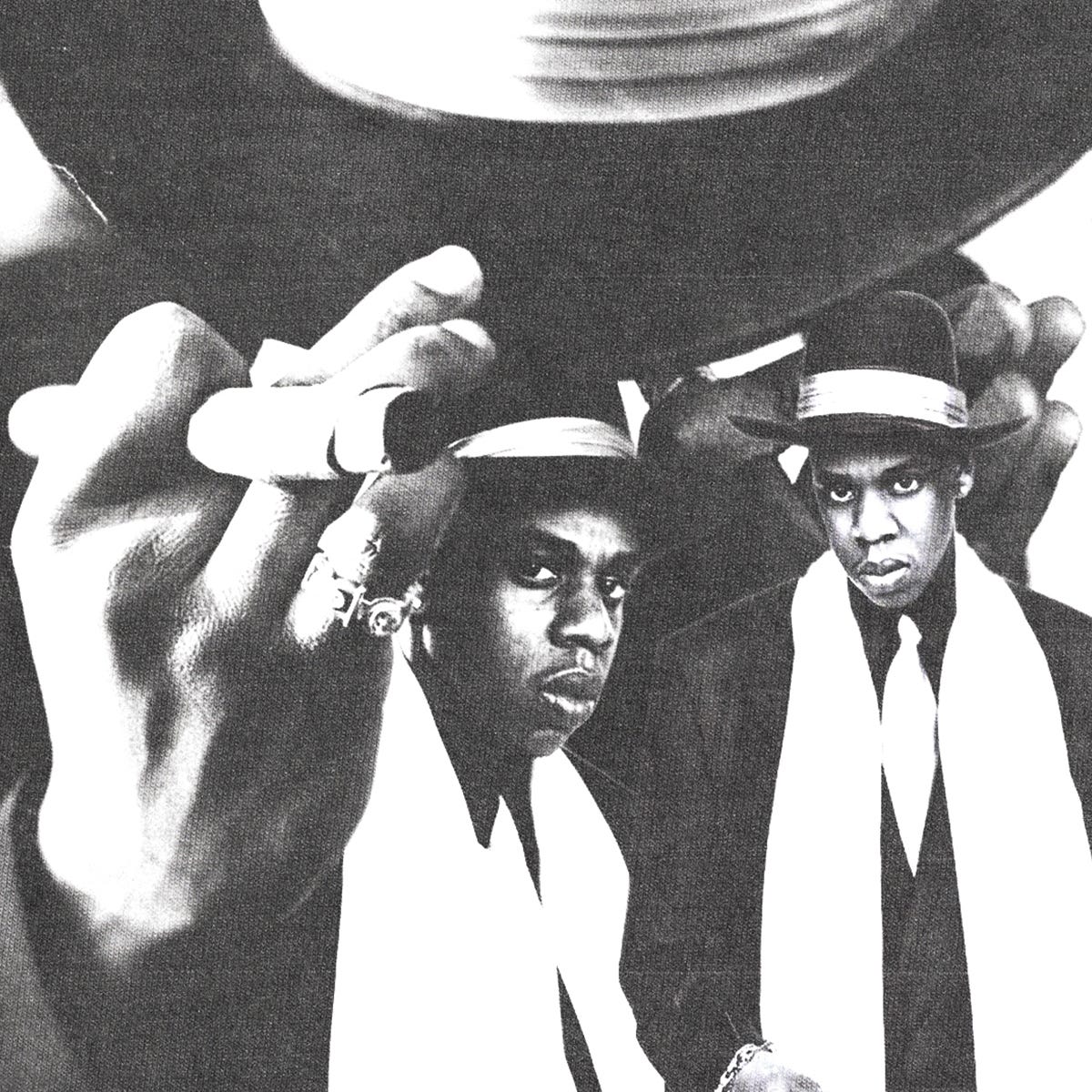
Why Jay-Z?
Out of every rapper, from Brooklyn to Compton, why did Shawn Carter emerge as the platonic ideal of the hip-hop superstar, an icon who redefined what was possible for the genre commercially while also shifting its artistic center toward his specific concerns and proclivities? It’s a valid question considering that for most of his cohort’s rise, Jay-Z was a non-factor: an unsigned technical stylist seemingly behind the times, more caught up in allegedly moving weight than the rap career that never took off. His boosters attribute this to business savvy and genius, his haters to opportunism and luck. The truth is more nuanced: going from project housing to billionaire status required a specific talent taking advantage of a specific set of circumstances at the exact right time. A butterfly flaps its wings, an undercover gets his man, and maybe we’re discussing fellow Brooklynite AZ instead. But we’re not, and a lot of that is down to Reasonable Doubt, the fulcrum for a musical career that shaped hip-hop’s central concerns and direction in ways that still reverberate today.
Discussing Reasonable Doubt, and Jay-Z more generally, requires caution. At least since The Blueprint, on which he declared RD a classic that “shoulda went triple,” Jay has been openly intent on shaping his myth, one that depicts him as smart but fortunate, savvy but humble, streetwise yet above the fray of rap’s competitive churn. Likewise, his having committed the ultimate sin of capitalist excess means that the internet is rife with those caricaturing him as a biting, backstabbing illuminati pedophile, second only to Diddy in having corrupted rap from within. It’s not like everyone’s approaching this with a level head.
The reality is predictably contingent: lyrically, Jay has always been the equal of fellow success stories Biggie and Nas—but what about the OCs and Ras Kasses of the world, similarly skilled acts with far less commercial success? Clearly, something else must account for Jay’s wildly anomalous career path, and I’d posit that more than anything else, it was his early failure to break through a crowded rap scene that allowed him to take advantage of the art form’s rapidly changing concerns, becoming the voice of his generation just as it reached adulthood.
Understanding Jay’s rise means remembering what hip-hop was like in the early ‘90s, when platinum status was rare and respect hard-won. No longer entirely dismissed as a fad, rap was still viewed as music for teenagers and the occasional college kid. Nas, Biggie, Tribe, Pac, Mobb Deep, Snoop, Raekwon and Ghostface, a broad sampling of Jay’s peers, all had their breakthrough records between the ages of 20 and 23. Pac and Big were dead by 24 and 25, respectively. Yes, ‘80s icons Chuck D and Ice-T were already grown men during rap’s golden age, but they played to fanbases considerably younger than they were, dispensing street knowledge as OGs. In contrast, when Reasonable Doubt dropped in 1996, Jay-Z was already 26, a grown man—but one performing for a hip-hop audience that was also reaching full adulthood, leaving teenage concerns behind.
This is no minor detail. Nas could only draw on experiences from his teen years on Illmatic, but on his debut, Jay was still spending money from ‘88, entering the public consciousness as someone who had lived through a fantastically fraught early adulthood. This also meant he could iterate on proven successes; an early knock against Jay was that he only succeeded by cribbing from Nas’s rap bildungsroman and Biggie’s crack-era audio Blaxploitation. But those digs dismiss Jay’s years of failed attempts to get a career going, a frustrating setback that must have felt intolerable, as the future Hov watched younger rappers blow up with hotter records. You couldn’t convince him that this was a blessing in disguised, and yet…
Picture an alternate timeline. Building a minor buzz thanks to his Fu Schnickens-indebted feature on Original Flavor’s “Can I Get Open,” Jay signs a starter deal at a local New York label, and drops a fast rap debut in Q2 ‘94, but the record flops as audiences have already moved on to more sophisticated approaches. Midway through recording his sophomore effort, Jay’s label gets folded into a major, leaving him trapped in a bad deal and dependent on street income until the law finally catches up with him. Facing life, he takes a 20-year plea bargain, becoming little more than a footnote on 2000s rap blogs, where he’s often confused with Hobo Junction’s DJ JZ. There but for the grace of God, Jay goes.
What actually happened—Jay signing to Payday just a bit later, then leaving the label to found Roc-A-Fella with silent partner Biggs and loudmouth promoter Dame Dash, and later partnering with Priority for a one-album deal before bouncing to Def Jam—was a far unlikelier outcome. Moreover, this rise would have never happened had Reasonable Doubt been anything less than a fantastic record, the logical conclusion to a generation’s worth of street corner tales, written by the rare man with both the talent and credibility to share it with the world.
Let’s not oversell Reasonable Doubt’s innovations: the spectre of the coke trade had haunted rap since its inception, just never in such exacting detail. Rae and Ghost couched Cuban Linx’s stories in layered metaphors and grindhouse pulp, while Nas and Biggie supplemented their real-life experiences with kayfabe storytelling by their second albums. Future Jay collaborators Scarface and UGK come close, as does Queens veteran Kool G Rap, but they prioritized immediacy, capturing the adrenaline rush of hand-to-hand sales as they happened.
On Reasonable Doubt, Jay is already world-weary and desperate: he makes it perfectly clear that drug dealing is a life he wants out of but cannot escape, drawn in by the seductive pull of its material benefits even as the inevitable bloodshed destroys him. Back-to-back burners “Feelin’ It” and “D’Evils” best illustrate this. The former turns piano bar jazz into an ode to the high life before DJ Premier uses the same instrument on the later to showcase crime’s hidden costs: violence, alcoholism as a coping mechanism and, above all, the corruption of one’s soul that comes with betrayal and being betrayed. This was not Ice-T getting a rise out of frightened parents or Ice Cube making a political critique: it was a man coming to terms with his own trauma, and realizing that there was no going back to being the young kid rapping about a Hawaiian girl. That this life story resonated so profoundly with an entire generation revealed just how widespread such experiences were, and just how profoundly they had scarred those who had endured them.
Yet for the most part, Reasonable Doubt is far from dour, and I doubt a record wallowing in misery would have gotten anywhere in a year as competitive as ‘96. Instead, the project revels in Jay’s cockiness over Ski and Clark Kent production that skates the line between hi-fidelity gloss and terrestrial soul. Because let’s be real, regrets (and “Regrets”) aside, Jay-Z at points makes dealing sound as addictive and euphoric as using. You want to be racking up in pool halls with Dame, roasting the homies, and turning your nose up at anyone with the audacity to not be getting money. You want to imagine yourself rolling up to Mad Wednesdays for a laugh, sippin’ champagne, only to be ushered on stage to deliver an effortless freestyle that rappers who are actually trying can’t match. You want to go bar for bar with Biggie, so impressing the King of New York that he invites you to feature on his album. You want to catch the opps slipping, taking their bricks and making them promise to never ever ever ever come around here no more. (Hopefully you don’t want to be trading sex raps with a then 17-year-old Foxy Brown or playing pause, but that’s because we’ve come a long way as a society.) This was Jay-Z’s reality but it was also the listener’s fantasy, whether they were actually in streets and hoping to beat the odds, or learning about this undocumented trade from the safety of the suburbs, as was the case with much of street rap’s audience.
Reasonable Doubt’s central duality—the rush of luxury and success colliding with the paranoia and regret that comes through acquiring them—would go onto define how hip-hop conceived of adulthood for the following decade. In its wake, the club wasn’t just a place to dance or meet girls, it became the space where hits were made and money was flaunted. Jeeps and lowriders rapidly became passe, and even the wrong Lexus became an embarrassment worthy of mockery. The intricacies of coke dealing came to play such a prominent part of the rap landscape, that for a while, differing perspectives were banished to the land of “alternative” and “underground” rap with only a generational changing of the guard courtesy of Jay protégé Kanye West and New Orleans free-associative weirdo Lil Wayne (partially) dislodging the topic from its place of prominence. Jay-Z wasn’t rap’s first drug dealer, but thanks to Reasonable Doubt he became the archetypal one. All of this from a guy whose previous career high was a guest spot on “Hawaiian Sophie.”
Jay didn’t immediately begin playing up Reasonable Doubt’s classic status: the record was not a smash success, and its biggest hit was the Foxy-featuring club outlier “Ain’t No N----,” whose inclusion on the Nutty Professor soundtrack (along with Jay’s work writing on Foxy’s debut) would lead to Roc-A-Fella jumping ship to Def Jam. Instead Jay built on the goodwill RD generated in the Tri-State, rapidly iterating on it and becoming an unlikely superstar in the wake of Biggie’s passing thanks to the Annie-sampling “Hard Knock Life” and a canny set of space-age hits with producers like Timbaland, Swizz Beats, and Irv Gotti. This version of Jay was enthralled by the immediacy of rap superstardom, positioning himself as the sole artist able to bring the suburbs to the hood, so dominant in his moment that he need not even acknowledge frustrated purists or dismissive critics. This was par for the course when it came to Def Jam’s late-‘90s superstars, but unlike DMX or Ja Rule, Jay was able to see where the wind was blowing, understanding that pop dominance is a transitory state and that there’s always a hungry up and comer gunning for your spot.
So, by late 2001 he pivoted, dropping the legacy-burnishing Blueprint, whose soul samples and analog warmth simultaneously appeased backpack purists and made him legible to rockist critics. Soon, he was performing Unplugged with The Roots and being interviewed on 60 Minutes, singled out as the rapper boomer parents name-dropped to seem in the know. That’s when the Reasonable Doubt classic industrial complex truly came into being, because whenever anyone wanted to understand this titan of arts and industry, Jay would point them towards his debut.
As he transitioned to legacy act status, Reasonable Doubt has only grown more important when considering Jay-Z’s arc. Vol.s 2 and 3 may have sold far more copies upon release, but they are very much beholden to their moment, timely but not necessarily as timeless. The Blueprint also looms large, even if the brand is slightly tarnished by its diminishing-return sequels. Reasonable Doubt though? That’s the Rosebud to Jay’s Charles Foster Kane: the emblem of lost innocence that explains the man, laying out what he lost in order to have it all.
I've been trying to understand the allure of Jay-Z since his debut, and while i still don't get it, this is the first argument i've read that i can start to wrap my head around. Well goddamn played, Son.
Dang , such a well written article .