


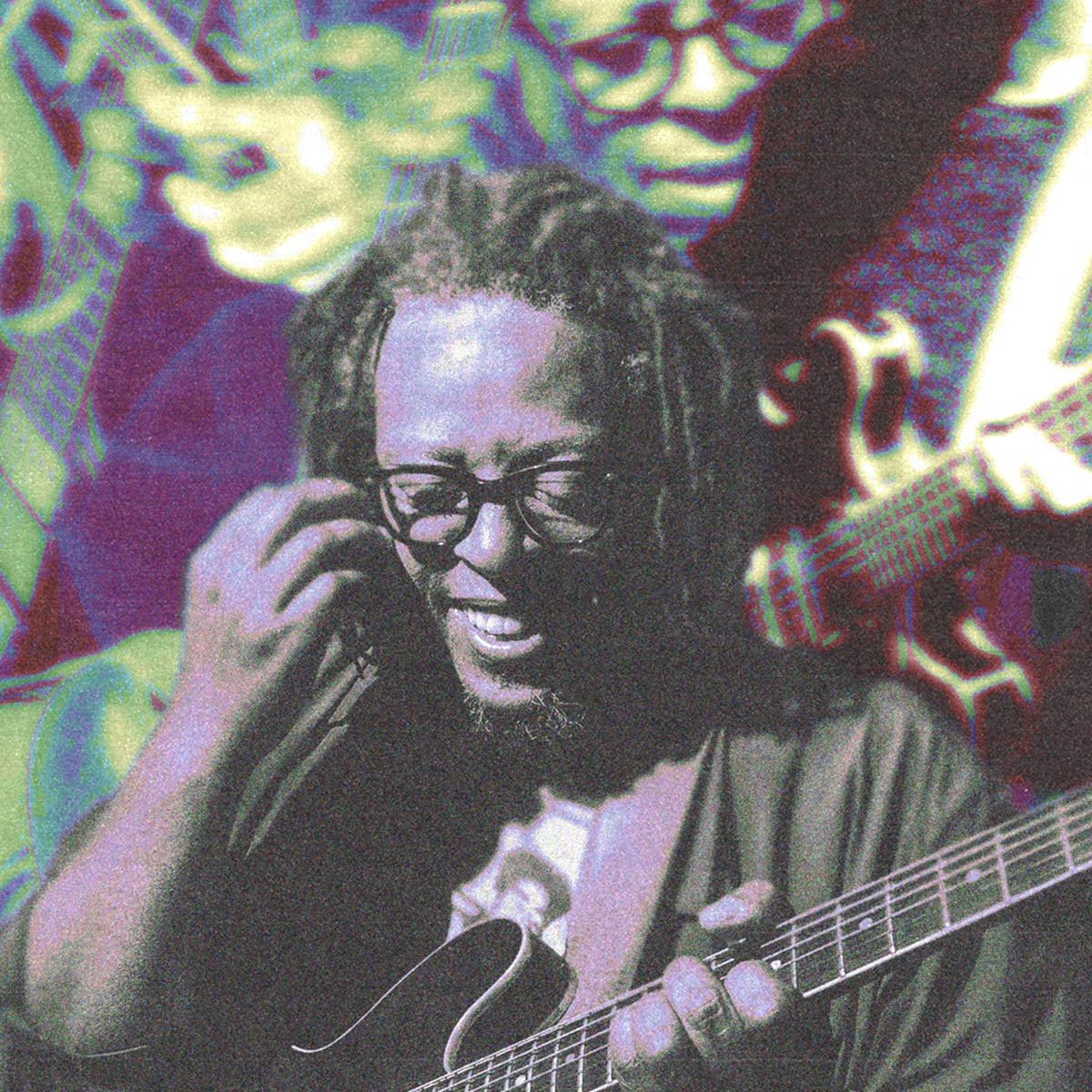
Put the new Jeff Parker album on your turntable “if you want to make your house feel good.” That was the gospel according to Flea during a packed solo show at the Black Cat in Washington D.C. earlier this month where the Pepper-ternt-jazzman spent his banter breaks showering his onstage collaborators with California-grade sunbeams of gratitude. “It’s just beautiful,” Flea said of Happy Today, effusively big-upping the new recording from the unassuming guitarist seated to his left.
Parker smiled softly, presumably feeling understood. His current group, the Los Angeles-born ETA IVtet, got its start making a much smaller room feel good circa 2018: the back of the Enfield Tennis Academy, a now-defunct venue in Highland Park where the guitarist and his crew channeled a bottomless sequence of grooves every Monday night across a celebrated seven-year residency. If anything, Happy Today—recorded live last August at the Lodge Room in Los Angeles, and captured on film by Charlie Weinmann—proves that the ETA IVtet’s rhythmic joycraft is a portable, adaptable, transferable thing.
Parker’s adaptability shouldn’t surprise anyone, though. After studying at Berklee College of Music in the ’80s alongside the likes of Roy Hargrove, Lalah Hathaway, Steve Lehman, Danilo Pérez, Joshua Redman, Mark Turner and others, Parker relocated to Chicago and quickly found himself in more ensembles than he could count, eventually recording landmark albums for Thrill Jockey Records with the groups Tortoise and Isotope-217. Critics taxonomized the sound of those bands as “post-rock,” a dull and inapt term that Parker’s aerodynamic guitar phrases always sounded like they were trying to breeze out of.
Now people call Parker’s music jazz, and for the past decade, his albums have proven the capaciousness of the word. A pair of albums for the International Anthem label—2016’s The New Breed and 2020’s Suite for Max Brown—were respective odes to Parker’s parents, capturing lively improvisation over sample-heavy constructions inspired by the avant collage of J Dilla and Madlib. Another two albums—2022’s Mondays at the Enfield Tennis Academy on Eremite Records and 2024’s The Way Out of Easy on International Anthem—found Parker taking his guitar deeper into the pocket, as if he were trying to locate the seam between the dry austerity associated with ECM Records and the glistening saturation of ’70s jazz fusion.
Glitch, groove, dryness, wetness. It’s all in there on Happy Today, an intricate live album with enough introspective heft to suggest some kind of cumulative statement. But if this is your first encounter with Parker’s music, that’s fine, too. The band goes hard and the crowd goes nuts. I called Parker on the phone back in April to ask him about the ETA IVtet’s gestation at the Enfield Tennis Academy (the site that gave the band its sound and its name); his experience playing on Flea’s new album, Honora; and music’s unknowable ability to change the mood of a room.
This interview has been lightly edited for clarity.
I feel like I’ve been inside the Enfield Tennis Academy through your records, but I haven’t. Can you describe it to me?
Yeah. You walked in, there were some tables, there’s a bar, and in the back of the room was where they had music. One of the partners was a real music fan, and a musician himself—I think he was a classically trained opera singer. His name is Ryan Julio and he was from Minneapolis. He knew pretty much everyone who came through the place, and he loved hosting the music and having the place become a legit music venue. It was a great, great place, man. Great energy in there.
What was capacity?
When it was full you could fit maybe a hundred people in there? Maybe a little bit more. There was no stage, so probably only ten percent of the people in the venue could see the band if it was crowded.
Looking back on the seven years the ETA IVtet spent there, does it have an arc to it?
I asked Ryan if I could play there on Monday nights because, at the time, I was still pretty new to L.A. So just to keep my chops and brain working, I found this place where I could play every week. I asked [drummer] Jay Bellerose, who is an old friend from college, to play. I’ve known Jay for over 40 years at this point. And then I asked [bassist] Anna Butterss to play bass because they’re just great, and I thought Anna and Jay would be an interesting rhythm section. I was initially going to do it as a trio, but [saxophonist] Josh Johnson would come anyway, just to listen. So I herded him into the
group.
We started out just playing standards, jazz repertoire. A lot of times it vacillated into more groovy, soul jazz kind of stuff, rather than straight ahead, be-bop kind of stuff. Eventually, we started playing some music by Ornette Coleman which, just by design, hints at a more open conception of improvising. We’d already established this rapport with one another just from playing together every week for so long, until eventually we decided to focus on improvising. The people were really receptive to what we were doing.
Michael Ehlers has Eremite Records who most notably puts out all the Natural Information Society albums. He came and heard the ETA IVtet many times, and he noticed Bryce Gonzalez over the corner who was recording us every week. And he was like, “What’s up? You guys got something going here.” He said he wanted us to put out a record on his label. After we did that, the band started to get a lot of attention.
It was very natural. And very slow. Josh Johnson put it really eloquently: “That’s how our music is, too.” We explore these long forms and it took us a long journey to figure out how to make this slow music.
Rewinding way back in your journey, I know you studied at Berklee College of Music with a staggering list of musicians. When you were there, did you learn more from your teachers or your peers?
I’d say it’s probably equal measure. I had some nice mentors there, nice teachers. I learned a lot about what I didn’t want to do from some of my teachers, too. But Berklee is a special place. You have a bunch of people from age 17 to 25, from all over the world. You have legit super high-level child prodigies and people who are just beginners who can barely play any instrument. It’s just a lot of youthful energy and talent in one place. My time in Boston was valuable for sure.
One of your fellow students there, Mark Turner, has a new album out called Patternmaster, and the title reminded me of this interview he did with Ben Ratliff in 2017 where they were dispelling the idea of narrative in jazz music—the idea that a solo should follow a golden mean-shaped trajectory. Is that something you ever think about?
Yeah, I think about it all the time. I play pretty much as a direct reaction against that, to be honest. The arc, man, it’s formulaic. That’s the last thing I want associated with my musicianship, that you can know what to expect. It limits one as an artist and you’re really digging yourself into a trench, if you ask me. To be clear, were they saying there should be a narrative?
No, they were against it. Turner was essentially saying that he wanted the information in his playing to be more evenly dispersed across the plane. It really changed the way I listened to his music—and to a lot of music.
It’s really kind of a recent thing. Well, not that recent. But cats didn’t really play like that until, when, the 60s? Before that, jazz music was much more dance oriented. The soloist didn’t want to peak and climax like that. They wanted a more consistent dynamic level, to stay in the same plane so people could dance to it. Once jazz got away from that, and it became more of a thing that people sat down and listened to, the dynamics changed. At least in my observation. I try to avoid that. I actually made a record called Bright Light in Winter on Delmark [Records] and my good friend Hyland Harris wrote the liner notes, and we specifically talked about that—avoiding the formulaic arc that a soloist is expected to follow.
Whether you’re stepping forward to take a solo or falling back to support someone else’s, your playing always feels really consistent. Do you feel like you’re shifting gears when you move from one to the other?
The improvising in the ETA IVtet is very natural. At the end of the day, the group is thinking more compositionally, and just listening to each other. As an improviser, there are a lot of different ways you can respond to the group. The most obvious way is to directly react to what someone else is doing, either by emulating it, or playing something that’s very obviously congruent with the ideas someone is presenting to you. Or you can play the exact opposite. You can listen in a passive way and respond with something that seemingly doesn’t have a lot to do with what the others are doing. With us, it’s usually a middle ground.
The common thing is rhythm. We try and keep the rhythm, and respond to the rhythmic ideas that someone else is presenting. But in an indirect way. To make these kinds of layers. And we stay on an idea for a long time. Once things feel like they’re settled, people will start to move away.
On this new ETA IVtet record, the newest tune, “Like Swimwear”—I distinctly introduced it with that theme, and I played it for a long time. I wanted to do something else, but I wanted the line to continue. So I looped it in my looping pedal. And it made the music move in a different direction. I took a solo out of that. And it made a different event happen with the group. I think that was really cool. It was all stuff I was consciously thinking about in that moment. A lot of very deliberate choices in that moment.
I wonder how that connects to the theme of the record. It’s titled Happy Today. I love the conditionality. Maybe not tomorrow, but today at least. Am I reading that right?
Yeah. Last year was rough. It was a real difficult year for me and my family. We were displaced from the Eaton Fires. We thankfully didn’t lose our house, but a lot of people I know did. But we were out of our house for almost a year, living in these temporary places—Airbnbs or in a hotel for a little while. That and Trump, man, coming in and seizing office and creating misery for everybody. The ICE raids in all the cities. Shit was just dark, man. It seemed dystopian. It still does. It took a toll on my family’s mental health and we were struggling in a way that I had never really dealt with in my life at all.
So we played that concert and it was beautiful, man. Just nice to bring people together and have them appreciate what we were doing. Then I saw the film that Charlie [Weinmann] made, and I put it in the context of what we’d been dealing with. I saw the photos that David Haskell took. It was a happy moment in a time when there was a lot of sadness around. So I called it Happy Today. And I made sure to have photos of everyone on the record happy and smiling.
How big of a deal was that for you? I understand you’re a very reserved person, so I loved seeing your smiling close-up on the album cover.
Ah, thanks. It was weird. I am a pretty guarded person. Obviously, I like to talk about music. But I’m not usually someone who would put a giant portrait of myself on my record.
I heard that Happy Today was initially recorded in the studio, but you decided to go with this live recording instead. Was it not working as a studio album? What was the difference?
The energy. We recorded it in my studio that I’m in right now. And there was no audience. No feedback. The stuff was fine, but the bodies are an important piece of the puzzle for us. The group had never recorded in a studio together. We’ve only ever really played for audiences. So it was obvious once we listened to the recordings.
I love hearing the audience on this recording. It feels so different from the polite pitter-pat applause you hear on, like, old live records at the Village Vanguard. People are shouting and whooping, and it sounds like they’re getting something they really need. What do you think that is?
Just good feeling. [Laughs], I mean, it’s good feeling. People always like when Jay drops the beat. We build up this tension, then he lays it down. People really respond to that. Good feelings, man.
That seems to align with this popular idea of joy as an act of political resistance—but I’ve also wondered if you think of listening as a political act. So much of your music seems to be about cultivating patience and attention. And to be clear, I’m not talking about the civility discourse. I’m talking about the activist left learning to better cultivate and call on its own inner resources. Is that part of the mission?
Mission? No. I wouldn’t say that. I think it’s a political act just to live a creative life, a life that’s based in making things. I think creative energy makes people respond in positive ways. My thing with my work is that I’m just trying to be honest. I try and have ideas. I think it’s kind of a brave gesture to try and articulate your ideas in the context of creative work. It takes bravery. You’re putting yourself out there. My mentors really supported me in that.
Now I’m about to contradict myself: I have made work that’s overtly political. That song “Go Away” on [Parker’s 2020 album] Suite for Max Brown is directly addressed to Trump. I just want this dude to fucking go away. But I don’t know, man. I just try and be honest. I think it’s important to try and at least have an attitude that you’re trying to move things forward, and make progress in art, and culture, and society.
People tend to see your career through two frames: Chicago-Thrill Jockey-Tortoise Jeff Parker and Los Angeles-International Anthem-Eremite Jeff Parker. Does that feel limiting?
No, I kind of look at it that way, too. When I was in Chicago my approach to making music and composing was very different. It was much more collective-based. There was a time in Chicago when I was in like seven or eight bands, and I was writing music for most of them. Then I moved to California, and I didn’t know anybody. I was kind of forced to make music on my own. Toward the end of my time in Chicago, I was really into hip-hop production, more as a study, really. Once hardware moved to software, you had samplers on your computer. You didn’t need to have an SP-12 or the MPC. You could just do it on your laptop in your spare time. So I was really into that. And that way of composing started to make its way into all the other stuff I was doing.
So when I came out to California, I was making solitary music. For the first time, I had my own music space, which I’m sitting in as I talk to you now. I feel like I really went inward. At the same time, I was exposed to a younger generation of musicians who had been following my career really closely. Makaya McCraven was one of them, and we became really good friends. I started playing with him a lot. But I feel like I started to really make my own music, and get away from collaborating with people so much—even though in the ETA IVtet, we improvise together, we all make the music. But I’ve guided it through my music that I’m working on. The way that we improvise is heavily informed by the music that I made, the music that came out of the New Breed project and me making beats and exploring production.
Tortoise is reactivated now, but I’m not touring with them this year. They’re in Europe right now. James Elkington is filling in. I just don’t have time. I can’t do everything.
What brought you to Los Angeles in the first place?
It was family. My partner, Lee Ann Schmitt, she’s a filmmaker and she teaches. She runs the film directing department at Cal Arts. So for a while, we were kind of living in both places. My daughter from a previous marriage still lived in Chicago at the time, so we were trying to spend time with her, and also be out here. Once our son Ezra started school, we had to plant somewhere. Lee Ann’s job was out here, so we came out here. This was late 2013.
Have you gained any new understanding of the greats who felt called to Los Angeles? The Wayne Shorters and Herbie Hancocks?
A certain aspect of the entertainment industry is out here. L.A. is very much an industry town. I didn’t move out here because of that, but it’s really prevalent once you observe the community. And the work here is different. Because it’s so spread out, it’s not a place known for nightlife. A lot of the work for musicians here is commercially oriented. Less so now because of the way the landscape has changed. But a lot of musicians here work in the studios, or in film, scoring work, trying to get music placed in different media.
I ask about Shorter in particular because when I heard you were going to be on the Flea record I thought about Wayne Shorter playing with Steely Dan and the Rolling Stones.
He’s a big influence on me as a composer, for sure. I study a lot of his work. Weather Report has always had a big role in my listening from when I was probably 13, 14, just starting to get serious about music. We’d play “Birdland” in the school band. Yeah, Wayne is a big one for sure.
What have you gotten out of working on this Flea project?
Exposure, for one. But musically, man, he’s a real inspirational person. He’s like a bundle of high-energy. Positive energy. He’s a very spiritual dude, he’s one of a kind, and I think he’s really grateful to have this new outlet to play creative music. It’s just joy. It’s a joyous experience. That’s mostly what I’ve gotten out of it. And a nice friendship with him.
We’re talking a lot about joy today. How do you channel it? You’re holding your guitar onstage, and before long, everyone in the room is happy. Can you describe how that happens?
No, I can’t. [Laughs.] Like I said, man, I just try to be honest. I kind of have an ethos. Or not an ethos. I don’t even know if that’s the right word. But if I don’t hear something, I don’t play it. I don’t waste my music. I try not to have any filler. I don’t want a cluttered thing. The idea is to be clear. And man, I’m very conscious that I’m making music for people. What I do is for us. It’s not even about what I’m doing. I’m doing it for us, for humans. And I’m very aware that it’s bigger than me.

Amazed by this band's music. The incredible run by POW continues.