


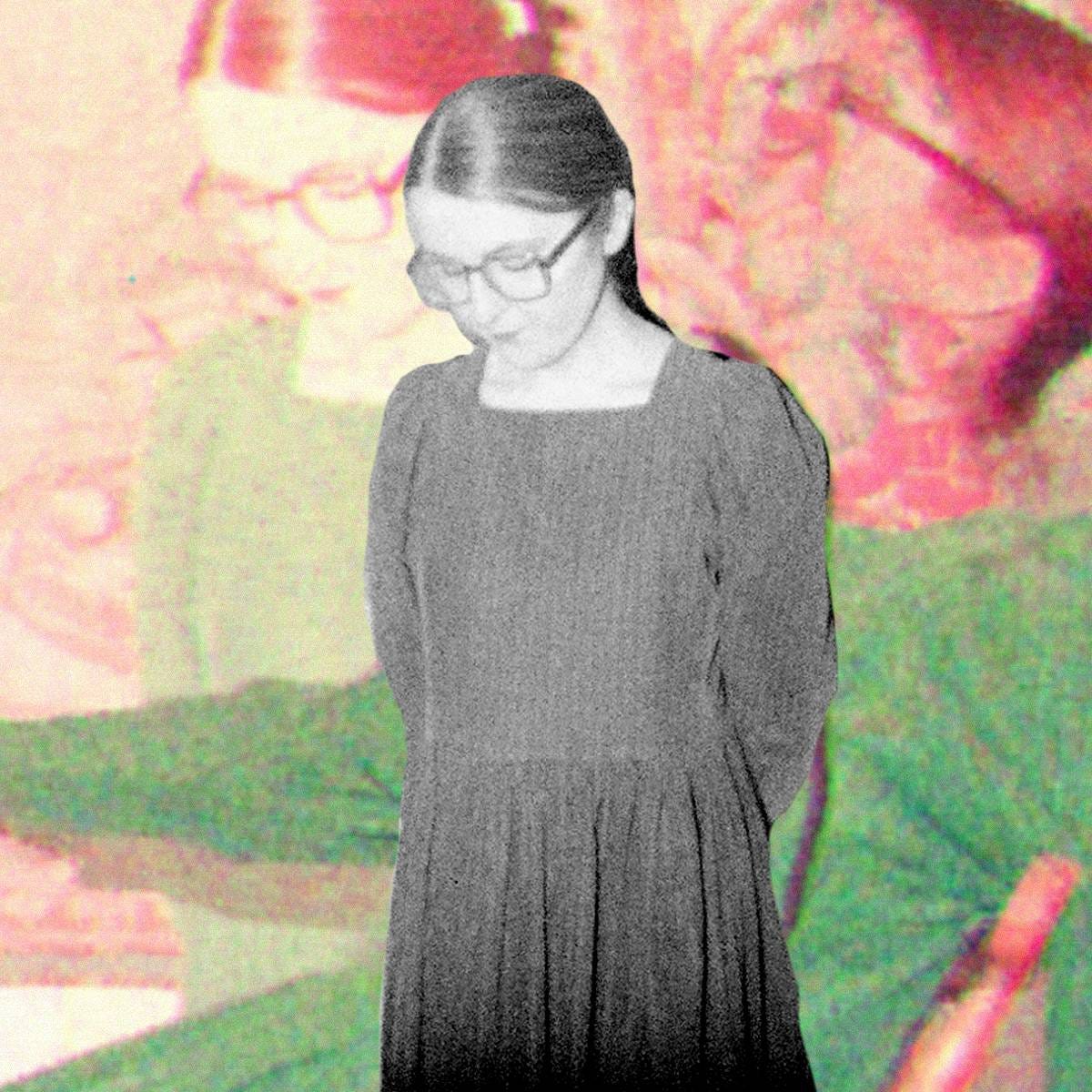
Art via Evan Solano
Michael McKinney was born again backwards.
In 2018, Jennifer Walton—a seasoned film and game composer, an ex-goth, and a practiced drummer—graduated from university and flew to America to tour with Kero Kero Bonito. It was something of a manifestation of a dream. Walton had long idolized America from afar, treating even news chyrons and malls as fantastical objects. But this was a strange trip: she drove through the Appalachian Mountains listening to sacred harp music, got her medications and laptop stolen from the group’s van, and stumbled upon a horrific Gordian knot: her father, she learned, was dying of cancer.
“There’s a strange thing about grief,” she tells POW seven years later. “I think some things in life, like falling in love, feel natural and innate. I always feel like it’s an inherited thing from the hundreds of people that have come before me. Grief is also like this. It should be a universal thing. But, for some reason, your brain just cannot compute it, and I don’t know why.”
Over the course of her career, Walton has tried on all sorts of hats. With WHITE NURSE, she interrogated histories of fascist imagery and beliefs in power electronics; with Flash On, she constructed joyfully devilish anti-club tools, collapsing dubstep and techno and the kitchen sink into a pile of who-knows-whats. As one-half of Cryalot, one-third of Microplastics, and one-fifth of NTS Hard Crew, she has been partially responsible for piles of wild-eyed dance-music and serrated pop records.
One way to read Daughters, Walton’s latest LP, is perhaps the simplest: it is a reaction to her time in the States all those years ago, an explicit reckoning with the way the life of her father and the million histories of America tangle up with her own. Another way, of course, is that it’s a head-spinner of a singer-songwriter record: a crash of Midwestern emo batterings and walls of noise. Daughters may be Walton’s most startling release to date, in part because it’s so wholly different from the rest of her oeuvre. It’s the sound of a kid who grew up with Karlheinz Stockhausen and Nine Inch Nails meeting the adult who’s a proud Deadhead and unabashed fan of Julia Holter.
In early September, we had a chance to sit down with Walton over Zoom, digging into her family’s history with experimental music, her relationship with the “completely inhuman” architecture of malls, how a variety of ghosts helped shape Daughters, and more.
(This interview has been condensed and lightly edited for clarity.)
How are you?
Jennifer Walton: I’m good. I’m just quite busy at the moment – in a good way. How about you?
I’m well. What’s some of the first art you remember really moving you?
Jennifer Walton: I was raised by my mom, who is self-professed [as being] not really that bothered about music. That's kind of because her dad led a choir, and led an orchestra, and was crazy into atonal music. She'd come home from school, and her dad is listening to the craziest music, and it was really aggressive. She didn’t really get into music.
We had a CD of “It’s Oh So Quiet” by Björk. I have really vivid memories of — I must have been three or four. That was playing in the kitchen, and it was this multi-sensory, overwhelming experience. It was crazy intense, and I’ve always had that with music.
I was always really, really into music, and always discovering it, and looking for it in ways that I find quite funny now. I was in primary school — so, you know, 10 or 11 — and just the biggest goth in the world, but I had no older siblings or anyone who could have told me how to get into that stuff.
Are you referring to the music, the subculture, the fashion, the tropes, something else?
Jennifer Walton: All of it. I was in primary school with dyed hair and checkered Vans. I was trying to make my mom buy me certain T-shirts and stuff.
I don’t know if this exists in the States, but there’s this real affinity between ex-industrial towns and goth culture. I feel that is a kind of throughline. I think I picked up on that early. [laughs]
You say “ex-industrial towns.” Where are we right now?
Jennifer Walton: I grew up in Sunderland, which is outside of Newcastle. It used to be a Victorian seaside town [and] tourist destination – [a] mining, shipbuilding, and glassmaking city. It used to be fairly fancy in the Northeast, and then, with Thatcher, everything closed down.
There is a music scene there, but it's quite small and quite, like, metal-y, and makina was huge there. All of the very cheesy happy-hardcore rave things.
But I was way too young for this. It was already kind of wrapping up by that time. [laughs]
One more sidebar: you mentioned “all that atonal music.” Is this early no wave? Something else?
Jennifer Walton: It’s early Stockhausen tape-manipulation music. A lot of that kind of stuff. I ended up inheriting a bunch of his records: Stockhausen, Ivo Malec, all of the [Musique] concrète stuff. My mum paints quite visceral images of coming home from a hard day, and the house is just blaring with bleeps and bloops. It’s very funny to me, but I can understand it; you can turn someone off music if it’s completely confrontational.
At this age, are you making music yourself?
Jennifer Walton: No. So that came a bit later. I mean, I was playing drums and stuff. My dad bought me a drum kit, somewhat out of guilt. I ended up saving up for a MacBook over the course of two years when I was maybe 13. My dad was a mastering engineer, and I'd seen Logic on his computer on a caravan holiday.
That planted the seed and broke my brain: “Oh, this is how it's done.” A bit later, the goth stuff got to Nine Inch Nails; through that, I got into Crystal Castles and the electronic stuff.
In terms of making stuff, I was playing guitar, doing the usual stuff. But I hadn't quite picked up that you could just do it on your own without a band.
So when does that click?
Jennifer Walton: I think it was that caravan holiday thing. Whenever I’d see him, I’d get the laptop, start playing around with beats. I remember I’d go away to his caravan in Scotland for, like, a week, and come back to school with three godawful tunes I’d made on my iPod. I’d play them to people like crazy. That was really exciting, and it got really lodged into my head.
After I was able to save up for Mac, it got started from there. It was all the way through secondary school, but I think my whole life I’d been aiming for music. I say that now, but I had a trajectory of: “This is actually feasible.” Especially being an only child and not having any musical friends, really, being able to completely take control was great.
At what point did you start taking music seriously as a pastime as compared to something you messed around with?
Jennifer Walton: Honestly, always. I was so weirdly driven since I was a child. My dad was in a rave band in the ‘90s – one-hit-wonder kind of vibes. But, because I wasn’t raised by him, that imprint was on my head: “You can actually do this. You can make it.”
I was constantly making stuff. I was always protective of my own work; I wasn’t releasing a lot. When I was 18 or so, I always had the “big album” in mind. I was really grinding on it, and that was a lot of the deconstructed club stuff.
What band was your dad in?
Jennifer Walton: It was called Opus III. They had a track called “It’s a Fine Day.” They were all in Sunderland, and they moved down to London when it started to happen. It’s this weird — what’s the word? It’s not an “omen.” It’s nicer than that. It follows me around, in a funny way. I remember: he used to tell this anecdote of me being a kid. He was talking about dance music, and, at the time, I called it “chap music,” because I was so obsessed with metal and stuff. I obviously came back around to it. But [laughs] it was super “no electronic music” until later.
What does an early Jennifer Walton track sound like?
Jennifer Walton: It was very Nine Inch Nails: Downward Spiral-core. There’s something funny about, when you’re 11 or something, writing MIDI loops on Logic. You can get fairly close to Pretty Hate Machine in terms of the ‘80s vibe. It was terrible: the same loop for ages and ages. It was that kind of stuff: dark electronica. So self-serious.
So you find your way towards production. I’m stuck by the distance, or perhaps lack thereof, between that and power electronics, with White Nurse. How’d you find your way towards that?
Jennifer Walton: I think it would always [have] been this slow evolution. I got really into it when I was at uni. I can't remember the initial point, but I feel like there is this throughline with Nine Inch Nails and Crystal Castles, where it’s so about the timbre and so about the tone. Me getting into power electronics was me realizing that it was always tone that I found evocative. It’s chords, and it’s melody, but, even now, it’s more about texture. There is this early-20s angst and extremity I was really feeling with the power-electronics stuff. I was in uni, and I hadn’t found my crew yet, and I was very anxious. Being able to externalize all this stuff was really good.
I think it was Pharmakon, maybe, who I was the biggest fan of: very screamy body-horror stuff. I found it really evocative. But it was this classic problem with power electronics: the further you go down, the more you realize every band is Nazis. It’s crazy! I couldn’t even believe it. I think there was a part of me that thought it was fun to play with aesthetics, like Throbbing Gristle did, but you keep going. I remember I bought this Genocide Organ vinyl, and it arrived, and I looked at the inner material, and I was like, “Oh, this isn’t a joke. It’s really bad.” [laughs] That’s the link, I think, though: texture, and constantly digging further and further in.
My next question was going to be about fascism. Why interrogate that then?
Jennifer Walton: I think I was really frustrated by it: why is all this stuff so fractured? Even in the history, going back to Throbbing Gristle – they’re a complicated one – but it’s always about this certain political ideology, and there’s no way around it. I ended up writing about it for my final project at uni: going back to the origins of industrial music – the brother of Luigi Rosso, who wrote the fascist manifesto. The two have always been so linked in this really brutal way. Then I came away from it, like: “Why even bother?” It’s such a strange one. Obviously, all music is political, but power electronics is on this knife’s-edge between either full-on polyamorous, queer ultra-left-wing noise music or just actual fascists.
I’ve got to know: what did you study in uni?
Jennifer Walton: It was kind of stupid. It was a BSC, so a science degree in composition for film and games. At that point, I was like, “I’m going to be a composer.” That’s all of what my work prior to uni was. Then the course ended up being a real scam. It’s my own fault for not dropping out sooner, but it just wasn’t very technical. I kept getting really frustrated – you can’t teach someone how to write music, necessarily. So teach me how to do the games element! Let’s learn some technical stuff. It wasn’t that. [laughs]
I stayed in until the third year. I tried to change course to Goldsmiths in South London, where I am now. But I couldn’t do it, because I would have had to pay tuition fees out of my own pocket. So I ended up doing something which is kind of crazy, looking back: I moved to London – my university was in Hertfordshire, which is two and a bit hours away – and then I started doing a two-and-a-half-hour commute to uni and back.
Every day?
Jennifer Walton: Yeah. To do it, I had to ride a scooter to the train station – there weren’t electric scooters yet. It was stupid, but it felt like the most natural thing to do. I moved to London then.
We got into this with Opus III, but how’d you find your way towards club music? I know you have a decent amount of club-conversational material. How’d that start?
Jennifer Walton: [laughs] It’s a funny one, because it’s something I think about a lot now. I think the genesis comes back to Holly Herndon. Platform changed my life. I hadn’t heard anything like that before. I was thinking about computers, and the digital, but her work is still very songwriter-y to me. It’s not club music, but it’s using all those aesthetics. All the music I liked before that – Crystal Castles, Nine Inch Nails – it’s vaguely electronic music, but it’s always in this band structure and songwriting structure.
At the same time, you have all the PAN stuff happening: Toxe, Endgame, Yves Tumor, Kamixlo. All that stuff was still quite songwriter-y in structure. I started going to club nights kind of treating them like gigs: I wasn’t there to club; I was there to see x person. Through that, I met aya [and] everyone else. That was the first group of people I met who were really doing it. Through that scene, I started writing more “club” music. [laughs] To me, the All Centre release [Flash On] was ultra-functional, but, now, when I try to play it out, I’m like, “What is this?” I love the music, but I think people like aya and Evan [96 Back] – people who grew up clubbing and interacting with functional club music – I find I don’t have the functional stuff. I’m way more on the band side of the spectrum.
So, to be blunt: How do you get from Flash On to Daughters?
Jennifer Walton: I don’t even necessarily know. I always used to joke that whenever I would open Ableton, if I just played around, I would always write indie music. It’s what I could do quite well, and quite quickly. Because I was working so much to brief, I had no idea what my voice was. I was always going into different aesthetics for peoples’ projects. I had lots and lots of demos with guitar music, and it was always funny to me: the albums that meant the most to me were Julia Holter or, like – it was always guitar music. The original version of the album was songwriter-y, but it was very electronic. It just wasn’t quite hitting. Tom, from Local Action, was interested at that point, but we both thought it wasn’t quite working.
Then we had the first half of “It Eats Itself.” No vocals or anything. Just that guitar line. I was in my bedroom, and I was like, “what happens if I keep making this ending go up a semitone each time?” I was bringing in all these sample libraries I only use in film music – all the orchestral stuff. In a day, I had this song, and it felt like something I would make, and it had all the references of something I would make, but it came into being so quickly that I was confused it was my music, in a way.
I wish there was more of an evolution, but this is what I should have probably been doing the whole time. I’d always been on the guitar end of things. All of my heart’s albums have always been band stuff. When this came out, I was like, “Okay, this clocks.” The All Centre thing was fun, and I’m proud of it, but it was more of an intellectual exercise: actively trying to make music of a specific form.
You were trying to make a PAN release.
Jennifer Walton: Exactly.
How would you say composition as a practice feeds into your current work?
Jennifer Walton: I really like it for making me quite disciplined: having to stick to deadlines, and having to deliver, and having to do things quickly. I cut my teeth on that stuff, and it was really enjoyable. I think I’m good at being able to shapeshift. I think, in some ways, it worked. But it also made it quite confusing to stick to a form. There is this element now – I think my music sounds filmic. I don’t know what that means, in some ways, but I think with Daughters, it was almost this idea of: once I had one track, I could make that the brief for myself – leaning into the grief aspect, or leaning into the Americana aspect, and holding myself accountable to those things as though I’d been set the brief to set the limitation. I think that was helpful. I really miss doing it as a job, because it kept me sharp in terms of being able to really churn stuff out, in positive ways.
Talk to me about grief, then. Talk to me about your mindset coming into Daughters, to whatever extent you’re comfortable sharing that.
Jennifer Walton: Of course. It’s this big spaghetti of things. It’s all these separate threads of things coming up together. That’s what the album is about. So: where to start?
I’d come out of uni and I pretty immediately started touring with KKB. It was going from zero to 100: having nothing, and then, all of a sudden, I’m in the butt end of America as someone who was very obsessed with America from a very early age. That disconnect was really crazy.
It’s also about this other thread: my dad’s war stories, his tour stories. In the band, they’d gone to Japan, they’d been to America. It had always been this life goal of mine. Even in Europe, before it happened, me and my dad were having a conversation. I was like, “If I can tour – that’s an actual life goal.” It’s weird to be doing it and knowing that. It’s a really odd thing to be so concretely living a dream, which lasts months at a time, but it’s also immensely stressful.
It really wasn’t easy-going, and loads of stuff happened. Basically, we’d found out – there was the end of the first run, which had been really difficult. We had a van break-in; my medication got stolen; my laptop got stolen; we all lost loads of stuff. It had been really difficult. It was there in this hotel room that I found out my dad had cancer, which was really weird. Also being in this quite liminal space, and trying to deal with this. The next few – we came home, I saw him, and a day later, maybe, we went straight back out.
It was still a dream, and it was still amazing, but it was tinged with this strange energy. Fast-forwarding afterwards, it’s a really strange one, with grief. He had cancer for quite a while, and it was terminal basically from the start. So, in some ways, you think, “We know this; we can prepare for it; we can deal with this stuff.” But there’s a strange thing about grief: you can prepare all you want for it, but it’s so dislocating, and it’s so strange.
How did this record work in conversation with that process?
Jennifer Walton: It was funny. I always went back and forth on it: on feeling self-indulgent on it, and feeling like “I’m just writing the songs, and then I’m adding the lyrics, and it’s not really about that, and it feels overwrought to say it is.” And it varies track-by-track. But I think, for me, it was this kind of catharsis of being able to channel all of this complexity into these different things. Like exorcising it. I’d heard so many of my friends going through really intense album cycles, where they were putting themselves into not-great mental places to write this stuff. I always thought it was really overwrought. I didn’t understand: “You’re just writing an album.” Then I did it, and I was like, “Oh, my God!” Everyday you’re battering yourself with the same emotional stick. It was really tough. It just felt really urgent, and it came into its own being, and I was caretaking the songs. They felt like homes for [the emotions]. It allowed me to talk about these experiences, even if it was vague, in ways that I really liked, and I’m really proud of. I feel really proud I can be happy with the actual material; for me, it does sum up a lot of those events well.
“Saints” uses audio from the hospital visits with your father. How interwoven was composing this and your relationship at the time?
Jennifer Walton: “Saints,” which has the sample, is probably the earliest of the tracks. I’d made it with no lyrics, and I made it pretty soon after this horrendous day. It just happened, and I hadn’t really thought anything of it. I’d taken the recording and scratched out the beep; it was what it was. “Saints” had always been on the album, but that sample worked as a jumping-off point to talk about my own health at the time.
It's tricky, because my old studio is in my dad’s place before he moved to Devon with his partner. “Saints” was written in that apartment. It becomes this strange thing where the instrumental was written in this place with the sample, and the lyrics are talking about having to leave that studio, or that house, or having to say goodbye. It is a quite weird conversation between the lyrics and the past. Part of it is, obviously, on purpose, and part of it is doing things by intuition and stepping back and saying, “Huh, that’s funny. I’ll deal with that later.”
Earlier, you mentioned this idea of being obsessed with America, and you’ve mentioned “Americana” as an idea that’s important to the record. What does it mean to you?
Jennifer Walton: I think it’s really difficult. It depends on the time you ask it and who you’re asking. I think it meant something different when I started writing the album as compared to what it means now, and I think it means something different historically as to what it means now. So I’ll answer in two parts.
Growing up as an only child in Sunderland, I played a horrific amount of Xbox Live – Halo 3. I was always in lobbies talking to Americans. I served my time. I hated my accent, but I gained this weird international accent for a while. I think it can’t be understated – and I think it’s even more present now with YouTube – all media is American.
So imparting that, but also being really obsessed with American history and the American self-story. It’s really problematic, but the story, just for itself, is so romantic. Being a huge Lana Del Rey fan. Then interacting with America in-person – how can I describe it? When I first arrived, they were playing the news on the TV screen. But I had only ever seen the news look like that through fiction – through House of Cards, through movies – so my brain takes that in as fiction. Same with the architecture, with everything. I’m internalizing everything as fiction.
I think it was me, as a Brit, but as someone who has yearned for all this stuff – which is really difficult to explain in a way that is really complicated – it was me trying to work through that. That’s part of the grief element, I think.
It’s changed so much, but it would be a lie to say I don’t have this huge romantic [laughs] relationship with my time that I spent there. It’s the open road and diners or some shit.
I’d think coming here with a fantastical idea of what the country is like would be a bit of an emotional car-crash. Am I making this up?
Jennifer Walton: No, no, 100%. One of the first places we arrived was New York. It was on my birthday. We arrived in Boston on my birthday, and the second stop was New York. It was the first time I’d seen sex workers or people shooting up on the street. Really brutal scenes that do exist in the UK, of course, but not to that extreme. I grew up near the Metro Center, which, at one time, was Europe’s biggest shopping mall and this bastion of English capitalism.
I fucking love malls. I love liminal spaces; I love all that stuff. It’s deeply calming and deeply nostalgic to me, so being in America and interacting with it there – it’s the fundamentals. That’s the bread and butter. I was constantly engaging with this thing that, for better or worse, is a part of me, and it’s something I think about a lot. It was a double-edged sword – seeing all these things were grim – getting my medications stolen, and then having to go through the American medical system as an outsider [laughs]. I know first-hand waiting in CVS. It’s brutal, but part of me is like, “This is crazy!”
Talk to me about your relationship to malls. Why do you find them so calming?
Jennifer Walton: The Metro Center used to have a theme park inside it. It's crazy. I think there was a kind of utopianism in the ‘90s and early 2000s: new Labor in the UK; everything's getting better. This shopping center had an immersive Italian village and an immersive Roman quarter. I was taken out all the time as a kid. Obviously, as a child, you're going from brick buildings to this belly-of-the-beast: everything is shiny. The architecture looks crazy.
I still go to malls and just walk around on my own. Just a freak weirdo: hiking through malls, not buying anything. I think there is something about going to the absolute extremities of capitalism. But, also, it’s immersive design. I’m a big theme-park freak. Even if that design is made to make you spend money, there’s something so fascinating to me about designing civic places in a way that’s kind of completely inhuman.
Sidebar: talk to me about the Grateful Dead, as long as we’re talking about music that bottles up America. [Walton produced a lengthy mix of their music for NTS.]
Jennifer Walton: [laughs] When I started working at NTS, it was amazing. I was consuming so much music, and I was adding so much to my playlists. It was really voracious and I couldn't get enough. It was constant immersion. After a time of nine-to-five hearing music and meeting musicians, I got so burnt out on music. It always came back to work.
It became labor.
Jennifer Walton: Yeah. So I didn’t listen to it at all; I just listened to ASMR or podcasts on YouTube. Then my friend Leia, who I’d met through touring, was a big Dead fan, and I asked her to make me a playlist of the Grateful Dead. It’s so tied to America, driving, road culture, San Francisco, and all that stuff that it hadn’t come over here unless you’re a bluegrass guy or a certain type of folk fan. Slowly but surely, I fell in love with Europe ’72, because it sounded like nothing else I had ever cared about. It had nothing to do with work; I was never going to hear it on NTS.
I kept going deeper and deeper and deeper. They have an amazing podcast [Grateful Deadcast] series they make, which is the[ir] history. History is really important to me, increasingly so, as it pertains to music. It’s a 360 thing – getting really interested in the Summer of Love, and the ‘60s and the ‘70s. I fell back in love with music again, but for music’s sake. It’s corny as hell, but it is completely true: they were always there.
I think the other thing I’ll mention is that because the UK has no relationship with the Dead, there is no baggage at all. It’s just about the music. It has nothing to do with wooks; it has nothing to do with knots or tye-dye. It was just music. I keep this thread now: normally, everything I listen to has nothing to do with work. I mainly listen to older music, because it feels like it’s mine, in a way.
You say history is increasingly important to you with music. What does that mean?
Jennifer Walton: I got really obsessed, through the Grateful Dead, with the 70s. Digging in more and more, and trying to uncover more about, say, American politics, or general youth-culture stuff, and then getting deeper and deeper on bands. They’d become what I was listening to, but I built up this bigger image of what was happening. I think it always comes back to the ‘60s and ‘70s and the last 50 years [for me]. It’s my own personal project of being able to dig into all of that stuff in terms of, I don’t know, Vietnam or something, but also the music of that time.
To tie this back to Daughters, I think of that record as your singer-songwriter record. Is this, in some way, an attempt to tie to those traditions?
Jennifer Walton: Definitely. Julia Holter was always one of my favorites, and having that in the back burner – but also how far she could push it out, with the extremity of Aviary and free-jazz stuff. The music around me – obviously, there’s the club stuff, but I have loads of friends in bands, too, who are doing amazing stuff. I think about how much they play with form. Even with caroline: yes, it’s a band, but it’s really complicated and production-y. What is permissible is so vague. In my mind, I think this was always gonna happen. I always aimed to do the big album. I always was aiming to do this – on the low-key, I just didn’t know how it would look. That’s why the All Centre thing happened; it’s why White Nurse happened. I was really proud of them, but I was more willing to let them go, because they felt less like a representation of myself as opposed to me trying to figure out how things are made. It was always working towards this.
Five years ago, if I told you your debut record would sound like this, would you have believed me?
Jennifer Walton: I think I’d be more likely to believe you then than I would now, in a way. If you could have shown me these things, it makes sense. It feels like an encapsulation of all the band-y stuff I’m into. I’m hearing this from friends, which is nice: “Oh, this makes sense. It’s pulling from everything.”
Do you anticipate continuing to chase this singer-songwriter dragon, or do you feel like you’ve done it and you can move on?
Jennifer Walton: I definitely feel like I've hit a thing. I feel very comfortable in it, and I feel like there's a lot. I'm really excited about writing again, because there's so many processes I want to explore. I have no idea what that’s going to look like, and I have no idea how it’s going to sound. I’m sure there’ll be a billion other distractions – and working with other people, and doing those other things in the meantime – of course. But I’m really excited to keep going in this.
When I did the first track, I was like, “Oh, it’s crazy how I can just do this – the music I love. I don’t have to do anything else. I can just do what I want to.” I’m really happy, and I’m really excited to keep going.
I got to experience Jennifer's brilliant DJ skills on Berghain's main stage years ago which was brilliant, then last weekend at The Black Lights fest I got to see Microplastics b3b which was incredibly fun as well..
But I gained a whole new level of respect seeing her play Daughters in a cozy little church on the Sunday of the fest. she really poured her heart out shredding on the electric guitar and screaming till her voice was breaking. she actually moved me to tears which does not happen a lot for me. listening back to the album now it's very moving in a more subtle way, it doesn't quite compare to the energy of that set but it's a gorgeous listen.
very excited to hear how Microplastics will sound as a band..