

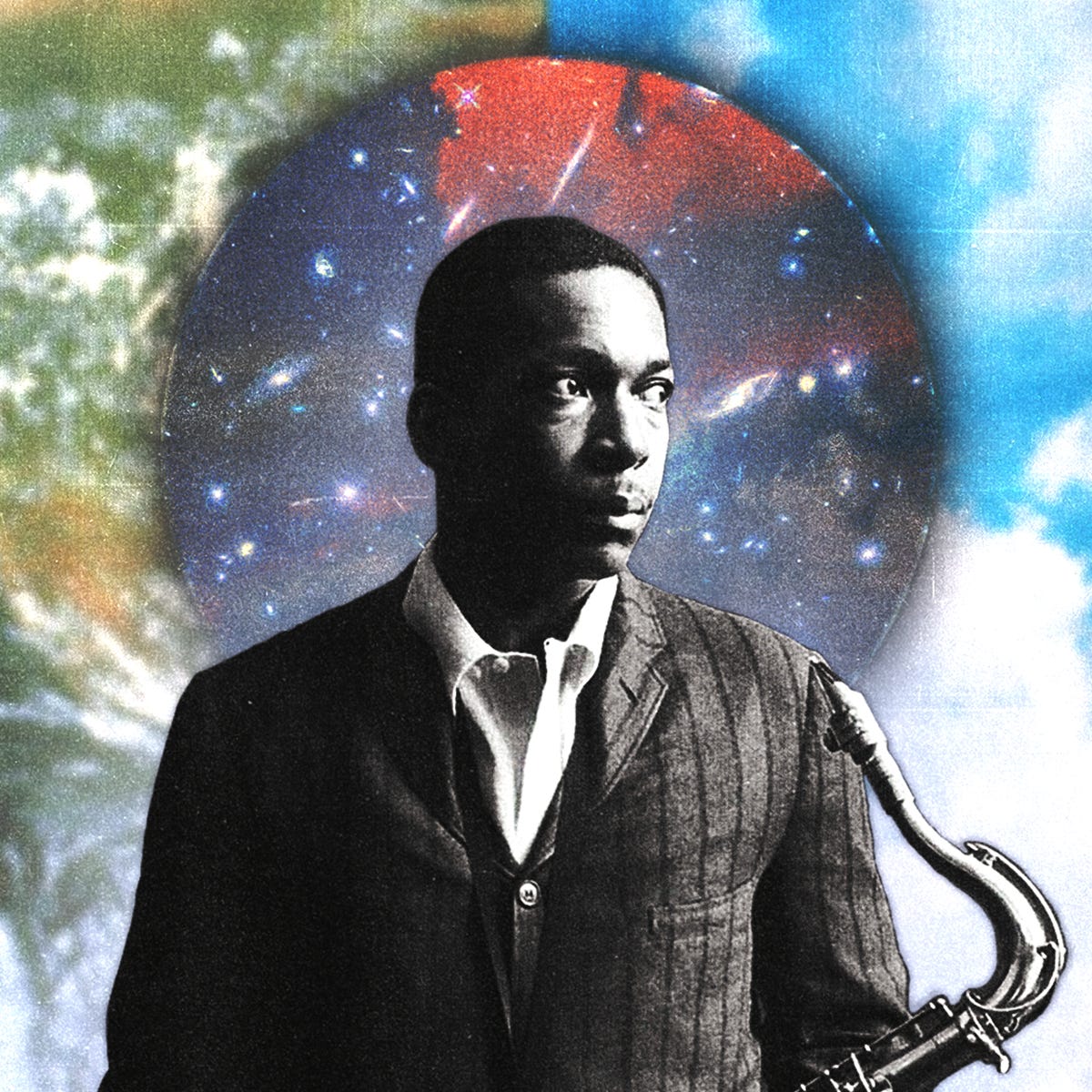
Before John Coltrane experienced the divine touch of God, he felt the fists of Miles Davis. It was right before Halloween in 1956, and the man who birthed cool was characteristically hot. For the last few months, the star tenor saxophonist in his fabled quintet had been showing up to work late in rumpled clothing, picking his nose distractedly, and nodding off on the bandstand. Frequently strung out on heroin, Coltrane compounded the disarray by drinking heavily whenever he couldn’t score.
The tension exploded backstage at Café Bohemia in the Village. In an incident recounted in Davis’s autobiography, the pugilistic bandleader slapped Coltrane upside the head and socked him in the gut. Whether it was the effects of narcotic sedation or a matter of natural pacifism, Coltrane barely flinched. Davis said that he “sat there like a big baby” while Thelonious Monk watched in disgust. After criticizing Davis for his aggression, Monk told Coltrane that he could come play for his band anytime.
Desperation seized Coltrane, who was born a century ago today. Only a year prior, Davis had replaced Sonny Rollins with the journeyman sax player, elevating him from relative anonymity to the upper echelon of young jazz giants. The newfound security allowed the 29-year-old to get married and start a family. But the needle wrought more damage. After a few more sporadic gigs with Davis, the mercurial trumpeter fired Coltrane for his “junkie shit.” By April 1957, he found himself back home in Philadelphia, living with his wife and adopted daughter, locked inside his room, waging a life-or-death battle to quit cold turkey.
If Coltrane ever told anyone what he weathered during that gruesome sickness, it was never reported. His daughter later described her awareness of his pain and suffering, but the humble and plain-spoken Coltrane declined to talk at length about his visions. After all, orphic revelations cannot be accurately translated. They are an out-of-body leap, lightning bolt illuminations electrifying the infinite darkness, apparitions communicating in alien dialects only accessible to the recipient.
These holy transmissions are best transmuted into towering Sistine Chapels of sound or iridian stanzas of poetry. Expressing them in the dreary shadow of plain speech can make them feel like a greasy “I can see the light” sermon. Coltrane must have understood this. That’s why we have A Love Supreme, the jazz analogue to the Torah, the Vedas, or the Tripitaka, sacred hymns summoned from Coltrane’s own Cave of Hira (a four-bedroom brick and wood-frame house on Long Island).
Released in 1965, it is the diamond sutra of spiritual jazz, a touchstone of the peace and civil rights movements, a soul and spinal influence on everyone from The Grateful Dead to Carlos Santana, Patti Smith to U2, Steely Dan to Earth, Wind & Fire, Bootsy Collins to Rick James. You can hear it in the beatific miniature symphonies of J Dilla and Madlib, the modern jazz reveries of Shabaka Hutchings and Kamasi Washington, the lunar futurism of Alice Coltrane’s grandnephew Flying Lotus and in Kendrick Lamar’s jazz-cracked, triple-timed revolutions of sound. In its universalist quest for harmony and physical transcendence, A Love Supreme feels like a healing balm. It is a heaven-sent communique to repair earthly sins. The Sagrada Familia as psalm. A prayer answered every time you press play.
In the liner notes written to accompany the album, Coltrane directly referred to its genesis:
During the year 1957, I experienced, by the grace of God, a spiritual awakening which was to lead me to a richer, fuller, more productive life. At that time, in gratitude, I humbly asked to be given the means and privilege to make others happy through music. I feel this has been granted through His grace. ALL PRAISE TO GOD.
It was the resurrection of original faith. Coltrane was born in 1926 in a North Carolina town so small it was literally named Hamlet. Shortly thereafter, the family relocated to nearby High Point, a heavily segregated hub of the southern furniture industry. Both grandfathers were ministers in the African Methodist Episcopal Zion Church, and Coltrane described a religious family that “planted the seeds in me.” Faith was intrinsically bound to the idea of a meaningful existence. His father was a tailor whose true passion was the violin; blessed with a beautiful voice, his mother dreamed of being a concert singer, but her preacher father refused to allow the pursuit.
