

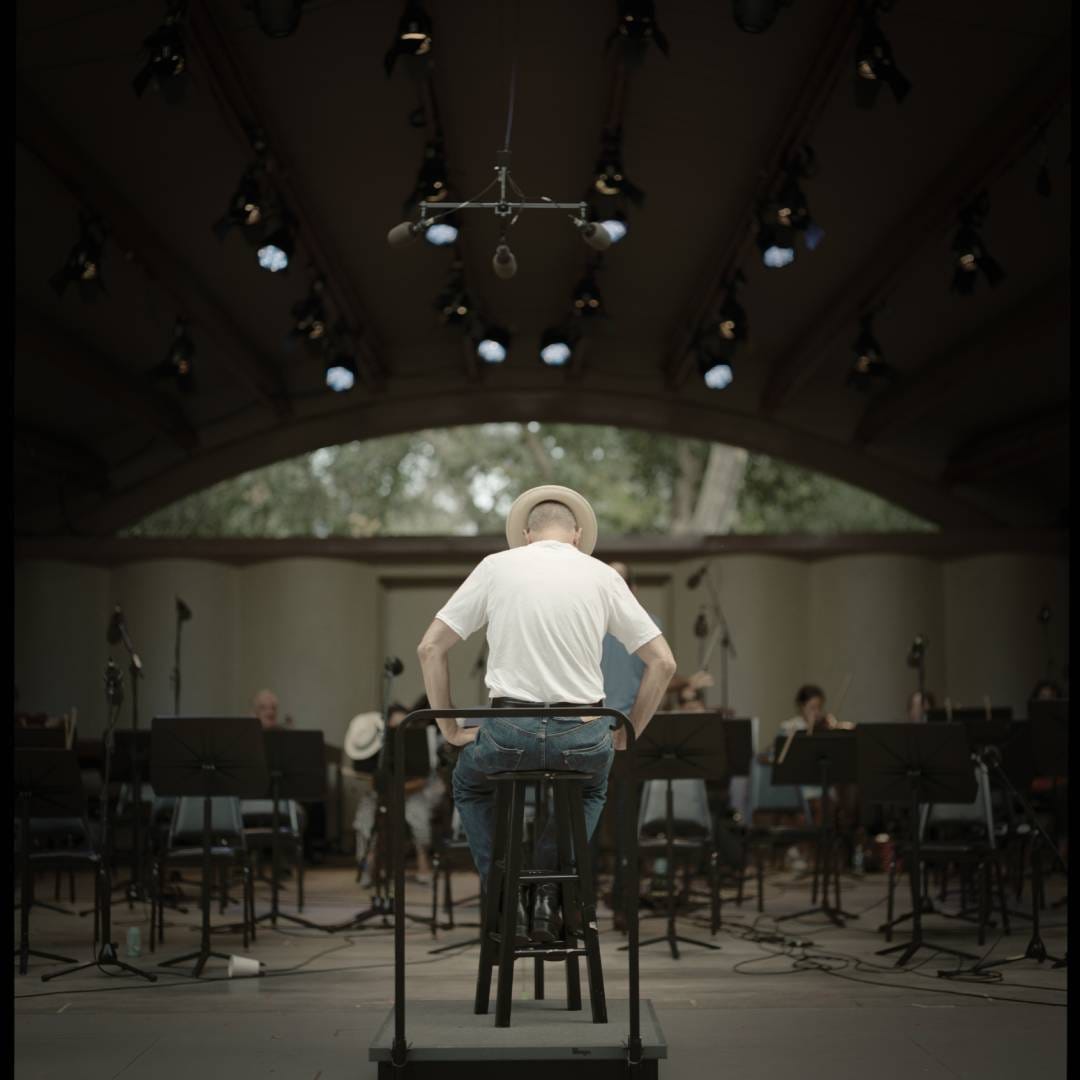
Image via Lucian Read
In a five-decade-long career, John Luther Adams has always chosen to forge his own way, carving out a singular lane for himself as one of America’s best-known composers. After getting kicked out of an exclusive boarding school in Atlanta as a teenager, he cobbled together a portfolio of amateur recordings and send it off to the newly-opened California Institute of the Arts on the advice of a friend, photographer Dennis Keeley (“I never listened to Dennis and I still don’t, but somehow, I knew he was right about this”). To his surprise, he was accepted and ended up being in the first graduating class at CalArts in 1973.
But CalArts wasn’t enough for him as a young musician. At the age of 22, Adams picked up and moved 25,000 miles north to Alaska, where he ended up staying for the next four decades (he finally moved to New York in 2014). Ten of those years were spent living alone in a cabin in a black spruce bog. Its minimal furnishings included a beat-up piano and a clock he kept in the refrigerator. While living here, Adams played percussion in the Fairbanks Symphony and the Arctic Chamber Orchestra (timpani was his specialty). This environment helped shape the recurring obsessions of work – remoteness, nature, introspection and the infinite expanse of the universe.
Adams has a very unique approach to composition. His pieces are composed of simple figures (the shimmering harmonics of Become Desert suspended in stillness; the dissonant fifths of Dark Waves), which progress through gradual surges in volume and intensity and often draw inspiration from various different geographical formations – deserts, rivers, the arctic. In fact, Adams probably owes as much to these natural phenomena as he does to composers like Edgar Varése and Morton Feldman. In each piece, a beautiful little world is realized. Listening to one of his compositions is like listening to form emerge from nothingness.
Throughout the 1980s and ’90s, Adams’ musical output was sporadic and limited. Then, in the early aughts, he began moving at a much faster clip, putting out a project almost every year. His work was well-received by critics and audiences alike, but Become Ocean was the game-changer. Released in 2014, it won him a Pulitzer Prize and a Grammy Award, and the following year, Columbia University honored him with the William Schuman Lifetime Achievement Award. He was, at this point, in danger of being praised to death.
Structured as a gradual accumulation of crescendos, Become Ocean is steadily ominous, yet seems to rise continuously up, never quite breaking the water’s surface. Instead, the listener is left to imagine a swimmer balancing a few meters below the water, rising and falling with the shifting tones.
Adams can count among his fans David Byrne, Iggy Pop, Oneohtrix Point Never, Thom Yorke, Wilco drummer Glenn Kotche and countless others. His music exerts a strange attraction. In 2015, Taylor Swift donated $50,000 to the Seattle Symphony Orchestra inspired by their recording of Become Ocean.
Unfortunately, the environment Adams sought to capture in his work is fast disappearing. During a return visit to Alaska one year, he discovered that his old cabin was sinking as the permafrost below it melted. In a way though, Adams has made the best of the situation. In recent years, he’s found a new natural environment, surrounding himself with rare species of birds in Australia, a move which calls to mind the first album in his discography – 1981’s songbirdsongs, based on actual bird songs – providing a nice symmetry to his remarkable, one-of-a-kind career.
Adams spoke to me from Australia, where he now lives with Cynthia (his partner of 45 years). During our conversation, he shared recollections of his younger years and detailed his many influences, both in and out of the classical field. At 71, he’s still quite active. For his recent recording with the JACK Quartet, Waves and Particles, he is, once again, up for a Grammy this year. – Jackson Diianni
(This interview has been condensed and lightly edited for clarity.)
What kinds of music were you exposed to as a child? Did you listen to pop?
John Luther Adams: As a kid, I had piano lessons. I played brass instruments in the school bands, sang in choirs and that sort of thing, but I didn’t really get my start as a musician until I formed my first garage band. Then, music became my passion. I was a rock and roll drummer, I grew up playing rock and roll, and pretty early on, I became kind of bored with the restrictions of the pop song back in the 1960s, and I think it was through Frank Zappa that I discovered this whole other world of music. You know, somewhere buried in the notes – the fine print of his early albums, there would always be this defiant little quote, ‘the present day composer refuses to die’ – Edgar Varèse. And my little rock and roll buddies and I would read that and we’d scratch our heads and wonder, you know, who is this Varèse guy?
And one day, my pal, Richard Einhorn, who is a composer to this day, was in a record store in Greenwich Village and came across this album with this mad scientist on the cover – the shock of gray hair and the swept-up eyebrows and the sort of stern countenance and it was the Music of Edgar Varèse Vol. 2. He snapped it up, brought it back and we wore out the grooves on that record. And you know, Varèse led to Cage to Nancarrow to Pauline Oliveros to Morton Feldman to this whole other world – to Harry Partch and Ruth Crawford… so I will always be grateful to Francis Vincent Zappa for being the open sesame.
I know you cite nature as a source of inspiration. Were there any other non-musical influences on your work? Visual artists? Filmmakers?
John Luther Adams: I have, over the years, found metaphors – found sources for music, for my imagination, for my curiosity – in visual arts, not so much in film, but more in painting and sculpture. Sure, the New York school of painters – de Kooning and Pollock and Rothko and Philip Guston – but also the next generations, the minimalists. And just this past year, the two artists I admired most, Robert Irwin and Richard Serra, both passed away within a few months of one another. But over the years, I‘ve found inspiration and resonance and encouragement, if you will – equivalence – between what I’m trying to do in music and what some painters and sculptors have been doing in their work. But I’ve also found inspiration, if you will – metaphor, as I like to say – in mathematics, in chaos theory, for instance, in the science of ecology. More recently, I’ve found inspiration and even a kind of faith in geology. In rocks. My most recent recording is called An Atlas of Deep Time and it’s ‘rock’ music. Back to my roots. It’s about 42 minutes long and the Earth now is about 4.5 billion years old. So the tempo marking on the score is circa 100 million years per minute. Very fast music.
What was your evolution into the role of composer like?
John Luther Adams: Clueless, fearless, curious. Nobody told me I couldn’t be a composer, so I decided I would be. It really had a lot to do with listening. With just snapping up not only these recordings of new music of Nancarrow and Harry Partch and Feldman, but also world music. Nonesuch [Records] in those days had what they called the Explorer series, so Indian classical music, Chinese classical music, Balinese and Javanese gamelan. And you know, Impulse was a very important label back then, so yeah, Coltrane and Eric Dolphy and Pharoah Sanders and Ornette Coleman. You know, this whole world of free jazz or whatever we call it now, opened up to me. I just listened to everything I could lay my ears on. And then I just started writing pieces. Much to my mom’s chagrin, I started putting nuts and bolts and hardware and ashtrays into our little baby grand piano in the living room and writing my first piece for a prepared piano. I just started doing it [...]
Would you ever consider being a movie soundtrack composer?
John Luther Adams: My music has been used in films from time to time. Most notably, I guess, in The Revenant. And in different films. But no, at this point – Richard Serra said years ago, ‘there comes a point in an artist’s life when all your influences, all your sources, have been deeply assimilated and you’re working from out of the work itself’. And I think I’m there. I’ve been there for the last decade or so. So work comes out of work. And it’s this self-contained world that keeps renewing itself and my job is to pay attention to it. So I have a hard time imagining someone coming to me and inviting me to compose for a film and my saying ‘yeah, I’ll do that’. On the other hand, I’m delighted recently – you should look this up, I think you might enjoy this – there’s a Romanian filmmaker named Leonard Alecu. I’m not even sure I’m pronouncing his name correctly. We’ve never met. We’re email buddies. And unbeknownst to me, he composed a complete film, a stunningly-beautiful film called Ice Breath, based entirely on Become Ocean. There’s no narration, there’s nothing but image and music. And the film is exactly 42 minutes.
It begins and ends with the music. It’s stunningly beautiful and I love it because it’s stunningly beautiful, it’s haunting and disturbing because it’s all filmed in Eastern Greenland and it’s icebergs. It’s the melting of Greenland. In black and white, infrared, slow-motion, up-close. Just every possible angle. And it’s on these mountains, these ranges of ice that are now calving off of Greenland and into the North Atlantic and drifting South. And what impressed me – I was skeptical when he asked if he could license the music – I saw the film and I was stunned by how musical the editing is. I mean, it’s a beautiful film as a film. But it’s incredibly sensitively edited. So Leonard is now doing a film to Become Desert, which he’s going to be shooting in Namibia. So this is my idea of a film score. I make a work of music that is, I hope, in its own way, a world, a place, a self-contained experience for you, the listener. And then, this gifted listener, this brilliant filmmaker, takes that piece of music, makes it his own and imagines and then brings about this beautiful, lyrical, haunting and disturbing visual dimension that I never could have imagined. That’s magic. Anyway, long answer to your question. No, I don’t think I’ll be composing a Hollywood film score anytime soon, but I am working with a filmmaker.
Was Brian Eno an influence?
John Luther Adams: No. I admire what he does and clearly there’s a certain affinity or a superficial similarity at times. The sound and also the whole idea of generative processes. The mathematics beneath the surface of the music. But I kind of lost the 70s and the 80s in pop music, because I was shot out of a cannon from Southern California and I went to Alaska and I lived alone in a cabin in the woods for a decade. So I just wasn’t paying attention at all. So I missed My Life in the Bush of Ghosts and Music for Airports and all of that sort of stuff. I found out about Talking Heads later. Which is fine. But I can’t count any of that music as in any way an influence. But when I finally heard this music, I thought, ‘oh yeah, I like that.’
Would you ever write music about an environment or a natural setting you hadn’t been to?
John Luther Adams: I don’t think so. Because I don’t do tone painting. I couldn’t work from a photograph or a film or an image or even someone else’s description of a place. Music is not what I do, it’s how I understand the world, it’s how I know where I am and how I fit in. So now, I’m in Australia. We’ve been here for the whole year, and who knows how long we’ll stay? You know, I began my life’s work in a very real way in Alaska. And maybe I’ll end it down here on the other extreme of the Earth. In the tropical savanna or the tropical rainforest or the desert or the wild coast of the Tasman Sea. I’ve gone back to my first teachers, the birds. And the birds down here in Australia are like no place else on Earth. In evolutionary terms, they’re truly unique. And we have a few hundred species in North America. Down here, there are almost a thousand species of birds. And they’re noisy.
There are some sweet singers and tweeters, but there’s a lot of percussion down here. So I’ve got this whole new world that I’m just beginning to explore, and it’s essential for me to be here, to be in a place. I can’t imagine that I would ever compose music about a place that I don’t really know. I’m not interested in just visiting a place. I don’t want to be a tourist of any kind. If I’m going to go somewhere, if I’m going to burn the carbon to travel a long distance, I’m going to stay there. And I want to feel in some way as though I know the place. That in some sense I live there. Although how could I live there in Australia? The Aboriginal people have lived here 30, 40, 50, some people think even 60,000 years. That’s a long habitation of a place. But I can’t go somewhere for a week or two and then get back on a plane and fly home and write a piece about it. That’s just not how I work. That’s not how I want to be in the world.