

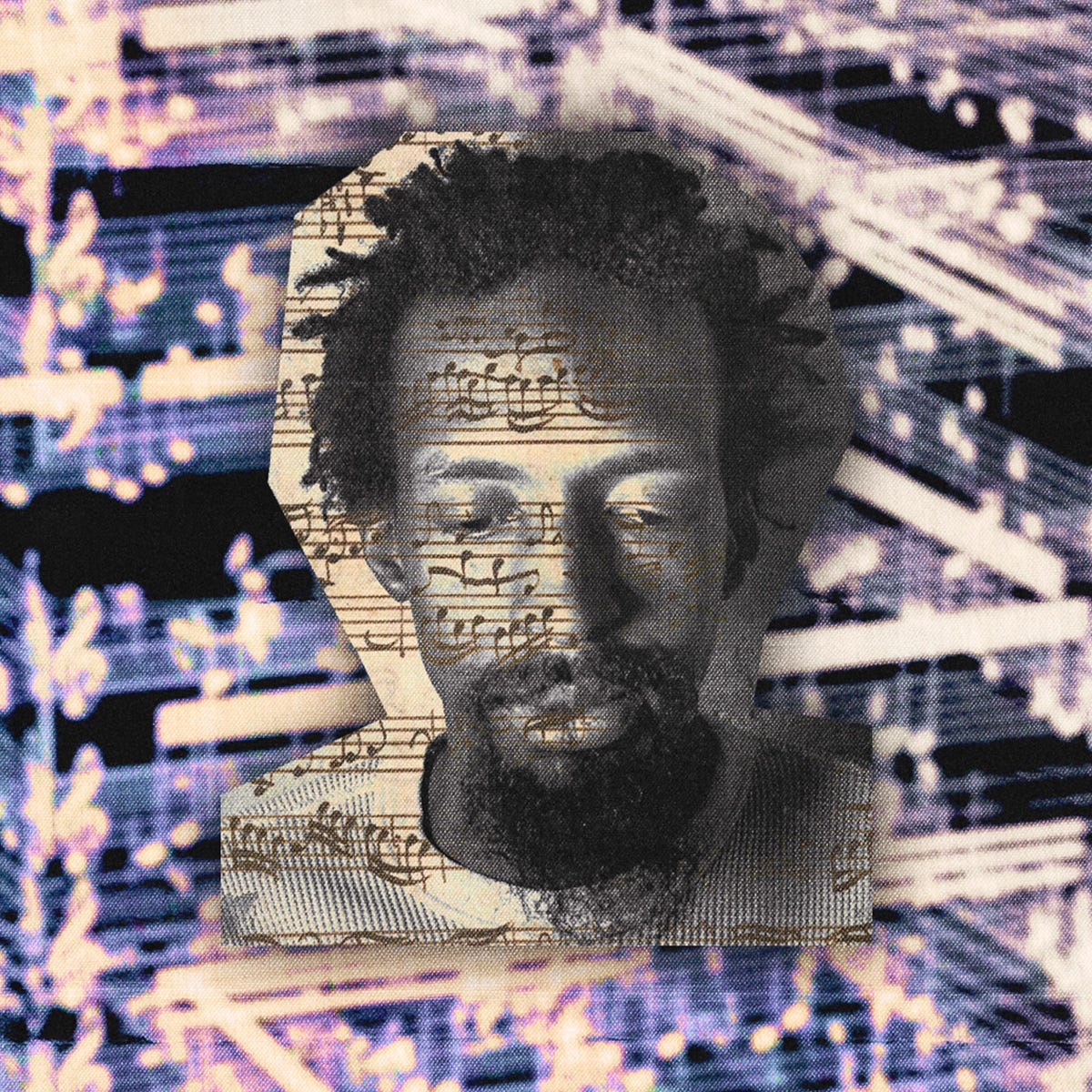
It’s hard to comprehend, especially in this moment of absolute cultural saturation, that the vast majority of the music ever made will never be heard again. Before the invention of recorded sound, though, that’s all that music was: something that happened once, never to be played in the exact same way again. The age of recorded music seemed to end that phenomenon stone dead. Yet as the historical record became more resilient, the fascination with vanished art grew, understood as a window into the prejudices and hierarchies which determine the canon. In the time of the abundance, forgetting music has become an act of political erasure. Losing something has become a choice. One such case is Julius Eastman.
Listening to the music of Eastman is a revelatory process. Some of the most iconoclastic songwriters of our time have become infatuated. Listen to “Joy Boy,” with its buoyant, springtime bounce, or hear the beginning of “Evil N-----” and its torrential skeleton keys. I spent my late teenage years around a lot of classical music, but I’ve never heard anything like Eastman. These aren’t suites or symphonies—they’re jolting and confrontational, as vicious as a Bad Brains song, as beauteous as Weyes Blood.
The first revelation came in 2005, upon the release of Unjust Malaise, the first—and then, presumably only—major compilation of the few remaining recordings of Eastman’s work, pieced together after a decade of Indiana Jones-style excavation by composer and lecturer Mary Jane Leach. Eastman’s boon time was the 1970s; the most recent piece of music on Unjust Malaise had been completed 20 years before its release.
My entire music life I’d seen buzzy revisitations like this come and go (who remembers Lewis?), but this was different. Unjust Malaise, as one writer in The Guardian put it, “completely rewrote the history of post-war American new music.” Eastman was an American minimalist operating at the vanguard of that movement, but his work was completely unlike his contemporaries— retaining an emphasis on repetition but growing outward not in length but in bulk, a post-rock ethos two decades before Godspeed You! Black Emperor. Suddenly Eastman’s name needed to be mentioned alongside the likes of John Cage, Terry Riley, Steve Reich and Philip Glass; it expanded the oeuvre and complicating the timeline. Mary Jane Leach had only remembered his work at all because she’d once caught a show of his at The Kitchen in Manhattan. When she mentioned his name to colleagues, few had even heard of him. Without her, Eastman was vanishingly close to being lost forever.
Julius Eastman died on May 28, 1990, in a Buffalo hospital at the age of 49. For eight months, almost nobody noticed. Eastman had spent his final decade living largely in destitution, his scores and manuscripts scattered to the wind during an eviction from his East Village apartment in the winter of 1982. Years of homelessness and addiction followed. That rupture came just as Eastman was producing some of his most vital work, appearing as singer, keyboardist, and conductor on records by Meredith Monk and Arthur Russell, barely a year after his notorious residency at Northwestern University where he premiered the three large-scale masterpieces he is now best known for: “Evil N-----,” “Crazy N-----,” and “Gay Guerrilla.”
The titles of that tryptic embody an increasingly confrontational ethos taking hold of Eastman’s work. He was a gay Black man operating among the most conservative cultural institutions in a time when homosexuality remained illegal, when Black Americans had only recently won full civil rights. Still, he compromised on nothing. “What I am trying to achieve is to be what I am to the fullest” he said in a remarkable 1976 interview. “Black to the fullest, a musician to the fullest, a homosexual to the fullest”. Eastman notoriously made his own remembrance difficult. He showed no regard for high-society mores, pissing a lot of influential people off. He used his scores as lining for his cat litter tray; he wrote directions in scrawled, incomprehensible hand—but its also hard to imagine his vanishment unfolding in quite the way it he had not been who he was. Eastman was failed, in several directions, by a culture which failed to commemorate his phenomenal art, and a social care system which lets so many Black, queer men die destitute and young.
In the wake of Unjust Malaise, Eastman began to be worked into the repertoires of concert halls across America, slowly. In 2015, the London Contemporary Music Festival put on the first major festival of Eastman’s music, followed closely by a 2017 exhibition and concert series in Philadelphia, pieced together following three years of research.
Few though have committed themselves to the project to the extent of L.A. ensemble Wild Up. Bandleader Christopher Rountree—a three-time Grammy-nominated composer and conductor—first encountered Eastman in 2012, and began a decade-long process of toying with his music. In 2021 he and his band dedicated themselves fully, committing to producing seven volumes once a year for seven years, performing all of Eastman’s surviving work—some of which we have recordings of, some of which is being laid to tape for the very first time. The end project will be something astounding and utterly unique—a greater feat than Beach Boys’ Smile or Dylan’s Great White Wonder—seven discs, decades in the reconstitution, completing one of the great jigsaw puzzles of 20th century American music. Julius Eastman, resurrected in full.
For Wild Up, the process has been transformational. Rountree told me about the way in which Eastman’s elusiveness has changed his approach to all music, in whichever form he encounters it. “Julius’ work has changed the way we work on everything else,” Rountree tells me. “It’s very special to encounter this thing and it catalyzes chemically with the way you run a rehearsal in general. We did a big festival of Eastman’s work at L.A. Phil and Andrew Yee, a really remarkable cellist, was playing with us for the first time. We had nine hours to rehearse and we were just talking. She asked, ‘Do you always talk this much?’” He laughs. “It’s why we have nine hours: so we can argue about how it goes. So much of the classical conservatory is just being on the factory floor: playing your part, doing the work and clocking out. The exact opposite of that is what’s required to do Eastman… It’s so open that it could be almost anything.”
Even after spending years with his work, the fifth volume of Wild Up’s anthology was a formidable proposition. Centered around what Rountree terms Eastman’s “opus,” “Gay Guerrilla”—the third of the Northwestern trilogy—is the composer’s most totemic, ferocious work. drawing on the characteristics that mark Eastman as a singular figure: queered allusions to Lutheran hymnals, passages of almost unbearably tense repetition, and sudden explosions of melodic ecstasy. Rountree perpetually emphasizes not simply doing justice to Eastman’s work but embodying his radical artistic approach: “Eastman only gave one sentence of instruction” he told me, “which is that all the instruments need to be of like-type. I knew we were going to break that rule.”
The music itself invites comparisons which might once have seemed outrageous. Where a canonical figure like Steve Reich was producing works of elegant systemic order, Eastman was doing something rawer and more visceral. His proto-minimalist architecture—those long, grinding repetitions which accumulate enormous psychic pressure—anticipate the feel of J Dilla’s deliberately slipping rhythms; the sense of time as something inhabited rather than measured. Hear the string which erupt twelve minutes and ten seconds in, set against the juddering grid of a piano; bright, jolting and strange; as thrilling as a Hit-Boy beat switch.
Because the project offers the most definitive version of a deceased composers work to date, deciding on the final version of each performance Wild Up present to the public remains a great challenge, and Rountree has approached it by filling the room not only with formidable players, but Eastman scholars. “We have ten philosophers in the room,” Rountree told me. Their version of “Gay Guerrilla” is, he tells me, the second of three full recitals, the winning version agonized over for months.
As is the way with the ongoing story of Eastman’s remarkably incremental resurrection, Wild Up’s members have become woven in to its tapestry . Richie Valitutto, the band’s pianist, is currently completing his dissertation on Eastman’s work at Cornell and was alerted by the leader of a church chorus, in the basement of a church which was due to be demolished, their were lost manuscripts of Eastman’s “Moon’s Silent Modulation,” of which there is no recording, soon to be discarded. Instead, the new piece appeared on Julius Eastman Vol. 3: If You’re So Smart, Why Aren’t You Rich?
It is a fitting metaphor for the project as a whole: Eastman’s resurrection was not dependent on institutions, but rather counter-cultural figures individuals like Leach, Rountree, and Valitutto who happened to be paying attention. That sensitivity, it transpires, cuts both ways. Classical music in general has been considered démodé for nearly a century now, but what’s striking is how Eastman embodied facets of American music we now take completely for granted as early as the 1960s. Explaining the title “Gay Guerrilla” to his Northwestern audience, Eastman said “a guerrilla is someone who is[…] sacrificing his life for a point of view. And if there is a cause—and if it is a great cause—those who belong to that cause will sacrifice their blood.”
The confrontational politics of Eastman feels familiar to us now, central as it is to artists who’ve released similarly searing work this year, such as Vince Staples or Ghais Guevara: artists for whom confrontational, uncompromised Blackness is the art, not simply its context. Meanwhile Eastman’s celebration of Black queerness—its capacity for defiance and devotion and joy—resonates alongside contemporary artists like Frank Ocean, Isaiah Rashad, and Princess Nokia, for whom the intersection is utterly central.
For a time then, Eastman’s work could, institutionally speaking, be celebrated for its ability to demarcate social progress. It took me some time to realize that the word “guerrilla” was, in 1979, not the most socially confronting word in the piece’s title. As Wild Up’s fifth volume arrives though, Eastman’s music has been imbued with not simply new form but a tragic political relevancy, as that old world order makes it own gradual restoration.
As we spoke, Rountree told me that every year Wild Up applies for an NEA grant to continue their project of restoring Eastman’s work, and ever yyear the funding had been approved. But then the administration changed, and the funding for “Gay Guerrilla”—already approved—was suddenly revoked. This is this is the way that culture works, when fascism is in power. The erasure of artists who prod at the hypocrisies of empire is not a historical artifact alongside the music: It is a present, active threat. Once again, 36 years after his early death, Julius Eastman finds himself at an inflection point, still living on through his beautiful music, still survived by its tragic relevancy.
Wow. One of my favorite pieces yet and first time listening to Eastman. This some powerful ass music.