

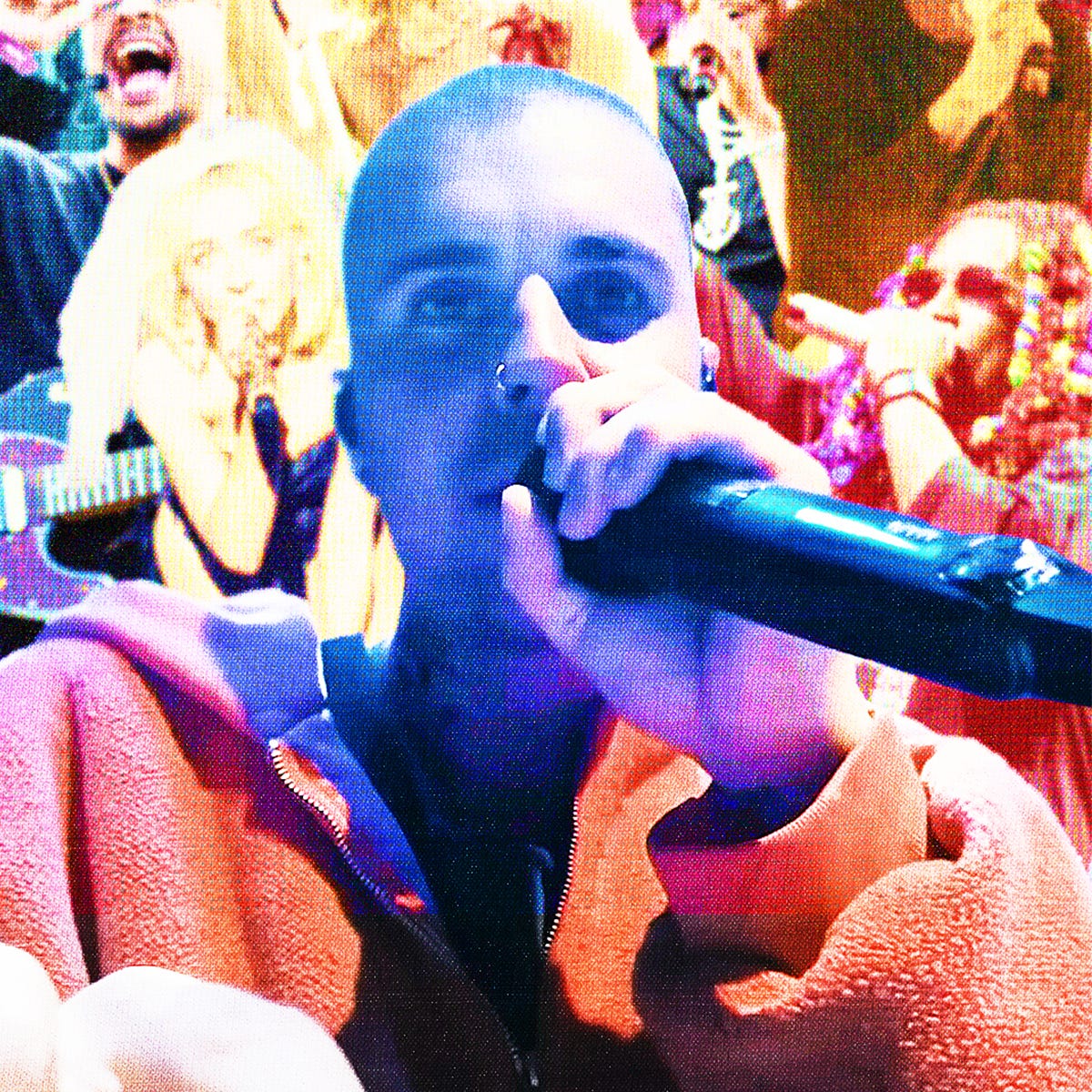
Art by DJ Short
In real life, you’re not supposed to look. You can’t be caught doing a double take at their sultry head tilts, prêt-à-porter shoulder leans, and gyroscopic triple axel fit reveals. This isn’t fashion week; there’s no front row set aside for those who want to alternate solemn gazes and reverent nods of approval. This is the VIP Section of Coachella, hallowed ground for the hollow. And these al fresco photo shoots and calculated reel creations are both an influencer rite of passage and form of financial restitution. Remember Econ 101: There is no such thing as a free all access wristband.
If gawking is what you want, you have options. In fact, you are highly encouraged to drop your favorite acronym in the comments. But don’t be gauche. These passionate declarations of sartorial approval and remonstrance are reserved for the fans judging at home. In the flesh, you must keep the fun going, as prescribed by the sign on the Google Gemini Photo booth. And why not savor the aesthetic bliss of this collagen Versailles—where everyone can be a spray-tanned Sun King?
Consider the cosmic blessings that allowed you to be on the polo field, versus those condemned to life in the digital bleachers. Pour out a little bit of Kendall Jenner’s 818 Tequila for those who didn’t make it. Inhale the Sol de Janeiro perfume mist. Remember, you cannot petition the Lord (or even Lord Disick) for prayer. That power belongs to Justin Bieber and Justin Bieber alone.
Coachella is no stranger to obsessive fandom. Recent stan armada invasions have included the Blinks, the Harries, Los Conejos, and the Frank Oceanographers. Normally, this intensity of devotion has been relegated to the GA masses outside the beeping VIP pylons. But the fully grown Beliebers have overrun the entire festival with the swiftness and fervor of peptided Mongol hordes. Even Julian Casablancas of the Strokes thanks the crowd for fulfilling the band’s “lifelong dream of opening for JUSTIN BIEBER” (Casablancas pronounces his name with the implicit heart-eye emoji).
Sabrina Carpenter and Karol G nominally headlined this year’s Coachella, which was easily the best since the pandemic. Some of the most innovative artists of the last half-century delivered brilliant sets, including Young Thug, David Byrne, Jack White, Iggy Pop, Clipse, Isaiah Rashad, and Trent Reznor. As always, America’s premier music festival elicited cameos from past and probable future headliners: Olivia Rodrigo, Lisa from Blackpink, Peso Pluma, Billie Eilish, SZA, Madonna, Snoop Dogg, Will Ferrell. But you didn’t need to see the thousands of car windows in the parking lot crayoned with “Bieberchella”—alongside the date of the messiah’s birth—to know that this year’s iteration was defined by the Elvis Presley of a generation barely sentient for the pre-iPhone world. If Elvis needed a swag coach.
The line for swag is endless. Across the field, at all hours, at least 100 people queue at the 10,000-square-foot, Bieber-branded Skylrk Oasis for the opportunity to buy $140 “It’s Not Clocking To You” hoodies, t-shirts advertising Bieber’s latest album, Swag, and “Future Mrs. Bieber” baby tees designed by Hailey Bieber herself (wink wink). Like the 2Pac hologram would have wanted, you can purchase your own “Bieberveli” merch or cop a “Sizzler” silicon iPhone case, equipped with a joint-shaped “integrated multi-use holder.” According to reports, Bieber’s Skylrk brand grossed over $15 million over both weekends in Coachella, shattering the previous record for an artist-owned brand on festival grounds by nearly nine times.
In the week leading up to the festival, TikTok and IG were a conflagration of psychic horror. Demand for “Bieberchella” became too obscene. After dangling free passes in exchange for content, brands and influencer agencies abruptly revoked them. Dozens of Airbnbs, confirmed and paid for, were cancelled. Would-be revelers were forced to slum it in seedy motels along Highway 111. In America, there is always someone richer, or at least dumber, and owners of modest four-bedroom desert abodes with a pool were now getting $50,000 or upwards for four-night stays.
You’re laughing, but you didn’t glimpse the tears of the quasi-influential and abandoned. You weren’t with them at the stylist being tousled, primped, lightened, and flat-ironed. You weren’t shooting injectables with them at the dermatologist’s office. You could never withstand the pain of taking a hammer to your cheekbones. Remember the saddest eight-word short story ever written: Infinity trifold makeup mirrors packed, never used.
But as Victor Frankl wrote, “Those who have a ‘why’ to live, can bear with almost any ‘how.’” For approximately 200,000 attendees at Coachella, their raison d’etre was the 32-year-old ex-Lil Twist accomplice behind mission statements like Believe, Purpose, Swag, and its sequel, Swag Harder.
It’s the wrong side of midnight on the first Saturday of the festival. For the last 50 minutes, Bieber has crooned songs from the Swags, solo in an oversized pink hoodie and Adam Sandler pantaloons. He performed an acoustic portion—the type of all-grown-up artiste gesture that gets you booked with a symphony orchestra at Carnegie Hall. Think Jon B making a Frank Ocean album. Or if Jack Johnson got really into early ‘10s Chris Brown. But now, it’s time to log on.
Sitting down at a laptop, Bieber cracks his knuckles and tells the audience that he’s going to “take us on a journey,” which entails a YouTube time machine back to his breakthrough single “Baby” and the ‘07 clip that got him discovered in the first place: a talent show cover of Ne-Yo’s heart-shattering “So Sick.” He was 13 and finished in third place. Within three years, Bieber would be the most famous teenager since Britney Spears.
In 2013, Bieber’s former manager Scooter Braun claimed that the then-teenager was “the only person in humanity who’s grown up the way he has—with smartphones and cameras on him 24/7.” He is one of the first native mutations of full-time surveillance. A commercial product of the age where the camera phone, social media, and the notion of performativity has thoroughly demolished our previous understanding of what it means to be a human. And now, Bieber offers a post-verbal chronicle of his roots via URL surfing and nostalgia for the time before internet memes became a form of mechanized warfare.
At Coachella, most people surrounding me are filming the 100-foot-tall projection of Justin Bieber glued to a laptop, watching his pre-pubescent self be taped for a singing competition. Within minutes, they will post videos of themselves watching screens that show Justin Bieber watching himself. Of course, millions are simultaneously watching it on the livestream. Whatever you want to make of it, Andy Warhol was right.
These days, if you leverage your 15 minutes properly, you can be famous enough to sell Fashion Nova for a lifetime. The idea of the household name is obsolete.
Network TV is dead, and cable is endangered. Outside of Timothee Chalamet and a few Euphoria stars, very few can name any legitimate movie stars under 40. NBA Youngboy is arguably the most popular rapper under 30, but New York Substackers are writing essays about how astonishing it is that no one downtown knows his name (unless they have a Pitchfork byline).
Earlier Saturday, on the same stage, Addison Rae had triangulated Oops…I Did It Again Britney and Lana Del Rey to perform the most compelling pop set of the festival. She has 88 million TikTok followers. By any quantitative measure, she is absurdly popular. Yet in terms of real-world impact, her ceiling is probably limited to a massive, ever-expanding cult. Your average normie probably couldn’t pick her apart from Madison Beer (I don’t know who Madison Beer is). “Diet Pepsi” may have 677 million streams on Spotify, but no million-dollar Pepsi commercials are airing at the Super Bowl.
By contrast, Justin Bieber is a religion. This is partially a quirk of timing. Bieber rocketed to fame right before the monoculture finally shattered, at the start of an all-too-brief cultural renaissance. The first half of the last decade now feels like a final heave of collective hope. The most severe aftershocks of the 2008 recession had largely ceased. Your parents hadn’t discovered Facebook. Obama was inviting rappers to the White House and Lin-Manuel Miranda was just an aspiring librettist trying to emerge from the garbage can where Immortal Technique had tossed him. AI didn’t portend a looming economic upheaval; he was still hooping in Turkey. The combination of low interest rates and a venture capital boom ensured that the millennial lifestyle was being subsidized by low-cost transportation, food delivery, and free Vice parties sponsored by PBR. Chromeo was everywhere.
In 2010, the future 45th and 47th President of the United States was still hosting The Ultimate Merger, an Apprentice spinoff in which he attempted to help Omarosa find love in a hopeless place (Las Vegas). Al B. Sure was eliminated in the sixth episode. At the end of the show’s run, Omarosa winds up with no one, a portent of the future to come. And that same year, Justin Bieber, a cherubic, mop-topped Canadian, was introduced to the world as the unblemished protege of Usher and Ludacris. What could go wrong?
It’s not like there weren’t warning signs. In that second year of Obama’s presidency, the Based God already cautioned us that how the Age of Information was ruining the human race (“everything is now on the internet…are we dumbing down for technology and the cost of living?”) To Bieber’s credit, he was obviously listening—at least since Lil B had rhymed “Bieber Fever” with “know I got the heater.” And on the first Swag, Bieber finally paid off his creative debt by bringing Mr. Look Like Jesus to preach unity on “Dadz Love.”
Bieber was by no means the first bubblegum phenomenon. Despite the differences of technological transmission, his initial ascent ostensibly seemed little different from long-forgotten ‘70s adolescent heartthrobs like Leif Garrett, David Cassidy, and Donny Osmond. He was clearly in the lineage of the New Kids on the Block, the Backstreet Boys, and ‘N Sync. Nor could you ignore the patronymic lineage of the first teenage daydreams-turned-Sirius XM channels, Presley and Frank Sinatra, the original young pope of the bobby-soxers.
But Bieber had several unforeseen advantages. For one, he, Usher, and Scooter Braun successfully exploited the vacancy for male teen pop idols that had existed since the boy bands broke up. The Disney-to-Platinum pipeline almost exclusively manufactured female stars like Miley Cyrus, Ariana Grande, and Bieber’s ex, Selena Gomez. His lone direct competition was the Jonas Brothers, who were so wholesome that they made Hanson look like Van Halen. By the time that One Direction reintroduced suspenders to American shores, Bieber had already been nominated for multiple Grammys, released one of the highest-grossing documentaries of all-time, and become the first artist in Billboard charts history to have five US number-one albums by the age of 18.
This is when signs of post-child star turmoil began to appear. There was a Calabasas egging brouhaha with his attorney, Lil Za. A Miami Beach arrest for drag racing drunk with an expired license in a yellow Lamborghini. He abandoned his pet monkey, OG Mally, in Germany, mooned his friends at the Mayan pyramids, and was escorted out a Brazilian brothel in bed sheets bearing said brothel’s logo. He puked onstage and pissed in a bucket in a restaurant kitchen while screaming “Fuck Bill Clinton.” There was an alleged assault of his bodyguard and a limo driver. Worst of all, he insisted that people call him “Bizzle.”
In later interviews, Bieber blamed it all on the Xanax. Mostly, it was a sensational career move. In order to be taken seriously as an adult, Bieber needed to shed the baggage that follows when your teenage years are spent being petted like a Shih Tzu by Ellen DeGeneres. And when Skrillex and Diplo remixed a piano ballad that Bieber had co-written with Poo Bear into “Where Are Ü Now,” a generational dubstep-meets-chipmunk soul heater, it suddenly elevated him into the ranks of pop stars that you had to take seriously—lest you be called a rockist, a hater, or the second coming of C. Dolores Tucker.
If you were outside in the mid-2010s, you couldn’t deny “Where Are Ü Now” or its sequel, “Sorry.” I even heard them played a few times at Low End Theory, where having Justin Bieber in your Serato would have been considered a war crime only a few years prior. While the critical fawning was slightly excessive, Bieber earned the respect. He always had a nimble and levitative voice, but he picked the right collaborators and learned how to really sing. He’d never be Usher or Ne-Yo, but he had a lighter touch and more range than Justin Timberlake, whose blue-eyed soul throne he’d snatched.
In a moment fraught with extreme paranoia and conspiratorial thinking, we’ve paradoxically welcomed the extinction of our privacy. Every now and then a few consumer advocates might raise the alarm that Kash Patel is using the Patriot Act to set up fake Kalshi accounts. But mostly, the American people have embraced the panopticon, flipping the cameras back on ourselves in search of maximum profit. We’ve upended old taboos about what personal truths were appropriate to reveal to perfect strangers. Everyone is micro-dosing celebrity. If the concept of shame had long engendered needless repression and self-loathing, it’s more refined sibling, dignity, helped safeguard a functioning society. A noble virtue that allowed for necessary restraint is now an enemy of the algorithm.
The last Great Gold Rush is for the cannibalization of the self. The winners are rewarded with clout dementia, a condition for the neurologists of the next generation to study, where nothing real exists outside of your narrow lens. This is what it’s like to be present for the Coachella Influencer Ironman: I am an NPC in their infinite scroll. The costumes, settings and songs may change with each seasonal fad, but in this matrix, the outside world is merely a prop. A splash of paint on a trompe l’oeil or a Sim without personality traits. And the high priests at the top of this ritual pyramid are the Biebers.
Unlike Anne Frank, I would not call myself a Belieber. For most of the last decade, I was only ambiently aware of the level of sustained worship towards him. Every few years, he’d pop up and do a magazine cover, where he’d obtusely reckon with religious piety, the temptations of fame, and the weight of being The Chosen One. There was the occasional Coachella or Grammy cameo. The close association with the Calabasas illuminati. That cultish Hollywood Pentecostal church. “Despacito,” of course. And someone named The Kid LaRoi? Not for me.
In 2018, Justin Bieber married the former Hailey Baldwin, a union that made them the Jay-Z and Beyoncé for people who have replaced their morning coffee with a caffeine reset sculpting cream mask. When Erewhon, the private equity, gluten-eradicating cold-pressed paradise partnered with Bieber for her own $20 Strawberry Glaze Skin smoothie., it made the supermarket an international status symbol. When they quietly took her name off of it last fall, presumably due to the licensing deal expiring, it made national headlines. Outside of the Jenners, there is probably no more closely followed Gen Z(ish) female figure—at least among those known for reasons unfathomable to your grandparents.
It’s a fairy tale for “Get the (Birkin) Bag” culture. The princess is played by a modestly successful model, former diehard Belieber, and daughter of the third-most popular Baldwin brother. After biding her time and saying her prayers, the biggest pop star of modern times proposed with a half-million dollar diamond ring. At her 2019 wedding reception, Hailey Bieber was serenaded by her husband and childhood crush. You can watch love conquer all on episode eight, “The Wedding: Officially Mr. & Mrs. Bieber,” of the YouTube documentary, Justin Bieber: Seasons.
This, too, was a sensational career move. Off the strength of her looks, charm, and new last name, Bieber launched the skincare brand, Rhode, in 2022. In less than three years, e.l.f. cosmetics purchased it for a billion dollars, leaving her in charge as the Chief Creative Officer and Head of Innovation. While I’m no cosmetology expert, my sources tell me that Rhode’s invention of an iPhone bubble case with built-in lip balm storage was the most ingenious technical innovation since the car cupholder. On both weekends of Coachella, Bieber and her brand hosted “Rhode World,” an “invite-only immersive activation” in honor of their new “hero product,” a pimple patch called Spotwear, which was developed with Justin Bieber across two years of laborious toil.
If you peruse the current Mrs. Bieber’s Instagram (58.1 million followers) or TikTok (a svelte 18.7 million), the content is almost thematically identical to any of the Coachella beauty influencers who have perfected the double-billed platypus pout. She’s posing in bikinis and expensive gowns, eating sushi to Britney Spears songs in face masks, and constantly dropping her skincare routine. The principal difference is that sometimes Billboard’s 8th Greatest Pop Star of the decade appears, as does their son, Jack Blues Bieber. At Coachella, the 20-month-old is decorated with a “Bieberchella” tattoo, presumably temporary.
If Justin Bieber’s better half depicts a jetset girlboss fantasy life, his transmissions to his 294 million Instagram votaries (the most of any male musician), have often been chaotic. This, too, is to his benefit. For the last 18 months, the content salt mines were aflame with videos asking some variation of “Is Justin Bieber Crashing Out?” At his most visibly erratic, there was a two-week stretch where he posted a different Drakeo song every day, a gesture that caused me to radically reevaluate my understanding of Bieber’s game. Clearly, Justin Bieber knew the truth.
But Aldous Huxley pointed out that “you shall know the truth, and the truth shall make you mad.” In Bieber’s case, the most acute manifestation was his viral confrontation last June, where he confronted a paparazzo outside of the Malibu SoHo House. Cowled in a blue hoodie, the singer unleashed an impassioned tangent that became an instantly platinum meme. “It’s not clocking to you that I’m standing on business” became one of those cultural hiccups to achieve total ubiquity, alongside other 2025 contenders like “6-7” and the software executives cheating at the Coldplay concert.
Within weeks, Bieber posted himself in a “It’s Not Clocking To You” hoodie, which eventually became the most ubiquitous merch of this year’s Coachella. As the internet does to everything, it made it a joke, which Bieber was in on, all the way down to a Swag skit where Druski reproaches him for over-enunciating “business.” But in its inevitable memetic dilution, it deleted the emotional power of Bieber’s rant from the collective long-term memory.
If you watch the video again, it’s his variation of Britney Spears smashing the paparazzi’s car with an umbrella. Authentic flesh-and-blood fury aimed at the cameraman, who serves as a proxy for all previous tormentors. A Truman Show-style break, where Bieber’s “rage” was really a moment of clarity and attempt to escape the prison in which he was trapped before he was old enough to understand the consequences.
The less amusing part of the video—the seconds that didn’t get clipped and quoted in news aggregations—concern Bieber’s raw humanity:
“I’m a dad! I’m a husband I’m a human fucking being!” Bieber tells the videographer, who keeps filming, aware that each extra second captured could be worth another thousand dollars. “You don’t think I’m a real fucking guy do you? You’re going to take this video out of context. You’re going to say I’m mad…Stop provoking me. I’m a real dad. A real husband and a real man!”
If this was once self-evident, it isn’t any longer. Bieber’s enduring superstardom coincided with the rise of stan culture. It’s not a particularly novel observation that celebrity (and politics) have filled the spiritual void once occupied by religion, family, and the cash rules pursuit of happiness. But the combination of parasocial obsession, the dehumanization of screen life, and our own narcissistic self-branding impulses, make it pretty fucking easy to pretend that these aren’t real people. For Justin Bieber, the world has always been a stage; for the rest of us, it’s an audition.
If Bieber possesses a streak of genius, it’s a byproduct of instinct. Most pop star crackups end in rehab, not the main stage of Coachella. But Bieber capitalized on his duress better than anyone in recent memory. There’s an old baseball pitching term called “pleasantly wild,” which refers to a hard-throwing pitcher who turns his unpredictable control into an asset. The batter can’t quite get comfortable at the plate because he never knows when a 95 mile-per-hour fastball will go screaming at his head. Intentionally or not, Justin Bieber embodied the concept: posting possibly drug-addled videos all over his Instagram, standing up to the paparazzi, singing in his boxers at the Grammys. No one could look away. In the process, he created insatiable anticipation for his Coachella performance, where the overarching question was, “what type of crazy shit will he do?” Bieber reportedly negotiated his own $10 million performance fee. No manager. We should all be so mad.
In the first section of Bieber’s set, the answer to all of the anticipation is nevermind. When I rewatched it later on the Livestream, it was memorable. But after six hours and three double whiskey and sodas, the reality of watching Justin Bieber croon wispy Calabasas slow jams was pretty deadening. The visuals were almost non-existent. No backing band or big name guest boosted the adrenaline. Still, the masses were enraptured. Usually, the audience thins out as the night winds down, but this is the most crowded that I’ve ever seen it.
Bieber is up there all alone, doing yearning R&B ballads like he was Mario, Lloyd, or any other mononymous loverman from the late ‘00s whose Coachella invitation was surely routed to spam. The question of race becomes unavoidable.No one expects Justin Bieber to be Jeremih, but is he a better performer than Lloyd? In the music business, star power and commercial viability will obviously take precedence over sheer talent, but by stripping the songs of all scaffolding, it revealed certain inherent limitations. Maybe this is all a little unfair to Bieber. But then again, there is skit on Swag where Druski tells him, “your skin is white, but your soul is Black.” Jack Harlow was taking notes.
Where we once expected showmanship, we now require spectacle. Bieber’s voice is strong and cuts cleanly through the cold desert air, but if this was about skill and catalogue, we would be watching Usher. The Canadian dream is confident and poised onstage, but little more. Charisma can only take you so far. He compliments the “beautiful people” here at Coachella. But his gift is for understanding the last possible moment to correct course.
Whenever the set threatens to fly off the rails, Bieber snaps back to control. His decision to show the crowd a Funniest Videos highlight reel initially seems like the improvised whim of a delusional superstar. A few years earlier, Frank Ocean, a mercurial sometime-genius, unraveled under these bright and unyielding lights. His influence can be heard all over Swag, through Bieber and his talented creative collaborators, Mk. Gee and Dijon (who joined him onstage later). For a few minutes, it seems like Bieber was about to take the same errant route as his inspiration. Then he opted to comfort the audience with the nostalgia they were tacitly seeking.
Millennial and Gen Z reminiscence is rooted in a shared cultural memory of ephemeral products, shows, games, memes, and clips, mostly consumed online. In the end, the Deez Nuts meme will be our Ozymandias. And Bieber instantiated this desire to return to a misremembered Eden. Here we are, at the most celebrated music festival in the world, where one of the most famous artists of his generation hurtles back to those halcyon days when the Double Rainbow guy could shut down the internet for a whole week. But the Double Rainbow guy died in 2020, possibly due to COVID.
When Bieber watches clips of himself walking into a glass door or falling through the stage, his face revealed an expression of glee and wonder. It’s as though he were watching them all for the first time, slightly unsure if he was actually the same person as the one depicted—as if the memories only became real once they were replayed on the screen. When he presses play on the abbreviated clip of his paparazzi encounter, he gives the masses what they want: a Dadaist recreation of the “It’s Not Clocking To You” confrontation. But this time, they can film it themselves. It’s slightly weird and boring to watch in person, but it is unique content.
None of the oldies were delivered as expected. For about 20 minutes, Bieber queued up snippets of early hits like “Never Say Never” and “Beauty and A Beat.” The old videos played on the giant screen, the Tiger Beat teenager beaming innocently in the background. In front of the laptop, the nose-ringed and neck-tatted final form sang karaoke, a second or two behind the beat of the backing track, simultaneously wary and wistful for the before times.
The desire to rewrite the past is the conflict at the center of everything from The Great Gatsby to Back to the Future to much of our political myopia. Just because we have to learn to live with regrets doesn’t remove the impulse to somehow redress them. But there has never been a stronger desire to live in a world where it doesn’t feel like you are being constantly followed or demanding that strangers follow along. A recent survey of 18-to-29-year-olds found that 62 percent believe their life will be worse than previous generations. At theoretically the most carefree time of their lives, nearly half wished that they could live in the past. When stability is elusive and salvation impossible, it’s only natural for such romantic longings to appear. And when daydreaming gets old, there are always the numbing distractions of the present to avoid having to confront the schizophrenic and hollow-tipped future.
Maybe Justin Bieber intuited all of this on a subconscious level. Or maybe he was just high off a Perc 30 and a blunt, and thought that a YouTube wormhole would be a great Coachella bit. No matter the motivation, it was secondary to the strangeness of the moment itself. After the initial shock of the journey back to our digital dawn, everyone around me couldn’t help but stare at Bieber remixing his own memories. They couldn’t wait for the next click, wondering where it would wind up, and what caption to write.
In those moments, Bieber satisfied all his believers still present—from the obsessive fans to the Nepo baby brand founders; the skincare packaging creative designers, the wardrobe curators, the backflipping streamers, the cruelty-free beauty tutorialists, and the TikTok prom princesses with “ADHD + Depression, but make it aesthetic” in their bios. Katy Perry and the former Prime Minister of Canada. All watching with eyes wide open, their stares riveted to screen and stage.
Afterward, Bieber wrapped up his performance with something that more closely resembled a traditional Coachella headlining set. He performed his hit single “Yukon” and brought out Dijon, Mk. Gee, and Afrobeats superstars Wizkid and Tems. Before he did, Bieber found himself hypnotized by one last viral video. Finally, snapping out of the fog, he sarcastically warned the audience about the dangers of “getting pulled into the deep dark web.” Standing up to face the crowd, he reminded them and himself that “we gotta’ keep this show going.” At this point, it might be the only advice left to give.
Victor Frankl has entered the chat. Great as always from Jeff Weiss. POW substack world domination continues its voyage.