

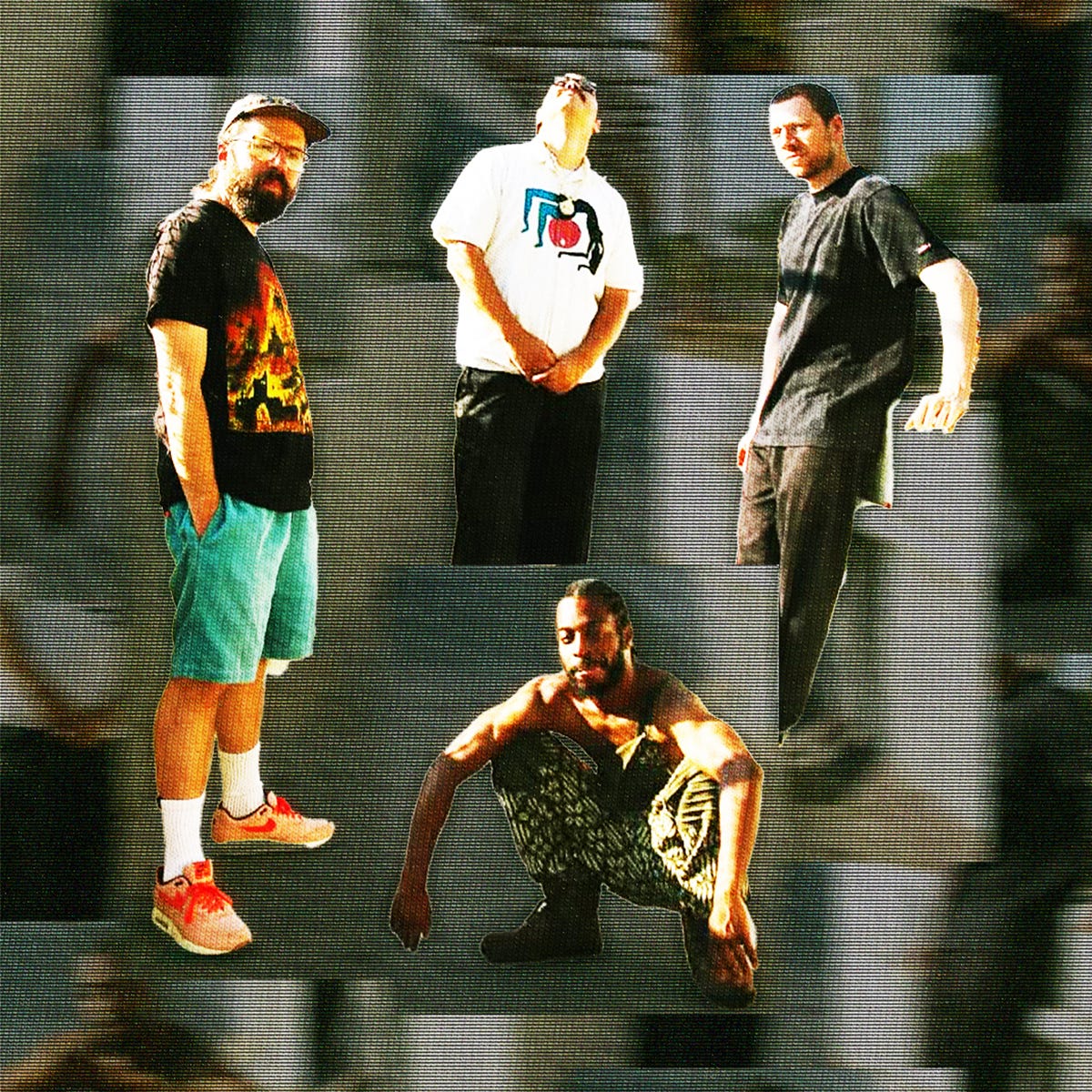
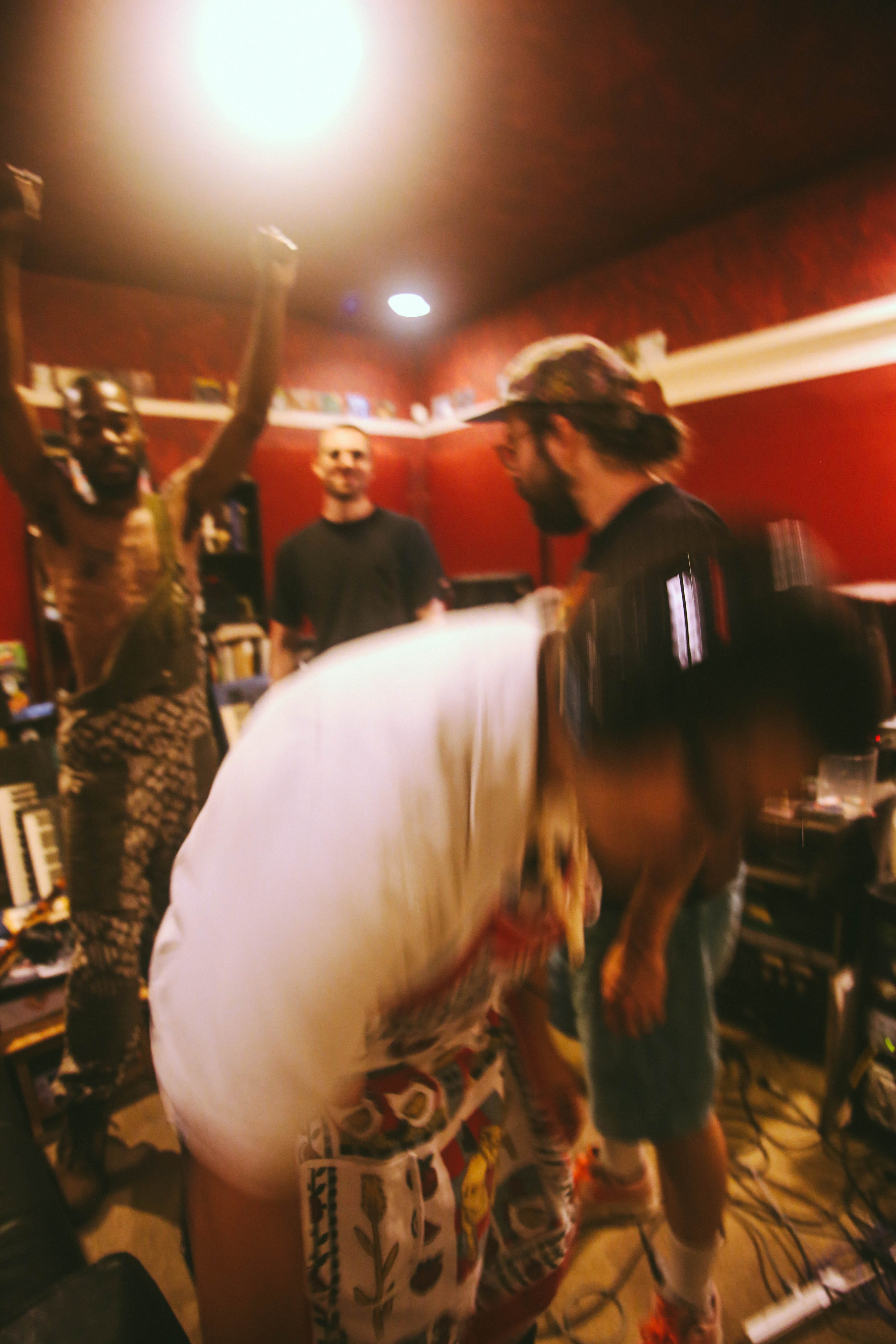
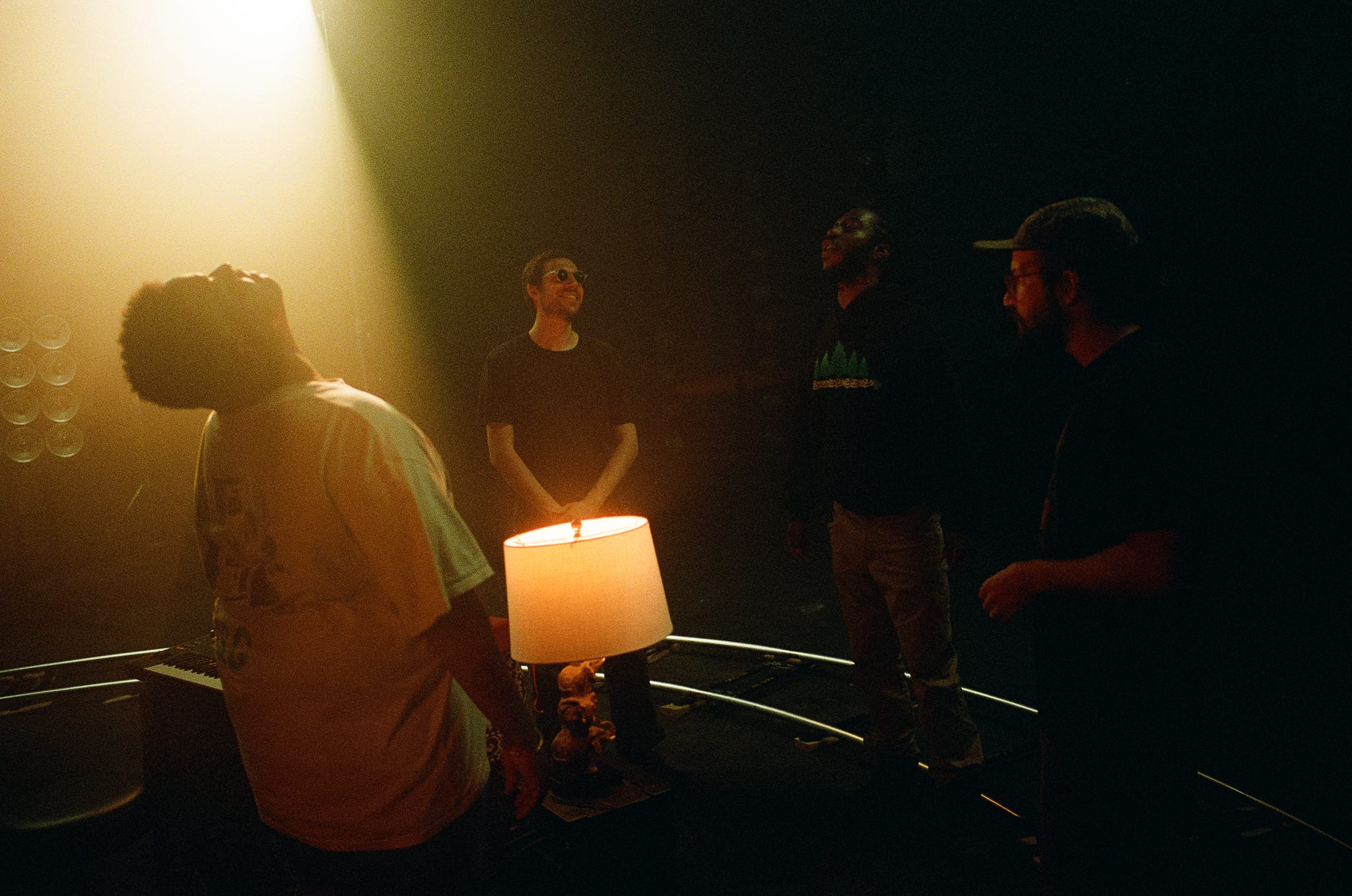
HUMAN ERROR CLUB is two keyboardists and a drummer. Diego Gaeta, Jesse Justice, and Mekala Session first linked up in 2019 for a one-off garage show that turned into one a band. Their fusion of spiritual jazz, live beat explorations, and synth alchemy has since made them a quiet but seismic force in L.A. and beyond. For HUMAN ERROR CLUB at Kenny’s House, they teamed up with producer Kenny Segal—one of underground hip-hop’s most trusted architects—to record three improvised sessions at his home studio between 2021 and 2024.
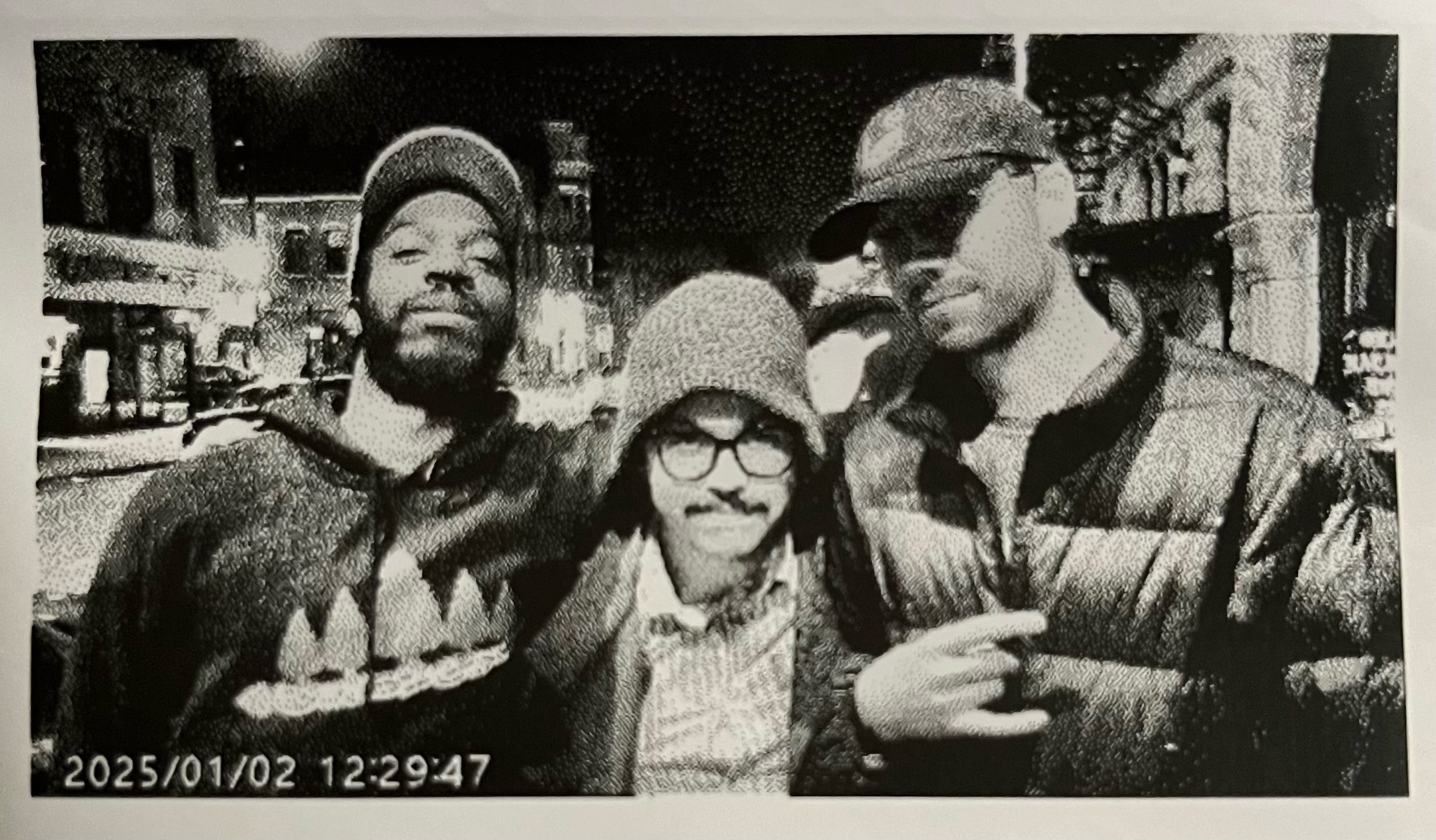
The album, released on Backwoodz Studioz last fall, bridges Segal’s world of warped hip-hop production with the trio’s shape-shifting live energy. It’s a synthy, off-grid journey. Over ten tracks, it brings together a constellation of Backwoodz regulars—E L U C I D, Moor Mother, Pink Siifu, Shabaka, Quelle Chris, and label founder billy woods—each folding into the band’s swirling universe of sound.
I sat down with HUMAN ERROR CLUB and Kenny Segal to talk about improvisation as composition, the joy of broken synths, the ethics of collaboration, and how the best music sometimes starts with no plan at all.
Can you introduce each other?
Mekala Session: Jesse Justice is one of the keyboardists in HUMAN ERROR CLUB. He used to make music under Max Bear and made the sickest SP-404 beats. Then he got tired of that and learned to play keys really good. He’s been making crazy modular synth music. He’s the best kind of nerd you would want in your band. I respect his attention to detail and sense of perfection. That’s Jesse Justice!
Diego Gaeta: Mekala Session, amazing being, innovator, cultivator, drummer. He’s the reason why we exist, technically. In the sense that he called it into reality. I’m grateful for that and the way he shepherded us through this Backwoodz collaboration. And he’s also the Pan Afrikan Peoples Arkestra’s bandleader.
Jesse Justice: Diego Gaeta is an incredible performer, songwriter and person who’s also born and raised in Los Angeles. It is one of the things that I love about this band, we’re all very L.A. people, from different parts. Our sound represents that.
How did HUMAN ERROR CLUB come together?
MS: I knew Busdriver. I did a show with him where I had to put together his band. I kept trying to call bassists to play. But everybody was busy. I was complaining about it at my house, and Diego said, “Well, I’ll do it. I’ll do synth bass.” That’s what we did. Jesse was the keys. We were the rhythm section for Busdriver, playing Kenny’s beats. That’s how we met Kenny, because he showed up to that show in my garage.
DG: I was playing basslines that he made, and he was like, “Dude, I really enjoyed the way you played those.”
MS: Then, I was asked to put a band together for another show. I was like, “I’m not going to call a bassist; I’m just going to call Diego and Jesse.” I was Captain No-plan. We had half a rehearsal and no plan. We just jammed. We did that gig, it was cool. Months later, Jesse had some studio time, so we went to record. That became our first album, released on Preference Records in 2020.
The original connection that led to the new album HUMAN ERROR CLUB at Kenny’s House was between Mekala and Kenny right?
Kenny Segal: I’m pretty sure I first met Mickey at this monthly party called Backbeat. We had a lot of mutual friends. I quickly recognized him as the gateway drug into the young jazz thing that was bubbling at the time in L.A., around 2019. I was friends with Aaron Shaw of Black Nile. I think I first found out about the Pan Afrikan Peoples Arkestra and later found out about HUMAN ERROR CLUB. As soon as I saw them, it clicked. I immediately was drawn to how they existed in that space of improv but still melodic, toneful and fun to listen to, but also weird.
Tell me about the new album. How did that project start?
MS: Kenny was producing for all the best rappers. He’s responsible for the best R.A.P. Ferreira albums. In 2019 he produced billy woods’s Hiding Places. I would say our album comes from a mutual appreciation. I completely respect how he’s influenced the hip-hop scene. And he kept coming to my shows like, “You’re in a jazz band, you make real drums, you do the thing that I really can’t do.” So, I was like, “Let’s make an album!”
JJ: One thing that we like to do is to go to different places where people have their set-ups and do our thing with what they have. We have interesting results trying out new gear and just being in different places. It made a lot of sense to do that at Kenny’s.
KS: It kinda naturally happened in that I was already the type of person to have musicians come over and record some stuff over my beats or just for fun, to sample later. The very first session, I know we were trying to record a project, but in my head, it was equally motivating like, “This will be dope. I’m going to have all this cool material to sample and make beats.” It was a win-win situation. But after we did that first session, it became apparent this was something we needed to explore. It felt like a natural evolution of my relationship with them.
How did the recording process go?
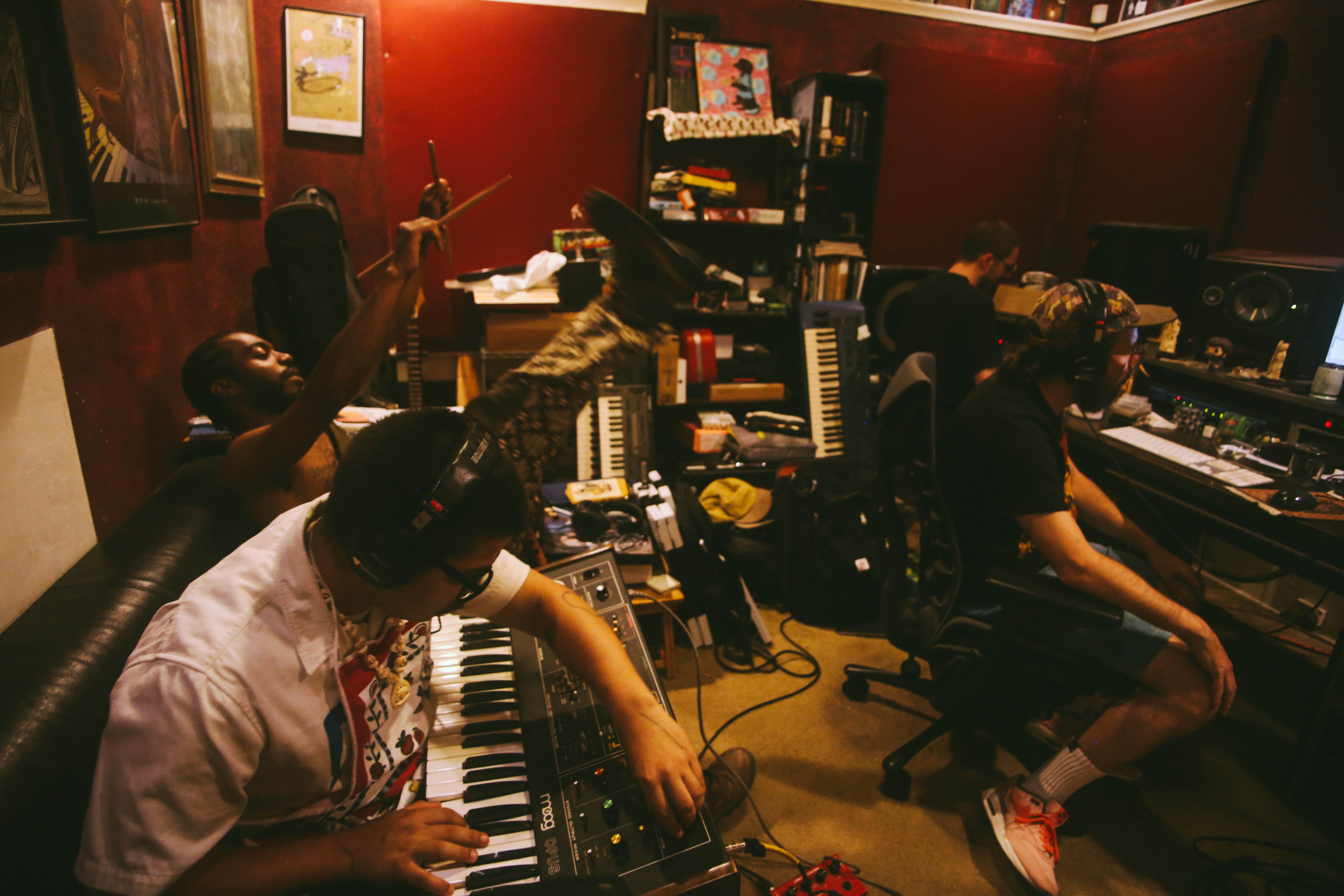
MS: We did the thing we always do. We picked a day when we were all available. The idea was that neither of you two would bring a keyboard. Kenny set up his studio to have as many of his things. After the first day we were very pleased, so we quickly put together another session. After that we did another session and that gave us all the material to make the album.
KS: The whole thesis was that they were going to come over and use mainly my gear. I had control over setting up the stations for each of them. It evolved over time. Diego brought a couple keyboards too. But the basic idea was that they’d use my stuff. The drum miking, we did different things each day. We did different versions of lo-fi drum miking. I was setting up the palette of colors for them to paint with.
Can you talk more about the way you improvise with each other? And how this is the basis of your compositional practice?
DG: We have nothing but a blank slate and a dense vocabulary of textures and rhythms. Basically, we have a shared language. We adapt to each other. Someone will motion a certain way, we’re all aware of certain signals. It’s really cool. The expectation from the beginning is that it is fully improvised, weaving a bunch of grooves, motions, rhythms and melodies. We’re like DJs but with instruments. We’re using textures of electronic music with spiritual jazz, which is our foundation. Being able to fluidly weave through dynamics so easily while still achieving big grooves is our thing. It’s how it works. That’s the recipe.
JJ: Especially when we’re at a new place like at Kenny’s. The discovery is a very fun part, new sounds from new instruments. Kenny was pulling out all these synths like, “Ah I haven’t pulled this Moog in years.” That Moog is on the album. Sometimes we’ll stop each other too like on the album you can hear Mekala saying “OOO What’s That,” which became the title of the song, featuring Quelle Chris and Cavalier.
MS: That song is sick because it is literally a sequel to the other song “Excuse Me, No,” on our first album, where the exact same thing happened. That’s the recipe of the band. We improvise song structure. We all listen to a bunch of music and we all know what eight bars going by feels like. You can only let so many of those go by without at least one person getting kind of bored and changing something or doing something by accident. And that inspires one of us to change something. It’s a free jazz band. I like to think we challenge people’s conception of free jazz because we don’t sound like what you think free jazz is. But to me we all have jazz chops, and we’re playing free without restrictions.
DG: Our heroes were finding great recordings and flipping them. But we’re the jazz element and we also know that we can sample it later. It’s exciting to be in that moment where so many people in Los Angeles are making music in the same way. So much of jazz knowledge has shifted into understanding production. It’s fun to be able to make what I believe is free jazz and also sample it to make it a hip-hop instrumental.
JJ: Our mood might affect what comes out a certain day.
DG: We’re able to be very honest with each other. We say our own piece but really unified.
MS: We can be really honest with each other because we know each other but also because we believe each other. There is trust.
JJ: It’s in the best interest of the music too.
When was the first session at Kenny’s?
MS: I have no idea.
DG: Time doesn’t matter. It happened. It could be anytime.
MS: Fuck time. Time is an illusion. Says the drummer [laughs].
JJ: I don’t know if we need to be so anti-time.
KS: The first one was in July 2021. The second day was in August 2021. The third one was in August 2024. The first two were close together and then the third one was much further down the line. Each has its own soul. Putting the album together, we pulled from all three sessions. It wasn’t always apparent that that’s how it was going to play out. At times, the album more heavily favored one of the three days. But it evolved.
What kind of gear/toys were used at Kenny’s?
JJ: He’s got a lot of little keyboards and boxes. We went through all of them. Some were definitely covered in dust. It was fun to bring some of those instruments back to life.
MS: When Jesse and Diego would be playing, Kenny would turn the knobs and press buttons. It’s a bunch of sounds that he uses on his own albums, like his Omnichord and DIY instruments.
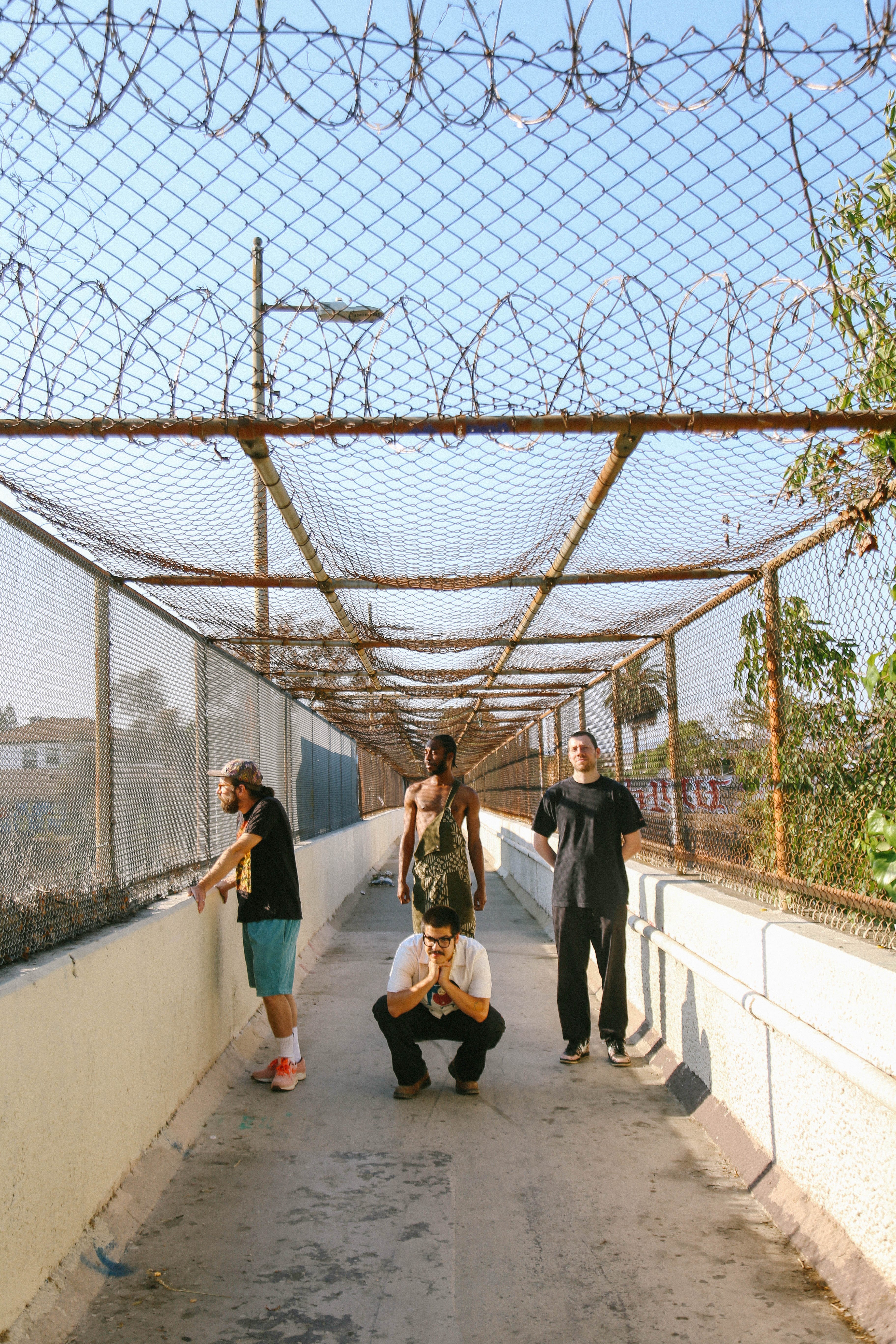
KS: I’ve always been drawn to things that sound slightly broken but in a cool way. I’m not big on big boy synths. I don’t have a Prophet 12 or a Moog Grandmother. I like esoteric kind of things. A lot of them are very intuitive to play. My circuit bent Omnichord was on a lot of the songs, my Casio CZ-101 too. Guitar pedals were on some songs, like the Instant Lo-Fi Junky, the Wash by Hungry Robot. I have a Moog Opus that they used on some songs. The first and last session have my Novation Bass Station doing the bass duties on most songs. The second session had the Bassline by Erica Synths. I was borrowing it from a friend, and it happened to be there when we did the second session. There’s a lot of SP-404. We ran keyboards through the SP. We also used my Yamaha PSR-6 keyboard, one of those general MIDI keyboards. We used my vintage Fender Rhodes piano. That’s on all the days.
Say more about Kenny’s role in the production of the album.
MS: He engineered it, he’s the one clicking spacebar and adjusting the levels. He’s responsible for the majority of the edits. He’s the one who listened to all of it and cut out songs. He mixed it. He also A&Rd this shit. If it wasn’t for Kenny, we would have never met billy woods. Kenny is our OG.
KS: I’d say my role was mainly curatorial. After it was all recorded, I went through everything, mining the recordings and figuring out what were the beautiful moments. Then there was the aspect of refining the songs and figuring out mixing and giving it a certain tone. Each session we got close to three hours of recording. We had so much and there was so many good things that I didn’t need to do too much nitpicking. Basically, anything that sounded cool I was keeping at first. Once I identified all of that, I started going through it and realizing “Oh this one is cooler than this one.” As I was starting to do a little bit of mixing, and sometimes when you bring things into focus it doesn’t sound as cool anymore. So going through that process. I tried to be as light as possible in the editing department. They’re so good at improvising that there was little to be done. The album took a lot of different shapes to get to the shape it is in. When making an album I always strive to have a dope listening experience. Whether that means going up and down a roller coaster, or going up the whole time, or going in a parabola kind of thing, which I think is the case for this album. I strive to have something that takes you on a journey where each track builds on each other. It’s a wild psychedelic synthy ride. It’s also kinda fun. I think that’s what separates them from other bands that might be in a similar space.
Usually, the three of you are the ones making the edits right?
MS: For all the other HUMAN ERROR CLUB albums the three of us sit together and figure it out. It’s like “Fun/Stressful.” This time we didn’t
DG: We always determine the sonics and the mix, but this time Kenny did it.
The musical explorations on this album are pretty different from former HUMAN ERROR CLUB albums. Were you searching for something in particular?
DG: My music sounds the way it does because I want to feel good and I want to make people feel good. But I also want to pose a challenging force to evil forces in the world. That’s why I want that texture, that conflict into the music, creating a cultural healing tool.
MS: It’s less of the shredding. This is also our first album where we got rappers and vocalists everywhere. This one is way more Dilla beats come alive, loops that don’t want to be loops no more. You might get a bridge out of nowhere. Not any rapper can rap on shit like that.
DG: It’s intuitive music. We play stuff off of how we’re feeling and what we might be imagining in that given moment. There’s no other conception other than honesty and the ability to collaborate. There are themes. I think it’s nice that there are themes, it’s a proof of human nature. The idea of HUMAN ERROR CLUB is based on this honest representation of three people gesturing intuitively into an instant design.
There are a lot of features on the album. How did you choose these artists?
MS: For some of them it was obvious, like of course billy woods should be on the album. Same with E L U C I D. It made sense to have Backwoodz affiliates. Everyone on the album had done something with Backwoodz before. Pink Siffu, Moor Mother… We got really lucky.
KS: That’s something I brought to the table, knowing people and being able to ask for favors. That also evolved over time. At one point the album was more of an instrumental thing. Once we started getting a few features the album started materializing in my head. We were super lucky that it clicked with everyone. That was one of the big wins. I tried to bring my expertise of producing rap songs in that aspect.
DG: I’ve been playing in Shabaka’s band for the last year or two. That was another connection. I’m just amazed at how he plays so intensely with so much heart. He’s someone we really love and look up to. He’s been a cool example.
The tracks don’t feel like they were made for rappers. It’s almost like the rappers are soloists. The focus is not really on them like it typically is in rap songs. Beats are made for them to stand out. It doesn’t feel like that here.
MS: Very few rappers on the planet are going to be like, “I want to rap on this.” Like on the song “DRAGONCURVE,” k-the-i??? is crazy. He’s one of the few cats ice-skating around cats backwards. Not any motherfucker can rap on these kinds of joints. But we’re not talking about any motherfuckers, we’re talking about the cream of the crop. I guess it helps that these musicians aren’t just incredible artists and visionaries but also really cool people that we have friendships with.
How did this project end up on Backwoodz?
KS: When we first started the HUMAN ERROR CLUB stuff, it was right when woods and I were working on Maps. Then we were touring Maps, we were touring Hiding Places. We were hanging out a whole lot, sharing what we’re working on. I was just playing woods the early demos from the first sessions. E L U C I D also heard that stuff early on. They both were into it. The Backwoodz thing naturally happened. He’s also the type of person who really believes in his homies that are around him.
JJ: The song “Dislocated” we produced on billy woods’ album GOLLIWOG was originally supposed to be for one of our albums. But woods really liked that song and really wanted it on his album. That was the first explicit connection.
MS: I guess Kenny and woods were hanging out and woods heard about this project and he was down to put it out. I would say I love all of our albums. I would be confident saying that this is our best work. Also, our next work will be our best work. I’m extremely pleased with the trajectory of this band. Until the three of us hate each other we’ll probably get more lit albums.