


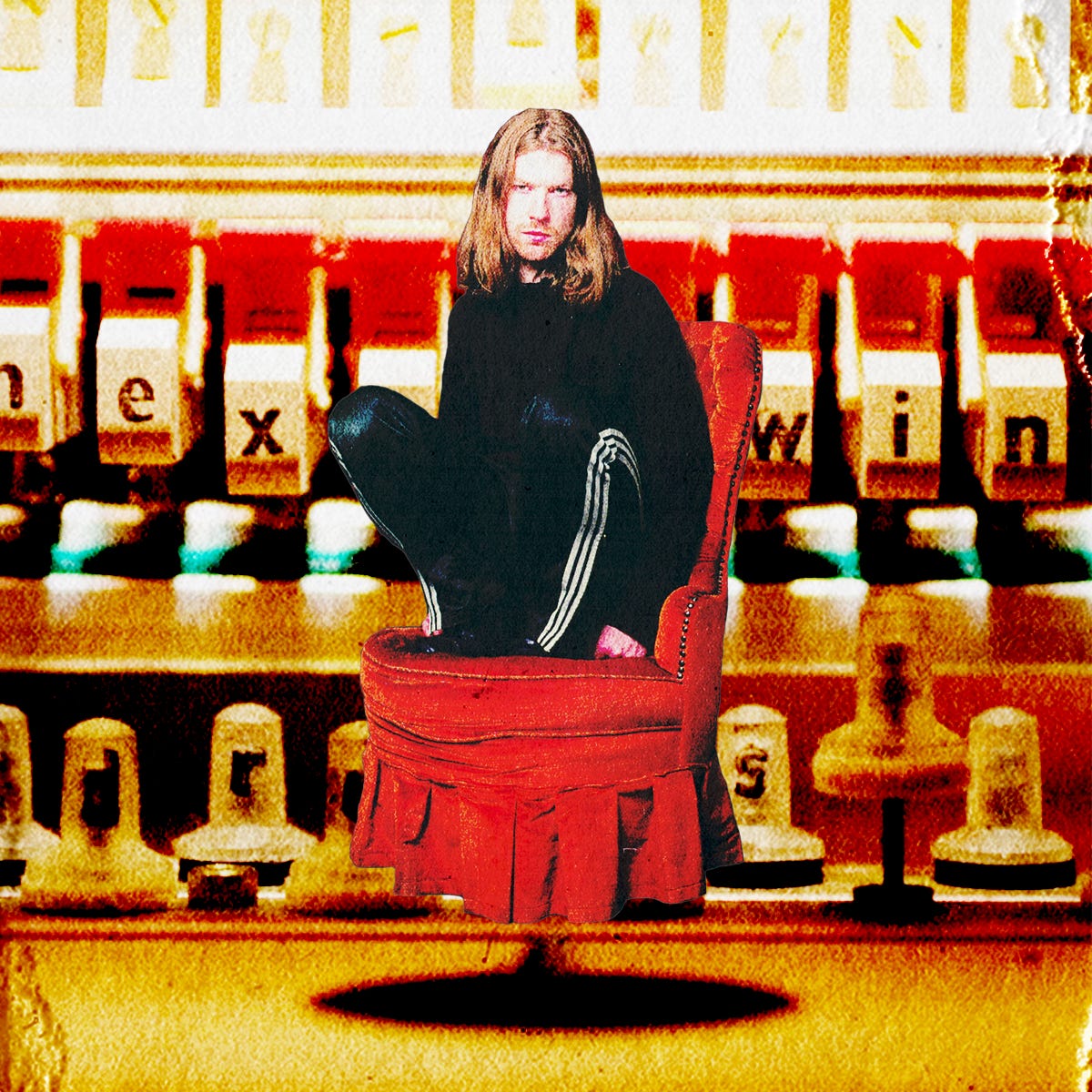
The anonymous TV host says: “Soon, you’ll have forgotten all about this, because you’ll be dead.” Next we’re thrown into the psychedelic philosopher Alan Watts’s meditations on the relationships between sleep, the unconscious, and death. Now a clip from The Secret Life of Walter Mitty where Sean Penn, admiring a snow leopard, says that “beautiful things don’t ask for attention.” The only connection between these shards of an increasingly fractured internet is a creaky, rattling, oddly meditative harmonium track from Aphex Twin’s unwieldy 2001 classic Drukqs.
137,252,913. That’s the number of times, as of late July 2026, that “QKThr” has been streamed on Spotify. The stats feel like a mistake, since Richard D. James heads would cite at least 50 essential songs before getting to this one. So why is it at the very top of his catalog, behind only “Avril 14th?” The answer is tucked away inside the data of a social media app: The song blew up as a popular sound effect on TikTok.
How did such a strange, unassuming composition pop off on a platform designed to reward bright lights and loud sounds, our lizard brains? “QKThr” feels like shifting your feet during an awkward moment, a not particularly comfortable break in conversation—which made it an ideal match for the 2022-23 TikTok trend “Corecore.” These posts stitch together seemingly unrelated images and videos that, when presented together over a song like “QKThr,” create the illusion of a cohesive, often emotional aesthetic. Asking the big questions and so on. The videos mock digital culture by exposing the hollow core of internet -cores.
“QKThr” is tragically effective as background noise to this end, tinting the (digital) air. It’s hard to believe the same artist is capable of making music that lays claim to the foreground with such abrasive, authoritative menace. It’s even harder to believe these two seemingly opposed modes reside together under the umbrella of one album.
Once a year, a new electronic artist gets crowned the next Aphex Twin. By writers, by fans, by Instagram pages. Direct comparison is a sloppy, imprecise way to describe any artist, but especially when it comes to someone as versatile as Richard James. Which Aphex Twin era, exactly? SAW II, Syro, Surfing on Sine Waves? He’s a man of so many pseudonyms that reducing him to a static reference point seems to miss the point entirely. Of course, that versatility is the very quality that makes critics so quick to smash the Aphex comp button. It would be paradoxical if it weren’t so trite. Individual songs of his have spawned entire subgenres of electronic music. It’s safe to assume that just about every electronic artist listened to Aphex Twin at some point, no matter how divergent their own work would eventually become.
James was already legend when Drukqs was released, but was also a few years removed from his peak popularity, which coincided with the late-‘90s electronic surge.His prolific run started with Selected Ambient Works 85-92, which gets most of the love; its ambient follow-up, SAW Vol. 2, confused some listeners at first, but is now revered for introducing Eno and Cagean concepts to the rave chill-out room. I fell in love with 1998’s Richard D. James Album because it leaned into the melodic side of his sound design, but still paired these (comparatively) catchy melodies with relentless drum breaks, automated at warp speed. Drukqs is commonly referenced as his most divisive work, and I get it. On my first listen, it sounded like RDJ Album’s drill n’ bass eruptions but on steroids, fed through a pencil sharpener. Plus whatever the fuck those weird percussion/piano songs were.
Critics at the time were similarly divided. Pitchfork dismissed the piano tracks as “crude instrumental contemplations” and “languid noodlings.” In a review for Spin, noted IDM/“intelligent” genre skeptic Simon Reynolds called the album “disappointing” and an “absurdist caricature of drum n’ bass,” its “whiplash beats suggesting the fast-forwarded impacts suffered by crash-test dummies.” His criticisms sound like praise in disguise to me, specifically the crash-test quality of the drill n’ bass cuts. Like the ferocious drum breaks of “54 Cymru Beats” which, despite IDM’s reputation as a dance floor disperser, propel me out of my seat, into motion. Maybe a bit spastically, but still.

