


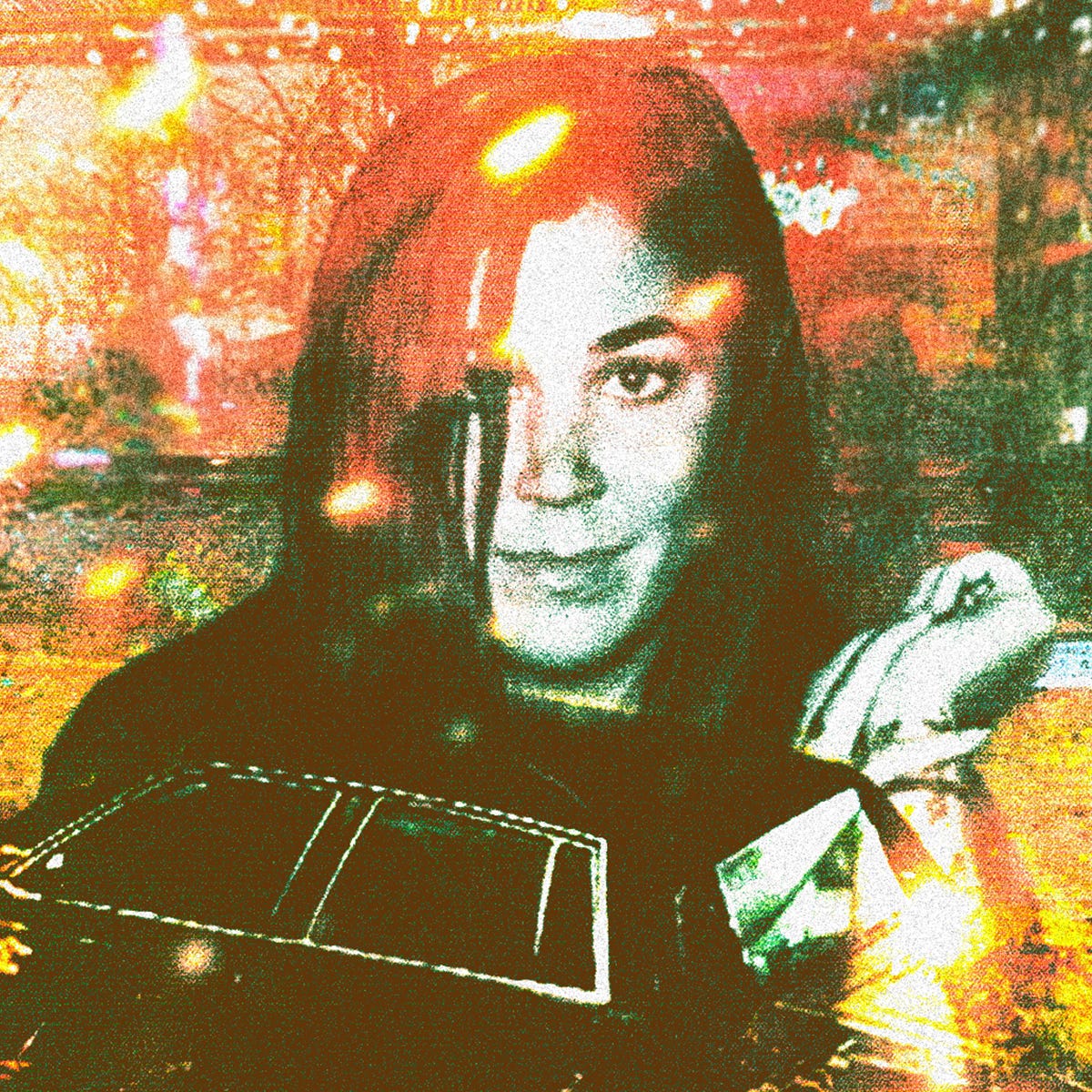
Toward the end of Midwestern Death Trip, her richly detailed history of a region and war-report from its bars and supper clubs, Meaghan Garvey raises an existential fear. “What did it mean that every writer I admired had drank themselves to at least temporary ruin? And was I crazy to believe that 20 years of drinking had given me more than it had taken away?” she asks. As it so happens, that question comes at the bottom of a page. At the top of the next one, a hand-wave slyly loaded with an actual philosophy: “Anyway, never take life advice from people who hate life.”
I’ve often described Meaghan as the best writer on the internet, which is both literally true—for my money, her Substack, SCARY COOL SAD GOODBYE, is the most evocative and idiosyncratic thing on this, or any, website—and a reflection of how her career, which began as a music critic, is refracted through the way our early adulthoods have been warped by the experience of being online. Death Trip rips her away from her computer and into the 1993 Cadillac Coupe DeVille she bought off of Craigslist. From a series of reports from around the region emerges a portrait of not only a distinct society, but one of the most singular protagonists in contemporary literature.
Meaghan called me from her home in Rogers Park, on the North side of Chicago, which overlooks Lake Michigan and some tennis courts that have been overtaken by itinerant men with pickleball paddles. We spoke about the book, her roots in criticism, and the wave of attention brought on by a truly bizarre interview with her ex-fiance, a brilliant grime musician who may or may not be dead. The songs embedded throughout are MG essentials, provided by the artist herself.
What’s the actual genesis of this book, was it simply an extension of SCARY COOL SAD GOODBYE?
SCARY COOL SAD GOODBYE was definitely the foundation for it. But the honest answer? I kind of am not that ambitious unless I’m prompted to be, so I probably would’ve never done this had my editor not sat me down at some fancy party a year and a half ago and been like, “I want you to write a book. I want it to be called Midwestern Death Trip. And in it, I want you to figure out what the fuck is your problem.”
If I asked Meaghan at 17 or 18 how she would describe the Midwest and how she felt about it, what would she have said?
I would’ve said, “It’s fucking boring as shit, and I can’t wait to leave it and go to some coastal city and become a great artiste. Where I grew up, Oak Park, is the birthplace of Hemingway. So ever since I can remember, everywhere I looked, his face was fucking plastered all over everything. But he was embarrassed to be from Oak Park. He latched on to Michigan in a way that is almost what I am probably doing right now, too. But yeah, he just thought being from the suburbs was lame, which: touché. My childhood was pretty dull. I was very shy. I wasn’t a loser, but I didn’t really have my people, so I just always thought the action of my life would start after I left. And that basically turned out to be true.
What actually enabled you to move to New York, and how did you feel when you got there?
Oh, man. OK. My ex-boyfriend drive me there and I brought my cat in a fucking cardboard box. Why didn’t I buy a cat carrier? He was literally in a cardboard box pissing all over my lap. But I went there because I got an internship at The Fader, which I went to for one day. I showed up two hours late, I left early, and I never went back. So immediately it was like, “What the fuck am I doing here?” Then three months later I get married [laughs]. This is a disaster. What the fuck?
That was the era—right before and right after you moved to New York—when you started getting noticed as a music critic. I know how much you think and feel about music, but did you care about the criticism per se?
I mean, the funny thing about that is that before I even conceived of the idea of being a writer, I was doing illustrations for Vice and Noisey. I was doing pencil drawings of Waka Flocka Flame for $75, and that’s what I was: I considered myself an artist, a visual artist. And so I hope this doesn’t sound douchey or glib, but I really wasn’t trying to be a music writer—or a writer whatsoever. But I think I just was so annoying on Twitter that finally someone was like, “Here’s $150, please shut the fuck up.”
You and [Fake Shore Drive founder Andrew] Barber always talk about 2012 in Chicago as this really electric time. That’s, what, the Two Way [Lounge] era?
Definitely. Me and Barber would go out and DJ Kenn would be smoking blunts outside of the venue. This was when my main job was still selling weed. So I was just on my bicycle delivering eighths of mid to art school students. Obviously regional rap didn’t come to being then, but it really felt so fresh to see all of these regional scenes take their first sprouts on the internet specifically. Did Spotify exist in 2012? If it did, I wasn’t on it. So it was also a pure pleasure to spend into your day on the internet and go to sleep thinking, “day well spent.” It wasn’t as nihilistic and scammy and culture war-ish and mean-spirited and Elon. It was fun to spend your time online.
And still, looking back on the time where you made a big percentage of your living as a critic, what did you like about that least?
Well, it’s hard to untwine simply getting older from what music criticism did to my relationship with music. But… I know everyone hates having a job, but I really fucking hate having a job. I hate having a boss. I couldn’t be a full-time music critic now even if I wanted to because being expected to focus on something just sort of kills it for me. And what I liked about it least at that time was, I mean, not to get all woe-is-me feminist, but guys would fucking print out my picture and jizz on it and send me a photo of that. This happened more than once. That was always really annoying. But when I think back on it, what I dislike is—again, this all has to do with growing older—I feel like my identity was so entwined with music and culture and criticism that it almost stunted my ability to figure out who I was outside of my taste and preferences. I feel like when a lot of your relationships are premised by my opinions and taste, it’s like a proxy for a relationship, not a real relationship. And for that reason, I just feel like it took me until my 30s to be like, “Who the fuck am I? And what do I believe, and what do I want out of my life?”
So as you move away from using taste as a proxy for that, what replaces it?
I mean, I don’t want to sound like a raging alcoholic, even though I think that ship has fucking sailed for me. But it’s definitely tied to becoming a regular at The Lighthouse, becoming a regular at local bars. And through that, getting to know my neighbors, getting to know better the very granular place where I lived, and being able to walk down the street and it’s Mister Rogers’ Neighborhood. And I’m like, “What’s up, Debbie? What’s up, Mike?” It might be foolish to say that my bar friends are a deeper relationship than my music friends because that has a shaky foundation of its own. But I think it was tied to owning the place where I lived and just leaning all the way into it.
We didn’t become friends until you were in your 30s, and in the time I’ve known you, I’ve always considered you uniquely good at meeting people.
And I wonder why that is because I consider myself kind of shy. I still have to psych myself up to make a phone call. When I was a kid, I was shy as fuck. But I love shooting the shit more than anything in the fucking world.
Some of that is what the utility of drinking is and always has been, right?
Completely. Completely. I mean, I don’t know. I think about this all the time, because you go on Twitter or wherever and there are these creepy little Gen Z people who are so nihilistic and yet so risk averse. I’m stereotyping obviously, but you’ve seen these people—they’re not just Gen Z, they’re my age now, too, and older. The Silicon Valley body optimization, Bryan Johnson or whatevers. And I almost want to counter them with hedonism, even though that’s so reactionary and stupid and only harms me in the end.
Well, I know you mean that, but you’re also being a little bit glib calling it hedonism because both through knowing you and reading the book, you get what is interesting and romantic and even deep about those… non-optimized parts of life.
I don’t want to speak for anyone other than myself, but for me, I sort of reject the modern need to pathologize everything to the nth degree. And I don’t want to say that alcoholism and addiction doesn’t ruin lives on the fucking daily. And maybe it’s even ruining mine. But the thing is, you have to very confidently decide what you want out of life and accept the consequences. And if you could do that, then I don’t think that the life I live is bad for me.
If you were forced to reduce it, how would you define what you do want out of life?
I don’t know. This is what I think about this so much, because I think part of the reason that I’ve been a little… I had a month out of sorts after I turned the book in. I thought I would be so euphoric with accomplishment but I was just sort of bereft and weird. And I think part of that is it’s become very clear to me that you cannot have it all. Whatever they say, you can’t have it all. You can’t devote yourself to your craft and have a happy family and be a stable loving partner and have a snatched hot rockin’ bod and have emotional stability. You can’t have all of those things. And trust me, I’m fucking trying to! But it’s just become clear to me that you got to sacrifice some of that shit, and I know which ones I’m keeping.
But you’ve been chipping away at these creative projects forever, living through the slow death of our industry, so on. Why did actually turning in the book put you in that space?
You know what the honest answer is? I’m just going to say it: Writing the book, I was so sedentary and I came off feeling like a fat slob. This is my answer. And I was just like, “Fuck, dude. How can I be the master of my craft and also be hot as shit?” I can’t do it and drink like a fucking maniac when I want to. I just can’t do all those things. I have all these extremes and I’m just meeting square in the middle, mid. So annoying. I know that sounds vain.
No, I completely understand that. But on a master-of-the-craft level, I’m going to force you to do something you’re going to hate. Tell me what you think you got uniquely good at as a critic.
I’m going to put this in a stupid way, but: to articulate a vibe. It’s one thing to talk about what music sounds like. It’s another to provide the historical cultural context. But it’s such a compelling challenge to me to just touch the fucking spirit and pin it down in a way that is not inside baseball and is not something that will be irrelevant in two weeks. And if I gave it to my 65-year-old boomer friend at the bar, he wouldn’t think it was gibberish. And I think that I got decently good at that through criticism.
In the mutation from that writing to the book, whose work not only had an effect on you, but really made you want to finish your own manuscript?
Well, it’s funny, because if you asked me five years ago, my answer would’ve been Eve Babitz. But I’ve soured on her a little bit in recent years. I just feel like she lies sometimes. And obviously everybody lies by omission—the most interesting part of someone’s book is what they leave out. But with Eve, I’m like, “Everybody can’t be handsome. Every party can’t be amazing. Everything can’t be all, like, jacarandas and bougainvillea and amazing crispy tacos and hot sex all the time.” And then you read the description from one of her friends during the ‘70s, and he talks about how her whole living room was littered with bloody Kleenex and her cats were getting high because there was fucking coke everywhere. And that’s just entirely out frame up until basically [1993’s] Black Swans. And by that time, she’s sober. And you could tell that she sort of resented it, she’s sort of listless and wistful and jealous of her former life. Who I replaced her with is Lucia Berlin, who I just think is the fucking dopest writer of all time because she, it is jacarandas and bougainvillea and tacos and Mexico, but it’s also like, “I am drinking Jim Beam at seven in the morning before my kids go to school, and I just crashed my car and now I’m in jail.”
Which is why you crashed your car and almost went to jail.
You can put that in there. Yeah.
What made you start SCARY COOL SAD GOODBYE?
There are two reasons. Everything starts with just a sick-ass title, and it was 2020, and I was walking around Rogers Park. There was this neurodivergent fellow who would just scribble his rantings and ravings in Sharpie on various walls, really prolifically, and sometimes it would be about Putin and Ukraine. Other times it would be these amazing poetic fragments. And so outside the fucking Dunkin Donuts under the Red Line, he had written “Scary, cool, sad, goodbye.” I was like, “Oh, fuck. Well, this name is just burning a hole in my pocket.” And I probably started the Substack that day, honestly. Before I started it, I thought I was just done with writing forever. I just thought it was over for me. I was working at this weird random bar. I just thought I was going to be a bartender and service industry person after this. I don’t know if it was my last-ditch attempt. Maybe I was just broke and thought it would make some money. But I think subconsciously it was my last attempt. “Don’t make me not be a writer. Please.”
It can be like an albatross though. You start this thing and then you’re like, “Fuck, man. How often do I have to write?”
I don’t feel that way at all. I am not trying to be a Substack booster because quite frankly, I think I’ve got one of the only good ones, but everything clicked when I started. I don’t know. I don’t do a lot of writing that I don’t share. It kind of seems besides the point. Maybe I’m a fucking vain narcissist and I want kudos, but I just don’t write shit privately. So this was the first time I could figure out what the fuck I actually cared about.
Earlier you were talking about how you realized you needed to stop defining yourself through your taste. But now, what would you say is the unifying quality of art you appreciate? Because I will see or read or hear new things, and every once in a while I’ll think, “Oh, this is a Meaghan thing.” But I’m not sure I could articulate what it is.
I like this American quality that is sort of the triumph of will over reason, and I like people who kind of seem like they got the shit kicked out of ‘em. I like people—and I’m cribbing this from an interview I did the other week with this guy, Daughn Gibson, but he said he admired people who lived a sad life confidently, or who did batshit things with confidence. And I think that describes the artists that I admire. I mean, the American dream is something that comes up in my book so much. I remember someone asked me, “Why are you so into the past? Why are you so nostalgic for a time before you were born?” I’m like, “Well, fucking look around, man!” Nobody likes this shit. If you do you’re a sociopath and you don’t know any better. You know what I mean? I can’t watch the NBA playoffs at the bar because it’s only on Peacock and not on NBC. And fucking eggs are $6, and buildings are hideous and nobody can fucking read. But at least I can use DoorDash. Look around, man. The dream has left the building.
So you’ve been talking about how the parasocial relationships people had and have with you are a drag. In some ways I think of you as a private person, but we’re all also creatures of the internet. And like you said, all your stuff goes online. You got a ton of attention for the interview you did with Tony, which on some level is what sustains us, economically but also as people. But that’s your life, too, and it must be sort of uncanny to have it laid so bare.
The only fear I have with this book is that I’ve said too much, that I’ve overexposed myself in a way that I can’t take back. Because I do feel like a private person, weirdly enough, even though it seems like I’m always spilling my guts on Substack. But that’s very controlled. There are so many things that are untouchable and just will never appear. So, yeah, it kind scares the shit out of me, man. Obviously Twitter is real, the internet is real, but I can walk away from that shit at any time and never look back.
Before we started recording you said your book is in some ways a dead-mom book. I remember when 808s & Heartbreak came out and you said that people think of this as a breakup album, but to you it was very obviously a dead mom album. What do you think are the hidden qualities of the dead mom canon that you can sniff out that not everyone might be able to?
I think maybe it’s different for guys and girls, but it has to do with this constant performance for the approval that you’ll never get. In me, definitely, and in Kanye, definitely, it creates a level of exhibitionism that I probably would not have otherwise. Ultimately, I don’t want to be a hermit. I dream to be one, but I don’t know. But it’s also so embarrassing for me to talk about myself. When people have been asking me, “What’s your book about?” I curl up in a ball and want to die. It’s so pathetic and weird, but I just want to feel like I did a good job and then I want everyone to leave me the fuck alone. Is that so much to ask?
What do you want to write about next?
Well, the big story looming over me that I still don’t even know the half of is Tony. He might still be alive, so I don’t know. If he were dead, I would be emotionally equipped to write about it. But if he’s alive, then I have to find out. Right now, I’ve shut out the possibility of finding him alive; I just can’t even touch it.
But if you had to put odds on it…
I think he’s fucking alive.
feel this so much: "The only fear I have with this book is that I’ve said too much, that I’ve overexposed myself in a way that I can’t take back. Because I do feel like a private person, weirdly enough, even though it seems like I’m always spilling my guts on Substack. But that’s very controlled. There are so many things that are untouchable and just will never appear."