


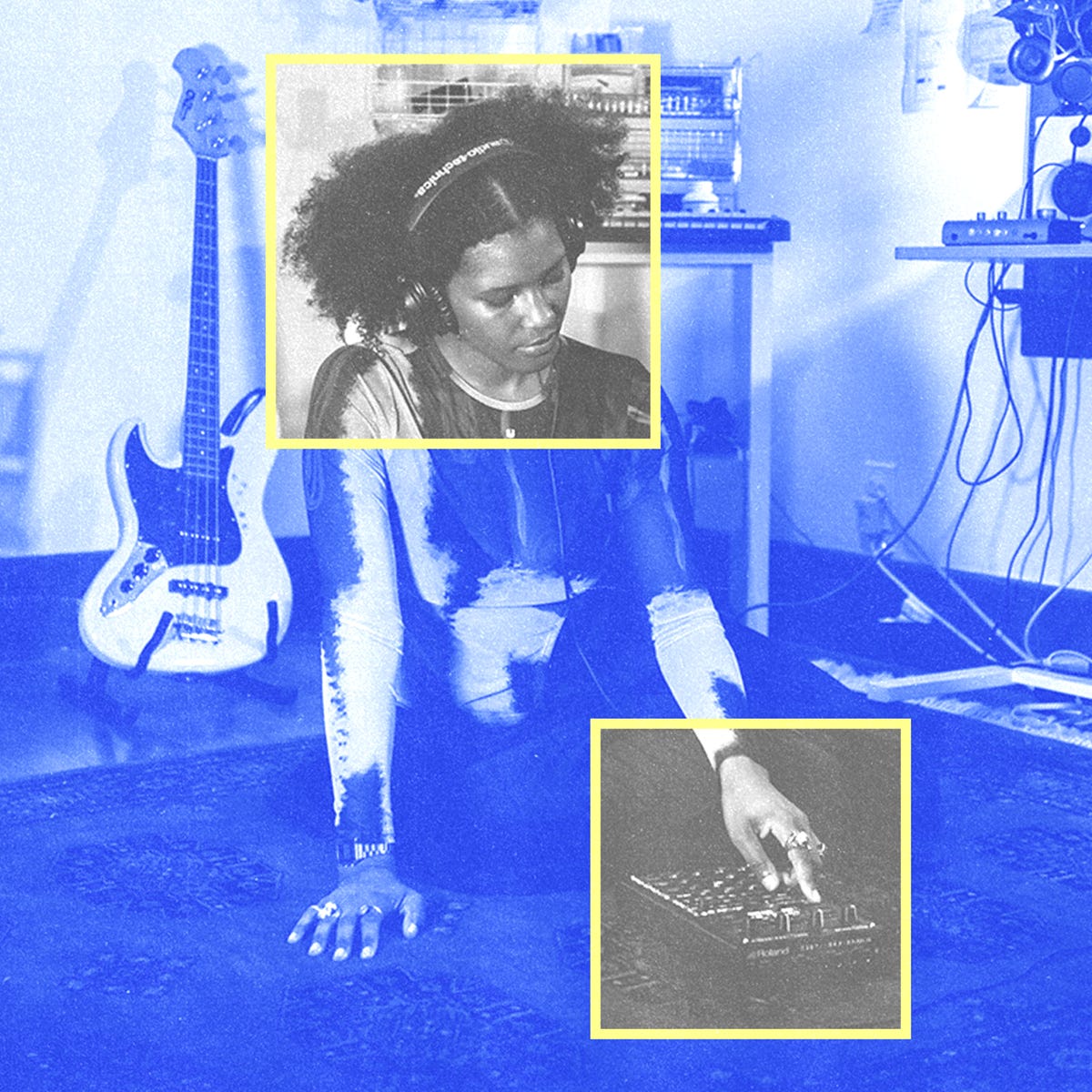
A little more than halfway through our interview, a departing onlooker interrupts to let meigapa know that she’s doing a good job. An intrusion on its face, albeit an overtly kind one, allows the Ohio-born, Los Angeles-based producer to take a beat and re-center herself for the home stretch.
There’s a slew of moments on Intentions, both formal and emotional, that represent a chance to regroup and move forward. Like the way a measured and full deep breath closes “Crashing Down,” following a barrage of “you’ll be OK”s raining down on your head, or how the blistering drumbeat forging the path for the bass line groove on “11.11” cuts out at the very end, leaving no support for her to call out, “for you to dream” into the ether.
These resets seem well-earned, considering that Intentions presented a challenge unlike any that megiapa had faced as an artist, one that was rather self-inflicted. It’s an album that forsakes individualism, which had largely characterized the reclusive beatmaker’s output. During the five years that megiapa spent working on this latest record, she forced herself to slow down and open herself to the warmth of instrumentalist collaborators, grafting stem after stem from keyboardist Kafari (Ahmad Muhammad) and bassist The Growth Eternal (Ghalani) onto old tracks that already hummed with the energy of synths and drum patterns with a Madlib-era ease, mutating and expanding upon ideas that previously existed as COVID-era production exercises. Much like her diddies vol. 1 and 2, warm melodies that feel rooted in the restrained lineage of Patrice Rushen and Aaliyah rub up against pulsating compositions that quietly sprawl like the city she’s found comfort in.
Intentions was also birthed among tectonic shifts—a move from Chicago to L.A., and the ending of a long-term relationship going hand in hand—prompting wholesale changes to her artistic focus and thematic lends. Not just because it seemed like a logical next step to crawl out of her shell, but in the way it manifested as nagging urges that wouldn’t let up. “It was like, ‘This is your last chance to do this,’” megiapa admits. “I keep talking about it like it’s my last thing I’m going to do, which is extreme and dramatic—but it sums up a big chunk of my life. So it does feel like a big release. And with that in mind, as a sort of accumulation of these years of emotional work, literally moving around, travel, relationships… it felt like, ‘This is your chance to say this.’ Tomorrow’s not promised.” Our conversation about what’s next after releasing the past five years on wax was edited and condensed for clarity.
First off, how are you doing today?
Yeah, I’m good. I am here. I made it. I’m tired, but I feel victorious. I feel like I made it through like a packed weekend with things to do. Coming off the Blue Note thing that I was just telling you about, I wanted to make sure that I’m on for that. I want to make sure I know what I’m doing, and so it’s coming from a busy rollout week, and Jack (WildChild) hit me up to do that, and I was totally down. I would love to help you out with that. Sounds so fun, and it super was. And now I’m here, which is so exciting. I made it, and I’m back in my old neighborhood. This is where I first was when I moved to LA. This is where I was living down the street.
Do you sort of thrive on that busyness?
No, no. Absolutely not. It’s not my M.O. whatsoever. Like I’m a chiller. A schedule with nothing to do is my favorite schedule, where I sit and I think and I reflect on my entire life. Like I’m just at home, like serially… I don’t be outside. Yeah. And I don’t like being busy, but this is a good kind of busy right now.
Did you see that in the way that you created for Intentions? Was it a slow process for a long time?
Absolutely, it was a very slow process, slower than I wanted it to be at times. There’s years where I was like, “I’m putting out my album this year,” and then the next year rolled around. I’m like, “Nah, it’s this year.” And then it’s like, “OK, you have to let the album tell you when it’s gonna be out.” And especially since I was collaborating—or one of the major goals for the record was to collaborate with others—it created this element of unknowns in terms of timeline and all of that, that I could not control, which was very uncomfortable. But I think it yielded the best results. So yeah, it was very slow. My life was happening, so the record really is just like over time. Probably a song for each year, probably something like that.
How does it feel to have to revisit old songs? On the tape, there’s a lot of things on the diddies that are very cool and have these little tweaks. Something I struggle with as a writer is like, writing something three years ago and then locking it in a little mental capsule.
Very difficult. I’ve never done that before. And so with Intentions, I wanted to sit with the music, and it was definitely a challenge. I knew it would be a challenge to open songs back up, revisit them. Cause I’m just like... I like to start songs. The diddies represent where I feel most comfortable. It’s just creating stuff and pushing it to the side. Like doesn’t have to be perfect. But for this, I was like, “OK, go back into Logic. Open that file up. What can we do today? Let’s listen to it. Let’s move through. Your homie sent you some stems. Let’s see how we can go back through those and fit those in. [See] what you did? How can we pull that back to make space?” It was difficult.
And then emotionally, going back to those songs, I’d much rather not. But again, are you accepting a challenge that you gave yourself? So, let’s go back there. This is what artists do. This is what musicians do. They sit with the music. They feel the things. Don’t be afraid of those emotions and what’s on the other side of that, which is a song that really does express what you wanted it to. The more I sat with them and the more I opened them up, I was like, “Ooh, yeah, let me add some backgrounds here that would really pull that emotion through for me, or like let me add something else here that’s gonna pull that emotion out.” So, yeah, it was difficult. I cried. I was like, “Man, girl.” But at the same time, I was like, “You’re doing it. You’re doing what you said you would do.” And so I feel like that was the motivating factor for me. It’s hard, but you’re doing it.
What did it take to get to that point where you could go back? Would you have done this years ago?
No, no, no. I feel like my music and like each progressive release represents where I am at that time and where I’m at in my process of making music. So the diddies represent where I was at: “Oh, I just want to be creative and I want to prove that to myself that I can play to my strengths by just making stuff fast.” Cool, I did that. And it’s like, what’s next then?
I think the goal was the motivating factor because like, “Ashley you have a goal.” And it is to release this music, it’s to spend more time with it, it’s to put it on vinyl if that happens: that was the motivating factor. This is what you said you wanted to do, so are you even doing it? Like you gotta revisit the songs in order to get to the finish line. So go open up the sessions…
It’s just interesting because it feels like almost how an athlete will lock into a task and be like “I got to practice this, I got to practice that,” or else it won’t happen.
That’s so interesting because I don’t see myself in that way. But when you just said it, I was like, “Oh yeah, I guess I did lock in for that thing, and I guess I did get it done.” I just don’t view myself in that way. But I think if there’s something on my heart that I want to do, and it’s as I look throughout the things that I’m involved in, it’s as though I don’t realize the energy from where I’m pulling that. But it is like if I say I’m gonna do something, I do it, and I don’t know where that comes from. But I think it’s like I have a commitment to myself to deliver on things that I say, and even to myself, I don’t want to let myself down… I’m definitely not an athlete. I did play sports, but I’m not competitive at all. I’d be like, “Oh, you go ahead, girl. You do it.” I didn’t win. I could run, but I’m not about to race you.
I had a mechanical question. What was your main instrument on this record, what were you handling more than anything else?
This is a vocal forward record for sure. I mean, if there could have been more beats on it, I would have done that for sure. I would say there’s a lot of singing. And synths, like I like to play around in those sounds and like to create and kind of fiddle with that stuff, so primarily that. And then my cast of amazing friends and collaborators filled in all the other beautiful things that you’re hearing on there… So I’m very grateful for them. But the bones were there: My stuff, I considered the bones, and they were like, “Yeah, this is cool,” and then they were like, “I’ll add this or that.” So my voice, and logic, those are my instruments.
When did you start singing, when did you start to believe “I have a voice now?”
Never, never. It comes at different times in my singing, and even last year, I met Mocky, and in working with him, I was singing different stuff, and so… I was just doing different things in my register that I didn’t know I was capable of. And there’s always these moments where I’m understanding more about my voice. And people being like, “You’re a singer,” when they hit me up. I’m like, no, I’m a producer. I happen to sing, but I started singing in the choir when I was like six in my church, and I hated it. And then I was also in the choir again in middle school… It was very white.
Nobody’s doing any type of runs, nothing, nothing. And this is very flat, but I still sang in it because I like singing, and my family’s [musical], my mom loves to sing. She’s musical, so we’re always singing in the house. But, I would sing on my brother’s songs. He would do mixtapes in high school and rap. He’d be like, “I need a girl on the hook,” and so I’d be like, “OK, laaaaa.” Like as a young wee child. And then yeah... I think from then it just became a little passion, a side thing.
I wasn’t like, “Well, I’m a singer.” And I had a conversation with my singer friend recently. She’s singing on my record, and she’s like, “You’re a singer.” I’m like, “Well, let’s talk about this. Like, let’s talk about why I don’t feel like one and why this and that. So we had a really deep conversation. This is just a couple weeks ago, so it’s like I’m still coming into it. It’s like I know I sing, but I don’t really identify myself first as a singer.
Why don’t you feel that you’re a singer?
Why don’t I feel like I’m a singer? There’s some power that women sing with that I feel like I don’t sing with, and I admire it. So I sing from a point of admiration sometimes, and I know I have my own voice, and this is the quality of my voice that I’ve been exploring more recently, where my voice sits in the range of types of styles of singing, and it sits at a specific place. People who inspire me, like Patrice Rushen or Aaliyah, those voices, Kelela, those are the voices I admire. But they’re not wailing on tracks. And it’s like that doesn’t mean they’re not singers, right? And so I’m exploring this.
But I think the main reason why I kind of reject it a little bit is because that’s just not how I ever positioned myself to begin with. It’s like I was making beats and then I would just add my voice on top, and it’s the little stuff that I’d be doing in my bedroom. So part of it is formalizing what it means to be a singer as somebody who started just playing around with music in their bedroom, right? And so it’s like the more I step into positions of singing, like singing at Blue Note background vocals or doing stuff like that, it’s like, “Oh no, you’re a singer.”
Definitely on the record there’s a nice, I don’t want to call it restraint, but an interplay between your vocals and the beat. What is the process for you? Was it always beat first?
Yes, you’re getting at it. You’re helping me understand. It’s almost always beat first, and I think that’s it. And so when I think about singers, I think about someone who’s writing songs. They have a song on their heart, and they’re like, “I’m about to write the song, and I need a beat to go with it.” Yeah. And I’m like, “I made a beat. Here’s a melody.” And then I start working from there. What does this bring up for me? And so I’ve always worked from that standpoint.
I’ve felt listening that you’ve become more OK with being emotional on tracks, how does that come about for you?
I think it’s part of that commitment to myself. It’s how I think this whole process is very challenging in the sense that it requires you to be in the front. And what I liked about being a producer is like, my brother and I would always talk about this, but the producers are behind the scenes, collecting checks. I love that. Nobody knows who I am, but like that’s my fucking song. I love that behind the scenes thing because it allows you to still be whoever you want to be without the expectations of other stuff. And being an artist the way I’m trying to release this record requires me to talk about myself, like to be here with you and be like, “OK, this is my process. And so emotionally as well, if I want people to connect with my music, will I allow people to know me?”
Do I want them to, and will I allow that? And I do think there’s a lot of growth in that process, being vulnerable, right? And so the didies aren’t vulnerable. I mean, some of them are. Some of them, as they progressively go on, talk about love, but like not in any specific way. And in this record, I was like, “We’re gonna stop doing that. We’re gonna try to name some things. We’re gonna use these songs to sort of move through stuff.” And there’s space for more of that in the future, potentially. But yeah, I think that’s why it was like a commitment to vulnerability and trying to put on the songwriter hat and do songwriters do? They name the stuff, they talk about it in a poetic way, and again, that’s not how I feel I identify. But I wanted to challenge myself to say more of what’s real for me and really talk about it.
Where do you fall in sort of the creating from like a pace, a place of emotional pain or like emotional strife?
Hell no! No. No. No. I think that’s cool though. That’s very like giving artist. It’s giving like deep in the artform, and this is where I’m like I’m just a beat maker. I like to make beats. I like my head to nod when I’m making stuff. Like it’s fun. But yeah, it was definitely a challenge to, especially with some of the more emotional songs, like access that and open those channels up. So and especially when the beat is leading that, it’s not like I’m thinking about this stuff and taking what’s on my heart and like going into the session. It’s like I made a beat. Now, what can go with that?
If you sit on a song for a little bit, there’s like arcs and chapters in the production, like the “Black Gold of the Sun” cover. There’s two to three different movements on even just the production styles. How do you balance not throwing the kitchen sink at people?
Hey, if you found a balance, that’s great. But maybe, maybe it was my luck that I struck one because yeah, I’ve been thinking more about song structure lately. I’ve been talking to more of my producer friends, Telemakus, we talk about song structure and how to have it as a guideline, but not as a strict structure. And I had that conversation with him only this year, so after the record was out. But as I was listening back to my music, I was like, “There’s places that I would definitely like firm stuff up.” But in terms of how not to, I think that was a huge part of why it was so difficult for me. Like these were decisions that I had never really had to make. In terms of where to put the crashes, or like where to put the drums, or where to bring things back, and where to add piano and background vocals. Like it’s sort of just intuition, I guess. But I wouldn’t say it’s informed by anything. Now, what I will say is that for arrangement stuff, like especially “Crashing Down,” my good collaborator Mocky. He’s like a song person. He talks about structure. He knows how to make a hit, and so like he helped me think about my music in those ways. But yeah, it was more of a feeling. It’s like there’s places still on the record. I’d be like, “Hey, let’s scale that back.” Or, maybe I go back and make changes.
Especially with the new collaborative process, did it feel like you were in a creative vacuum before? Now, what sort of relationship did you strike with those who filled out your instrumentation on the record?
So it came about in a way where I found myself in a random session at a friend’s point, and the keys player Kafari or Ahmad, he was there, and Ghalani, the bass player, but Ghalani didn’t have their bass, so we were just listening to some of my songs, and then Kafari just pulls up like the keyboard and starts playing over it, and I’m like, “Oh, that’s exactly what I need.” Yeah, real, real live instrumentation on my stuff. And so after that point, they were down to add to it, and I sent them songs, and they just played over them and sent me back stems. And so, yeah, same deal with Ghalani. Yeah, we had a studio session. They just played whatever bass that they were feeling over it. And so I went home with like 50 stems. Like I had stems and takes and stems and so much to work with was very overwhelming, and for some of those tracks, I let that [rest], it had to sit for months. I didn’t even know what decisions to make. I don’t know where to start. I don’t know where to comp. I don’t know where to cut stuff. Like this is overwhelming. And yes, very much it was just me and my beats before. Very safe, very personal experience. And then I’m just hit with all this beautiful music and all these decisions to make.
Where are you drawing inspiration for beats from, or even the instrumentation elements from your collaborators?
Does it sound black as hell? Yes, I like that. Like the bass line on “on the spaceway fr fr” is one of my favorite things I’ve ever heard. It’s simple, but the way Ghalani just delivered on that bass line from their own internal space, like whatever has informed Ghalani, completely met something in me that I was like, “That’s exactly it,” and I love that. And then the requisite is not only how it sounds black as well. But like, what’s informing me? Or where do I get inspired from? I think it’s just like whatever music that I’ve been listening to, and I’m challenging myself recently to expand that to start listening to more input because I just cut it all off. To be quite honest, I haven’t listened to anything new. Well, I have been, but throughout the making of the record, it was very much closed off. Nothing was allowed in. It was all just like, where is this coming from as it comes up? And for “Black Gold of the Sun” specifically, like each song really has a story of how it was, where it came up. I met Stacy Epps. She came to my house in the summer, in July, in Chicago, and we connected immediately. And we were swapping songs back and forth, playing demos for each other. She was just playing songs, and this song came on. I was like, “What is this? Why haven’t I heard this?” And so I, with that inspiration of having met her, and just like formed this sisterly bond and this song and learning about this song,
Speaking on the “Dreaming About You” cover, how much do you love the Blackbyrds?
It’s such a cool lineage. Like that is so cool, and I love them to this day. Like I see Kilgo, he’s like online still, just like playing his drums and just playing his shows, and that is the spirit. I love to see it. Yeah, they deserve all the flowers.
What did you do to the song in the process—what was the attempt with the first cover, and then how did it change?
I still remember the caption I put for that cover when I posted? I wasn’t even gonna do that, and I had had that cover for like two years before I even decided to put it anywhere. And I was like, “I’m not a covers person, but here’s a stripped down, like slowed down version of ‘Dreaming About You.’” And I think there’s something fun. Like I don’t, I haven’t done covers really, but there’s two on this record, which to me is very interesting because they’re not. It’s not even like what I do. But there’s something really fun about taking the music and embodying it to the extent that you can reproduce it in your own way, and that’s fun. I’m just gonna play around with these sounds to try to sing it, and I was like, “Oh, let’s keep building it.” And so the first rendition of that track is like I don’t know if it’s slower, but it’s weird. Like it’s weird. I was like, “should I even post this? This sounds like shit, girl. You are not doing this justice.” And that’s always a thought with covers, right?
But yeah, that one had weird synths. I mean, I love things that are kind of detuned, so I feel like I was going on in the first version. And yeah, this version is literally just a bass line and some percussion, and Ghalani just rips through the whole thing, and it became this very beautiful bass-centered version of the song, and my vocals, which are basically just the same as they were on that original one. But I struggled with that one too because it had changed so much, and I was like, “Does this still sound? Because is this still technically a cover? What is this now?” Well, it is fire, and it’s beautiful.
On Sun Ra, what draws you to both the music and his philosophies? Because he shows up all over the album in the form of mantras and themes.
I’ve read some poems, I’ve read some of his books, but there’s an iceberg. Where are you gonna go in Sun Ra’s philosophy? Do you have time to go there? There’s so many places I have not gone to in this work, but the general concept is something that really inspires me because it’s about offering Black people a different narrative than what we’ve been given or forced to accept. And I just love that, and I love that it takes place in outer space.
Like I loved watching Twilight Zone. Like as a kid, I would just get lost and like very scared in the Twilight Zone and like re-runs of that show. And I don’t know. There’s something that draws me to the unknown, and I’m not afraid of it. I think some people are scared about what they don’t know, but I’m very intrigued by it. The outer space ways or Sun Ra’s philosophy of a better outcome for Black people is what I’m all about, and I believe it. Like if we were to be beamed up somewhere today, I’m there. It’s a possibility that things could be even better than they are right now.
And also just his bravery, like to be truly about that life. Like, there is no crack in his output. It was like this is what it is. He believes it, and that is his truth, and he’s living it. He’s inviting us on that journey with him, and it’s like, are you gonna go or not? And I love that confidence. It’s like people think he’s crazy, but I’m there. I’m there.
It seems that the writing culminates with a willingness to let things and go and allow the natural order to take hold. Is that also Sun Ra inspired, just something you had to learn in your own life?
Yes, very much the latter. Yeah, I didn’t have a choice but to learn that lesson because, like, I’m very… I don’t want to say controlling, but I’m organized and I like knowing what’s gonna happen. And I was just raised that way. Like I wasn’t allowed to just surprise my parents with, “Oh, I gotta go somewhere tonight.” They’re like, you need to plan it out. You need to give us time. Have a plan. My dad’s like, “What’s your plan A? What’s your plan B? And you need to have a plan C, if not also a D.” And so I’m always thinking through life that way.
So, over the course of this record, it was definitely having to lean into the uncertainty because whatever plan I had, like a long-time relationship, marriage, like that. Those conversations being had and that not being true anymore was like, “Oh, you can’t plan for everything, and you gotta let go and just throw yourself into an unknown future.” But on the other side of that is probably the greatest thing that you never imagined, and so that has been the resounding lesson through this. The more that I leaned into something that was not planned, the better things turned out for me.
Over the record, “Crashing Down,” where it goes, “you’ll be alright,” I didn’t know how much I would need that song. Two days later I got COVID for the first time, and I’m playing back the demo singing to myself with chills and shit in Mexico, and it began to inform a lot of things later on. I kept revisiting that song and needed it past that original recording. I think after that, a few years after that, I ended my relationship. Everything I knew in Chicago was no longer true. I left a puppy. Like it was. Everything is different now, so it’s like how do we learn from this, and how do we continue to trust an uncertain outcome? But here I am right with you today.
There’s a conceit that shows up on “My Baby” and throughout the record, that the idea of distance and space in between a record, or somebody that you love, informs how you approach that thing or person.
I would say we need time. I would say in our average day, like we’re too time forward. I grew up very time oriented. Like I said, like you need to be on time. Like you need to have a plan. Like very regimented, and it has been a challenge to let that go or to try to be more lenient about time. But I have found, especially in the making of the record, that you can’t rush things. Like it doesn’t matter what timeline you want something done in, especially if you are involving other people. You can’t rush that. You can’t control time. If you want somebody to be there with you doesn’t mean they’re going to be there, and so being OK with time and waiting and using the time that you have in a way that you don’t have to use it. It takes years to make a record. It takes time to make good music, right? At least people would say. But I want it out tomorrow. Like I want to move past these emotions. I want to stop having to revisit this stuff. Like I want to hurry up and get past this, these, these chapters.
And I realize that’s not always possible. It does take time, and what can I do in that time that can lead to the destination I’m trying to go to? So, like, in terms of like the “My Baby” track, that was what I was saying on there? It’s like really wanting to be with this person and wanting to be with them all the time. I experience that in a relationship just like you’re in a fresh relationship, you’re like I don’t want to be lonely. What am I gonna do when you’re not here? I think it’s a real emotion. I experienced it, and I challenged myself to be like, “Hey, you have your own life. There’s other things you could be doing.” But it was fun to put that in the track and like kind of express that longing.
There’s a line on “wishing (u) well” that sits with me: “I wrote it for you, so I hope you enjoy it.” When you write about someone, how does that change your relationship to the music? Or even, to that person?
That’s such an interesting question. Yeah, that was my dad who was saying that he wrote me a song. That is so cute. Like, who’s ever written me a song before? Oh my goodness, I had to put that in person. This is so sweet. Yeah, I think off the record. This was the first time where I was writing probably with this specific person in mind or people in mind, and so for me, that process was interesting. It obviously depends on the nature of the song. What are you writing about? And for me, it gave me just a way to process and move through those emotions. But not having to interact with that person, it’s here in the world as a statement, but not as a conversation.
Yeah, it’s giving space to it, and in terms of how it impacts your relationship with that person, of course, you can imagine them listening to it, right? Like, what happens there? I mean, I don’t want to be in the room. Actually, I want no parts of it. But yeah, it’s sort of like a hope-a hope that things land, a hope that you are heard, if that’s your goal. But from my perspective, just like this is something on my heart that I want to say, and that’s the end of the conversation.

