

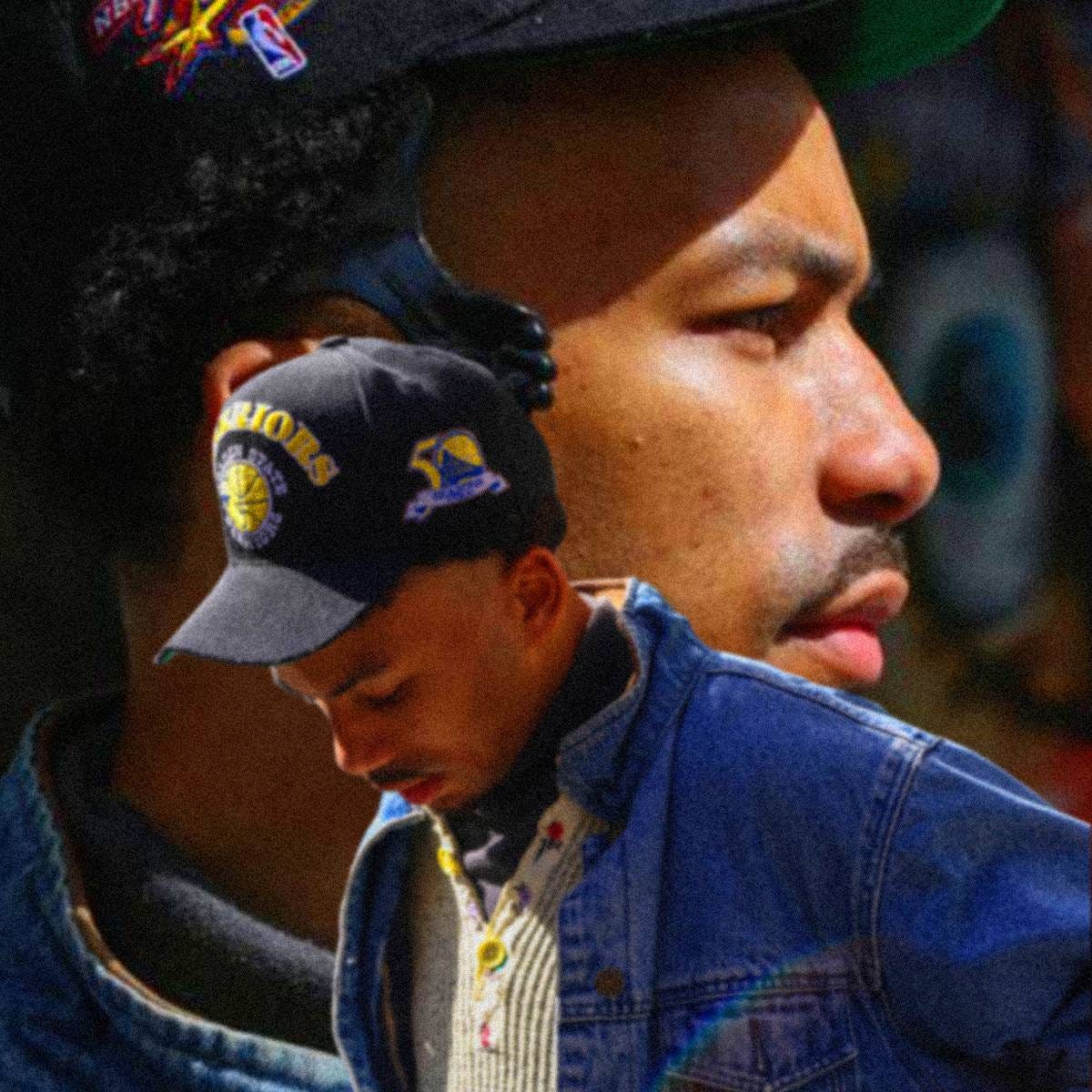
Art via Evan Solano
Dr. Dre’s The Chronic being listed as one of the best Bay Area rap albums is why Alan Chazaro doesn’t trust anything generated by AI.
Ride deep enough into Oakland, away from the glimmering shores of San Francisco’s skyline, past the shipyards and brackish waters beneath the Bay Bridge, beyond the aerosol-bombed walls near the Amtrak trainyard parallelling Interstate 880, a few stops from where BART glides through the Lake Merritt and Fruitvale Station, and even further, where an abandoned MLB stadium sits, you’ll find yourself in the heart of East Oakland. Only then, just before you reach the neighboring suburb of San Leandro, a wealthier city where trees bloom and potholes noticeably disappear, will you arrive in the Deep East.
East Oakland is responsible for supplying some of the most notable rappers in West Coast lore, not limited to Too $hort, MC Hammer, and the Hieroglyphics. Go back to the regional birth of the genre in the early ’80s, and trace that wavelength into the present day, and you’ll uncover a slew of slick word benders who grew up in the East: Shock G, the Luniz, Keak Da Sneak, Philthy Rich, Trunk Boiz, Clyde Carson, Kamaiyah, Damian Lillard, 22nd Jim, 1100 Himself, ALLBLACK, Ovrkast., Seiji Oda, Aflacko. Ad infinitum.
Here is also where you’ll find Michael Sneed, a Gen Z songwriter, producer, and vocalist who grew up near the 106th and MacArthur intersection. Sneed adds his own hyphy-injected Broadway musical flair in a manner that both adapts and experimentally deconstructs the perception of what East Oakland hip-hop is, or could be. He’s a griot from the internet age, a New Oakland vanguard scripting verses as community historian and de facto pastor. He’s a chosen disciple who KRS-One once declared transcendent and invited to perform at his concert after hearing an adolescent Sneed freestyle at his middle school–in which the South Bronx luminary gave a seminar on the role of hip-hop as guttural medicine evolved across centuries and continents and peoples.
Sneed’s connection to Deep East Oakland is built across multigenerational lineages of migration and persistence. He’s a neighborhood baby raised inside parochial churches next to liquor stores, where sideshows and other kinds of illicit activities are popping off. The sort of place where, as he recalls from his middle school youth, you might see a local icon like DB Tha General sliding down the avenue in a scraper, flipping off anyone who stares for too long.
A relatively forgotten part of the East Bay metropolis, Deep East Oakland is so distant from Oakland’s commercial core that it feels like an afterthought for city officials and left to fend for itself. Simultaneously, the city as a whole is rapidly gentrifying, and isn’t what Sneed once remembers as home. In Oakland, like most major U.S. cities, housing displacement has disproportionately affected Black families in recent decades, with local reports showing a 27% drop in the city’s Black population in the past ten years, despite an overall population boom in Oakland.
The result of all that is a grown up version of Michael Sneed: a polymorph, at once regionally-informed by Oakland and unfettered by the conventional expectations of his area code. He’s a walking amalgamation of Baptist churches in the form of Bay Area mixtapes. His pneuma is optimistic gospel meets soul-weathered blues. He’s Pixar musical scores DJed by an unexpectedly aggressive hypeman inside an NBA arena. He’s a hybrid cover band of A Tribe Called Quest, Bone Thugs-N-Harmony and The Fugees, performed on a slam poetry stage as a 20-something-year-old idealist.
floaters at the buzzer! is Sneed’s latest — a 12-song, 36-minute odyssey in search of himself as an Oakland musician, mixing Jeezy’s Atlanta trap anthems, Jersey club, and HeartBreak Gang’s post-hyphy party bangers with snap-your-fingers jazz, Michael Jackson pop, and Disney Channel sing-alongs.
In a 90-minute phone call in which the young artist grapples with the complexity of inhabiting so many interests, and navigating the masculinized pressures of being a rapper, Sneed retraces his journey with as much sincerity as anyone can ask from a young California star-in-the-making.
https://open.spotify.com/album/1MTodq6IqzqFEav64mt1Jg
Congrats on the new album. I remember when you texted me snippets of it during the process. How’s it all feeling now that it’s out in the world?
Michael Sneed: Thank you. The best part about it is that I can now start to focus on other things I want to work on. I’m proud of this [album] because I was able to cover a lot more than my last project, Junior Varsity Blues. Doing that now allows me to do new stuff in the future. This honestly feels like my second best project overall. And it’s one of the best rap albums [of the year] in my opinion.
Wait, so what do you think is your best album?
Michael Sneed: Days We Lost.
That’s real. First albums are always hard to top because there’s just so much hunger to prove yourself to the world. And to be fair, floaters at the buzzer! is less of a rap album, and more of a music album.
Michael Sneed: Yeah. It doesn't cover everything I’m into sonically — but it covers more than anything else I’ve done before. Did it sound different from what you expected and from what you remembered of the preview I sent you?
It was way more musical than I remembered. Also, as someone who has been listening to you for some years now, this version has a more consistently aggressive energy to it than your previous albums. Songs like “blend*,” “DogWalk!” and “town sh!t 4ever!” have more of an “I’m him” vibe to them. I’ve sensed it in your music before, but this album literally turns that up. Is that something you also noticed, or is that just a natural thing now that you’ve been in the game for a few years?
Michael Sneed: Man, if you can believe it, the album sounded even more aggressive at one point. When I was making this project, I was in L.A. with [Bay Area rappers like] P[-Lo], [Rexx Life] Raj and Jay [Anthony]. I think there was a lot of masculine energy in that, and they’re all older dudes than me, and that just rubbed off. I felt the need to prove something, I think. I felt like people needed to know I’m from Oakland, so I felt that urge to tell people where I come from. I’ve seen crazy things in my life, know what I’m saying? I’ve had to defend myself for my entire life. There was a moment [while making this album] where I needed to prove that I was raised tough, because you don’t hear that in my music always. I make music to uplift people. I’m vulnerable in my music.
But I think subconsciously, I wanted y'all to know that this is where I actually come from. Later on [in the process], I was like, “ok, there’s too much of that masculine energy.” That’s not all that I am. This isn’t who I want to come off as. Yeah, I can have that exterior at times and have that toughness when needed, but I’m also still that kid going to church who wants to write musicals and be Peter Pan. I’m still that kid who had two older sisters watching after him and was forced to hear Spice Girls and Destiny’s Child. I appreciate feminine energy, and I felt like I needed to fix that on this album. The original version was overbearingly masculine. This version you hear gets some of that Oakland toughness but also has that softness in knowing you feel like you have to be tough, but offering a space for emotions. That’s the more necessary part of this project for me. That masculine part is necessary to reach vulnerability. Like, tell me how you really feel, and listen to how I really feel.
Props to all of that. You grew up in Deep East Oakland. How would you define “Town Shit” as a mentality and a state of being, within that context of vulnerability you’re describing, especially for those who are unfamiliar with Oakland and its legacy?
Michael Sneed: It’s a lot of different things. When I think of “Town Shit,” I think of pulling up to my neighborhood intersection and turning onto my street. Seeing 50 cars in a gas station parking lot. There’s motorcycles and just music blasting in front of the liquor store parking lot. Sideshows are happening near the freeway, you know, people doing donuts with their cars. I think of DB the General driving down my block and flipping everyone off. Dudes like him. But I also think of the activism that is instilled in us. That spirit we have, in those who are from here. We’re the descendants of [Black] Panther babies. I think of Huey [P. Newton], Angela Davis. I think about that energy being passed to our generation. That will and desire to fight for rights.
At one point on this album you say, “dumb ass East Oakland, never dumb it down,” which is both an homage to riding the hyphy bus and going stupid doo doo dumb, as well as a declaration of your own consciousness as an artist. That’s a huge duality.
Michael Sneed: A lot of people in Oakland and the Bay, we have the ability to be ignorant and have fun, but we’re also still sharp as a knife. A prime example is Tupac. He’s not 100% from Oakalnd, but he talks about how he got his game here [as a member of Digital Underground]. His mom was a Panther, so she got some of her game from the Panthers in Oakland, too. You get that political side with Pac, and he presented that fully, but he also presented the fun, drink, smoke, mindless lifestyle. And he’ll fight if he has to. That’s the most Oakland attitude. ALLBLACK is also like that. ALLBLACK talks about pimping and putting girls on the blade, but also, in the same week, he’ll go to People’s Programs and give out breakfast to the less fortunate. That oxymoron has always been a very Bay Area and Oakland thing.
Where does that activist mindset and desire to uplift others in your music, as you noted, come from for you? In one of your recent videos, you’re rocking a “F*CK ICE” t-shirt airbrushed in the red, black and green colors of the palestinian flag.
Michael Sneed: That has been my whole identity as an artist. I’m the kind of guy who might not say much, but when it’s time to speak on right and wrong, you know I’ll say something. A lot of my family comes to me for that energy. Like, “man, something’s not right in the world, and we’ll get past it, and we’ll figure it out and make it work, and we’ll do the best to make it out of this situation.” That’s the spirit of my music. Especially as a rapper. I’m like a mix of Huey and Jazmine from the Boondocks. Some of that is just naivety. But if you don't have some of that, you’ll just be hopeless.
Right now there’s a bohemian renaissance happening in East Oakland rap. You, Seiji Oda, 1100 Himself, Ovrkast., demahjiae, Nimsins. Those are just a few from your area who are making noise and doing things in a way that honors Oakland’s hip-hop past, but also builds on it with different styles and innovative blends. What would you say to that?
Michael Sneed: We’re kind of the new face of Oakland music. We’re all coming up together right now. We have a similar type of spirit and energy, and we are around the same ages. I’m actually on the older side of that group. But we have a militant way of speaking about what we see in our own ways. We’re mostly in our mid to late 20s. We came up in Oakland when Oscar Grant got killed. I was about 13. That’s a pivotal age to see something like that. We were young, but aware enough to understand what’s happening in the world around us and why it’s happening. Now we’re mature enough with our emotions to understand how we feel about all of that. Man, think about Occupy Oakland. I was 10, 11, 12 years old during that. Growing up around it. And we also used to have Youth Uprising, Youth Speaks, Youth Radio back then in Oakland. All of that instilled that spirit inside of us that we’re making our music with.
And also whatever was on television during those years. That was peak anime coming to America on Nickelodeon. I know that emerges a lot in your music as well. Your tag line, “yip yip!,” comes from anime.
Michael Sneed: Exactly. Watching stuff like Naruto and Avatar [The Last Airbender] at that age. Those were life lessons, too. Never go back on your word. Never surrender. Never give up. Fight the system and make sure the places you live are fair for everyone, and not just for one specific group of people. Those lessons are very prominent in the anime my generation grew up with.
What anime are you currently rocking with? Or is that something only from your youth?
Michael Sneed: This year has been hard to watch. But I’ve seen Go! Go! Loser Ranger!. Been reading some manga, too, but those can get weird. Oshi no Ko. The first season of that is one of the best television I’ve ever watched. My Hero Academia. Orb [: On the Movements of the Earth]. There’s a few. I don’t watch it like I used to in college and high school, but I try to keep up.
I actually wanted to ask you about college, because you graduated from Howard University in Washington D.C. A top HBCU in the nation, right in the heart of the Southeast. That’s not common for Bay Area rappers. How did that experience shape you as a West Coast artist?
Michael Sneed: Being in D.C. gave me exposure to new things, like Go-Go music. You don’t hear it much on this specific album, but it’s in me. Also, being in D.C., I got a lot of spoken word poetry. I was already into poetry and spoken word because of my older cousin and Youth Speaks. But being in D.C. and exploring the open mic scene outside of my cousin’s shadow gave me a new love and understanding for it. Any spoken word artist will tell you that D.C. has one of the best open mic scenes in the country. That impacted my delivery, my cadence, my writing. And as for Howard, I wouldn’t have the love for club music from other regions if it wasn’t for Howard. I love Atlanta trap and Chicago drill because of those years. I heard that stuff in the Bay, but at Howard, that’s the only thing getting played. You have people coming to school from those [other] cities, so that helped me understand those sounds. That’s why you hear those influences in my music.
That all makes sense. This album is especially diverse in its sound and inspirations.
Michael Sneed: HBCU bands? Man, seeing that at Howard. That orchestral element. You can actually hear those notes in “blend*.” There’s some chants and orchestral sounds in there. I’m doing that because I went to an HBCU. When people hear my music, they never guess that I’m from the Bay. They actually think I’m from the Midwest.
That’s hella funny. Why do you think the Midwest, specifically?
Michael Sneed: I get compared to Chance the Rapper a lot. But I’m also a big fan of Noname, Common, Eminem, Bone Thugs, Twista. Those are all people who I’m influenced by. They curated and created their own sound. When I was really starting to learn how to rap, those people were influencing me. I put out music at that time and it sounded similar. Once I learned what I wanted to do, I built on it.
Tell me more about how you balance all of those influences with the range of other genres you pull from. What challenges, if any, does it present?
Michael Sneed: My grandma was an opera singer, and she sang in the church. So I’ve always been around music. For me, it’s always a challenge to bring all of that into what I do. I do a lot and I’m inspired by a lot. I can try to go into something just thinking of doing one thing, and sometimes it works. That’s basically what I did with Junior Varsity Blues. Like, alright, I’m just gonna do soul samples and raps. Right? But one of the reasons it can take me years to put out any project, especially this project, is because I’m trying to juggle those new and different sounds. I think I finally kind of learned how to make them all one thing instead of trying so hard to divide it all as this or that. I’m just doing it all in the moment and not really being so controlling of it. I want to see what naturally comes out and then figure out after how it all fits. I’m just making the music and letting the story tell itself through the sonics.
What’s something new that you were aiming to do with this project?
Michael Sneed: One thing I wanted to do, that I’ve kind of done a little bit in the past, but really focused on with this, is letting people know that I’m from the Bay, from Oakland. Everyone thinks I’m from the Midwest. I wanted to put that emphasis on Oakland, specifically. My first two projects are soul-based. It’s more soul music and gospel. It doesn’t really go beyond that. But I wanted to go beyond that in this. I don’t always get to put that out. You know, HBK horns, true Bay Area music. My goal was to make all that sound like a cohesive thing. It’s a lot of genre blending and bending sounds, but I think it worked well.
You also have a noticeably larger cast of features on this project to help you with all that. There are some notable Bay Area hitters like P-Lo, Rexx Life Raj, Ovrkast., 24kGoldn, Hokage Simon and YMTK. What was the collaborative process like for you on this album, and why so many folks on this album?
Michael Sneed: The fun part for me was that I got to write all my parts around so many talented people. Being able to write and construct complete songs with others is fun. I’ve written for others in the past, but not very much with others in the same room for my music. But the challenges of that were getting some of the verses in on time. The project was supposed to come out in June but we couldn’t get everything cleared in time, you know, people are putting out other projects and their own stuff, and so we had to wait until after August.
Sometimes, we didn’t get something until two weeks before release. That was a little difficult, but that’s why you don’t always hear features in my music in the first place. I’m used to making music on my own and for myself and being on my own. But I think the wait and the process made this worth it, because it brought new energy into my music and people were doing things that I wouldn't typically do. The thing is with rap, stuff just happens. You might get a call and get to the studio with about five minutes [of advanced notice]. And things just happen.
You’ve become a protege of P-Lo and his older brother, Kuya Beats. What have you learned from being around them at this stage of your career that you can apply to your craft as a vocalist, songwriter and producer?
Michael Sneed: I’ve learned a lot, specifically from Kuya and P, but also from my close friends Ovrkast. and demahjiae. They all taught me how to program my drums, for real. My drums weren’t good before I hung out with those guys. I’ve learned how to be tonal and drum focused now. I used to be melody and sample focused; I thought that was the most important thing. But the drums drive the groove. The drums drive how people move. Get your pocket and your drums right. There’s no real rules with drums. Before I met them, I had a certain way of doing it. But around them, I learned that it could be different [mimicks various drum rhythms and patterns]. It doesn't have to be 1, 2, 3, 4. It can be 2 and 4 and a half. Or 3, 2. Or the snare can land wherever you want. Same with the hi hat, the kick. You can have fun with it.
You’ve had an ongoing relationship with basketball in your music, which can be seen from your album cover art to your previous EPs, like Junior Varsity Blues. Your younger twin cousins, Amir and Amen Thompson, are even in the NBA. Where does your family’s connection to the sport come from and what, if anything, does hooping have to do with the way you approach making music?
Michael Sneed: I look at rap like a sport. Similar to basketball at times, but more like boxing — specifically with rap. The construction of an album can be like basketball, but with rapping it’s more like boxing. I’m in the ring and trying to take a head off. Albums and music as a whole? That requires a team. We’re on the court, entering the season, doing our best job to dominate the entire league. We want to have the best outing and performance each time, so each song is like a game, in that sense, and the whole project is trying to get to the Finals. Did we do enough work to get there? That’s very competitive. I’m trying to have the best performance.
Obviously, music is subjective. In basketball, if you win the championship, you’re undeniably the best. Know what I’m saying? But with music, someone might see your music as the worst, [while] another person might see it as the best. So my mindset is to come in and think about how we can regularly compete with the best: the Earl Sweatshirts and Tyler the Creators, the Kendricks. And also with my friends. I want to compete with Kast and demahjiae. None of us want to have the worst album from our group of friends.