


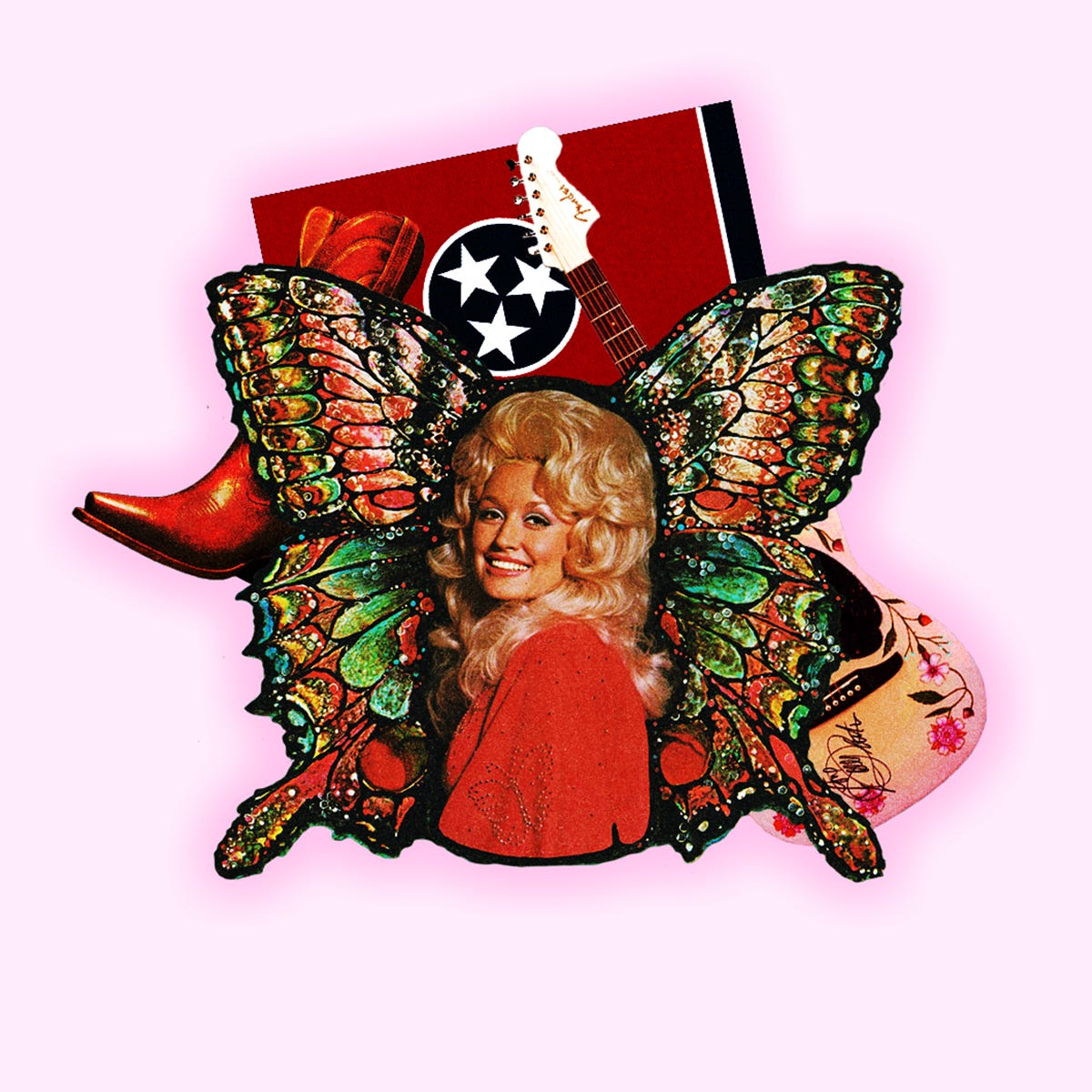
I hope she went in her wig. When I picture Dolly in her final moments, I want to believe she was wearing her tallest heels, with a full set of acrylics, her eyelids painted in shades of baby pink and blue. Dolly Parton died yesterday, August 25, in Nashville, Tennessee. She was 80 years old, but she might as well have been 13, performing at the Grand Ole Opry for the first time, or 19, freshly relocated to Music City but already a venerable veteran of the stage. Even in her late 70s, performing at the 2023 Thanksgiving Dallas Cowboys halftime show, she looked and sounded ageless, a wizened woman and a whimsical girl in the same small body.
Dolly was proudly plastic: “I can have it all, even if it’s fake,” she said in a 2020 interview. She was always on, constantly performing; even after hours on the set of of 9 to 5, surrounded by women preaching the power of feminist liberation, her co-star Lily Tomlin says she never revealed her natural hair. She was the embodiment of the promise of stardom: absolute reinvention of the self, a never-ending performance. One of 12 children born into extreme poverty in the Great Smoky Mountains, she became an expert at play-acting celebrity, sewing her own dresses from cloth sacks and singing into a microphone made out of a tin can and a reedy tobacco stick. And it’s that unrelenting, self-aware projection of an extreme feminine ideal that ultimately protected her: from facile categorization, from oversimplification, from constraining her impact to a single genre or cause.
Dolly was always in on the bit; she cracked the joke before anyone else could. In songs written by men from early on in her career, she called herself a “dumb blonde” and lamented her “cheap lipstick,” winking at her image as a self-proclaimed “Backwoods Barbie.” “Can we start by talking about the biggest thing about you?” a male interviewer asked her in a television broadcast from early in her career. With a knowing grin, batting her eyes as her cleavage spilled out of an emerald green dress, she asked, “Well what would that be?” (Luckily, the answer was “your determination.”) She embraced the absurd expectations of womanhood and used them as a shield and a trojan horse, a pragmatic presentation in an industry built on artifice. Too synthetic to be a threat to other women, too shiny to be ignored by men, Dolly spent her entire life toeing the line between drag and diva.
As a songwriter, Dolly held weakness and strength in the same hand, singing about ugly feelings in her prettiest facade. In a dress cut well above her knees, a wig teased to the heavens, and a pearly-white smile, she took to the stage to sing “Just Because I’m a Woman,” a song about the ways men discount and discard the opposite sex for the sin of being less than perfect: “My mistakes are no worse than yours.” Her songwriting resonated because she confessed to complex and uncomfortable realities—jealousy, doubt, fear of abandonment—without shame or reservation. Dolly could write a hit in an instant, composing the theme to 9 to 5 using her acrylic nails as an instrument in between takes on set. But she was also a master of ambiguity, unafraid to let a song like “The Bridge,” about a pregnant woman who is abandoned by her lover and contemplating suicide, end suddenly and tragically.
And then there was her voice. At times a muscular and sharpened weapon, at others a winsome nightingale, Dolly’s steady soprano ushered the sounds of the humble American folk tradition into the realm of pop music. Listen to the way she carries the minor melodies of “Little Sparrow,” as if embodying the sound of the wind beneath delicate feathers. Or the way her voice catches on “long, hard fight” on “Light of a Clear Blue Morning,” as if she is uncertain that “everything’s gonna work out.” It’s the sound of remaining humble in greatness, of telling small stories with her massive range. She sang about hollers and banjos and yodeling the blues, loyal to her roots in song and, as has been well-documented, in her immense philanthropic efforts, which targeted illiteracy and poverty in the Tennessee mountain towns that raised her.
There was magic in the contradictions of Dolly Parton. Perfectly flawed, beautifully grotesque, an intensely private person who wanted to belong to everyone. In her book Behind the Seams, she wrote, “I wake up with new dreams every day;” four days before her death, she told People she “dreamed herself into a corner.” Dolly manifested an icon out of tin cans and cloth sacks, gluing rhinestones onto a patchwork coat of many colors until it shined.
