


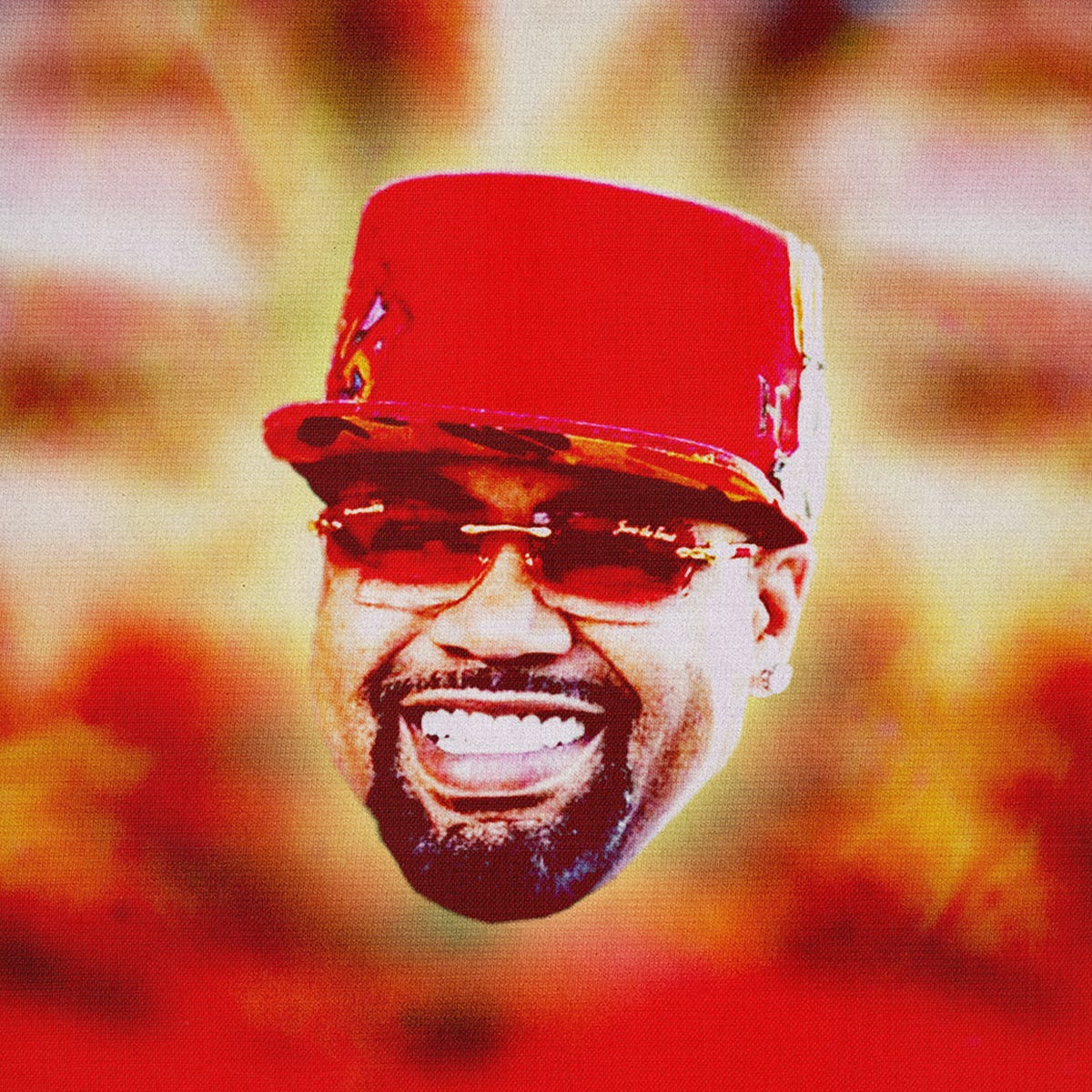
I’m outside in the New Orleans sun waiting for Juvenile to give me a call, and I’m listening, once again, to “Nolia Clap.” Each time I listen to the 2004 single, I become my ten-year-old self learning about New Orleans for the first time—New Orleans is the place where the Saints play, the place George Bush let flood, the place where they do the Nolia Clap. It’s only once this spell of Proustian reverie has subsided that I realize the sky above me has opened up. That’s what the sky does here: it opens unannounced. In the grueling summers, the attendant thunderclaps ring like church bells, offering brief earthly salvation from the suffocating heat. On a spring day like today, the rolling rainstorms are just an occupational hazard. There’s an honesty in this. New Orleans is perhaps the most beautiful, fun, and culturally generative city in America; it is also a remarkably difficult place in which to get comfortable.
To the extent that Juvenile’s music has always communicated ontological truths about the city of New Orleans, it’s the sense that precarity is lurking around every corner which comes across on his ostensibly breezy recent album Boiling Point. As hip-hop settles into its classic rock era with an attendant procession of disgraced moguls, 30/40/50-year retrospectives, and Super Bowl halftime shows, there is by now a common expectation of what a late-career rap album is supposed to sound like and do. In many ways, Juvenile’s album-length foray into self-described “unc mode” comports nicely with these preconceived notions—the record’s occasional missteps include DJ Khaled collaborations and an uninspired, Shaboozey-indebted crossover bid. And yet Boiling Point, the New Orleans legend’s first solo LP in over a decade, is self-possessed and purposeful without veering into the didactic temptations that bog down so many a purportedly serious dispatch from one of rap’s elder statesmen. On Boiling Point, Juvenile is recognizable without sounding stale, playful while rarely pandering. On its surface, the record exudes comfort, alternating between kicked-back cookout playfulness and ready-made club bruiser that feel, in the context of Juvie’s resume, like stat-padding the greatest ass-shaking career of all time. And yet below its easy surface, the album frequently roils with echos of the hunger, ferocity, and urgency that vaulted Juvenile into rap’s pantheon from his once-unprivileged situation as the oldest of the Hot Boyz. Boiling Point is preoccupied with comfort, but the fact of its existence demonstrates that Juvenile neither takes this comfort for granted nor expects it to sustain itself.
What I mean to say is: Juvenile did not have to release a record on his 51st birthday. Nor, for that matter, did he need to have a second, star-studded album waiting in the wings to be released some time after his 54-city tour across the United States. Juvenile has four adult children and somehow even more incorporated business ventures. If most late-career albums are a thinly-veiled pretense for the comeback tours, Juvenile enjoys the luxury of getting to skip that step entirely: in the wake of his viral NPR Tiny Desk performance in 2023, which centered a stripped-down bounce infectious enough to ward away cynicism from even the most resolutely stripped-down-skeptical heart, Juvenile has enjoyed a period of sustained public relations wins traditionally associated with an upstart presidential campaign. In the last three years, Juvenile has toured extensively, headlined the ill-fated Cash Money Records 30th anniversary shows, and reunited on stage with his fellow Hot Boys B.G., Turk, and Lil Wayne at Wayne’s Lil WeezyAna Festival. At home, he is a loving father; on the road, he has been recast as an appropriately-boisterous, appropriately-drunk uncle. Juvenile’s music has by now become as durable, omnipresent, and evocative New Orleans cultural export as Popeye’s chicken.
As with many of the city’s hallmarks in the popular imagination, this period of Juviebiquity has led with the hits and the ass-shakers. Juvenile’s canonization has emphasized the sort of joyous, sexy, drunken celebration that has long-served as shorthand for New Orleans’ culture; as with all shorthand, this understanding is neither incorrect nor complete. But New Orleans, too, is unbearably hot, inequal, poor, racistly governed and policed. There is a temptation to implicitly fetishize the city’s abjectly desperate material conditions in discussing its robust, singular culture—pressure makes diamonds, desperation breeds ingenuity, all the rest. That, of course, is incorrect; culture thrives when and where people can thrive. And yet it remains true that Juvenile’s music remains inextricable from the abject desperation from whence it was born, that it like the city it’s come to soundtrack exists in a place of both-and. There is no “Back That Azz Up” or “Slow Motion” without Juvenile’s signature, grizzled bark, just as there’s no “Ghetto Children” without his undeniable ear for melody. Juvenile’s music has always been made to soundtrack parties thrown on days where it seems too hot to leave the house, anthems for celebrations made sweeter by what came before them and what lurked beyond their horizons. Boiling Point, for all its laid-back bacchanalia, is a record that sounds like a lifetime of looking over one’s shoulder. It is an album about not taking anything—least of all, being the life of the party—for granted.
The day before setting off on his Boiling Point tour, Juvenile and I spoke on the phone. That the New Orleans legend was calling from Trombone Shorty’s studio registered as proof positive of his middle-aged creative irrepressibility. We spoke about his new record(s), aging, parenting, censorious probation officers, the New Orleans Saints, life as a working musician, and posting on social media while drunk. The below conversation has been lightly edited for clarity.
You’ve described this record as a complement to 400 Degreez. I’m curious, what did you have in your mind’s eye when you said that? What are you trying to accomplish on this album?
I really didn’t have a goal set, so that’s kind of a hard question for me. But what I can say is, the reason why I say it’s a complement is because I didn’t do the album by myself. Like, when we put 400 Degreez together, it was a lot of minds in the room, the likes of Wayne and everybody like that. And this project was pretty much similar, you know it had a lot of thought process and a lot of people that was involved in putting the album together.
Obviously, you’ve got Mannie [Fresh], but you got a lot of other big name talents and new faces in there too. What was that like getting everyone together?
Just trying to have the right fit for the songs that I’m working on. You know, the thought process, when you’re recording a song, you don’t really record thinking of who you’re going to put on it. So as far as the features is concerned, I like to record the song and then listen to it and think who would be the perfect person to put on that with me. And production, as far as production, a lot of the guys that did the beats on my album is actually my friends, so it was kind of inevitable to have them on my album.
I was going through the credits on the album, and every once in a while—for instance, there’s “Pull Up” with Birdman, Goodfella, and Lil Bryan. I clicked on Lil Bryan’s name, and he’s got three listeners a month on Spotify. I’m like, you’re really opening doors for people with this record.
[laughter] Oh, that’s good.
Here’s my question for you. Rap wise, you’ve accomplished it all. You’ve got a lot going on—you’ve got the businesses, you’ve got your family, and musically you’ve got nothing to prove. Where do you find the fire to get back in the studio and to keep recording new music?
Man, I got to say the fans, man. It all started from the whole Tiny Desk thing. My fans kind of encouraged me to do everything I’m doing right now. And not just that—family too. It’s cool getting to do stuff with your kids while they’re grownups and having them have those experiences that you had when you was a kid. So that makes it even cooler, too.
How old are your kids right now?
Twenty-seven. Twenty-seven, one of them’s getting ready to make a birthday, 30 and 32.
So they’re really adults. You can engage with them on that different level now.
Oh, definitely. Definitely.
I heard you mention that your kids helped sequence the album. Of course, your son [Young Juve] is on the record too. What’s it like working with your family like that? It’s a family business!
It’s cool as hell, man. It’s got to be one of the coolest things. Because they’re more attuned to what’s going on right now, especially on social media. I need those opinions as much as possible. But the cool part about, is like, what parent wouldn’t want to work with his kids and do something that they actually love doing? And getting the opportunity to share with their kids? It’s like the greatest gift ever.
It’s probably fascinating from their perspective too. You grow up in the city of New Orleans as Juvie’s child, it’s big shoes to fill. Being able to step in with you and work hand in hand is probably a great experience for them too, I imagine.
Well, I taught them to always put on their own shoes. Don’t worry about filling up nobody else’s shoes, including me. Wear your own shoes and set your own mark. Set your own goals and go out there and chase them. That way you don’t have shoes to fill, or have to follow behind me, or nothing like that. Because sometimes, you know, when you do that, you put yourself in a bad place. And I don’t want my kids in a situation like that. I see kids that try to follow in the footsteps of their parents and they try a little too hard, and it winds up going haywire.
A bit of a Bronny James situation.
And psychologically—I don’t think it’s good for the psyche. That could ruin you, man. That could really mess with your mental health.
I’m curious about something that comes up a few times on the record, which is B.G.’s legal situation. You have a number of songs featuring B.G., you have lyrics referencing what he was going through. I’ve been fascinated by what B.G.’s had to go through on probation, specifically the process of having to submit his lyrics to federal probation officers for approval. What was that like to work with?
That’s exactly what it was. It was like this thing, we had made all these songs, that song included, and everything had to be like—they had to go through the lyrics, and it was just like a process that for me, I feel for him it. It’s hard to be creative when you know somebody’s about to go through your lyrics and probably condemn ‘em. So it is hard. And then as an artist working with somebody like that, knowing that you can only make a certain kind of music, y’all got to be in a box. That’s not a good feeling either.
So did y’all literally submit the lyrics? What did the process look like?
Well, all the lyrics had to be submitted. The B.G. songs, all of ‘em had to be submitted. Right now he’s off papers, so it’s not happening right now.
Oh, God bless. I’m happy to hear that for him.
Yeah.
So, with the B.G. situation—
[laughing] Did you say shit-uation or situation? What did you say?
It is a shit-uation, frankly.
It was a shit-uation.
It’s one of the most aggressive examples of something police and prosecutors have been doing for a long time, which is criminalizing rap music.
The amendments…that don’t line up with the amendments, right? Freedom of speech, it just don’t make sense.
There are a lot of people out there who consider rap a young man’s game. You have the unique perspective of being a kind of elder statesman. How do you wear that hat?
Really, really, man, the young guys give me energy and motivate me. And the fact that I’m sampled, a lot of cats really like sampling my music, and a lot of these young cats, they give me motivation, man. Because, not to take nothing from them, I just feel like the bar has been set already. The bar’s already been set, so you just have to go out there do you, and hopefully you can reach that bar. But the bar has been set, and it ain’t moving. So you got to just go out there and do you do your music and don’t try to reinvent yourself to the point to where you missed the fan base that you had from the day one. The people that supported you from day one. They are the most important fans. New fans, they’re important also. But the ones who’ve been with you from day one, they are more important because they’re going to be with you when the club’s got two people or two thousand. You know what I mean?
They’re going to know the words. They’re going to be shaking ass in your case.
For sure, man.
You mentioned that the fans were the ones who pushed you to do the Tiny Desk and the fans were the one who pushed you to do this record. Did you see a boost online in fans after the Tiny Desk, or did it just get the old fans more motivated?
Oh man, it skyrocketed like crazy. Not just that, but the booking, being book for shows because of it. The craziest part about it, while we’ve been doing this interview, Trombone [Shorty] just walked in the door, and I’m actually in his studio.
Well it was Trombone who pushed you to do a lot of the live instrumentation too, right?
The live stuff, yeah.
So you’re going live on the tour?
Yeah. Well, some of the shows, I don’t think we’re going to be able to, because of the place, the buildings. So some of them we’ll just have the drums and stuff, but I’ll always have something live with me.
So no backing tracks, just you and the band.
Always.
What can fans expect on the tour?
They definitely need to know that the show is going to be two parts. So there’s going to be one part Boiling Point, and the other part is going to be 400 Degreez and the classics. But one part will be Boiling Point because I’m definitely going to sing the new songs. Normally when I have a new record come out, I really don’t sing a lot of my new songs, but because of social media I can get so much great feedback on the new songs that it’s a must that I sing them.
How has the feedback been?
It’s been crazy, man. Each little short video that I did in the car, they averaged 5 million views.
I’m telling you man, people love the car for some reason.
Yeah, I got more loading up now. More loading.
There’s a lot of radio-friendly songs on the record, obviously “BBB,” “Hot Boy Summer” is made for the airwaves too. Do you have that in mind when you’re recording?
It just comes together. That song [“Hot Boy Summer”], we have a video for that song, and that song was on the radio. It was the first single.
It’s real catchy.
Yeah, man. I mean every man feels that way. [Ed.- the chorus of “Hot Boy Summer” proceeds “We can have discussions ‘bout what we think of each other, but I’d rather take my clothes off, fuck something, and doze off.”]
I got a kick out of the interlude after with the guitar solo. It’s real glam rock. It’s real arty. I liked it a lot.
Thank you, boss. Thank you. We’re trying to put rap out, but still we want people to know that we do music. It’s music for real.
Let’s go back for a second. You were talking about how the new guys give you energy. Who are those guys who are energizing you? Do you have new guys who you’re especially keyed into?
Well, me and Rob49 just did a mixtape together. So I’ma always say nephew. But my son Young Juve gives me a whole lot of energy. I mean nonstop energy. But I mean it’s…42 Dugg is my nephew. The list is long man. Future, I love Drake. It’s not too many that I don’t like. I like DaBaby, I like Lil Baby, I like… if they’re on the radio. I’m pretty much listening to them. Let’s say that. I’m listening to Big X Tha Plug. Of course. I think Wayne is always the greatest rapper of all time.
Yes.
But I listen to everybody. I try to keep my ears down to the street. I’m listening to Fetty Wap right now, so I’m listen to everybody. That’s my guy too.
I’m from New Jersey, so there will always be a place in my heart for Fetty Wap.
Yeah! On top. He came on my podcast not too long ago.
How’d the podcast come together?
Well, me and Mannie decided that we wanted to do something, do a podcast, and do something that was different, like funny. Something that you could have fun with and bring that other side out of the stars, because a lot of stars don’t show that humorous side. So we just want to get ‘em on the show, ask them some questions. But most of our points and the questions that we ask is just trying to get them to tell us something funny, or tell us a funny story or something.
It reminds me of those podcasts with, like, Jeff Teague or some of those ex-NBA players. It’s a lot easier to get someone to open up when you’ve got some common perspective.
Yeah, you can pull ‘em out there a little bit. Like, “yeah, I heard this. I know that.” And it’s, oh, here you go bro…
A few years ago I ran to Mannie, and somehow he ended up buying me a drink. I was like, what the hell are you doing buying me a drink, Mannie? But I guess he’s the mayor of New Orleans in his own right.
He’s the boss. He’s the fucking boss.
So, we get a lot of him on the record. I read that you’ve got a second record in its infancy somewhere too. Tell me about that.
So I’ve got a whole ‘nother…you know I did north of forty songs. I was trying to put ‘em out at one time. [laughs] Artists, we get away for a minute, we don’t really understand. I’m like, nah. Then my daughters and, well, my kids, they got together. I let them line the songs up on the album. And they picked the songs that they think should be on the first album, and they got everything right. See, I was mad about the Lil Wayne song not being on there. I’m like, damn, why the Lil Wayne? She’s like, you got to save something for the other album.
So we’ve got Wayne coming on the second album.
Yeah, it’s a lot of people that’s on the next album. Rob49, Wayne, Youngboy. So yeah, I stayed out of it, man. I was a little heated about it, but I try to back out a little bit and let my kids run the show a little bit. Most of the time they be right, so.
You talked about social media. How has the landscape changed, releasing rap music now?
My baby girl, I don’t want to say her name, she runs my social media. She showed me how TikTok can make your career, how people are using social media to pretty much run their businesses. A lot of businesses are ran off social media. And she just showed me a world that I was missing. Well, not missing. Well, a world that I really had not that much interest in, truthfully. Because when you’re so stuck in your ways and you’re not used to something, you don’t see where it’s going to be some big deal for you. But it is, it’s a big deal and I advise everybody that’s trying to overlook it to get into it. She schooled me on everything. If she wouldn’t have told me I made a mistake on what I said about Tiny Desk, I probably don’t ever do Tiny Desk.
So she was the one who told you, you’re making a mistake
Yes! And told me I need to apologize, and I need to do the show. Cuz this might be career-ending.
She was talking about the career ending.
Yeah. She knows how to scare me. She knows how to scare her daddy.
Well it sounds like she gave you the right advice at the end, right?
She’s good. She’s just good at what she do. She loves social media. She believes in algorithms and stuff like that.
And so you’re seeing songs take off because of that?
Yeah, I mean a lot of things that I do is off timing and algorithms, even my posts. When you see something crazy on my posts, something weird, the words not spelled right, it just looks sloppy, that’s me. That’s definitely me. [laughter]
All the good stuff’s your daughter.
Yeah. I mean after three cups of cognac and a couple of smoke…I’m not spelling that good no more.
That’s something I love about when the generation that came up before social media engages with it. It feels a lot more vulnerable and real, because you guys haven’t necessarily been schooled in it your entire life, how to act for the internet.
Yeah. We tend to get on there and make a lot of mistakes because we still have to learn. The worst thing that I think, that I’m good at, is I don’t put my emotions on social media. I keep it to myself or amongst my family. So I think that’s the good part about me. If I’ve got something negative going on… and I felt like that from day one. I’m like, so you put it all your business in the public? If I’m mad at somebody, I get on there and say it and everybody knows it? Nah!
The social media beef never ends well.
It intensifies something that’s wrong. You know what I’m saying? It doesn’t make something that’s wrong better. I’ve seen that too many times on social media. I could be corrected, but I haven’t seen it.
When you’re in the heat of the moment and you say something, you don’t say it with the intent of it staying in public forever.
People tend to say things, we all do, we say things, and we’re like, “damn, why did I…I shouldn’t have said that.” On social media, you don’t have that chance to recant that or pull that word back, so you’re stuck.
I feel like that’s a perspective you have as someone who’s been in the public for the majority of your life at this point.
Yeah. What your mama told you when you was young? If you don’t have nothing good to say, don’t say nothing at all.
Does the social media stuff excite you, or is it an added chore you’ve got to do to put out your work?
Well, it excites me. It excites me and it scares me also. Because the same thing, they say what makes you laugh can make you cry. I’ve seen people who love social media, who really care about what the world thinks about them and what people that’s involved in these social medias, their opinions, that really care about that, and they put their life on social media. And then when somebody come at ‘em, they call it cyber bullying, it destroys them mentally. And I think that’s the people who really need to stay away from it.
I live in New Orleans. I didn’t grow up here, and your music was one of my first introductions to New Orleans culture. I remember being a little kid, hearing the “Nolia Clap.” It was bringing New Orleans to the world. What’s the main thing about the city that people who don’t live in New Orleans miss about it?
I think that the culture.. it’s a multitude of things. It’s the music, the culture, and the food, and the hospitality, the Southern hospitality. I think those things, I think that describes us most, and we’re set apart in those things. We are so far different than everybody else.
I definitely see you take pride in carrying the torch of the music. In the Tiny Desk, it’s you, Trombone Shorty, and Jon Batiste. It’s rare to see people from other cities getting that wide of a cross-section of musical talents and them all making sense together on stage.
Right. Well, God don’t make mistakes. One thing about us, one thing about New Orleans, we stick together and especially if we are out of town or we’re somewhere else, we definitely sticking together. And when it comes to music, we just have a different kind of love for music and a love for our culture and we just like to spread it and teach people about the culture. I think that’s our calling. It’s like everybody from here is like, that’s their calling to let the world know about New Orleans.
I don’t think it’s unfair to say you’re one of the city’s biggest ambassadors. How does that feel?
No. I think that’s fair. Great feeling, man. That means I did something in life that’s worth being honored, or worth being cherished, or of being recognized. I don’t have an opinion of myself, of who I am to the city, or what I am to the city. I let the people say that and make those choices. But I could tell you what I am to the city: I’ma always be loyal to New Orleans as a whole, what it stands for. I don’t have to be loyal to a person in particular, but loyal to the soil. Yeah, that’s me.
It’s an extremely important thing to do. New Orleans is such a culturally big city. The rest of the country owes a lot to it. And also it’s a city with a lot of day-to-day struggles, and I think it’s extremely important to have someone, a group of people, continue to put on for it. So I think that’s very valuable.
Yeah, I think we’re one of the oldest cities in America, if not the oldest city in America. We created a whole lot of things and a lot of opportunities and a lot of things came from New Orleans, especially when it comes to food, alcohol…
What’s your favorite dish? What’s on the rider for you?
I cook gumbo, but when I’m on the rider, I’m eating Popeye’s when I’m out of town.
So you’re Popeyes over Canes?
Uh, no, if I have that option, sometimes I weigh my options. I do Canes too. I like Canes too. But Popeyes…I’m from the old school. I’m the old school. We didn’t have Canes back in the day.
You saw that the Canes guy is trying to buy the Saints?
That’s a great idea. I think that’s a good idea. He’s a good guy, and I think he would make for a good owner over no disrespect, but I don’t think Gayle [Benson, owner of the New Orleans Saints] is into it, and her boyfriend is not doing a great job.
Gayle’s a good Catholic girl. All she cares about is whether or not you go to church. She doesn’t care if her coach is winning or losing, and I think you need someone who wants to win.
Yeah, well…ain’t nothing wrong with that.
Talk to me about your businesses. You’ve got a lot going on—carpentry, Juvie Juice, the podcast. Where do you find the time?
Compartmentalizing. I’ve got a couple guys around me that set these schedules for me. I just stick to the schedule. I try to make all my appointments, and all my schedules and meetings and stuff like that, and it works out, man. You do in stores. I sign autographs from my Juvie Juice, the 400 Degreez chips with Elmer’s, kids love those, I’m always popping up at schools with those. My other company, which I’m not on shelves yet, is called YAC, which is my cognac. And I just got my licensing and stuff with that. So I’ve got a couple of things going on. What else? Of course, I’m in the cannabis business too. I’ve got a grow house out there in Oakland. Well, San Francisco. I’ve got a strain that I grew called 400, but we only sell that on the west coast. We don’t sell it nowhere else.
At this point in your career, are you approaching the music like one of your businesses? What does album mode look like to you?
I hate to cut you off, but I’ve got a paper business too that’s called Juvenile Bats. And they sell that everywhere, it’s all over the city. Yeah.
When you talk about from compartmentalizing, is there a certain part of your creative mind that you’ve got to turn on when you’re in the studio? Whereas the other shit’s just business?
The studio is probably the later half of the day, most of the times for me, unless it’s something that I’ve got to finish, but the studio is normally the evening to night, middle of the night type thing. From nine to five, my time goes towards my businesses.
So you’re truly a working musician.
Oh yeah, definitely that! Definitely that.
There’s a lesson there for the younger generation. It’s not easy to make a lane in music off of the music alone.
It’s not.
Talk to me about the phrase “Juvie Beverly.”
Well, my good old friend from Q93, well he’s not at Q93, no more. Slab1 works at the other radio station. I can’t even think of the radio station off the top of my head. But Slab1 always called me Juvie Beverly because I’m always booked like Maze, like Frankie Beverly. So I produced that track and I sampled one of Maze’s records. I just said, shit, I’m just going to call it Juvie Beverly. Funny, funny thing. So that was kind like a joke or something between me and my guy that stuck with me.
“Lenny Kravitz.” I saw him last year at Jazz Fest—you’re not lying about the rockstar status.
Nah. He’s a real rockstar, real rockstar. And we’ve got our own personal Black rockstar. So we honored him.
And that’s Mannie on “Lenny Kravitz,” right? It’s a pretty colossal way to open the record, Birdman into a Mannie track.
What a statement, right?
“Pay Me.” It felt good to hear you back on a bounce track for a second.
Yeah. Well, I feel like the women owe me something. I’ve been making booty records for these women for 25 years and they ain’t give me shit. [laughter]
You’re collecting your debts? [Editor’s note: “Pay Me” revolves around the phrase “Pay me back in pussy.”]
Yeah…nah, I’m playing. Yeah, I couldn’t, even if I wanted to. My wife would kill me. That ain’t happening. That ain’t happening.
Do you have a favorite child on this record?
It’s too fresh. It’s too fresh right now. I’m bouncing around too much, every other day it’s another one. It’s too early, man. Its…I ain’t locked into one. Yeah, it is going to take me a minute to answer that one.
Do you have anything special planned for the New Orleans show in May?
Oh hell yeah. I can’t tell you though. It’s big.
You’ve got Boiling Point, another album on the way, the tour. What does this next chapter of your life look like to you?
Man, I don’t know. I plan on doing maybe two more albums and calling it quits with the music, as far as me making albums. I’m not going to never stop making music. So I might drop songs here and there so… I’m not retiring, if that’s what you’re asking. But I’m ready to do some vacationing.
Where’s on the top of your list?
Damn… Africa. I’ve never been to Africa. So Africa is definitely at the top of my list. All over Africa. That’s at the top. But I’ve got to go to Japan. I want to see, I’ve been to Korea and stuff like that, but Japan is on my list. I’ve never been there. So those are the two places I want to go.
Well, you’ve given us all a lot, and I think when the time comes, you’re very due for a vacation. But I hope you never say goodbye to music.
Nah, I can’t. Somewhere along the line, I’ll be in there.
I’ve got to say it, the music’s still grown and sexy. You’re not slowing up.
Hey man, somebody got to do it.
