


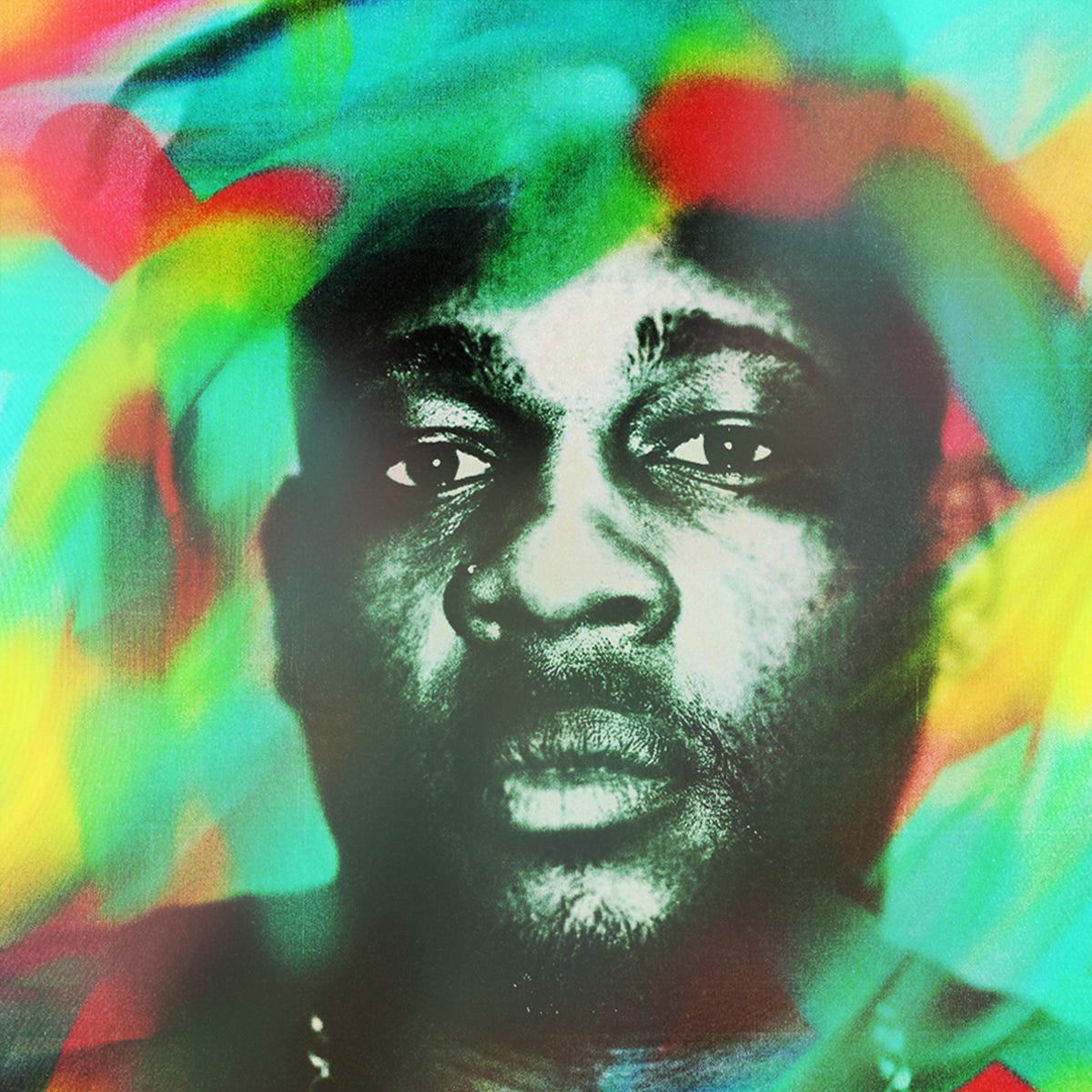
A few minutes after I hang up the phone I realize I forgot to ask Open Mike Eagle about fate. As suggested by its title, DOOMED!, his long-awaited collaborative album with Kenny Segal, plays with the idea of relationships that end in every splinter of space-time: silent car rides and petty arguments looping ad infinitum. On one song, he prays to a higher power for the strength to stop checking his ex’s social media pages; God, presumably, bumps her Stories higher in the algorithm.
But DOOMED! is not really about the cosmic. In fact, the very ordinariness of its scenes are the source of both its tragedy and comedy: arguments over the color of a rental car, single-seat reservations to see late-period Wes Anderson. In the 20 years Mike and Kenny (the alternative here is “Eagle and Segal”) have spent mutating the post-Project Blowed underground rap ecosystem, the seemingly banal life experiences have accreted, to the point where nominally civil text exchanges can be imbued with—or seen for their—Gothic stakes.
DOOMED!, which is out at midnight tonight, is being issued by Backwoodz Studioz, the label co-founded by billy woods and which has become a hub for inventive, independent rap in New York and beyond. “I tend to be so off in my own corner of the world doing my own thing that I don’t always get an opportunity to see where I fit in the overall constellation of all the shit going on,” Mike tells me. With this album, he resituates himself at the center of that universe—and probably several others, too.
I think we imagine these big life events as something we’ll go through once. But you did the divorce album [2020’s Anime, Trauma and Divorce] and then now it’s like, “No, what is breaking up though?”
Yeah, I certainly wasn’t planning on enduring another breakup. I certainly thought that the original breakup album would be the only one that I ever had to make [laughs]. I just find myself in a place where I have begun to look at my work as a place to have my feelings. When these big life events happen, I’ve just gotten really used to dealing with it in that specific way.
Was there a point earlier in your career when a voice in your head would say, “Sure, some shit’s going on in my life, but now I need to set that aside, compartmentalize it, and go write raps?”
Oh, yeah. Yes. Every album before [Anime, Trauma, Divorce]. There was always shit going on. I never thought of my music as a place to deal with super personal shit before. My thesis was always looking outward at the world—societal ills and satire—and I wanted to point at other things and say, “Hey, look at that. That’s weird.” And I never even thought about really putting my shit in there. Or it was a case where I’d make songs that were about me and I’d take them off the album.
Was that to protect your privacy, the privacy of others? Or did you find yourself worrying about whether an audience would find it interesting?
To me, I think it was really more about the colors I’m painting with. And if I whiplash from talking about a bunch of genre shit or a bunch of racial shit or a bunch of sociological shit, if I whiplash to something very personal—that I’m not even really going to get into details about, some inscrutable, suddenly personal thing—I’m like, “Is that helping the record? Or is this interrupting the record?” And that was the mindset I was in. It was like those songs always felt like they were from a different movie.
Well then, what switches over in your brain to make you comfortable releasing those songs?
The truth at the center of that transition was, first of all, me having a therapist that’s actually a good match for me and my problems. Because I had a lot of therapists that weren’t that.
I mean, you rap about therapy breakups on the new album.
Right. It’s a simple thing, but it was something my therapist literally reminded me of one day: I have a tool. You know what I’m saying? Most people don’t have an outlet. They don’t have an arena. They don’t have a forum to deal with stuff that’s difficult. The things that are hard to find words for, the conversations that are hard to have in life, most people just don’t have a way to deal with that. And I had one built in and I wasn’t using it.
But most people’s therapeutic exercises aren’t subsequently released to the public.
So the divorce album was a lot tougher than this one. And I think a lot of that had to do with the fact that it was the first time that I was doing something like that. And I did feel myself put out there in a way that was unprecedented. The most difficult thing really was being able to have a distance from the work in terms of criticism. That was the real hard part. Because as you start putting out music, you go from being very, very sensitive about everything each person says to having a professional distance—you have a way to navigate that emotionally. When I put out that record, it was like going back to square one on sensitivity. And I think that was the hardest part to wrap my head, around because I wasn’t able to anticipate it. And by the time I was deeply in my feelings of it and very uncomfortable, it was way too late to think about it.
Did you find yourself specifically bothered by reviews of that record?
Yes, absolutely. Yes, yes, yes. Because the operational difference psychologically was, previously, if you had criticisms of my work, it was just my work. And it’s like, OK, great. It was never made for everybody to like, so whatever. I don’t like it, but it’s fine. That was the first time I felt like if somebody was criticizing that project, they were criticizing me as a person, because my personhood was on display. So it was a lot harder to have that distance.
This is your first full-length album with Kenny Segal, but you’ve been close with him forever.
We’ve just always been in the same circles for so long and have crossed over a bunch of different ways, not only with the collaborations on my albums. I was working with Project Blowed on the label side when they put out his Ken Can Cook album. So I was doing executive production and behind the scenes stuff for that. We used to work together at a nonprofit here in L.A. called JUiCE. I think that might’ve been when we first met. So this is going back to ‘07, ‘06. We’ve known each other a very, very long time. And it is certainly at the point now where, from JUiCE to Project Blowed to Low End Theory, me and Kenny are uniquely situated to look around the landscape and be like, “Oh yeah, we’re like a couple of the last ones standing.” We’ve seen so many scenes go. There have been so many shows that I’ve been at and Kenny’s been at, and me and him just end up talking. There’s a shorthand, there’s a familiarity with each other. We’ve had the collaborations through the years too that always seem to go well. So the groundwork just seemed like it was pretty well laid, even though this is not the way I typically like to work.
Meaning with a single producer? Why do you not typically like that?
I think what it really comes down to is that I like to have a lot of control and I don’t like to have a lot of conversations. I’m very much a dictator when it comes to my creative output. And it’s been hardened by my experiences in film and television and stuff like that, where those things are soooo collaborative. And it always makes me run back to this music shit where I don’t have to answer to nobody. I get to make all my decisions. I get to execute my vision exactly how I want to execute it. And so the level of sharing that has to happen when you do this type of record, it’s not as comfortable for me. And how that ends up manifesting itself is I’ll get to a point in a project where I want some other beats on it. I want some different flavors on it, or I want to make the kind of move that would break the thing.
One version of this is you link up with a producer, you guys settle on a group name, and then you can be like, “Well, this is a fundamentally different thing. He has equal control.” But this says Open Mike Eagle on the cover.
It does. I think Kenny, because he’s been around so long and done so many of these projects, he’s uniquely suited to understand that there is a degree to which, even though we are co-conspirators on this project, once it’s out, if there’s criticism or people who have bad shit to say about it, it’s going to come back on me first. As the rapper, there is some positioning thing that happens in the world where these don’t end up being equal. You don’t share the blame or the criticism equally.
Now, I imagine, given you’re talking about the dictatorial tendencies, the process on a writing and recording level probably didn’t change that much for you from how you would do a multi-producer album, right? Did you record this at Kenny’s studio?
Nope, it didn’t change at all. I record everything at home and send it over to whoever my co-conspirators are. But because this was a collaborative album, there were more iterations on songs than usual. Because I’m writing something, demoing it, sending him even the demo vocals to start iterating on the beat. And so there’s a lot more back-and-forth development like that, track-per-track, than on one of my usual albums.
I remember hitting play on the album for the first time and thinking, of the flow on [opener] “Out to Lunch,” “God, this is so confident.” Because it’s an interesting flow that really highlights all the things happening in the writing, but it’s understated. I think a lot of artists would think “I have to come in harder, more ostentatious.”
That’s a trap, Paul.
It is, but is this a situation where you’re working from cadence first?
It’s a per-song basis kind of thing, but I also think about where I’m meeting this project in the course of my own journey with my own style. If you look at stylistically what I was doing on Anime, Trauma and Divorce… different things start to happen around the Component System album. You can hear me trying to find other ways to play with cadence.
How would you describe that evolution?
I think the simplest way to put it—and this may not be a very clear answer—the simplest way to put it is to try to find cadence that is still satisfying to me, but more interesting. To get away, get off of the sort of four/four grid that I’ve been working in, that I grew up on. It’s always been the most satisfying or entertaining cadence, but just wanting to find some way to move past it that’s not completely sacrificing rhythm. I don’t want to be the person with the cadence so unpredictable that it feels like spoken-word poetry. I like rap rhythm and cadence. I like that. But I could also recognize inside myself a desire to find more interesting ways to play with the beat.
On a very mechanical level, looking for these new cadences, looking for these rhythms, is this you walking and driving around to beats? Are you turning the mic on to do this? How does it actually happen?
I think a lot of this has just developed in making Component System, making another triumph of ghetto engineering, making these Previous Industries records. Previous Industries, the way we record is like a rap bootcamp. We’re getting together every week and writing. So it’s like—
Oh, you’re writing in person together?
Oh, for Previous Industries, absolutely. Every song we’ve ever made, we’ve all written together in the same room. And so that’s an album and a half and we’re wrapping up another one. It wasn’t the case of me being like, “Oh, consciously, let me try to find a different pocket here.” I’m already on that. And so when I’m hearing these beats and I’m starting to write, I’m already into these new ways of kicking off a verse or new ways to string together the multisyllabic rhymes. That is still the foundation of what is satisfying to me about writing rap. But it’s like I already got these different ways to hang them on a beat.
Briefly, on a recording-at-home level, what are you actually recording on and into? Is it Logic, ProTools? What kind of mic are you using?
I do everything at Ableton. So I produce in Ableton, I record in Ableton, I perform with Ableton. That’s just where I’m at these days. It’s everything fucking Ableton. Okay. I got a real expensive Neumann microphone. I got a really nice Focusrite preamp, just big studio quality. I’ve been doing a home recording game for so long, it’s like I know what the essential sorts of pieces are for what I do. And making sure, that to the degree that I can, the room sounds decent. Those are the main focuses.
The other professional aspect I’m interested in is, obviously you’ve been streaming a lot. Are there psychic demands of that? Because even if you control the topics—you’re not being interviewed per se—your face and your brain is out there on display a huge percentage of the time compared to the average person.
On one hand, I don’t know the answer to the psychic cost of it. I feel like the real cost will be revealed long-term. And also recognize this, Paul: Every day when a person livestreams is a roll of the dice on whether or not they’re going to say something that fucks their entire lives up. There’s no net and it’s a tightrope walk every time. Now, I have built an audience, a community that knows where I’m coming from. I don’t think anybody’s waiting for me to fuck up or nothing like that. But that is essentially what the job is, is to be entertaining or educational, whatever it is, and not shoot yourself in the fucking foot. And the gun is right there in your head. What I’m saying?
I liked when you were going through that Pitchfork list and adding your personal lens on these big canonical records: I was at school downstate at this time and actually what people liked was X, Y, or Z, or This song was big even though it didn’t chart. I always find that really interesting on a historical level, an askance angle on a popular thing.
I did that and I like adding that because I’m a big fan of context generally. I think historical context from people who were there I think is really important, and I think it gets lost in a lot of this. So I think that’s the cool thing about being able to turn on a microphone and a camera, just talk about this shit is that sometimes there is a perspective that somebody like me can bring. Maybe it’s not what you think I would be interested in, but I had life experiences based around some of this music.
To that point, as we sit here on whatever it is today—July 30th, 2026—what is your favorite rap album of all time?
I mean, it’s still Midnight Marauders.
Well, I appreciate that because I have always been a Marauders guy and I’ve always been told I’m wrong.
I’ve been having this argument for 30 years [laughs]. You know what I’m saying? And I found that there’s some analogues now, like the two Pete Rock and CL Smooth records—some people live and die by the first one, some people like myself think the second one is a lot better. And what it really is, is right around that time, and between ‘91 and ‘93, it’s like the technology changed and the mixing capabilities of engineers changed. So now you could get these high quality, smooth sounds, and it wasn’t just all about the banging drums. I think the ‘91 thing, people were really, really hung up on the big dusty drums and the upright basses and shit. The thing people mean when they say raw. It’s usually upright bass and big ass drums. And all of a sudden in ‘93, you’re able to filter out so many frequencies of samples to get, oh, you can get just this pretty-ass Rhodes on top of everything. And I like the fucking pretty Rhodes! That’s my shit. So the ‘93 shit’s always going to be superior to me because that’s the sound I like. But I think that a lot of people who prefer the ‘91 shit, their preference is that raw thing.
Well then, if you can try to step back from the moment, is there something technologically happening now that you really appreciate in rap production?
Well, I think with production, the really interesting thing now, people tend to encapsulate it with the term “drumless.” And sometimes it’s literally drumless. Sometimes what it means is that the way a beat is constructed, the snare is a lot quieter than it used to be. And it gives the whole beat a different feel. It gives a rapper a different bed to lay across when the snare isn’t taking up all the space. And I don’t always love music like that because I think whole albums of it can get kind of same-sounding. But there’s a lot of experimenting with using other sounds as the drum sound. And I think Madlib started a lot of that. Even Timbaland was doing a lot of that back in the day. But I feel like that’s where the real experimentation is happening right now: volume, drum sounds, and throwing the rule book out when it comes to that shit I think is really cool.
There’s always going to be a war around that because there’s people who want to protect what they believe to be the spirit of hip-hop. And it is so based on when you came into this and started enjoying it and a person’s ability to keep finding interesting things in what’s happening now. And it don’t mean you got to like everything. I don’t like everything. But I do see it as a constant evolution.
Two of the best to ever do it. Super cool interview.
augusttruly.bandcamp.com
🪬