

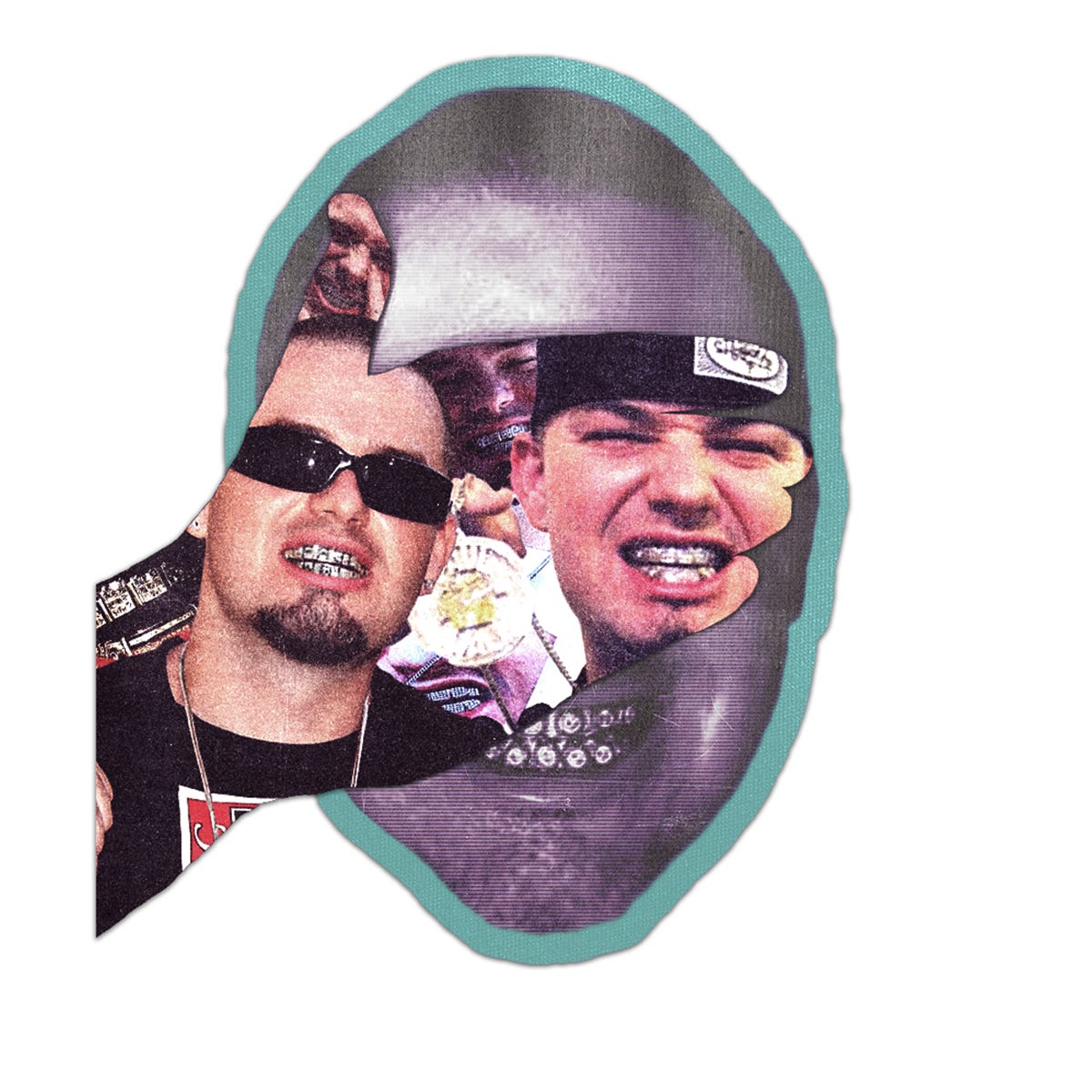
The White Rapper Mount Rushmore is The Beastie Boys, Eminem, Mac Miller and Paul Wall. The Beastie Boys came up when rap was still novel, and carved their own lane when the lanes were still being carved. It took almost two decades for Eminem to follow, manifested like Slaanesh by the sheer volume of white rap fandom, sufficiently talented to make his race a moot point.1 And then there was Mac Miller, patron saint of the diverse urban high school (the natural habitat of the white rapper), who outgrew frat rap to fall in love with jazz and then join the 27 club.
Finally, there is Paul Wall, who is less of “white rapper” and more just “a person from Texas.”
The great American philosopher Bomani Jones (also born and raised in Houston) talks about the racial divide in this country not as white v. Black, but more broadly as there being “two Americas.” It’s not a euphemism or a dog whistle, it’s just a clean way of conceptualizing a fact about American culture without doing a “white people be like this, Black people be like this.” And it’s useful because you can’t generalize about that many people at scale, and because there are a lot more than two races in this country. There are about 2 million Latinos in the Houston metro area, not to mention about 150,000 Vietnamese people and 150,000 South Asian folks. White and Black just isn’t sufficient. Which is to say, the most demographically interesting thing I noticed at the Paul Wall and Termanology show at Le Poisson Rogue on Friday was the number of young Indian dudes, who were probably also just “people from Texas.”
Let’s get this out of the way: Paul was excellent, performance completely on point, smiling like an idiot the whole time, still icy as a freezer. He only really has one true hit song, but he has been murdering guest spots and posse cuts his entire career. So it was a lot of other people’s songs interspersed with one million slick bars about diamonds, candy paint, and 84s. He opened with Bun B’s anthemic “Draped Up,” letting the hook ride before spitting his verse from the long-as-hell remix. He hit Riff Raff’s “How To Be The Man” and Lil Keke’s “Chunk Up The Deuce” and That Mexican OT’s “Johnny Dang.” It became a de facto celebration of Texan excellence: He had his DJ play a few songs he wasn’t even on simply to pay homage.2 So while he didn’t do anything from his days running with Chamillionaire, we did get the hook from “Ridin Dirty” and a big shout to his former partner. He closed with “Still Tippin,” “Sittin Sidewayz,” “Drive Slow,” and “Grillz.”
Termanology3 is a seasoned veteran who had no problem rocking a crowd that was not exactly checking for him. He brought out Brooklyn legends Smif-N-Wessun for the Griselda-flavored “Kaleidoscope” and made the DJ Premier-produced “How It Goes Down” feel anthemic like Primo tracks are supposed to. But Term makes the kind of orthodox East Coast rap music that Europeans and uncs on Facebook love to tell you is “real hip-hop.” He is the kind of dude who, well, still closes his sets with DJ Premier tracks in 2026. He and Paul are kind of a strange fit, especially for me. I mostly outgrew Term’s flavor of rap because I got more into rappers like E-40, UGK, Three 6 Mafia and, well, Paul Wall.
Paul and Term have had a bit of a bromance for the last few years, and the show was in support of Repeat Repeat Repeat, their third album together in five years. Like the two that preceded it (2022’s Start 2 Finish and the following year’s Start Finish Repeat), RRR is firmly on Termanology’s home turf. It’s a boom-bap record anchored by production from Term’s frequent collaborator and fellow Bostonian4 Statik Selektah. Their earlier albums feature guest spots from AZ, Sheek Louch, and CL Smooth; Bun B shows up a few times, but he’s on his fifth TrillStatik tape with Statik himself, so he and Paul are probably filing the same paperwork. And like, both these dudes are comfortable rapping on whatever, because they are both very good at it.
But there is something “two Americas” about the contrast between Paul Wall and Termanology. East coast rap’s mythology as the pure form of the genre has died hard. I’ve seen Wu-Tang, Gang Starr, and Public Enemy held up as superior to everything from Cash Money to Jay-Z to Clipse to Ludacris to Waka Flocka to Das Racist to Young Thug. It gets real racial real fast when you start considering the underground/commercial divide, and the seemingly unkillable idea that only rappers like Slug and Sage Francis are worthy of rockist attention.
Paul Wall is a rapper’s rapper. Not every rapper cares that much about rapping, which is not necessarily a bad thing in a genre where your main job is to sound cool. What is cooler than being too cool for your job? But when I interviewed him in 2015, he talked a lot about how much he loved Bay Area street rap, and he had dedicated an entire song to the recently deceased Pittsburg rapper The Jacka on his latest album. Most of what he was listening to at the time was rappers like Husalah and Andre Nickatina. These are very popular artists, but still, not household names, and not the answers I was expecting.
So I guess I should not be surprised to hear him on a Bob James sample I can’t place saying “my bonus got ‘em acrimonious.” And I shouldn’t be surprised to see him putting in work in the studio with a dude living the good off of 1995 shit.
That beef was for Fred Durst.
The number of RIPs was depressing. Screw, Watts, HAWK, Pokey etc.
He’s Puerto Rican, for the record.
Technically, Lawrence, MA. For posterity.
I endorse this Mount Rushmore (not that my endorsements mean squat). Great write-up, as usual.
Not to mention that Paul Wall was on the VERY EMO 2007 Honda Civic Tour with Fall Out Boy, Cobra Starship, +44, and The Academy Is... who actually featured Paul Wall in one of their greatest "TAI TV" skits: https://www.youtube.com/watch?v=Qup_UXPy1uY
This alone makes Paul Wall fuckin' cool.