


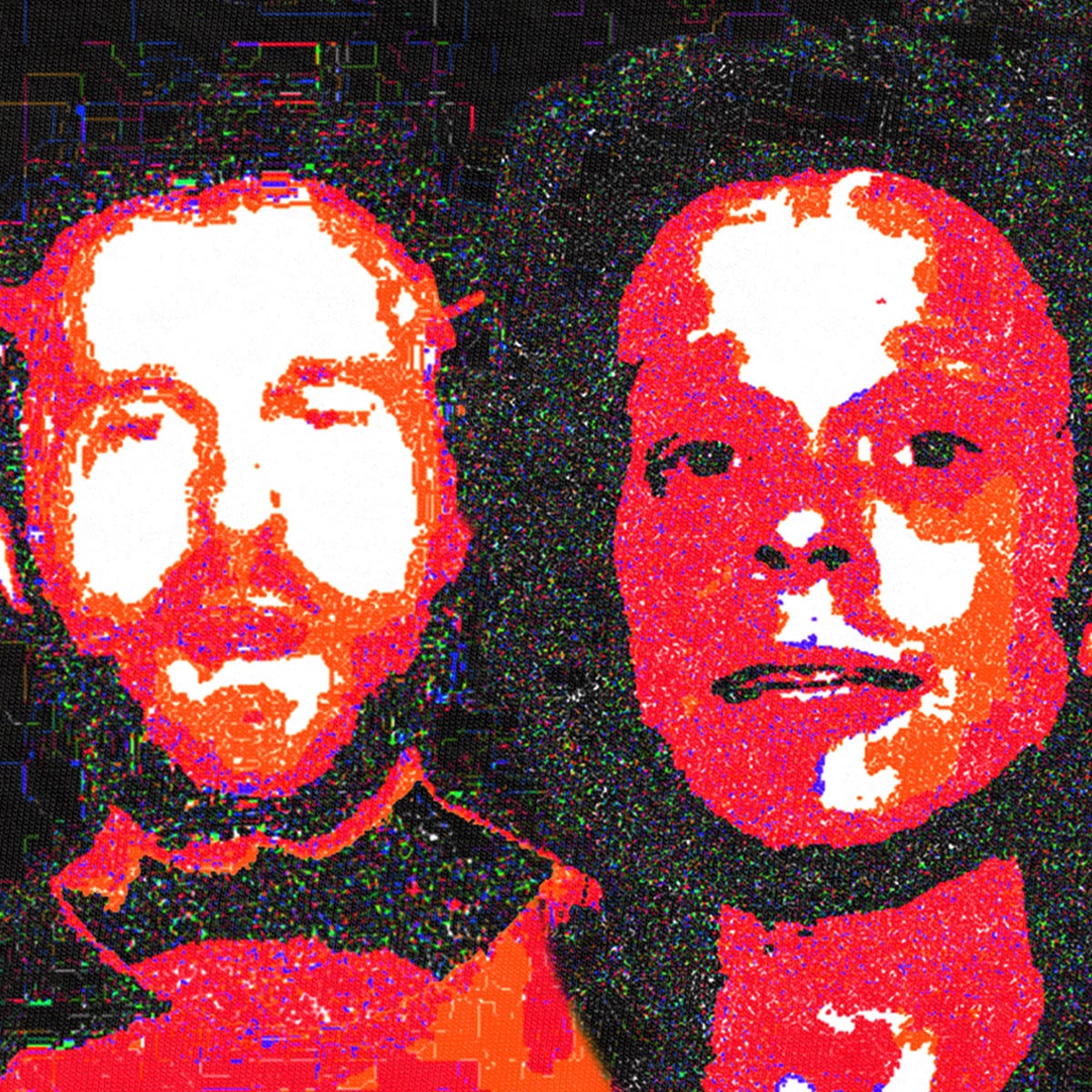
The first time I listened to Phiik and Lungs—some of their work together is collected in a series called Another Planet, other times that phrase stands in as a group name—was the first time I’d been glad to feel as if my brain was misfiring. I would grin in my car as an image of Brett Favre’s hands tremoring from Vicodin withdrawal and another of a New Yorker walking nervously through a Midwestern Target, convinced he’d become the target of a mass shooting, bled together, blotting one another out. It became clear to me that all the data would not compute on the first pass, which is how the world at large has felt for some time now.
Phiik and Lungs are childhood friends who grew up mostly on Long Island, where “motherfuckers were doing bear heroin,” the latter says. Over the past handful of years, they’ve distinguished themselves amidst a thriving New York underground. Both members cite their relationship with another lynchpin of that scene, AKAI SOLO, as formative—not only as on-mic stylists, but in terms of the work ethic required to hone those styles. “Writer’s block is not fucking real,” Lungs says. At one point during our three-way video call, and at Phiik’s urging, he shows me the gigantic bags lining the wall of one room in his house, each one stuffed with notebooks full of rhymes that will likely never be used.
“Tireless” works as a descriptor not only of the process, but its results. On their songs, each MC raps what sound, at first, like impossibly dense walls of text. This often gets mistaken for double-time rapping—sometimes the delivery is fast, but it is more often than not simply unending.
People Are Not Your Friends is produced entirely by steel tipped dove, and will be released on dove’s Fused Arrow Records next week. It sounds, more often than not, like an old robot found in a crawlspace and shocked back to life. Yet for as obviously and delightfully considered Phiik and Lungs’s work always is, the new LP scans, more than any of their others, like a natural and inevitable consequence of a certain worldview, one where everything is interesting and most things are ominous.
This conversation has been lightly edited and condensed and then filtered through fiber optic cables that run under the Atlantic Ocean.
What was it like working with Dove, taking your hands off the wheel on the production side?
Lungs: It’s nice because Dove has this shit together. It’s always fucking kind of smoke and mirrors: People will tell you that they can do some shit and then they can’t, or they just don’t have the right experience. Sometimes heads are good at one thing and not the other. There’s a lot that could go wrong. So working with Dove is nice because, yeah, it’s just like everything is situated. He’s been doing it for a minute. Normally I record, mix, and master everything for all our shit. So I did Carrot Season—well, Zeroh did the mixes on that. But AP4, all the APs, all the NoFace stuff, BAD NEWS, all the stuff I did with [Fatboi] Sharif, I generally do. Because in the past, almost every time that I’ve outsourced something to somebody else, I’ve had to just go back and do the whole thing over again. And that’s not true with certain people: Zeroh is amazing. But with Dove it’s just nice. I mean, I literally just had another child. I just had the birth of my son couple weeks ago, so it’s been really nice. It’s been really a pleasure working with him.
You guys have been making records together for a minute now. Are you constantly writing and recording without particular albums in mind, or do you say, “We’re going to do an Another Planet record right now?” And are you generally writing together, or writing to beats separately?
Phiik: Me and Lungs have known each other since we were like, yea high. Since elementary school.
Lungs: So all this shit about best friends is not a myth. I’ve known Phiik since I was in kindergarten.
Phiik: That alone makes it super easy for us to figure out what we want to do, and collaborate. That’s my man, that’s my best friend. So at the end of the day, it’s pretty seamless when we come together.
Lungs: We’ve literally been doing this since we were 14, and I’m what, 31?
Phiik: Fifteen years-plus of trial and error. But yeah, we do everything together for the most part. I mean, when we go in on something, we definitely have a plan in mind, but we don’t strictly stay with that. Like me and Lungs right now are working on something with Ewonee from Mutant Academy and simultaneously we’re gearing up for AP5. The writing we do is usually together. Lungs writes by himself, too, because he’s got the ability to mix and master, and he’s got the whole setup at his crib. So sometimes he’ll get ahead of it and be like, “Yo, I just laid this for this,” and then he’ll send me the version and I’ll have some time to work on it. But ultimately I get the best spark when I’m around him because it’s just easy to bounce energy off each other and really lock into a place that we’re both very familiar with.
Now in terms of bouncing energy, that makes a lot of sense. But you’re not writing linear story songs, right? So how much discussion, if any, is there about what do you want to do on a given track? Are you talking about direction, texture, theme beforehand?
Phiik: I mean, not really.
Lungs: Yeah, we’ve known each other for long enough that we both know what we want to do. We both know what we want to accomplish. The thing developed on its own and it’s developed as a product of who we are and who we have been and what our life has been. You know what I’m saying? The only person that I will even do that [premeditation] with is Fatboi Sharif. ‘’m trying to represent whatever the fuck the current moment is, be it dystopia or not dystopia. And I can do that by just doing good writing.
I am not a huge fan of [high-concept approaches], with notable exceptions: I think of “Loosifa” by Juggaknots. That shit is like what Sharif kind of is on, which I fuck with, because to me it has to be some sort of show-not-tell. Every rapper should read fucking Elements of Style by E.B. White. Literally, bro. Me and Phiik don’t want to make something bugged out for the sake of it being bugged out. Sometimes I feel like Another Planet be getting lumped into “weird hip-hop,” which we definitely are, but I think we’re more weird in the vein of old Def Jux shit. So a lot of the times I’ll try to not tap into the super conceptual writing shit. For me, what’s more interesting is structure, flow, “How can I make this interesting in terms of its punching style?” I want people to be able to listen to it and relate to it in terms of what 2026 is and not some fucking abstract, crazy other place.
We’ve talked a lot about writing, but how did you two arrive at the vocal styles you have today?
Phiik: Oh man, that took a minute. We both used to sound a lot different. I’ll never forget, actually, the one tip that Lungs gave me early on was: Rap from your chest. That doesn’t sound like it’s all that complex, but it makes a huge difference. And hearing yourself over and over and over again—you instill a sense of confidence in yourself as you continue to do it. Because you can hear us both being less timid or just more full in our voices over time, really figuring out the way that we want to convey something.
Part of it is taking time to really decide what it is that you want to sound like. Because we both didn’t start rapping fast—but it’s not even fast. We weren’t putting a bunch of words in a line when we first started, if that makes sense. That whole development really, I think is what brought us to where we are.
Lungs: I just fucking watched Ip Man movies and I saw his punching style and then I was like, I could rap like that. Because it’s not fast. It’s relentless. He just punches motherfuckers like 10,000 times, you know what I’m saying? In the movies, they make it look like it’s punching fast, but it’s more so about not stopping. That’s what heads get confused: I don’t want to be Twista.
You guys never seem bothered by the pace. There’s still room for bend and personality and dynamics as opposed to, when you hear a lot of rappers who are just rapping fast, it’s like they’re pushing themselves to the limit in every bar.
Lungs: And if you notice—at least for me, Phiik raps a little bit louder—I’m quiet as fuck. I can literally make an album in my house without getting a single noise complaint. And the reason that I do that is because if you use less breath overall, that gives you more to work with. And also the way that I literally write the raps, too: every single word is on my phone in just one line, and then there’s spacing in between the bars. So it’s literally just vertical, straight down vertical. Single words. Because then if I’m doing that at a level where I’m not yelling, that’s the biggest thing. If you listen to my early raps, I’m yelling OD. Nobody want to hear that, bro. How hard you are going on the song is not necessarily the thing that dictates how hard the song is. Ka don’t go above a fucking whisper most of the time. And that shit is heavier than anything that you’re going to hear from a motherfucker who’s yelling at you.
It’s just studying, taking things away, even from Wu-Tang and other popular rappers like that. There are purely punching, purely mechanical things [to learn]; I feel like sometimes with coke rap, you see white rappers who are on some, “Yo, I have to completely be a different fucking thing.” But when I listen to Roc Marciano, the takeaway to me is not like, “Oh, this dude’s rapping about street shit,” it’s like, “Damn, bro, listen to how well he was able to do that breath sequence.” Of course when I’m listening to music I’m hearing people speak their truth and shit, but the content is not the thing you have to emulate anyway. You have to replace that with your own life experience.
More broadly, as white people in rap, how do you think about your place in the ecosystem?
Lungs: I think of my place as somebody who just makes rap music who’s trying to do something to the best of their ability. Overall I think my purpose is to assist in any way that I can. And I also think that as a white rapper, my purpose is to play the background frequently—in a good way. The main thing that I never wanted to do with this shit was disrespect it. Especially as a white person, if you’re going to be doing this shit, you have to really study what it shit actually is. At the end of the day, it was revolutionary music that was intended to communicate not only political messages, but bring light to situations and voices to people who are being completely fucking ignored. So for me, I’m very thankful to people—even though heads talk about corny rappers and shit, I fucking love Immortal Technique. I’m very thankful to heads like that. But I think as a white rapper, it’s your job to love this shit enough that you’re being yourself. And also speaking about the things that need to get spoken about—and then keeping your fucking mouth shut and understanding when you need to shut the fuck up. This is a privilege that heads are allowing you into spaces and shit, so just don’t be a fucking asshole.
You got to show up, you have to put in work, and the scene legitimizes itself at the end of the day. All of these relationships that we have, all this shit is just organic. And heads are kids, bro. You know what I’m saying? We were all just kids fucking running around trying to do this shit. And I mean, it’s beautiful. It’s really beautiful right now. A lot of our friends and people that we’ve known this whole fucking time are doing great. I mean, I get fucking emotional at AKAI SOLO shows, bro. I swear to God. I literally have watched that motherfucker rap in front of actually no one. You know what I’m saying? And seeing that shit is fucking great. And there’s so much love in the New York scene too, right now.
It seems like it’s in a great place.
Lungs: It is, bro. It really is. It’s doing great. And all the shit that they say about New York is bullshit. When people say no one in New York supports each other, it’s like, bro, it’s not the case. Y’all just don’t go outside.
We’ve talked a lot about how, in content and form, you guys are delivering a kind of information overload to evoke feelings about an era that’s defined by that very sort of saturation. But what is the concise answer to someone who asks “What do you rap about?”
Lungs: If everything just blows up and the apocalypse happens and aliens find this shit, I want them to be able to listen to the thing and be like, I understand the vibe, the dread of the time period that they lived in.