

Over a thousand people were dying a day in the U.S., and our eyes were still glued to Britney. My wife was scrolling through Instagram at my parents’ house, where we were quarantined for a month in the insular summer of 2020. She gasped landing on a picture of the 2000s “princess of pop,” hair disheveled with an almost sinister stare directly into the camera. She noticed a number of concerned comments, looked back into Britney’s knowing eyes, and noticed that her eyelashes appeared to spell out the numerals “911.” She projected the image onto my family’s TV, where my mom, dad, sister, and brother-in-law all weighed in on the viral-bound debate over what, if anything, Britney was trying to communicate.
This was the nadir of the then 38-year-old’s conservatorship period, which coincided with the peak of public interest in social justice. The conditions were ripe for a shackled celebrity to draw the energies of a digitally rubbernecking public. So “Free Britney” went from the fringe interest of mocked YouTubers to the cause du jour, and while racial progress debatably stalled out at performative black squares, the public really did succeed in leading to the legal dissolution of an exploitative financial family arrangement.
The effort to “save” Britney was a remarkable 180 from the relationship she originally had with the masses. To be pro-Britney in 2020 was a feminist mandate, whereas the singer’s rise to fame was marked by the thinly veiled misogyny of the times, from the double-edged discussions about her body to those censorious “bimbo summit” headlines. The way “woke” was a self-flaggeling reaction to the shameful norms we had once collectively upheld, you could see the free Britney movement as something of an atonement. Jeff Weiss, POW’s founder and figurehead, was more complicit than most, having served in the tabloid trenches that made a living demanding their pound of flesh from the singer.
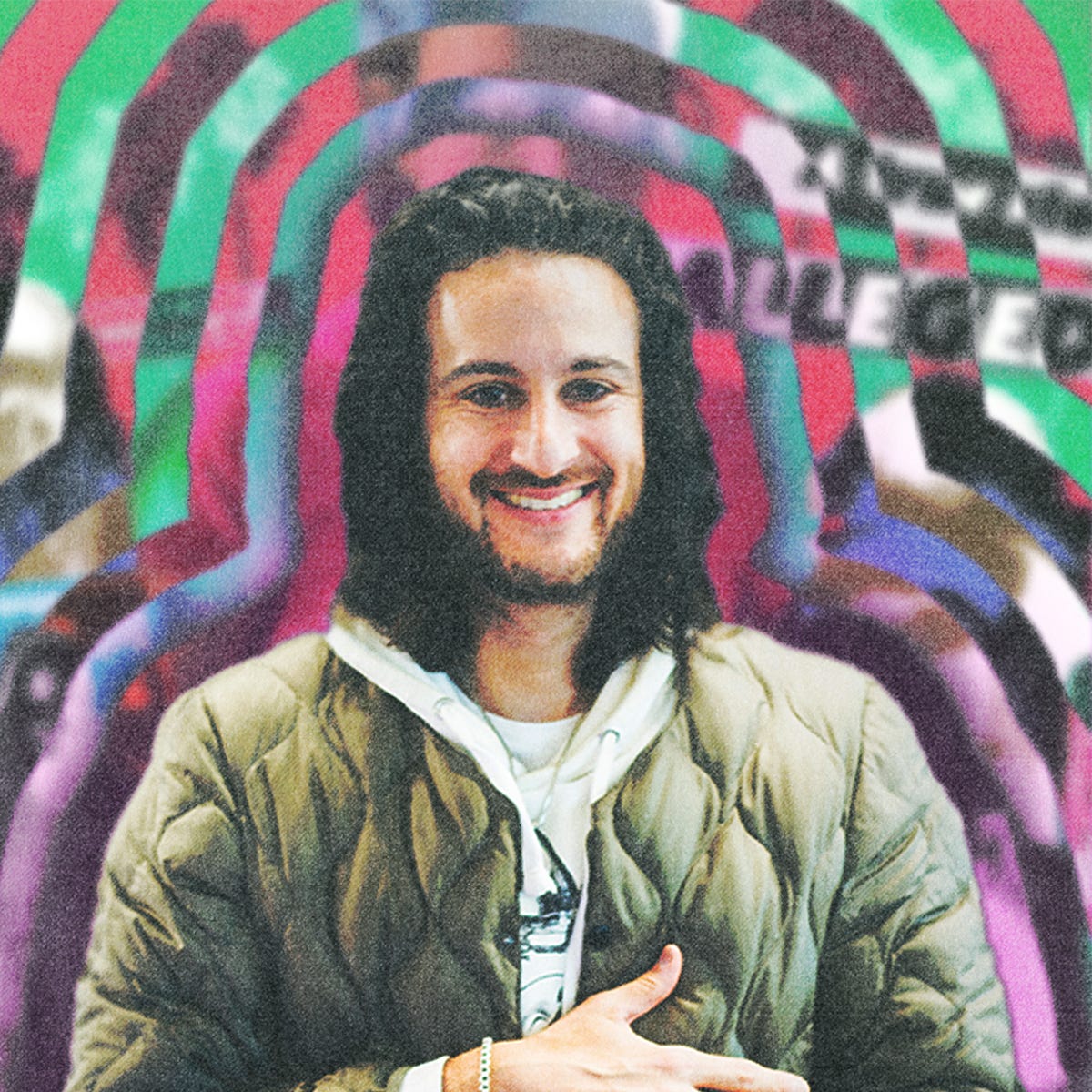
As you surely know as a reader of this magazine, Jeff published his debut novel Waiting for Britney Spears: A True Story, Allegedly a year ago, a feverish account of the passions and players that made Britney America’s sweetheart before turning her into the cautionary tale of her era. The book is a portrait of not only a lady on fire, burned by her admirers, but of a country’s race to the bottom at the turn of the century. Jeff documents the dawn of everything that has made modern life so increasingly grim—from the instant gratification and political weight of cheaply distributed celebrity soap operas to the perverse professional incentives that push talented individuals into jobs that actively erode their values.
It’s a haunting, deliriously funny literary achievement, and thus naturally received acclaim upon its release across legacy media (the New York Times positively described it as like “mainlining the sugar at the bottom of a Sour Patch Kids box”), new media (a Goodreads user called it “like War & Peace if Britney Spears was Napoleon”), and the increasing overlap between the two (the most enviable accolade in my opinion is the New Yorker’s Jia Tolentino saying on Instagram that Jeff “really just goes for it with the confetti cannon”). Between relaunching music journalism’s most vital remaining masthead, his insurgence into the otherwise oft-banal podcast world, and speaking about the book across the country as the best coiffed talking heads, Jeff has had a career-defining run over the past year. This summer marked another achievement, with the book comes out in Poland, its second country—with a Russian translation dropping next year.
Jeff spoke with me last month for the latest edition of our ongoing Book Club, reflecting on the book’s anniversary, the skills from independent media that served him working with a big publisher, and of course delivering no shortage of poignant quotables. He reflected that being on a press tour teaches you to speak in sound bites for the modern world’s limited attention span, so for the literary-minded readers of POW, we freed Jeff to go long.
It’s been one year since Waiting for Britney came out. What are your reflections on how the book was received a year later?
To be a writer in 2026 requires myopic delusion. You need it to survive and function and finish a semi-coherent thought. Every sentence is my own personal Antietam, and halfway through each battlefield advance, I want to lay down on the document and croak. But these delusions are necessary. You have to believe that with time and hard work, the writing will improve, the ideas will crystallize over the course of subsequent drafts, and ultimately, people will be receptive to the work.
For a long time, a writing “career” felt like slowly climbing a mountain. But once I finally put a book out into the world, I discovered that what I believed to be steady geological terrain was actually a melting glacier. And as you ascend this slowly disappearing mass, you have to be careful not to slip and fall and break your ankle on the black ice.
I sold the book in 2021, when TikTok was obviously an established social media platform but it hadn’t yet terraformed our collective neural consciousness. The internet going algorithmic in the last five years marked a dramatic change from when things were linear on “the timeline.” We’ve watched monolithic publications disappear or degenerate into sub-literate slop. So it has made it extremely difficult for any author to promote and market their book—especially if you’re not trying to be on TikTok—all in the video…dancing. People who once read ten books a year are only reading one or two. And many of the people who read one or two can’t finish anything longer than an Instagram caption.
I don’t have any substantial complaints about how everything transpired. I’m grateful for all the attention and praise that the book received, but none of these macro developments are conducive to surviving as a working novelist. No one wants long form meditations that simmer over the course of several years. They want bloodsport reactions, which are financially remunerative but are the antithesis of being a serious writer. Nuance, weariness and skepticism scan as boring to most people. Maybe they always did, but it’s gotten dramatically worse over the last five years. And this hot take information economy drives the social media cesspool—anything subtle or cautiously deliberated gets drowned out by bold-faced, brazen, grotesque opinions.
The author should not have to be the main character. I do not want to live in Norman Mailer’s world where you are constantly forced to make front-facing video advertisements for yourself. It’s degrading, but if you want to be read or even have the ability to get on someone’s radar, you are forced to compromise and succumb to the narcissistic demands—or get very lucky.
But I don’t want to come off as too cynical. The reception was about as close as I could have hoped—a friend of mine said to me, “I don’t ever want to hear you complain about anything again.” And he’s probably right, I shouldn’t complain again, but I will because that’s part of the job.
I was going to ask how you’ve experienced being on the other end of the press circuit. You’ve been a journalist for many years, but in promoting a book you have to switch to playing the subject rather than the observer.
As much as I disdain selling soap on social media, I loved doing press for the book. Maybe I’m wired differently, but you sit in tedious solitude for years on end, writing and editing and turning your lungs black. So it’s mystifying when I find out that there are people who want to return to their hermitage rather than go out and talk about what has consumed the last half-decade or more of your life.
I’m thankful that so many people wanted to talk to me about it. I got fortunate and most of those people were intelligent and engaged and asked smart questions. The book was covered in The New York Times, The Washington Post, NPR, the London Review of Books, and a bunch of other places. I couldn’t ask for anything more.
Unfortunately, I do think there’s a disconnect between the reach of the legacy media and BookTok. BookTok was where most books get sold. Reading clubs are where books get sold. Goodreads is where books get sold. But a lot of people on Goodreads don’t understand irony, or the purpose of fiction, or the blurring of fiction and non-fiction—which is not new. What is Proust if not autofiction? What are the Beats if not auto-fiction? A lot of Hemingway is proto-autofiction, at least the Nick Adams stuff. But we live in this bizarre hellscape where people can understand that reality TV is half-real and rappers haven’t always done what they say they’ve done in raps. But for some reason, the writer gets very little license to muddy the waters between the author and the first person narrator on the page. There is something about the written word that scans as real in a way that visual information doesn’t.
Much of Waiting for Britney Spears is fictionalized. It’s not a pure novel—I’m not writing Lord of the Rings. I’m not writing Valley of the Dolls. It’s probably closer to something like City of Night or Herb Gold’s Fathers or any of the Beat stuff or even Fear and Loathing in Las Vegas. But I consider it a novel. Maybe that’s my own fault for selling it as non-fiction, but that was also part of the higher concept—what is fiction in a post-reality world? I understand when something is entirely made up of whole cloth, but politics is fiction. Truman Capote wrote that “all literature is gossip,” but now, all of life is gossip. And all gossip is speculative or subject to innuendo and half-truths and conjecture. And I wanted the book to match the tenor of the existence that we inhabit.
People may argue about how much of what you portray as the truth is allowed to contain elements of fiction, but anyone who’s ever written non-fiction has exaggerated reality to some degree. That’s what makes it interesting to read.
I’ve become close with John Rechy over the last decade. I had lunch with him last week, and he’s working on his final novel. He is 95 years old, and he was thinking about writing a final book about his concept of “true fiction” That’s something that I was drawn to inherently in his work, and I consider Waiting on Britney true fiction in a similar way.
Your book came out on one of the “big five” publishers, so you also got something of a taste for what it’s like to be an artist signed to a label. Can you demystify that experience?
I have immense gratitude towards my editor, Jackson Howard, and the publisher, Sean McDonald, at MCD x FSG, who obviously took a chance on me and did a really fantastic job of editing the book. That in and of itself is a luxury to have—a good smart editor and publisher that had vision and didn’t tamper with the book in any way. Obviously, they helped shepherd it, but they allowed it to be as weird and blurry as I wanted it to be.
I’m lucky that I was forged in the low-budget fires of DIY and independent media. This is the only time I’ve ever had any kind of muscle behind anything I’ve done. POW has been ruthlessly independent for 20 years. I never had a staff job at a magazine. I wasn’t staffed at LA Weekly. I never was staffed at The L.A. Times. I didn’t get the benefit of the imprimatur of a huge publication that was like “This is going to be our guy, and we’re going to make him a star.” And props to anyone that gets that push—use them for all their worth—but I had to learn how to move without resources and be creative about the way that things were promoted.
It’s probably worth saying that it’s not a financially lucrative thing to be an author. Even if your book does well, you have to sell a ton of copies to recoup. But it all comes down to choices. If I wanted to write a straightforward Britney Spears biography, somebody probably would have paid me a lot of money for it. But I had zero desire to write that, or anything remotely resembling that. There are people that were like “I didn’t learn anything from this biography,” and I’m like it’s not a biography—it’s about Britney Spears in as much as it’s using her as a symbol for our culture and media the last quarter century, and our desires to project fantasies onto a person and to destroy them for our own perverse glee and the boredom of society at large.
But yeah, I had to realize pretty early on that if I wanted it to be the book I wanted it to be, I was going to have to be willing to spend money that I had saved up to help promote it and tour it. I think it’s important to demystify it for younger authors because there’s never going to be a moment where you’ve made it. It’s never gonna happen to you. I think about the writers of our generation that have made it, and I don’t want to put anyone’s name in my mouth, but they’re still hustling, you know what I mean?
What was interesting to me, was I did a piece at the end of the tour and I had the closest experience I’ve ever had to making it. I went to St. Petersburg and I did an event with Caroline Calloway and it sold out this small bookstore. They had put me on the cover of the local alt weekly, and of course that meant such a profound amount to me because I grew up reading alt-weeklys, and so much of my energy was expended trying to fight the takeover of LA Weekly for a year or two. I couldn’t imagine anything more full circle. I did another event in Toronto for Lore magazine with this CBC journalist Natalie Harmsen and Carl Wilson—who is one of the all-time great music writers of this century. And over 100 people bought tickets and it was packed and so fun and I was like, “Wow, this is kind of everything you would have hoped for.” And then you have to confront what’s next.
I’ve interviewed a bunch of people that have had that moment, but I’d never had that myself. It’s silly, but people treat you differently when you’ve written a book—I don’t think that makes you a great writer, but that’s the way human beings work. They care about what school you went to or how many Instagram followers you have. In some circles they’re like, “Your book got covered here and it was on this publisher.” I think it’s stupid, but on some level I always felt like I had a chip on my shoulder because I just dreamed of writing books. Everything until this point felt like a way to get there, to get to that moment in St. Petersburg. And then you have to figure out, what’s the second act?
The novel ends right before the conservatorship. Britney’s probably had several acts, and I’m sure in her own career she had a moment of “This is everything I wanted as a kid.” But of course the Britney story still continues. What does the post free Britney moment say about the state of America today?
I feel like the problem with America is just that it’s never Goldilocks and the three bears. We can never get it just right. It’s always one extreme or the other. It’s either Britney is Rapunzel trapped in a castle, or she’s the most brazen monster who needs to be locked up and supervised at all times. And no one ever considers that life is complicated and complex, and that’s what the book tried to get at—that everybody is to blame. Nobody is ever deserving of 100 percent of the blame, but very few people are willing to accept any of the blame.
You get into plenty of the darkness behind turn of the century media in the book, and you talk about that moment in time where a lot of the cancerous technology we have now was beginning to metastasize. In retrospect, do you believe there’s some upside to any of the early 2000s tabloid culture? Did we get anything right back then?
This was the moment when the line started to blur about what was considered unsuitable for the mainstream publications and what was exclusively the province of the tabloids. That’s partially how the tabloids died, because the point of the tabloids – beyond the fact that it was a pre-digital era and people liked the photos—was that no self-respecting publication would publish these kinds of things. But now, in journalism’s attenuated and dismantled stage, everything and anything goes. There’s always been a high demand for what’s prurient and salacious. The Page Six-ification of the culture has long been a slow train coming, but now it’s everything. Donald Trump is the president. He is the ultimate Page Six creation.
Spencer Pratt was considered a serious candidate for mayor of Los Angeles. We’re about the same age, and he’s one of the first people who became aware of what it took to become famous in this Gods and Monsters environment. Reality TV requires the same qualities that are required to make it in politics nowadays. This is not what politics should look like, but everything is entertainment. There was a UFC fight on the lawn of the White House. We have a cabinet staffed by people who Donald Trump just thinks are good on TV. Spencer Pratt is very charismatic and probably somewhat bright, but that doesn’t mean he should be running a multi-billion dollar bureaucracy. I think a lot about the Mencken quote: “For every complex problem, there is an answer that is clear, simple, and wrong.”
But tabloids created these very easy narratives, right? Of course, it’s something innate to human nature. What is religion if not an easy narrative? What are soap operas? People like heroes and villains, and the tabloids gave people heroes and villains. But it merged obviously with reality television, and now we have this world where it’s become seemingly inextricable. We don’t know what’s real and what’s false. And it all really starts during the era when the book takes place.
We really only have one channel left from which we consume everything. Entertainment, news, opinion—it’s all through our phones. Of course what people say and what works on those channels starts to feel the same—the medium is the message. You can’t get diversity of thought if it’s all based on what works for 15-second snippets.
If you’re restrained and nuanced and balanced, nothing will ever cut through. The only thing that defeats the algorithm is constant outrage. And again, that’s what works on reality television. That’s what people look for. Britney was one of the first reality TV stars, and there wasn’t screaming on her show and it bombed. If the show was just her and Kevin Federline fighting, it would’ve been massive. But it really just showed them in love. It ends with her getting married. That’s not what people want. I mean people do like a wedding, but people prefer a divorce and an affair.
People want to be able to pick and choose. They want to root for someone, so they want one party to transgress and they want the other to be virtuous, and that can change week to week.
I’ve found that there are villains capable of doing heroic things and heroes capable of villainy. Good fiction is where you capture this emotional and intellectual complexity. The narrator of the book is supposed to almost be a stand-in for our own personal morality. Everyone in this world is willfully compromised. Everyone who was watching this train wreck was compromised. Everyone buying the tabloids was compromised. And now we live in a society governed by the cliche, “there are no ethical choices under capitalism.” What’s interesting to me is trying to navigate that, and figuring out what is more ethical—because nothing is going to be purely righteous. Life is a series of less bad decisions, and I’ve just learned that there’s no such thing as the ideal. Yet you should keep your idealism, because fatalism is a poisonous philosophy. Plus, sanctimony is exhausting.
My favorite people are the ones who understand their own fallibility, and I wanted the main character to be likable but certainly very capable of immoral decisions. I always say you really only know about your own morals until you’re presented with the right offer. Otherwise, you’re only dealing in abstraction.
Britney’s music has come back into the zeitgeist as an influence on a new crop of pop stars. I think particularly about the rise and acclaim for Addison Rae. What do you think it is about Britney’s music that is resonating newly right now?
The Blackout album was ahead of its time. She portrayed a kind of numb automaton, this robotic future that we didn’t quite inhabit then, but we could see over the horizon, and now we are firmly mired within. It’s one of the reasons I wanted to write a book about her. She has this Marilyn Monroe mystique—even when she’s revealing a lot, she’s revealing very little. I think there’s an ambiguity and a vagueness at the center, and a mystery.
Addison Rae is definitely to me the closest analog to Britney, but we don’t mint stars like Britney anymore. Pop stars don’t cut through in the same way when there aren’t magazines. You used to walk by a news stand and Britney was on five covers. You used to turn on MTV and Britney was always there—she was in a Pepsi commercial and she was at the Super Bowl and she was performing with Michael Jackson and she was at the Grammys. She was everywhere, and now everything is so fractured. So I think Britney and the recurring fascination with her is also partially rooted in this desire for the before times.
The rest of our lives are going to be really based on those who can remember the before times and those who never saw them and have nostalgia for the before times. As an older millennial writer, that’s one of the things we’re tasked to do, because we’re like the youngest people that can remember what it looked like before everything collapsed.
You have no shortage of projects—running a label, writing as a journalist, revitalizing music blogging culture with POW. What do you see next for Jeff Weiss, the author?
I want to write a Drakeo book, which I would ideally be able to pair with a documentary, because we live in such a visually obsessed culture and I’m not that bullish on the fate of literacy. I am optimistic that there is a world in which people want to read, but to be able to get the audiences that can sustain the art, things have to now be multimedia. The archetypes of the authors that I loved when I was growing up? There is no equivalent now. I hope there is a publishing industry by the time that my book comes out next, and I do worry about AI devouring the minds of a generation and shaping what we think is good writing.
If writing is going to survive in a meaningful way, it will have to compete with other entertainment options. It might have to be a little more flashy and showy. But that doesn’t mean that it can’t be subtle and have sophistication. I dream of a future where young adults want to read books, but I do worry that the scroll is just taking a hammer to our brains and splintering it into a thousand pieces. We’re at war with the machines and anyone who says otherwise is only deluding themselves.
It’s a little act of anarchy that you wrote a “non-fiction” book about Britney and one day someone is going to prompt AI for her biography and your book is going to get in there.
There was an interesting conversation between George Clinton and Boots Riley, where George Clinton says AI is a tool and Boots Riley argues it’s the antichrist. The Fitzgerald adage about the test of a first rate mind is holding two opposing ideas in your head at the same time. That tension is what I think the book is ultimately about, and I think that the internet is reducing our ability to hold two opposing ideas in our heads at the same time. More often than not, both things can be right. But that doesn’t look good on a t-shirt.
'Waiting for Britney Spears' was one of the more unique books I've ever read. Many lines were blurred in a very interesting way. Hype for book two about Drakeo !