

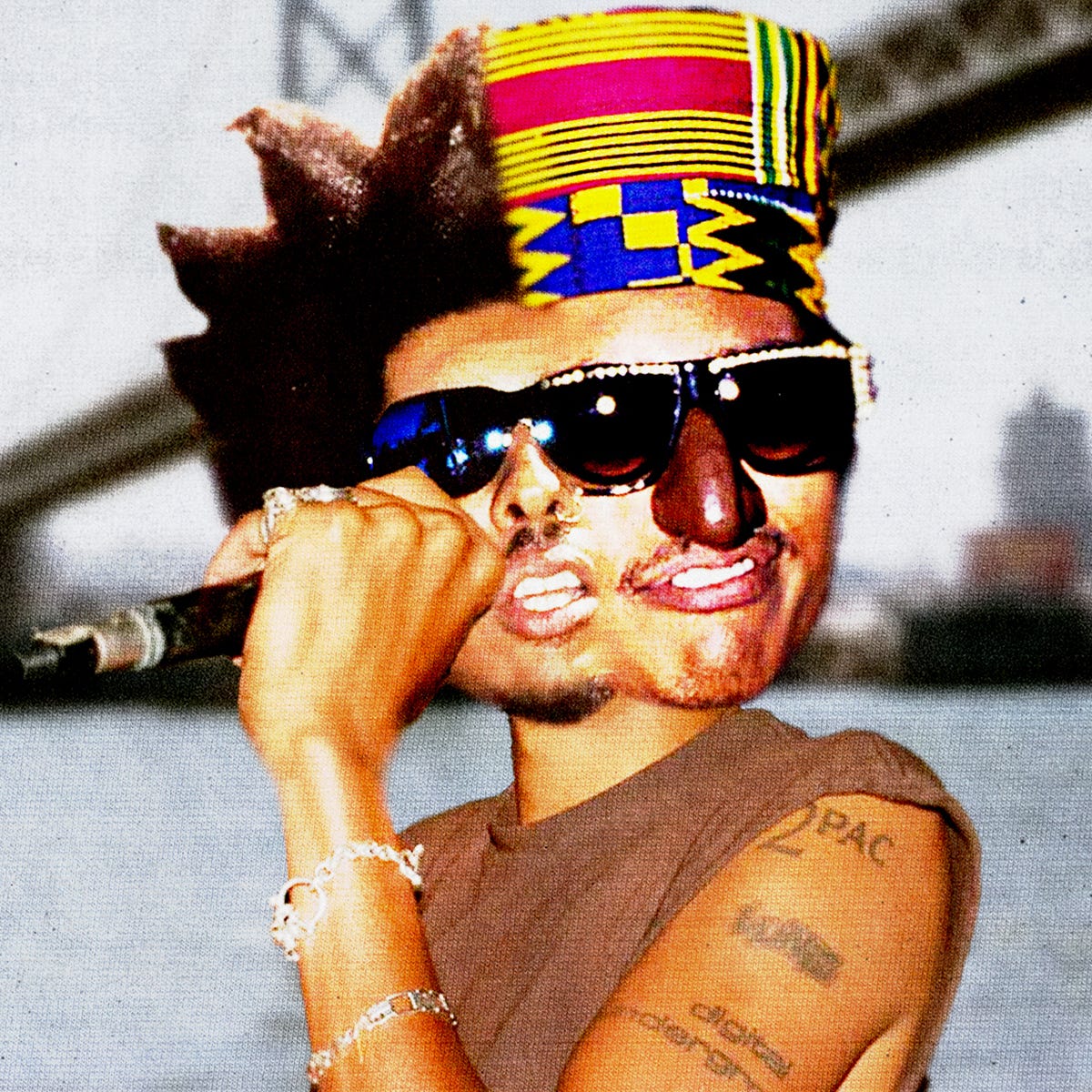
Money-B was in Denmark when he realized things were going to be different. It was 1990 and Digital Underground, the Oakland rap-funk collective that initially consisted of him, Shock G, Chopmaster J, Kenny K, Schmoovy Schmoov, and DJ Fuze, had just released a debut album, Sex Packets. The LP was based around the concept of a fictional drug called Genetic Suppression Release Antidote (GSRA), a pill that instantly tricks your mind into believing you’re having otherworldly sex, transforming fornication into a frictionless activity. Basically, a hit of DMT specifically engineered for horny people.
Digital Underground had conducted a forward-thinking guerilla marketing campaign across the Bay Area, with fake pamphlets for GSRA strategically placed outside doctor’s waiting rooms and even stuck to lampposts within the Red Light District. They claimed GSRA was already being successfully used in trials by lonely NASA astronauts, with the overall aim of duping the public into believing this drug was for real. The group did not achieve any sort of lucrative mass psychosis event. But when one Danish radio journalist, despite having only swallowed a fake, paper tablet, was suddenly dancing suggestively and throwing off her clothes, it really did seem to its creators like GSRA had taken full effect.
“Me and Chopmaster J could see from that interview that people believed Sex Packets was a real thing… and that the record’s concept had truly worked as a piece of propaganda,” the now 56-year-old Money-B laughs during our warm phone interview. “You’ve got to remember that the AIDS crisis was rampant from 1989 to 1990, but we were trying to create this world with Sex Packets where you can take the drug and get all the pleasure you wanted, without exposing yourself to any of the dangers. We wanted to make safe sex seem cool!”
This underrated 1990 album achieved exactly that, doubling up as clever satire of a fear-mongering sexual age where young people were taught by the right-wing media to be suspicious of all Black promiscuity. It was also the launch pad for Humpty Hump, a gangsta rap Groucho Marx who hilariously boasted about eating lumpy porridge and making babies in Burger King bathrooms. Masterminded and played by Shock G himself, this goofy alter-ego resulted in a highly popular, San Francisco-earthquake-referencing shaky leg dance, plus a platinum single that rose as high as No. 11 on the Billboard 200 charts.
There’s an argument that it opened up the doors for every rap alter ego that followed, whether that’s MF DOOM or Slim Shady. “If Shock G had Humpty’s nose on, he wouldn’t answer you if you called him by his real name!” remembers Atron Gregory, who managed the Digital Underground and executive produced Sex Packets. “He might stay in character for days on end… on some Daniel Day Lewis shit.”
To mark the album’s 35th anniversary, Tommy Boy has reissued Sex Packets on vinyl with foldout 3D artwork designed by Shock G’s Rackadelic alter-ego, the cartoon capturing the loose sense of fun that defined these studio sessions. The reissue also underlines Sex Packets as a forward-thinking classic of the early 1990s, and Digital Underground as a sort of West coast De La Soul. Just like the Long Island trio in their 3 Feet High and Rising days, Digital Underground seem driven purely by an agenda of melding Flower Power vibes with playful boom bap production, using self-deprecation (on “Doowutchyalike” the group rap about seeing a foot doctor about sawing off their “bunions”) as a key songwriting ingredient. They similarly blurred the lines with reality through their conversational skits, with Money-B telling me a lot of people thought “Gutfest 89”, a song about a fictional festival where “back fat” is celebrated as beautiful, was real.
The Digital Underground knew how to be rumbunctious, sure, and make spunky rap songs that would be a natural fit for soundtracking screwball Dan Aykroyd comedies (by 1991, they would cameo in the Aykroyd-directed comedy horror, Nothing But Trouble). On another standout, “Underwater Rimes Remix”, Shock G puffs out his cheeks to rap as MC Blowfish, flirting with mermaids under a bassy beat that imitates bubbling bong water—the words “deep sea gangster” never fail to make me chuckle. Sex Packets has a commitment to sparking joy that’s a lot like finding a fire lantern after getting lost in a pitch-black cave, especially back then during the AIDS and Crack crisis, and especially right now during our current news cycle of endlessly grim WW3 predictions.
However, it’s clearer and clearer upon revisiting this music in 2026, just how much it’s focused on spiritually connecting up to the purple-scented funk grooves that acts like Parliament, Funkadelic, Jimi Hendrix (“The Way We Swing”), Miles Davis and Prince had already laid down in the decades prior. It’s obvious Shock G would have been unhappy to see Sex Packets reduced to “novelty rap” music. During its creation, Money-B tells me how Shock G would not wear footwear in the studio, because he had heard George Clinton did the same thing due to socks and shoes potentially getting in the way of being fully connected to the funky bass notes naturally floating up from the earth’s crust.
“The studio was really funky,” says Money-B, laughing again. “Doritos-type smell.” On Sex Packets, expansive songs frequently surpass 6 minutes in length; there’s a commitment to community-driven genre splicing that sees funky basslines dissolve into punch drunk love flits of blues piano; eclectic samples of everything from KC and the Sunshine Band to Parliament and Prince are chopped up so they sound like they’re having a live conversation with one another; and the music can’t decide whether it wants to be profound (on the raw “The Danger Zone” Money-B breaks down how the Crack era was always a government plan: “They give us drugs in bunches!”) or unapologetically ratchet: “Freaks of the Industry” is perhaps the first ever rap beat that sounds like it’s having multiple orgasms.
Digital Underground sounded like nothing else before them, helping Californian rap be defined by more than just an L.A. point of view. If N.W.A were the kings of mean mugging and being about their business; and Too $hort was the smooth talking, socially conscious pimp; then the Digital Underground were the princes of clowning around with wry smiles on their faces. “Remember, a lot of our members were connected to the Black Panthers and the civil rights movement, so we always reminded the world of the fucked up shit going on in America—that was our job!” Money-B is careful to clarify.
“But we were just as committed, if not more, to helping you have a laugh.” To celebrate the re-release of Sex Packets, I spoke at length to Money-B and Atron Gregory, where we discussed the slept on genius of Digital Underground’s chief Shock G; getting samples cleared by Prince; the importance of maintaining an eccentric sense of humour; and how the introduction of a young 2Pac (who was on the tour for Sex Packets, mostly doing backing dances with blow-up dolls) changed the group’s dynamic.
I’ve been thinking a lot about how in the late ‘80s, there was this swing toward more of a nihilistic gangsta rap sound and a lot of live rap shows were suddenly being shut down by the police. But with Digital Underground, there was more of a fun-loving approach and you guys rapped about Black-white unity on wax. Was that juxtaposition intentional?
Money-B: When we came out you had your N.W.As, your EPMDs, your Slick Ricks; everybody had their own sort of persona and personality. I always say we were more along the lines of a Jungle Brothers, De La Soul, or A Tribe Called Quest—but the West Coast perspective of that lifestyle, you know? The misconception was that all Californian rap sounded like N.W.A, and that definitely wasn’t the truth.
The way N.W.A would mean mug was radical, but so was the way Digital Underground smiled, right?
Money-B: Exactly that. Our studio sessions were all about making each other laugh. But when I was rapping about stinking up the dance floor, it was also a reflection of Oakland slang! It was important we were showing pride for the Bay Area and how people really talk down here. Too $hort opened the doors there and we kept it going.
Atron: I was the tour manager for N.W.A, so going from that harder sound to Digital Underground was a real juxtaposition. I went from people protesting at our shows with N.W.A to experiencing these sweaty parties with the Digital Underground. I think that’s what people liked about the Digital Underground, to be honest. They weren’t in-your-face controversial and, as a collective, they felt more in line with Parliament-Funkadelic than traditional gangsta rap. They were more approachable than the other rappers!
Shock G is obviously so crucial to the Digital Underground and its overall sound. From The Piano Man to MC Blowfish, the way that guy would shift between characters was super eccentric. He’s like a hip hop Peter Sellers in that respect. Did you know from the first time you met him that he was wired a little differently?
Money-B: He was eccentric from the very first time I met him! He walked into the house and he had on these polyester sweatpants, Puma sneakers with tassels hanging out the back, a high-top, a beret, and a Black leather jacket with no shirt on. He was just a different kind of cat; from a different era, almost.
Atron: It was obvious he was unique. When he became MC Blowfish, he really embodied the role! He puffed up his cheeks. It was like live theatre. He was a beautiful painter, too. He was a student of music and an amazing piano player. I got to know Chick Corea and he got exposed to Shock’s piano playing and said it was some of the best he’d ever heard! That shows you the level of musician that Shock G was! You say eccentric edge, but to me Shock G was more cutting edge.
“The Humpty Dance” was a huge hit and really propelled Digital Underground into being a global success. It’s still an infectious song today. What inspired the character of Humpty Hump? And, when was it obvious you guys had a hit on your hands?
Money-B: You know, Shock grew up in Tampa, Florida, and he had this off-the-wall uncle called Eddie, who was this loud, boisterous, car salesman type of character. There was another guy he knew who was super flashy, but outdated at the same time, and didn’t have any self-awareness, right? Shock combined these types of personalities and put the hip hop flavour over it. That’s how Humpty was born.
With Sex Packets, we’ve already spoken about how the concept was a reaction to the AIDS crisis, but what was your intent in terms of the sound? Revisiting it today, Shock G was one of the first to really sample Parliament and Prince in such a hyper animated type of way. I love how the title track makes “She’s Always In My Hair” feel more schlockly and playful, as an example. Would you agree Sex Packets is at Ground Zero for G-funk?
Money-B: You’re right about the samples being more cartoonish. I don’t think Shock gets enough credit as a producer when it comes to sparking G-funk, but I definitely know he was acknowledged by the creators! I know the P-funk innovators like George Clinton and Mike Hampton respected the hell out of Shock G and that was because he was using their funk to create new funk.
Atron: With Sex Packets, we were driven by proving we were proper songwriters. That’s why you had nine-minute songs on there! You’d go into the studio and there would be live instruments, whether that’s drums, pianos, keyboards, saxophones, synths, or guitars. Then you’d have DJs scratching and Shock G chopping up a sample live. We did a lot of Sex Packets at the Starlight Studio in Richmond. There was everyone recording there, from Raw Fusion to Saafir and 2Pac, and it was like one endless party. The Bay Area in general has always been a very creative space, and that studio was right at the epicentre.
I think “The Danger Zone” gives a lot of balance to the album, as it shows the dark side of America and how the crack era messed up whole communities. Money-B, you’ve got a bar on that song about how the crack “came in bunches” and was government-sponsored. Why was getting that idea out into the world so important to you in 1990?
Money-B: My dad was a member of the Black Panther party and he saw how outsiders would put drugs right into the core of the movement in order to disrupt and disband any progress. A lot of our revolutionaries ended up strung out, remember? Crack destroyed our communities; it killed our role models; and it all felt like a government-sponsored plan to do so. It was like yes, sure, we make music for people to party and hang out to, but we have to remind you of the dark side as well!
There are a few Prince samples on Sex Packets. Prince wasn’t clearing samples for anyone back then, but he was a big fan of you guys and even had Digital Underground play at his club. That must have been a trip, right?
Atron: Shock G was a big Prince fan. I got him to write Prince a hand-written letter, which the publicist Karen Lee then gave to Prince. The next day Prince cleared all the samples for free. The Digital Underground would play at Prince’s club, Glam Slam, in L.A. The ultimate compliment was when Prince got Shock G to produce a remix of “Love Sign.” I know that was a big moment for Shock G, as Prince didn’t let many rappers come into his world.
So, the album is a smash and you guys are touring the world. I know 2Pac joins at some point during the Sex Packets tour; what are your defining memories of touring with him?
Money-B: I used to room with 2Pac and he was super messy! He would just throw his clothes everywhere. You remember that show The Odd Couple? That was me and 2Pac. I was the tidy guy, he was the messy one. He would roll his blunt and leave the ash everywhere; the dirty clothes would be on the floor; and bits of last night’s pizza would be around the room. We used to get into it about his mess, somewhat. It was almost like he knew he didn’t have a lot of time and therefore focused all his energy on the art and living rather than maintaining those everyday self-care things. I wouldn’t say 2Pac’s energy changed the group too much, because he was down with the Black Panthers just like we were, you know? He was the type of dude who if he loved you, he would die for you. Having him around was a great thing for the group. I am glad we got to take him to Japan!
Why do you think we’re still talking about Sex Packets all these years later?
Atron: I remember right before Sex Packets came out, we did a tour of Europe and “The Humpty Dance” would come on and you would look to the top of an arena and every single person all the way to the bottom was rocking! 20,000 people were jumping and dancing and smiling. That’s when you realize not so much your life has changed, but you’ve really accomplished something. The music was something that touched so many people, because it was non-threatening and it maybe felt like an escape from the darker world outside the venue.
Money-B: Shock was obviously a genius piano player, but Chopmaster J played the drums and had a jazz musician as a dad, while Fuze had been around musicians his whole life. In a way, Digital Underground was like the first hip hop band with Sex Packets; it opened the doors for The Roots.
For me, “We’re gonna get sweaty, just in case you bring the towel in” from “Rhyming on the Funk” feels most like a mission statement for this LP.
Money-B: For sure. Sex Packets was about helping you leave your troubles behind for 60 minutes and escape to somewhere sweaty and fun, where you could dance and forget about it all.
So happy to see this. Digital doesn’t get the respect they deserve. Truly unique.
Still the direction I wish things went. A new world they built, which this world saw maybe just as a place for tourists. Really it is where we could live all the time - harmony and fun and sex and playing and joking around, and still super conscious and righteous.
Bay Area vibrations. Of course!