

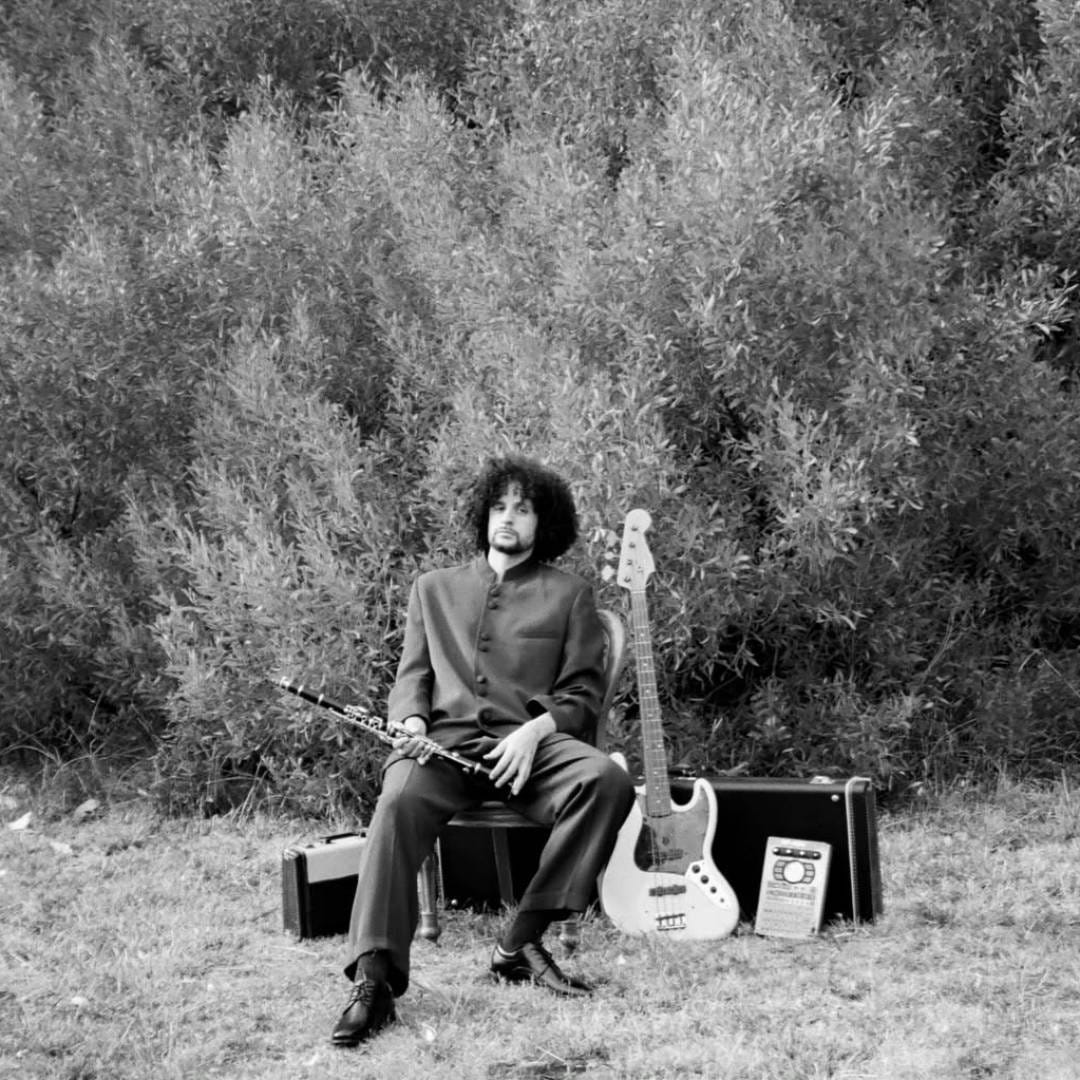
Image via @_detigre / Rhys Langston/
Kevin Crandall still misses Rudy Gobert in a Utah Jazz jersey.
With a clarinet atop his recording desk and a gaggle of guitars to his right, rapper-producer Rhys Langston details to me the slow learning curve he’s gone through with each instrument that litters his studio. For an accomplished musician whose latest record, Pale Black Negative, includes original compositions on acoustic guitar, banjo, bass, clarinet, electric guitar, percussion, and synthesizer learning to play has been a slow march: “Playing instruments is not very intuitive for me.”
Langston learned the clarinet by just guessing through the fingering until he could play tones clear enough to chop up for beats. No music theory. No outside instruction. Just feeling and grit. This unstructured approach helped shape his perspective as a “genre abolitionist.” When Rhys began producing at the height of 9th Wonder-era boom bap revivalism, the LA polymath declared that, “straight up, I’m too fucking weird for this,” and took a hard left turn, instead conjuring up woodwind-driven beats like “Resident Harebrain” to prop up his rhymes. His noodling has served him well across dozens of projects wherein he established himself as peerless.
The twentieth musical project of Rhys Langston’s career, Pale Black Negative, is a leviathan from the creative depths of a great artistic mind. It's the realization of both his instrumental exploration and the genre abolition he’s been pushing towards his entire career. On Bandcamp, Langston tagged the project genre as “post-intellectual”—a designation whose only other members are a tape of six electronica “Nightmare Worlds” and a project that has borderline incoherent spoken word over piano titled, among other things, “Lil Uzi Can’t Ride the Rollercoaster.”
Rhys’ post-genre pursuit is at its apex on Pale Black Negative’s best three-track run, starting with “When the Orchestra is Dreaming.” To start, Langston whips out a Beastie Boys-esque singing voice to flout his hard-earned clarinet and bass skills. Then, the Ishmael Reed-inspired “It Jes Grew (Right Outta Me)” kicks in with a knee-slapping banjo lick as Langston raps about smuggling okra seeds. He then stitches in recordings of friends talking about their hair and rips off a sung refrain of “it jes grew” while the aforementioned clarinet chops dance in the periphery. “Chancla Gander (a Spiritual for Moziah)” ends the triplet with perhaps the most intimate track the LA artist has released over his 20 projects. Through a series of chants over disparate drum fills, Langston pays homage to his cousin Moziah, a brotherly figure who shaped his approach to life and kickstarted his first sample library.
The release of Pale Black Negative has also been a charge for Langston amidst the grim government-sanctioned kidnappings and subsequent protective uproar that has ripped through the city he calls home. Langston recently penned a piece for the Los Angeles Review of Books titled “A Week Occupied by ICE, or How Close Does the Violence Become,” reflecting on his personal experience during the week that LA became the flashpoint for the ICE raids that continue to devastate communities across the US.
When we spoke, Rhys detailed to me the hesitation he had in releasing Pale Black Negative while LA was surging in defense of its people. Reaching out to friends and family for advice, Langston ultimately decided to go ahead, using the energy of this album release to fuel the commitment and action he reckons with in the article.
I caught up with Rhys a couple days after Pale Black Negative dropped. We chatted about the album, his reverence for genre abolition, and the peculiar history behind his learning to play the clarinet.
(This interview has been condensed and lightly edited for clarity.)
First I just want to check in with you; how are you feeling with everything, with the release? Everything that's going on right now, I imagine it's a pretty big mixed bag of emotions.
Rhys Langston: Yeah, I had a moment on Monday—I was like, do I ask my distributor for a last-minute delay, pushing this forward a week? Then I was just talking with some people close to me, like my parents, who are really supportive of my work. Some friends. And yeah, it was definitely this big consideration of my importance, my ego, my humility.
All in this one moment, because my feelings around last Friday or Saturday when the escalations for all the ICE raids were happening, I kind of was just like. Oh, this is… I've been very excited for this record, but I kind of want to be more of a complete human than focusing on this thing. And just figuring out how to place that. Yeah, just the sentiment was I kind of wish I didn't have to put this album out right now. Not that I didn't want to; it's just it felt very strange. But, I think I did it in such a way. It's not explicitly political work as much as my other stuff is, but I got a lot of people who said this is of the times. It's okay to do it.
The day it dropped I sent money to a few mutual aid organizations, and I went to a protest, and I only went for, like, two hours. And as I was leaving, they threw tear gas into the crowd, and I was like, alright, I will put my body on the line, but right now, I'm gonna make sure I walk this fine line. The semester just ended for me as a teacher—this is my full-time job as a musician now, so I gotta do this full-time job. Do as much as I can for the greater good after making the decision to be like, alright, let me thread this needle. It's not very concise, but I'm sure you kind of understand what I mean by all that calculus.
On release day you put out this video saying you're using the energy from this release to charge up by reading some revolutionary texts to help outline action. Can you talk me through how you feel like it's energizing you and how you're putting that energy towards commitment and action?
Rhys Langston: If anything I think it's just a confirmation of the independent study I've been doing. You are in the middle of a graduate program, and I know there's probably been moments where before you got admitted into anything you had to really renew or remind yourself of your commitments. I didn't get accepted into the programs I was going for, for a few reasons, I think. So doing a bunch of independent study and researching things and being ready in a certain extent, unfortunately, for these flashpoints that happen. Not self-congratulatory, but not being caught out of nowhere. It's not a surprise to me.
It’s confirmation to keep going in this direction, and you're doing the mental work, now do the mutual aid, physical social work component of it. I think it's just a reminder. Okay, keep a certain level of discipline, you're on the right track. Also, there's room to grow. So that is kind of what I meant. It's more of a reminder of the ethos and the orientation as I do anything, whether that's this release, or putting myself in either harm's way, or in community in certain moments. That's how best I can elaborate on that for me.
Talk to me about this idea of genre abolition.
Rhys Langston: I’m not sure when I first–I haven't heard anyone else say it, so–coined the term “genre abolition.” Had to have been in the last two years when I first thought about it. Not to trivialize or aestheticize abolitionist movements, but I do think that it points experimentality in a political way? Away from just an aesthetic or “art for its own sake” approach. Just knowing how, in the context of how ideology is baked into culture. Popular music. I was having a conversation with someone about this the other day about popular music—the racialized components of it, the class components of it. Who gets to be pop. Who doesn't. I think the conversation was with Yousef [Srour]. He was talking about Frank Ocean, who won the inaugural Best Progressive R&B category and then he didn't submit his next albums for the Grammys. Why can't he be pop? Why does he have to be “Progressive R&B?” What's the subtext there that the establishment is telling artists of a certain background or a certain place in the racial order?
It's not entirely just that, but abolitionism was really coined around the time of abolishing slavery, and it has that heaviness to it. Thinking about how race music became R&B, became urban, and so on and so forth. Just who is allowed to make certain types of music. I'm very fortunate just due to being ambiguous and recognizing that I get more opportunities than other people do to, like, wiggle. But even so, there's been write-ups where I'm singing on an entire track—not rapping at all—and someone says, “Rhys Langston just released this rap song.” It's not that rap is lesser than, but it's not what's being done. It's silly.
Genre, largely, has been used by the culture industry to categorize and typify, and put people in key demographics. That inherently just reveals ideology baked into, and the hegemony underneath, everything. I wouldn't say it's tongue-in-cheek too much, but there's a little tongue-in-cheek thing where the music has this ultra leftist edge to it, even when you don't think it does. It's a little playful. Genre abolition—get people to think “what does that even mean?” And also, I do think for the music industry and the entertainment industry and how it reproduces ideology, genre is really useful for the powers that be in creating categories that serve its interests.
I completely agree. Kristie Dotson—she's a philosopher at the University of Michigan who works on epistemic oppression—writes about epistemological frameworks and how they can be especially pernicious in perpetuating epistemic oppression in that we all view the world through the same knowledge base. To be able to critique that knowledge base itself is really hard because you have to be able to get outside of the framework. The upshot of this is that when I think about your idea of genre abolition, it feels like that same sort of trying to get around this idea of genre in its entirety, because as soon as we start talking about things with respect to genre we're falling into this oppressive, conceptual slop.
Rhys Langston: Yeah, totally. I think that's the interesting thing, too, about the spirit of hip-hop in and of itself. The sampling that was born from it was deconstructionist of genre. Particularly how hip-hop production techniques now influence every single genre. I think it's very important to call to attention that when people talk about the spirit of hip-hop being lost or hip-hop being dead, there's a way to look at hip-hop as something born from nothing. Lack made into abundance. With everything being so compromised, and we're post-appropriation and all this stuff, that spirit of looking outside the framework. Recontextualizing, deconstructing, remixing.I think that merits a different kind of consideration. We should consider the techniques that we use to do that.
Back in the day for hip-hop, the techniques to get free were sampling. And now the techniques are absorbed into the power structure. It’s this weird thing where everything is compromised, but everything is fair game. I don't know if that confuses my points, but that’s also logistically how it feels on a day-to-day, to be trying to make music without falling into genre trappings, because you can't escape anything. Everything has a referent. I don't know what completely new sound could be made these days. Even baile funk out of Brazil has a lot of sonic references that came before it. That's the hottest club shit right now, probably. But yeah, you gotta try.
Pivoting a bit—what’s the story behind the inheritance of your clarinet?
Rhys Langston: Right, so 2021 I got it. I wanted to play a wind instrument for maybe a year or so, and being in LA, everyone plays sax. There's a lot of trumpet players. There's a lot of this and this and that, and I was like, well, that's weird? What's different? You're always trying to be different. I want to play the clarinet. And I kept saying that messing around, and I mentioned that at a dinner with my grandparents. So my grandfather remarried, so I have a step-grandmother. Her brother passed away young, but he was a very accomplished clarinetist.
So I basically got this dead man's clarinet that had all this energy imbued in it. I mentioned it at dinner, and they were like, well, you know we have one? And I was joking around, working on music, I'm just trying to play clarinet blah, blah. And then they were like we have one here. The corking was all worn away, so I couldn't put it together properly. I called a bunch of woodwind repair places, and I told them it was really old, from the ’70s I think. It's a really good clarinet, and you know how people are, they're just super dismissive. They're like don't even try and bring it in here, don't even fix it.
So I didn't even try to do that. I brought it to a place on a last hope without consulting, calling them first, and all those people were all dumbasses because the guy was like, “oh, this is a beautiful clarinet. Wooden too? Wow.” It’s not plastic. For like 70 bucks he re-corked it, tuned up the valves and everything. The levers and shit, and I really just guessed my way through it. That instrument, because of its transposition in orchestra, in classical music, is not a very sensible instrument to learn if you don't know music theory or how to read music. But I kind of learned how to play it on this record by just trying to get good enough tones that I could chop up, and eventually got to the point where I could play things more completely, less broken up. Less hobbled together.
It's interesting that I kind of just mentioned it and it became very fundamental, adding a different kind of timbre and tone to this record. It was used in other things. Because this record was made largely in 2021, 2022, projects that came out before this were actually made after it, if that makes any sense. So it's just funny. This is actually the foundational moment where it started to be used and considered in the wheelhouse of things.
In the liner notes you talk about how impactful the death of your cousin, Moziah, was in 2021. Would you be willing to talk a bit about the impact he had on you and your artistic process?
Rhys Langston: My cousin Moziah passed away suddenly, due to some unfortunate circumstances in 2021. Like January 31st. The way we grew up, a lot of cousins on my mom's side, and so he was oftentimes around. He and my brother were really close. He was basically a brother as well. He was always the X factor in a lot of social scenarios, where he's just someone who's just out of pocket but sweet, and is weird in a positive way. Just themselves entirely. That was always him, and he always reminded me to just be strange and be kind of out there.
He was into some serious, serious stuff. His parents raised him kind of in the Pan-Africanist tradition, but he was always really hypercritical of Black Israelites and the ADOS movement and the Nation of Islam. He would be like, yeah this kind of just appropriates white supremacist logic and it's kind of anti-woman and anti-Indigenous. He had a lot of realness that he gave me and put me onto before outside people knew about shit like Yakub as a meme and stuff like that, you know? We talked about that from a young age, and he was really, just keyed in to understanding history on a real level and combating a lot of nonsense about where ancient knowledge in Black radical knowledge comes from.
He created a lot of music. Just really out there shit. He never got to a point where I think he got to realize his vision. He would mix Ranchera music and house and do crazy shit like that. He was really into hybridizing culture. Our family grew up around a lot of Chicano and Mexican-American folks, so we were always deeply connected to the crossover between our family's history and Hispanic and Indigenous communities and culture. He just listened pretty far and wide, and it was 2012, 2013—he gave me like four hours of music digitally. That was the start of my first beats ever. Some stuff that I'm still proud of.
He was deeply influential in many ways. We did a traditional Ifa ceremony of life for him with a drum circle, and I remember one of the things that they were saying was, “we offer elements in your favor,” and, uh, I just kind of did that chanting [on “Chancla Gander (A Spiritual For Moziah)”]. “Called you up we ruminate / offer elements in your favor.” That just kind of came out of that energy, memorializing him that way. That track actually has a two and a half minute B-part that I didn't include on the record because I couldn't get it to sound where I wanted it to be in terms of finished polish. But that track turns into a thrash punk song. So it flips from a traditional spiritual into a thrash punk song, because he was also into hard rock and punk. In another world, that track would have came out and the outro would have been like [imitation thrash punk noises] using the melodic motif and turning it into bass guitar and noise music. We're still, I think the family never really has recovered from his loss, because he just made family functions pretty interesting. He’d always just roast everyone, take down a lot of the walls and stuff. So this track, even though it's the shortest one, I feel like it had to be in there. It’s not everything I wanted it to be, but I feel like it's enough, still.
What made you want to include the sampling of your dad’s voice on the title track?
Rhys Langston: He still is [acting], but he had a long, very successful career as an actor. Not anything too big, but he's a performer; I get a lot of my performer genes from him. I had this vision of talking about the time that I broke my leg and basically had a Sean Livingston-type injury if anyone knows what that consists of, which is the worst shit. I had that happen to me at 15 years old due to a few different things.I was in hyper-competitive basketball and pushed myself to the brink surrounded by a lot of not very great influences in terms of adults who were coaching me and all that. I knew he could do a good impression, so I was like can you do an absurdist Bobby Knight impression for me? And so he came to my home studio and laid that down. But also, even though he was very artistic and he's supportive of my art, he was prototypical basketball helicopter dad.
He curses himself a lot for forcing me to play through some injuries that led to my catastrophic leg injury that I fortunately recovered fully from. But I still have nerve damage to this day in that leg. For me, it was kind of this moment where we could laugh about basketball, because for a very long time, he pushed me too far, and there is a lot of bad feelings around that. But I get a lot of my comedic flair from both my parents, but from him, and being able to collaborate with him was really fun. We've done a few things, not too many. And being able to laugh at the basketball shit, because even if the intro and outro spoken parts are funny, that track is a bit more plain-spoken about some things, some hard emotions and hard memories. I think being able to laugh with him about basketball in general, it's a moment. Because, for a while, it was like, you forced me to do this shit I didn't want to do, and all this stuff.
Relaying back to the genre abolition—I love that you have this Open Mike Eagle feature that's not actually him rapping at all. Can you talk to me about how that came about?
Rhys Langston: If I hadn't already constructed a song to the beat, I feel like it'd be perfect for him to create his own hit off of it, but I already had so much written. Those two verses and the choruses, and the one part he could have rapped to maybe would have been the outro. There's the beat breakdown. But I was like, hmm, what does this really need? I can't remember the conscious thoughts I had, but I believe it was something along the lines of, yeah, what does this track really need? Which was, I think, a large theme on this album. What does this track actually need versus how you would otherwise systematically construct an album. So I was like, well, [OME is] kind of a goofy dude. He has these acting chops, and maybe it would be more breezy for him to just approach it this way, rather than overtly rappity raps on it.
It's a problematic movie, but one of my favorite movies is Airplane!, the original Leslie Nielsen comedy. A lot of jokes these days just wouldn't fly, and I still watch it sometimes and I'm like, oh, okay, oh, wow. But a lot of really good bits. The bit that I did at the front was a riff off of that, and then I basically told Mike you know that movie? I'm kind of trying to make an absurd airport scene, can you turn me in something? And I sketched out some stuff. I said, do your own versions of those. So, when he sent it back I took those away and he did his whole other thing. So I gave him a formula of what I thought, and then he was able to improve. So, yeah, it was like an anti-feature, which is cool, I felt that in a good way.
What was the last feature you received?
Rhys Langston: The Hymnal feature was the last one. He came over and recorded that. That was really cool.
Can you tell me about that moment?
Rhys Langston: In 2018, my old English teacher from middle school, who's a poet, invited me to read at a bookstore. I met him there; I didn't know who he was. I barely knew who Darkleaf was, even though I was tapped into the LA scene and stuff. Just eluded me. We kind of hit it off. We had a similar philosophy about language and deconstructing sense, productively.
Then it was 2022, we were at the Project Blowed Anniversary show and I had done a set on one of the stages. We had a cipher outside and he was freestyling, and he spit this crazy verse. I think it was more of a written poem, but the fact that he just spit it in a rap cipher and it just didn't really have rhymes, but it was just this hyper-rhythmic deconstruction of sound and color. I reached out to him, like, “yo we should actually just fucking hang out.” We did a few times, then we read poetry together a few more times in the last two years.
He's been kind of in and out of being active in the scene. Mostly out, working. Writing poetry for his own self. So he came over and he recorded the feature, he was like, “oh, is that good enough?” We got a take that we liked, and he was just like, “I'm so grateful that you gave me this opportunity to just record.” And I mean, shit, dude, yeah! You're giving me life, too. He was really just in deep gratitude for the ability to jam out, listen to shit.
It was also an interesting time–that was in June of 2024 when we recorded it, finally. I was living with my ex-fiancee and it was the beginning of the moment I began to realize I have to get out of here. This is not a healthy situation. And so him bringing his energy, rounding out this summation of work with that feature. It was like I needed this but I also couldn't quite appreciate it because I was in such inner turmoil.
How does it feel to be able to feel that gratitude and impact engaging in art with somebody?
Rhys Langston: I think it feels like one of the highest things you can do with art. If you take away how art has been constructed for us in a system of commodities and world of capitalism, it inherently is a conversational thing. A way to relay experience. Ways to relay experience or having a conversation about things isn't just I'm telling you about me and you receive it, there’s activation energy.
I started to make music because I saw it as an inherently social artform, whereas writing, painting are not always able to directly speak in such a way. I've been going through a little bit outside of the world, and so there's a little bit of depression going on for about a year-and-a-half now due to my relationship ending and a bunch of other things. When I get those edifying moments, whether from someone else or from my own work through art, it feels deeply spiritual and the reason for living, to be grandiose. That’s my big answer.