

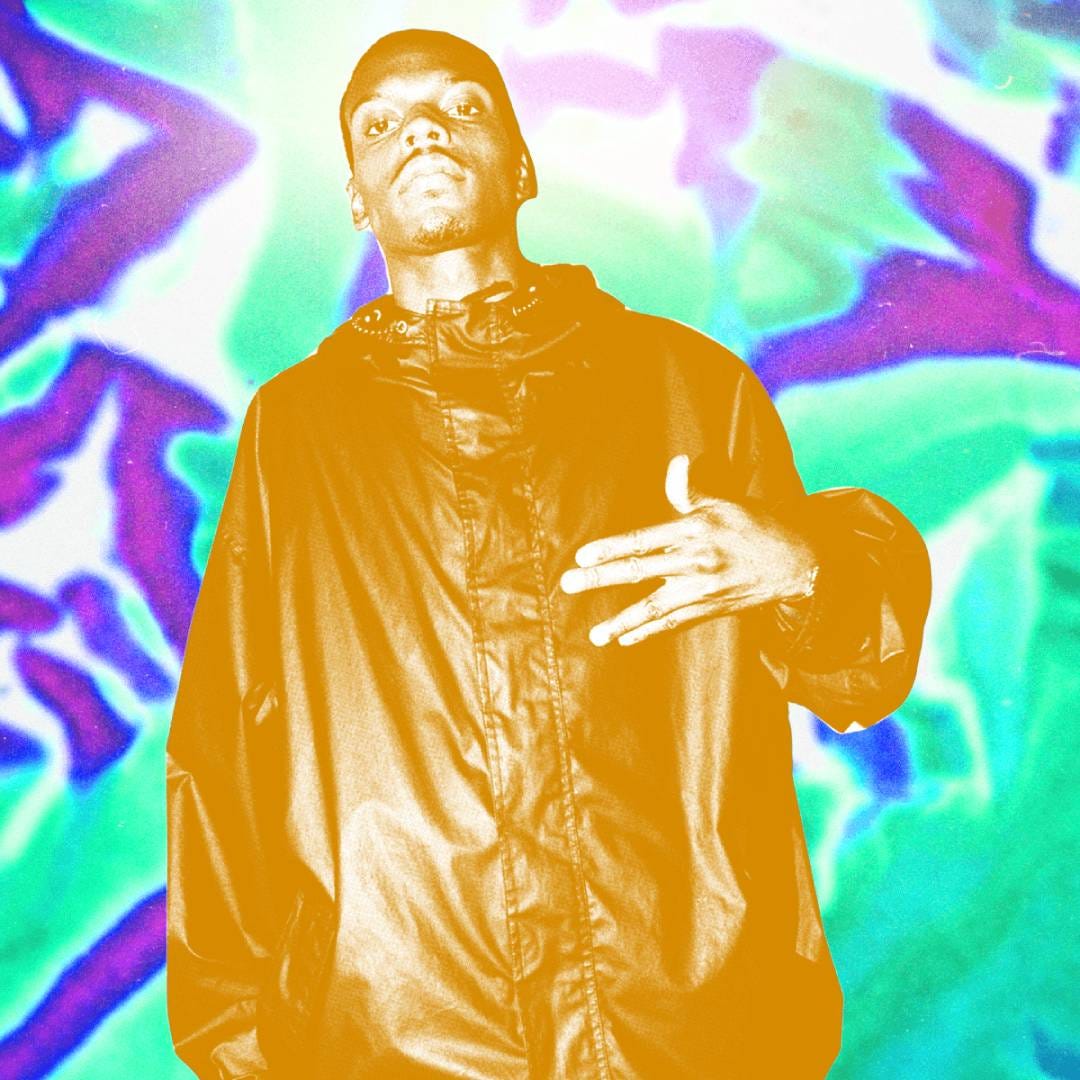
Art by Evan Solano
It's a new day for Te P
It’s hard to capture just how enigmatic Rosco P. Coldchain was when he first emerged from the Philly streets. This is the place that produced the first gangsta rap song (Schooly D’s “PSK, What Does It Mean). It birthed one of the most nostalgic summertime anthems ever (“Summertime)”, and supplied the stylistic inspiration for one of rap’s last great dynasties (State Property x Roc-A-Fella.) But if you came of age in the city in the early 00s, you distinctly remember the first time you heard the voice of Amin Porter, the North Philadelphia-raised rapper who took his alias from a Dukes of Hazzard villain and flipped it into one of the most iconic names in rap history (just ask Vince Staples).
During a time when everyone in the game was stunting on us — MTV Cribs, spinners, Jacob watches — Rosco reminded us that “that ain’t real life.” As his voice spread through the city on historic 2 Raw For the Streets DVDs and popular songs like “I’m Not You”, so did his myth. The storied meeting with Pharrell. His legendary block down Norf. The way he brought the world to the trenches in the “Hot Damn” video. Even the menacing origins of his name. No matter how popular Sco became, he never seemed out of reach. His flow was as unpredictable and aggressive as the city he championed. And after 14 years in a Pennsylvania prison, a moment at a local coffee shop brought us together to talk about his unbelievable journey.
Born Amin Porter, Coldchain spent his early childhood in Philadelphia’s under-resourced and dangerously unpredictable North Philly neighborhood. Born to a young, rebellious mother, who embraced Islam as a religion of activism, an adolescent Rosco noticed early on that he was different from the other neighborhood kids. Fights for his own survival were common.
His earliest memories were filled with family on 18th & Oxford. His grandmother and aunt lived on 17th & Jefferson. “J Street” was one of the earliest blocks known for pharmaceutical drug sales: pills, syrup, and more. Naturally, Porter was torn between the strict and structured environment of his mother’s home and the streets.
Once the face of fast-learner programs and honors, Porter was eventually sent to Learning Disability (LD) classes–stuck in a system designed to fail him. He became another misunderstood Black boy left on the fringes. Going from a quick study to discarded, Porter found refuge in his cross streets and in the OGs, who, in his words, prepared him for the inevitability of being outside.
Out of fear and a desire to change their environment, his mother moved the family to Southwest Philly. She was hoping for a safe haven from the violence and drugs of her son’s new daily routine. It was just the opposite. Amin quickly found a new, craftier way to hustle. Reflecting on that period, Rosco said if you checked his rap sheet he’s never been arrested for drugs—only violence. That delineation matters to him because it draws a line in the sand between Southwest Philly’s get money culture and North Philly’s get busy culture.
Now, at this same time in Philly, the streets overshadowed rap. So, without transcendent connections to examples of it working, most cats stuck to their original hustle. But, somewhere in between leaving the city to hit small towns, group homes, and a stay at a mental facility, Rosco found time to write. The first raps weren’t very good, but offered the space to vent complicated emotions. And with the influence of his uncle, two cousins who rapped, and the shared blood of his grandmother and music legend David Porter running through his veins, Rosco developed a purposely erratic, combative rap style.
Porter swiped the name Rosco from his affinity for a specific gun. The surname Coldchain was a riff on a character from his favorite TV show, The Dukes of Hazzard. He soon made a name for himself in cyphers throughout the city, especially the legendary 2 Raw For The Streets series. His words were brazen and communicated hard truths: danger is omnipresent and violence was the fastest solution. All that he needed was The Moment.
Then he met Pharrell when the super-producer was on the the block for a Philly’s Most Wanted video shoot. Walking up to P, Rosco name-dropped a local rapper, rolled a blunt, then started spitting. From this chance encounter, Rosco was no longer just another Philly gangster trying to go legit rapping. He was now in the orbit of a pop-cultural phenomenon who’d already worked with Britney Spears, Jay-Z, and Usher.
By 2002, things started to explode for Rosco with two show-stopping appearances on Clipse’s Lord Willin’. Having built a sincere brotherhood with Pusha, Rosco credits the Cocaine Cowboy for helping him learn how to write in bar structure and for being his champion inside the Star Trak camp. Songs like “I’m Not You” and “Hot Damn” introduced a new kind of voice: tough, agile, unpredictable. Each line another thought in the calculated but crowded mind of a modern day outlaw. Next, “Delinquent” was a bouncy warning shot to anyone standing between Rosco, his Desert Eagle and his paper. It didn’t hurt to have Pharrell giving him all the gas he needed to burn through these records.
The “Hot Damn” video catapulted Rosco into the stratosphere. Filming in front of his aunt’s house, he’s flanked by Philly street legends. A teenage Meek Mill pops a wheelie. The mask, jumpsuit, thermal, and timbs… For the city, many felt Rosco’s success was their own. He didn’t come on the scene and tell us how he had all these material possessions, how he could take our girls or even how he was now around famous folks. Instead, he told us how hard things still were. How he was trying desperately to survive. And how far he was willing to go to make sure of it.
All this fame came with a real test. He had to manage expectations from people who expected him to change as fast as he’d arrived. Instead, Rosco chose to remain loyal to the people and the places that shaped who he was; no matter the cost.
During our conversation Rosco made it clear: real life was just too heavy. The streets were still calling, he was trying to be a single father to his kids who he had sole custody of, while carrying the weight of being a consistent, signed artist to a major label like Star Trak. It was impossible to put these things aside and live in the studio.
After a few delayed projects and some lost footing between 2004 and 2006, 2008’s There Will Be Blood appeared as a final flicker of hope. When I asked Rosco how it felt to finally drop that project, he said calmly: “I didn’t feel anything because of all the shit going on.” Just a few months after There Will Be Blood dropped, Rosco was in police custody.
When discussing the trial, Rosco exhibits an almost eerie calm. He points out that he saw the entire thing coming. It started with police responding to a shooting. While still in the area, they end up stopping two men — him being one. Shortly after, the victim died and was identified as a 31-year old male. A few days later, Rosco and the second man were arrested in connection with the incident. But after questioning, he says everything played out like a movie once they’re formally charged with murder. He just didn’t know how it was all going to end.
Before turning himself in, he got his family affairs in order and called to thank the one industry friend he had, DJ Premier, who was the only person he felt kept it solid in a weird industry and showed an unwavering level of loyalty required amongst men. Then came the trial and sentencing. He didn’t get life and in that he found peace.
Trying to summarize 14 years in a Pennsylvania prison would disrespect the depth of that time – not only for Rosco, for the many men and women behind the wall. So I won’t. Those years were marked by an unfathomable purgatory. He was jailed while the world moved on without him.
To pass time, Rosco listened to Lil Durk and 30 Seconds to Mars; he got deeper into his faith; he found discipline through fitness. He even built a relationship with a female guard. But loss was never too far behind. It kept showing up at his cell in the form of family, friends, and loved ones passing. I’m not here to speak for another man’s grief. But it’s clear: Rosco carries a lot of it. His childhood scars are stacked with his street and prison trauma. Forcing him to hold the weight of a life that always seems to charge him a premium. After 13 years in, just a year from his release, his uncle passed, then his best friend, then the love of his life. He even lost his younger brother. In 2023, molded by the loss of so much time and those closest to him, he finally walked out of prison.
The hardest rapper to never truly rap for a living poured everything into his music. It’s been just over two years since his release, and Rosco has dropped more music than he did his entire stay on Star Trak. Sin City, with DJ Phrillz, felt like a return to the DVD days of old. Where a young Rosco, glaring straight at the camera, shirt off, cigarette in hand forced his way into our homes.
Last year’s Last Night Should Have Never Happened makes you sit in its haunted energy. While he frigidly wrestles with who he is, the circumstances behind why he spent so many years inside, and challenges whether the game he gave everything to ever truly loved him back.
There’s always been two sides to Rosco: humble and Herculean. Living on Borrowed Time coming only a few months after LNSHNH is full of street recollections, including “STARS BEYOND THE NIGHT,” a love letter to his brother Bird who was killed while Rosco was locked up.
One of the first things you notice about Rosco when you sit with him are his eyes. They’re piercing in a way a parent’s are when they know you’re lying. They don’t just look at you—they look through you. And with those eyes comes an unfiltered honesty. As we chopped it up in the back of a local market, drinking IPAs, reminiscing on both of our upbringings, different parts of the city, his latest project For The Mature, and his plans for the future, it was clear just how far he’d come.
You’ll notice I reference his song “Disappointment” throughout our conversation. Released in 2006, it’s his version of Pac’s “I Ain’t Mad At Cha.” In verse one: tensions with his mom. In verse two: a prayer for freedom. In verse three: an apology to fans for the missed chances, the fear of success, the time lost. These fears and contradictions created someone deeply aware of his flaws and his gifts.
With Rosco’s second chance, he’s focused not just on staying out, but on doing right by his mother, his brother, and himself. We talk about every version of the man whose fire opened up the world to him, while costing him almost everything.
You've spoken about your childhood in different ways but it still feels amorphous. So I'd like to know from your words – what kind of child would your mom say you were?
Rosco P. Coldchain: Bad. Sweet. Uncontrollable.
What do you mean by uncontrollable?
Rosco P. Coldchain: I couldn't be controlled. And my mom was a scared parent. She has this kid that’s just acting out consistently. She didn’t know how to deal with me or how to find out what was going on. You know, I’m pre-ADHD. I had a diagnosis. The thing is, the medicines were new. They were trying these drugs that shed awareness on mental health in the mid to late 80s. I'm the guy that brought the Lithium, Depakote, Prozac in. I was really just intuitive. After the 302's and mental institutions and shit like that, my mom realized it all. It was bad.
OK. Scared how?
Rosco P. Coldchain: Like, what is going on with my child? And if he’s like this now. What could happen to him? Why is he acting like this? Unfortunately, my mom internalized a lot of it. Of my personal decisions and the making of them. She felt like it was her fault. I was very abrasive and radical and free. So I didn't listen to shit. At this point, you know, my mother, unfortunately through all of the stress that I caused her is now in dire straits. So, right now, I just try to be the best son I can be. With the understanding that I wasn’t just crazy. Now I see it like, like you really might got some shit going on that you need some real assistance with. How many wild dudes do you know like that but we talk about it? Like this stuff is regular.
There's a piece of this I find really interesting. I'm born in the 90s. Like half of the city was Muslim. But you were Muslim in a time when there weren’t many Muslims in the city, at least where you were. Y'all were like pioneers.
Rosco P. Coldchain: Then, activism was really big. Family was really big. And religion was really big. But people were looking for a religion that would empower you against the system. My mother didn't want to go by that old system of turning a blind eye or cheek to something. She felt that Islam was that religion. I've been Muslim since I was about two years old. I don't know nothing else. The thing about Islam is it has always been vilified. Even in the 70s. It's always been the antithesis of Christianity, and then the religion for you know, the desolate. You know what I'm saying? Religion is whatever you choose. I just know my mom gave me that and that's what I understand most. I ride with it. And it made more sense once I started to read more. It was more about empowerment because of what was happening around us.
Thinking of you as a student, I can see you being ahead of the class. But what kind of student would you say you were?
Rosco P. Coldchain: I'd get bored. That was the problem. They misinterpreted it as, “He's disruptive.” No. I’m bored. There’s nothing else happening. I went from something called Academics Plus, honor student, mentally gifted to LD. Because of my behavior. And I’m like, “LD?” They got me in here with these crazy people like, she’s fucking licking glass. Then I started to think, “What's wrong with me?” Crazy motherfucker don't know he crazy. A kid definitely doesn't know he's out of pocket. He's just doing crazy shit. I thought my crazy really wasn't crazy. I thought I was mimicking men, the older gentleman or the dudes that I used to look up to in the hood. But for my mother, it was like, “How was he even this advanced to even know this stuff to even be wanting to do it?”
Was your mom able to see how far ahead you were in the streets because she was aware of what was going on outside?
Rosco P. Coldchain: She was super aware. My mother has been a community activist my whole life. So, she’s always been aware. The thing with my mom was, she was trying to figure it out. You gotta think. You were birthed by a lady at 18. By the time you were 5, she was only 22. How much could she have known? What could she have truly done as an 18 year old child herself? Most likely your grandmother was raising you more than she was raising you. So she didn't really know what the fuck she was doing. She just understood what she wanted in life and out of her life.
Something that’s really hard to explain to people is what Philly was like in the 90s. From your perspective, what was that Philly like?
Rosco P. Coldchain: It was fun. It was love. I got money. That was the main part. Everybody was happy in terms of getting money. There weren't many complaints. The back door was always open – but everybody earned. That's what I can remember. You weren't coming out dirty. If you come outside, your Dickies better be clean. Ironed. Creased. Because little Ginna from down 61st and so and so, and little Rita from down 17th and so and so, they’re gonna be there. And when you run across them, if you're not looking the part, they're gonna grind you the fuck up. And not only grind you up to their girlfriends, they grinding you up to the streets. So you better look the part. At least to a degree of which nobody knows what's actually going on. It was all about presentation.
While we’re talking about the city, Philly has its sections and everyone feels the way they feel about them. But you said in a record, talking about moving from North to Southwest, “These niggas rock up just like us. They just like us.” What did you mean by that?
Rosco P. Coldchain: I’ll never forget the first time hearing Rakim say, “It’s never where you’re from. It’s where you’re at.” This is the 80s when I first heard that. I didn't understand the meaning of it or anything. But once I begin to understand it's not where you from, it’s where you’re at, I started to understand that even though I'm from North Philly, Southwest showed me the invaluable aspects on how to hustle properly without getting caught. North ain’t show me how not to get caught – Southwest did. I’ve never been to jail for drugs in my life. So, being around them I gained an understanding of how they played with the different counties. They went to Yeadon. They went to Darby. They went to these different counties outside of Philly to hustle. So they taught me how to be a consummate hustler.
One of my favorite things about our great Philly rappers is all of them are so open about saying, “I did not grow up rapping.” It clearly wasn’t cool to rap. Why was it so uncool to rap in the city?
Rosco P. Coldchain: It was new. Nobody really saw the potential. It was only for entertainment. It ain’t like basketball where everybody played it. Football – everybody played it. Philly also doesn’t like somebody that represents the streets in an artful kind of way. If you represent the streets, you gotta represent the street. So, if you're not rapping about it, if you’re not talking about it. It’s looked at as uncool. It has always been like that.
At some point, you started to put some kind of words together though. What inspired you to start?
Rosco P. Coldchain: So I had an older cousin that rapped. I got two older cousins that rap. In the glory days of rap they were the shit. So we're talking ‘88, ‘89, right? I also have an uncle that plays the guitar. He’s a Blues player. And my great uncle is David Porter from Memphis. He was behind Stax Records. My whole family is actually from Memphis. So, in terms of the innate musical ability, that's always been there. I already understood sonically. I didn't know all this at first though. So these are like third cousins, second cousins to my grandmother. I didn't know all of this was in my blood. The only thing I was really going off was the emergence of Hip-Hop and my Uncle. My writing was all circumstantial. Could have been seeing something. Could have been hearing something. No matter what though – I was always writing. I wasn't good. But I always felt the urge to get my emotions out. Maybe it’s because I’m an only child.
You’ve answered questions about meeting Pharrell in Southwest so many times because this is kind of where the legend of Rosco is started. But what was it that made you able enough to step up and take advantage of what you saw as an opportunity like that?
Rosco P. Coldchain: This goes back to the question you asked earlier about my mother and how I was raised. I've always been free. See, my thing is, it wasn't crazy. It was non-conformity to societal rules. You can't put a governor on me. You can't put a ceiling on me. I don't live in that realm. Never, ever. I'm 5 like, “Yo, I'm gonna be a race car driver.” And if you don't believe it, you fucking watch. I wasn't that dude. You tell me, “No.” Really? I can't do it? Fuck you. I don’t know where it comes from. But it has to be my mom. Because it's a rebellious spirit. It's a free spirit.
For the next few questions, I’m gonna use your song "Disappointment" to reference some things because it’s one of those songs that you shared so much about what was going on with you at a specific time. In the song you say, “It happened so fast. Transition from thug to being a rapper.” Can you speak to just how fast it happened?
Rosco P. Coldchain: Yeah. I'm only 21 years old when I met Pharrell. I was signed two years later at 22, almost 23. You gotta think, I got famous off of fucking features, right?
You didn’t just get famous for features. You got famous for taking artists' records with your energy.
Rosco P. Coldchain: [laughs] Alright. That's dope for you to say that. Sometimes it was just like, niggas ain’t me.
Going back to “Dissapointment” and you saying it took 2 years for things to happen. There’s still an energy in that record that you can feel. It felt like there were things pulling you from different sides. Was there anyone from where you’re from saying, “Go do that,” Or, simply, “Go live.”
Rosco P. Coldchain: There wasn’t too many people telling me to do that – outside of Pharrell. That’s who I should have listened to. But the reality of it was I had too many components in the city that I thought needed me. I was trying to care of everybody. I didn’t want to leave anybody. He was the one guy that was saying, “Get out of there.” I just couldn’t see it then.
Lil Duval tweeted about Philly once. He said people in Philly could care less about anything else going on outside of the city. All they care about is being the shit in Philly. As you share I can’t help but think about this idea. Can you speak to that?
Rosco P. Coldchain: I don’t know where this comes from. I think we just enjoy showing off. Any state you go to, they’re gonna have a calling card. You go to Texas, they’re going to wear Cowboy hats and drink lean. You go to Philly you gonna see big beards. Everywhere has a standard. I just feel like Philly has a standard. We’re a hard town period. It’s a blue collar town. When you’re dealing with Hip-Hop or even sports, we’re very opinionated. We get attached. People are so overly passionate that it can cost somebody their life – as it has. I can’t tell you in the slightest bit why we’re that way though.
When you think about that period, how did people receive you?
Rosco P. Coldchain: It was love. Wasn’t no hate.
Can you explain that?
Rosco P. Coldchain: I wasn’t one to hate then. They might try me now. But they wasn’t hating me then. And if you did, you better have kept it to yourself because somebody would have been paying you a visit.
OK. But things had to feel different right?
Rosco P. Coldchain: I think there were a lot of things going on. People were surprised. Especially people from that street element because it was still taboo to rap. It was one of those things like, “He can rap? What the fuck is going on?” There was a lot of that. I met a lot of guys in jail. Others along my travels in the street. So, obviously I’m not going to be telling them that I rap. But it was received well because I was a rapper now. They were hype. They felt that I was trying to change my life in some way, shape or form. It was also a cooler way to change your life to them. Instead of getting a regular job or something like that. I had a line of people who were ecstatic that I was trying to change my life for the positive. Their confirmations had given me purpose or a reason to keep going with the music even though I understood it wasn’t bringing me nothing then. But once I did start making money from it and being able to look out for people who did look at me in that way – the gratification came. I was happy that I was able to help the people that didn’t know. It hit way different for them. I was giving out money regularly. [laughs]
How did cats you didn’t get along with in the street deal with your success when they got wind of it?
Rosco P. Coldchain: They shut up. They got out of the way. You know what’s bigger than you. You can talk all you want. But if you didn’t like me, you kept it to yourself. It was really that.
One of my favorite moments from this period is your Def Poetry Jam appearance because of what Def Poetry Jam was at the time. When you came on, you brought a completely different energy with what you were talking about. What was that moment like for you?
Rosco P. Coldchain: Poetry is different from rap. I didn’t realize I was doing spoken word. I knew I was doing poetry. But not spoken word. So, when Pharrell did what he did and decided to put me on the show, I was against it. That was not my idea. When we did decide to do it though, it was the most logical thing he could have done for me because I did everything off of experience – especially in that time. A lot of stuff wasn’t embellished. So, anything I gave in that time had to be from experience. It had gotten so bad that I would place myself in situations just so I had something to talk about.
You saying it was self therapeutic is so interesting because in the moment it feels like you were so in your body about it all. You closed your eyes talking about smoking heavily and popping ecstasy. It was like you were talking to you. Even the audience was dead quiet. They didn’t really know how to receive you. Is there anything from that experience you still carry with you?
Rosco P. Coldchain: It was great. Again, all of it is therapeutic. I don’t write music from a place of trying to sell it. I write from a therapeutic standpoint. For someone to receive something that you may have close to your heart, like a personal feeling, or a perception of yourself – and feel like it’s relatable – it’s always going to feel good. ‘Cuz it validates why you were writing it in the first place.
After this, you start popping up on different projects. You’re on The Neptunes’ project. You’re on the Clipse’s projects. What was it like being around that kind of creativity coming from what you’re coming from?
Rosco P. Coldchain: I think we all get that moment where we think, “Is this really happeneing?” In the beginning, I felt that when it was actually happening. For them though, it wasn’t like that. Pusha was my friend. I mean, he still is. Of course we’re not where we used to be when we called each other every day. Pusha was the most relatable to me though. So, when it materialized, I always had him as a cheerleader. He was also my teacher. Between him and Pharrell, they both were at the time because I didn’t know how to count bars. The structure and all that stuff came from Pusha. He taught me how to understand sonics. That same understanding got him a plaques. I didn’t care about approval or understanding. My homies was who I cared about.
“Cot Damn” seems like the record for a lot of us younger cats watching it happen. The jumpsuit, the mask, the timbs, was that your idea?
Rosco P. Coldchain: Yeah. It was me and Benny Boom, Pharrell and everybody sat down. They asked where did I see myself fitting in the treatment and the video. And I told them, this is how I see myself. So, when it was time to shoot in the hood, we went to my aunt’s house. She lived next door to my father. And we shot the video.
If you knew you knew. There was a lot of Philly royalty in that video.
Rosco P. Coldchain: RIP Fat Mike. There was a lot going on in that video. A lot of real street niggas in that video. [laughs]
There’s a random fun fact out there that Meek Mill might have been wheelie-ing a bike out there too.
Rosco P. Coldchain: He was 15 in that video. He was a kid. Yeah. That is him popping a wheelie on a bike.
This is random but this thought just came to mind. Is it a coincidence that you're the last person on all of these records?
Rosco P. Coldchain: That was my position. That’s where they understood my position to be. I’m the finisher. I’m the closer. Honestly, being the closer you have the bigger job. So, if people are giving me that job. They’re also telling me that it’s something they may not be able to handle. I thrive in it.
Jumping forward a little to a record where this happens, and – to be honest – scared a lot of people, was “Chinese New Year.” It felt like you were talking over our shoulder with lines like, “When you hear this hummin’ / common sense will tell you to duck and get the fuck out of harms way / you absolutely dying to make my day.” What was the approach to this?
Rosco P. Coldchain: Honestly, it was experience. And what I was dealing with at that time. Nothing else. Just my truth.
“Coldchain, I’m the block when it bleed.” What did you mean?
Rosco P. Coldchain: Wow. That was that shit. That was that line. It was just a fly line. That wasn’t nothing too much to it. It was to have you say, “Oh Shit.” A little razzle dazzle.
“I’m young and I’m Black. And I just don’t give a fuck.” When this comes in, it cuts against everything.
Rosco P. Coldchain: I remember that. I meant that. I meant every word in that. And when I tell you I meant everything I said in that record. I meant everything I said in that record. I was livin’ it, bro.
Something that’s so interesting about you is you’re very anti-establishement. But you’re also very pro-structure. Where does that come from?
Rosco P. Coldchain: We have to present a dichotomy for the people because I’m not structured when it comes down to it. I’m still trying to learn. I’m trying to figure it out. Structure is how you educate yourself. If you’re not patient enough to understand what the lay of the land is, you won’t understand the structure. When you’re going in different places in order to survive, you have to know the lay of the land. Which in turn, gives you an understanding of the structure. When you understand the structure, you can begin to move in a more efficient and proficient way.
With these highlights, there are some years between your projects. So, let’s go back to "Disappointment" for reference. You said, “My attitude passive / I took it all for granted / I didn’t take advantage / despite all my chances.” What was happening at that time?
Rosco P. Coldchain: I’m still dealing with what I’m dealing with. Life is still gonna life. I still know who I know. I’m still from where I’m from. All of that was happening still. It’s that simple.
When you mentioned the chances, it felt like you were alluding to a lot. What were you getting at?
Rosco P. Coldchain: Despite all my chances meant all of the blessings I was getting. It wasn’t nothing but blessings. While I’m getting all of these blessings, I’m doing things to hinder those blessings. I needed to do some introspection.
“Music wanted by masses / the only question they askin’ / “When’s the album droppin’?” / your opportunity’s passing.” You even say in the ad-libs after the questions, “I don’t know.” There’s such an understanding of where you are. And a willingness to say that you don’t know.
Rosco P. Coldchain: Let me tell you something about the "Disappointment" record. I remember where I was when I did it. I was off of 51st and Walnut. It was a spot called The Garage. I remember doing the record and thinking to myself because I had a lot going on. I hadn’t gone to court yet. I had a lot of court cases going on. I had an attempted murder. I had custody of my children. I was looking at life in another state. I remember what I felt at that time. The despair of it. I was thinking that I did everything I possibly could fucking do, bro. Musically but also trying to become legitimate. It’s like having a big bro telling you to get your life together and do the right thing. And I’m doing everything I can do. But, bitch, this is what I know. Because, if this is what I know and I do something wrong – I’m not gonna know. ‘Cuz wrong is my normal. That’s what that song was about. So, don’t become frustrated. Don’t become disappointed with me under these circumstances of me trying to understand legitimacy. If I knew better, I’d do better. I’m trying to figure it out, bro. Slow down. Give me some time. But wasn’t no time.
That honesty is the human experience.
Rosco P. Coldchain: That’s the only thing I’m trying to encapsulate. What else is there? I’m not a fuckin’ alien, bruh. I can’t tell you about them.
You end the record with a simple line, “Afraid of success.” A lot of people don’t understand what might lead someone to self-sabotage with all of these opportunities. Can you speak to that?
Rosco P. Coldchain: People are afraid of change. Nobody’s really trying to change. I’m accustomed to doing what I do. It’s normalized. And it makes me feel good. I don’t have to stress about it. So, this is what I’m gonna do. I don’t want to have to feel uncomfortable. We’re creatures of habit. The first time you feel uncomfortable you want to get back to that normalcy. I began to understand this out of making other people feel uncomfortable.
There Will Be Blood finally came out in 2008. It has a bunch of classic records with your take on them. How did it feel to get the project out?
Rosco P. Coldchain: You know what’s crazy? I didn’t feel nothing. You know you’re supposed to feel a sense of excitement or whatever. I didn’t feel anything. And I remember that specifically because of all of the shit I was dealing with at that time. I didn’t care about nothing. I had another kid on the way. Project was dropping. But I had all of this shit going on.
“Death Around the Corner” on the project is a 2Pac flip. A lot of people don’t touch 2Pac. Can you speak to approaching that record?
Rosco P. Coldchain: I just listened to Pac and how complimentary it was towards my life. I remember hearing the original “Death Around the Corner” the first time and thinking to myself, “This has got to be the most reflective song that I can identify with right now.” My baby moms was tripping at that time. I’ll never forget that. I ended up getting a baby mom that was never really about the streets. So that was always her thing like the woman in the original record who was tripping on him. She was tripping about him with this AK and sleeping with guns. But that was essentially my life. So, it was like, I gotta do this shit over again.
On the “Victory” record, you’re talking directly to Puff asking him why there isn’t an instrumental for it. And go as far as to call it dumb. Why did you do that?
Rosco P. Coldchain: Funny story about that record. I had to go to this event that Puffy was at for Live Aid after Hurricane Katrina. You might remember this event because it’s the one Kanye tripped out on the president. So, in that, I was there for the performance part of it. I can recall thinking specifically at that time in terms of Puffy, “None of you celebrities are doing what you’re supposed to be doing in terms of people.” You’re on Live Aid because you guys aren’t mad enough. Or showing to me that you’re upset enough. It felt like something to do in the eyes of the public. I just remember writing that and not giving a fuck about nothing.
On “Cry Now,” there’s a line where you say, “I’m a long way from my past. It looks good. But I’m really doing bad.” Can you speak to that?
Rosco P. Coldchain: There was nothing else in that but me meaning exactly what I said. [laughs]
Ok. But you have these sobering moments that we weren’t used to at the time. Rappers were always telling us about how they were killing it. That’s not what you did. You felt like the one person in the room that would tell the truth.
Rosco P. Coldchain: I am. Even if I don’t want to. If you know what Amin is. The thing I love about Islam is Muslims pick names that they understand you will become. If I choose a name for my child it’s the exact name in which he will represent. Obviously, as Americans we don’t understand Arabic. Without understanding Arabic we don’t understand its culture in totality. If your mother named you Ar-Rahman, the most beneficent, the most grateful, the most gracious, you’re supposed to represent that name. In knowing this, you’re supposed to be honorable enough to know that this is what you’re going to represent. I’ve always felt that my name, Amin – which means trustworthy or truthful – was my Momma knowing this is who I was going to be. Hey man, I could be truthful about all the wrong shit. I don’t care about superficiality. I care about truth. I just vouch for that. So, without even knowing me, you see me as honorable because of how I hold the truth. My name is all that I need.
So, in 2008, you also caught your case. Before that, where are you?
Rosco P. Coldchain: Newborn kid. My baby mom is pregnant. I have custody of two other kids. Just came home from doing a year skid bid. Trying to figure out where I am musically. Arista’s not there anymore. Interscope is pretty fucked up. My deal is not going well. Everything is falling apart. But I’m trying to maintain some semblance of decorum. I’ve never been the kind of guy that was the rapper’s rapper or acted like a rapper. That wasn’t my shtick. I had got a job over Jersey. I was printing papers. My man got me a gig over there. I had one foot in – one foot out. I was living.
Did you see all the shit coming?
Rosco P. Coldchain: Yep. I called DJ Premier and cried to him on the phone. I told him, “Thank You,” because I knew it was about to happen.
You called DJ Premier?
Rosco P. Coldchain: I swear to God on my dead brother. I called him. He’ll tell you about the conversation. He a reall nigga. That’s my man, bro. He was my only industry friend for real, for real.
You took me right to my next question. How did the industry folks react?
Rosco P. Coldchain: Man, them niggas is hoes. I mean, I’m a savage, bro. There was things that I was doing back then that was probably uncouth. But we ain’t them. Me and my people moving around like that. So, it was like, they wasn’t on it like we was on it every day. Maybe it was my diction where I appeared dumber than my mark. I’m in a Dickies suit. I got this funny slang. But I’m already hip. Like, the shit y’all think y’all on, we been on. That’s why we on this. Now, there was some dudes that I liked. Paul Cain was solid. Paul Cain for sure. He was such a trill one. And I just so happened to be upstate with one of his cousins. I called him when I came home. Consequence was a good guy. I remember Consequence saying something on Youtube when the labels was acting crazy with me. Everybody was likable. But there was some shit I didn’t like.
How did your family react?
Rosco P. Coldchain: They went every way, bro. I can’t really give you a definitive answer because there was so many different aspects of it.
When they read the verdict what did you feel?
Rosco P. Coldchain: I was cool. I already saw the movie in my head. I already knew how it was going to play out. And it was so wild. First things first, I seen a lot of movies. And I actually took part in a lot of movies. So, for me being part of these movies, if we see the same movie again, we kind of know where this is going to go. Even though I hadn’t gone to the movies a lot at that time. I was the Joan of Arc of my former life. You feel me?
So, it was like, I knew where this was going to go. I knew the characters. I knew who was gonna say what. I was laying back seeing if I was going to be right. And, I was more hurt because I was right. At that point you’re at a crossroads in your life where you know – I ain’t gonna see the streets no more. Once you know that, you come to a calm. ‘Cuz then it’s like, ait – we here.
I didn’t expect us to go there. But thank you for that. Now, four years in your bid, another project titled, “Almost Famous”, comes out. How did you make this happen?
Rosco P. Coldchain: That was my man, Fatin. He produced “Cake” for Lloyd Banks. He studied with 9th Wonder. We had a ton of music together. This is the era of Koch. So, in that, he was like, “I got you a digital deal.” I was like, “The fuck is a digital deal, bro?” He said, “Yo bro, trust me.” So, I did. You know, the guys I deal with are real capable dudes. I’m a nerd. So I like nerds. When you meet someone who is into something that’s ahead of the curve – especially when it comes to technology – then I’m ten toes down. So, he just put all the music out.
What was it like to have music come out at that time?
Rosco P. Coldchain: I had no feeling. I was naked. I was emotionless, bruh. Yep.
“Loser” is the first record on that album. While everyone was talking about ballin’ crazy, you were calling yourself a loser. Where does this complete understanding of self come from?
Rosco P. Coldchain: My mom. My mom. [laughs]
“The Hippest” is one of the coolest, toughest records. “I’m the coolest guy to ever get killed by / 2 guns / 2 hip / 2 high / know why?” Again, cats weren’t saying things like this. Can you speak to just how you chose your words?
Rosco P. Coldchain: I was just always on this. You know what I’m saying. I’ve always been someone who wasn’t trying to hurt you. But everybody wasn’t willing to get their hands dirty.
When you were gone, one of the dopest things to see was cats picking up what you left. Cats started using different flows. They were trying new things. Even the music in the city changed. How were you staying in the loop?
Rosco P. Coldchain: Because the way they started rapping was my flow. They’re rapping my flow. Respectfully to every rapper that hears this, all of that is my flow. Because when I hear it, I hear so much of me in each rapper that they not realizing it’s me. But I also understand where they might not even know me. But this is simply how they write because they can write like this now and not care about it. But me, I was caring. I was trying to figure out how you do it. And everybody was looking at me like it was the newest thing since sliced bread. I’m like, “I’m really just learning.” So, I know a lot of the rappers are still learning. But people consider them good. They haven’t even reached their potential. They just on some, “Fuck it.” Meek is like, the one who really knows how to rap, rap. But even he studied.
Speaking of Meek, who in the city were you listening to?
Rosco P. Coldchain: OT [The Real]. Meek. Uzi. At that time I was listening to a little PnB. I was listening to a little bit of Kur. The usual suspects that you hear now.
Other artists you were listening to outside of the city?
Rosco P. Coldchain: We was Durk and EST Gee upstate. We was on that. I was on Durk. I liked whatever Von put out. Those was my lil’ guys. I was listening to them. That was the vibe. EST Gee. That was my man. I liked him. He talk crazy. He feels familiar because we got the same vibe. Because we country.
Anybody we wouldn’t guess?
Rosco P. Coldchain: Yeah. I was listening to Swahililand by Ahmad Jamal. I was listening to a lot of Jazz. Masago. FKA Twigs. I was into everything. 30 Seconds to Mars. I was listening to The Internet. I was listening to Country. Chris Stapleton.
There were other artists out here who were keeping your name alive by using it in different ways. One of the most recognizable is Vince Staples. He named an entire album after you. What did you think about that?
Rosco P. Coldchain: It was dope. I mean, that’s why I love the West Coast because they get it. They appreciate shit. And they let you know where they got it from. The only thing is, if he liked me so much, or if I influenced him in this way, why didn’t he reach out? But it’s still love. It was super dope to see that.
While all of this is happening out here. What was your program like in there?
Rosco P. Coldchain: Typical. Workout. Eat. Pray. Bid with the men. Call whoever would pick up the phone. That’s it.
I see fitness is still part of your regimen now. How big of a part did it play then?
Rosco P. Coldchain: It played a heavy part. It was one of the reasons I stayed sane. ‘Cuz then I had enough to put my frustration into. I knew what structure and discipline were through working out.
Because this is a Commonwealth, things go on here that don’t go on anywhere else. How would you describe being in a Pennsylvania prison?
Rosco P. Coldchain: Did you know Pennsylvania has its own constitution? In that, think about the prisons. In that regard, all prisons are dangerous. All prisons have gangs, clicks, whatever you want to call it. All prisons have knives. It did get worse if you were a lifer. They cracked down a lot. They put cameras everywhere. You know, you have a lot of guys living there. This is their life. So their life becomes sneaking around the COs and the institution to make a living. Or to just live. The things that you would have done to live, cameras stopped that. There ain’t no more getting it in or getting a package in like they used to.
But in that, a lot of things changed for the better. They did get Larry Krasner. And also Josh Shapiro [the Governer]. Once they got into office, they fought for different legislation, rulings, programming, and different approaches on how to deal with corruption in the legal system. Once they began to attack that and more light was shed on it, they began to enact the investigation on different cases that dealt with corruption. A lot of these cases are stemming back forty to fifty years. All these different prosecutors. All of these guys with a lot of time. Some of these guys are dead. For homicides, there’s something called an H file. All of them have this. But the prior DAs weren’t allowing you to see the H files. The H file is making both sides privy of information that the defendant wouldn’t immediately have. It goes beyond discovery. So, when we go to court and you’re not presenting this file and it has reasonable doubt in it. You’re getting a 90 percent conviction rate for the next election because of this.
Guys were going up, going up and getting cracked for nothing. And then you got people like Lynna Abraham. You got this guy Seth Williams stealing from his own mother. They’re putting the men upstate forever. They don’t even know the litigating circumstances of these mens’ situation. So, when they got in office. They opened the floodgates. That’s why the FOJ is possessed of at because they want to get him out of there because he’s too liberal. He’s too this. He’s too that. But guess what? The crime rate in the city has went down tremendously. In that, a couple of my guys have come home. I got guys that came from doing twenty something years. I got guys that came home from doing 30 something years. See, I didn’t walk the yard with cats with light time. And if I did, I had to like you a lot.
14 years is a long time. And I don’t have to tell you that. For us, your release was a little surprising. Can you speak to what your release was like?
Rosco P. Coldchain: I knew I was coming home. I just didn’t know when. But my release was fucked up for me because I had a the situations happening back to back. It was wild. One of my uncles died. I mean, everybody was dying, bruh. Then my man Isa Deen Campbell, he was like my best friend, he passed. I’m getting released in August. This is all in May. But even the year prior to that, I was just on a parole hit for a year because I wigged out. During that time, the girl who was my chick then, who worked at the prison, she died. That one was wild because even though I had nothing, she just wanted to see me happy. When everybody was shittin’ on me – she came through. And my homie, Dirty Reek, RIP Dirty Reek, he died. I had so many deaths, bro. I’m so numb to it now I know I don’t look at it the way other people look at it. I also couldn’t allow these deaths to make me spiral out and show weakness. Because if I do, these niggas gonna exploit it. Or, i’m gonna put myself in a worst jam and never go home. I learned from wigging out because I spazzed out on a guard the day COVID hit.
It was on some like, thinking this was Y2K type shit. Because they didn’t really know what it was. I was so stressed out. I didn’t know where it was coming from. George Floyd – all this crazy shit. So, I got 3 months in the hole and they put a year on top of my time. When I got out of the hole though, I started tightening up. I said, I’m gonna get my life together.