


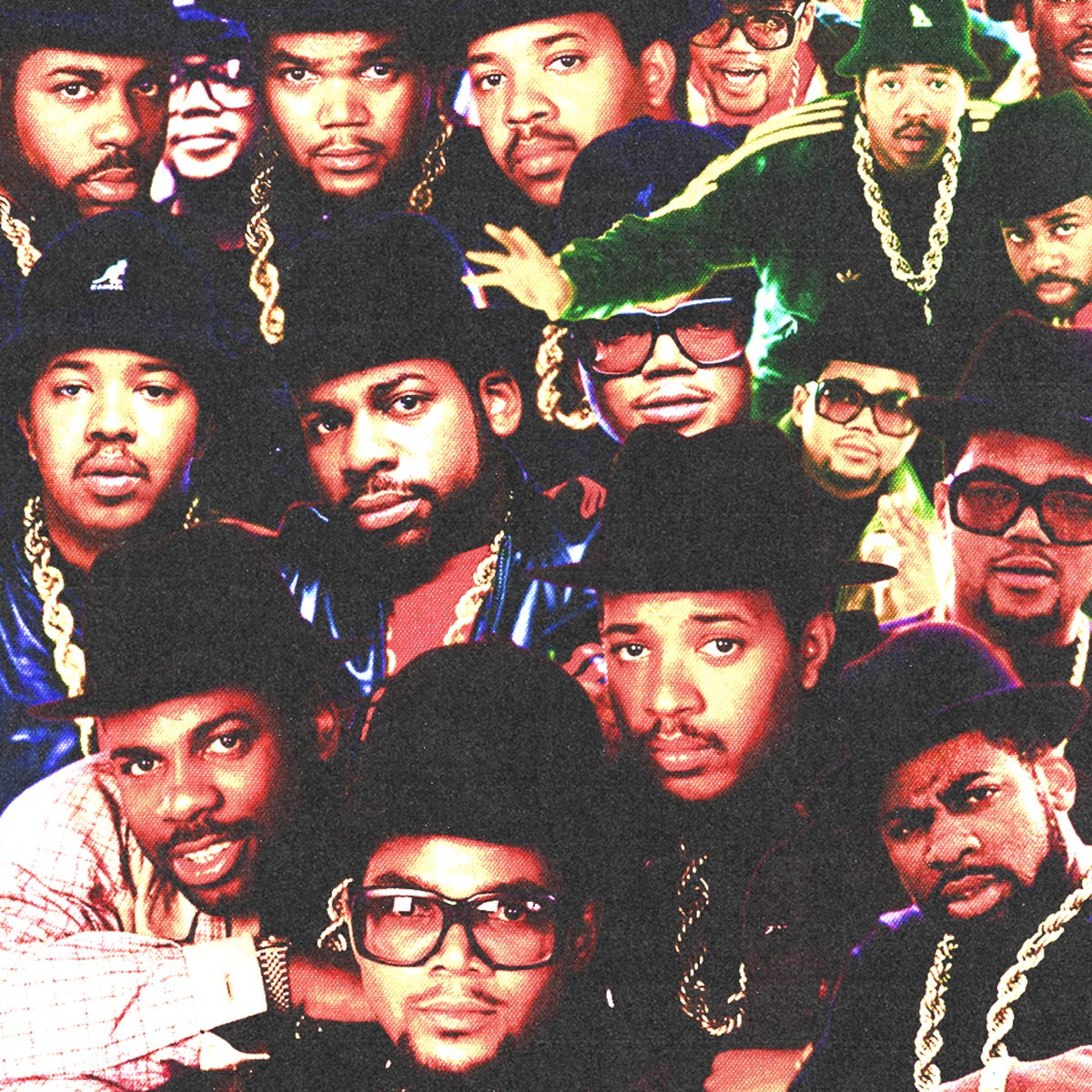
You shouldn’t trust people who say they’ve invented something. In hip-hop, as in life, everyone is a transitional figure, a tenuous tie between the past and the future. The elevator pitch on Run-DMC is that they mutated rap from the primordial, neo-disco ooze of its early recorded days into something sparer, tighter, more sinister, and kinetic. And if you browsed Tower Records a couple times a year (or internalized the tidy narratives of countless books and documentaries) you would be forgiven for thinking so. It’s a nice story.
But try to tell it to the men themselves. From the time an obsessive party promoter named Russell Simmons was shown the high school diploma he demanded from his kid brother and finally leveraged his connections to help him make a record, Joseph “Run” Simmons, Darryl “DMC” McDaniels, and Jason “Jam Master Jay” Mizell insisted that they were part of a sacred—and temporarily broken—lineage. A few years later, after they had become a local, then national, then global sensation, and laid the groundwork for hip-hop as a commercially viable venture, DMC would rap that he and his partners “took the beat from the street and put it on TV.” It’s easy to read that as a simple underground/mainstream split, but that ignores the dimension of time. The group was always reaching back past “Rapper’s Delight” to catch the spirit of the routines that enamored them but never made it onto wax.
Still, it was probably inevitable that Raising Hell would be received as a culmination. Released 40 years ago this month, Run-DMC’s third album was rap’s first true blockbuster: By July, it had been certified Platinum, a first for hip-hop. (Whodini’s Escape, LL Cool J’s Radio, and Raising Hell’s predecessor, King of Rock, all predate Hell but were not certified until later.) Their redux of Aerosmith’s “Walk This Way” was crucial in getting both rap and post-Michael Jackson Black music writ large into permanent rotation on MTV. The album was so monumental, in fact, that it codified stylistic quirks—the precise rhythms of the tradeoffs between two MCs, the sweatsuits—as core tenets of a genre, a culture.
Yet in the same way that histories of Run-DMC tend to ignore the rich tradition from which the group was drawing, histories of Raising Hell would be incomplete without mentioning how quickly the sea change it brought on left its creators in water up to their necks. The next year would see the studio debuts of MC Shan as a solo artist, Ice-T, Boogie Down Productions, Public Enemy, and N.W.A; the animated style that made DMC and Run resurrected for the record-buying public was replaced, as the platonic ideal of New York cool, by Rakim deadpanning from his spot on Melle Mel’s couch. “Walk This Way” was quickly cordoned off as a museum piece rather than a record unto itself.
But its genesis was an act of recalibration. In the second half of 1985, in the wake of King of Rock and their screen debut in Michael Schultz’s superb real-time Russell hagiography, Krush Groove, Run-DMC was on a marathon domestic tour. Where their first two albums had been produced by Larry Smith—who had mentored the group early on, gotten them gigs at his beloved Disco Fever, and allowed them into the low end-heavy, delightfully synthetic world he also opened to Whodini—the MCs decided they wanted something even more stripped down. While on the road, they wrote nearly every lyric that would eventually make Raising Hell, and even began performing the new songs live. When, in early ‘86, they played a pair of homecoming shows at the Apollo, they leaned entirely on material that was not yet available for purchase.
The tracks themselves were recorded over three months of intensive sessions at Chung King Studios. The group had enlisted a then little-known young producer named Rick Rubin to oversee them; Rubin, perhaps in an effort to counteract the effects of ubiquitous cocaine, urged the rappers, especially DMC, to stay within themselves, to be poised and keep a little in reserve. This is borne out on the finished songs. Take, for instance, “Hit It Run”: DMC is still attacking the first syllable of every other word, but there is a sense of control that would not have been present in an otherwise identical take of his from 1984. Even the Slick Rick pilfering on “Perfection” is made palatable by a calm that took years to develop.
Dating back to the earliest days of their friendship, the three men had been puzzled at the gap between their favorite rappers’ abilities and what was captured on the radio, or on vinyl. “When a lot of the old guys, like Kool Moe Dee, Treacherous Three, and Grandmaster Flash, got in the studio, they never put their greatness on records,” DMC says in Brian Coleman’s 2009 book Check the Technique: Liner Notes for Hip-Hop Junkies. “Me and Run and Jay would listen to tapes in our basement and we’d say, ‘They didn’t do that shit last night in the Bronx! What the hell is this ‘Birthday Rap’ shit and ‘What’s your zodiac sign?’ So we said that we weren’t going to be fake.”
The group’s self-titled debut, from ‘84, is perhaps their best record, a Smith-led fugue where even the serrated “Sucker MCs” is unmistakably designed in a studio. On Raising Hell, even concepts that could be written off as commercial gimmicks (“Walk This Way,” the Toni Basil riff “It’s Tricky”) are executed as if Run and DMC are re-rapping them every time you hit play. This keeps the comic misadventures of “You Be Illin” from feeling forced or overdetermined; it makes closer “Proud to Be Black” scan as a natural extension of the group’s philosophy, rather than an attempt to add dimension to an LP right before the needle slides off.
Cool can be an elusive thing, redefined rapidly and without notice. But in ‘86, no one had this sort of gravity. When DMC raps, at the beginning of “My Adidas,” about the charitable success of Live Aid, it sounds like the sort of filthy boast one might make about sex, money, or violence. Few other MCs can do that—and many of those who can would stake the line on irony. Here, it’s a straightforward boast as slick as any about limos with tinted windows.
It was that ineffable cool that ferried the group through “Walk This Way.” Jay had planned to include the break from the song in a compendium somewhere on Raising Hell. (The group went out shopping for the rock album with the “toys on the cover,” a wrinkle from the time when DJs would scratch the names off of their record sleeves to ward off imitators.) It was Rubin’s suggestion that Run and DMC re-rap the band’s lyrics, but it was Jay who ultimately convinced them to, touting Steven Tyler’s “flow.” When the rappers showed up at Chung King to find Tyler and Joe Perry waiting to record the new version of the hit, they asked them: “Are you the Rolling Stones?”
DMC insists the greatest period of hip-hop was before “Rapper’s Delight,” and not—or not only—as a matter of principle. In a 2023 appearance on N.O.R.E.’s Drink Champs podcast, the 59-year-old recites verses, never laid in a studio but committed to memory, from his idols in the late 1970s. They are, almost without exception, as layered, sly, and complex as almost anything that would appear on a rap record until 1987. “Anything that is holy or sacred to a nation, a community, or a people will get diluted, polluted, or destroyed once it’s commercialized,” he says. “And a lot of that commercialization is very good. But if there was no music business, we’d still have hip-hop.”
If “Walk This Way” had never been released, or if “My Adidas” had not served as an unintentional test case for the way hip-hop could be used as a marketing vehicle, the line from New York subculture to global business might not have been drawn so straight. What makes Raising Hell one of the genre’s most fascinating, and most essential albums is that it is the precise point of convergence between that popular potential and the unmonetizable culture on which it’s based.