


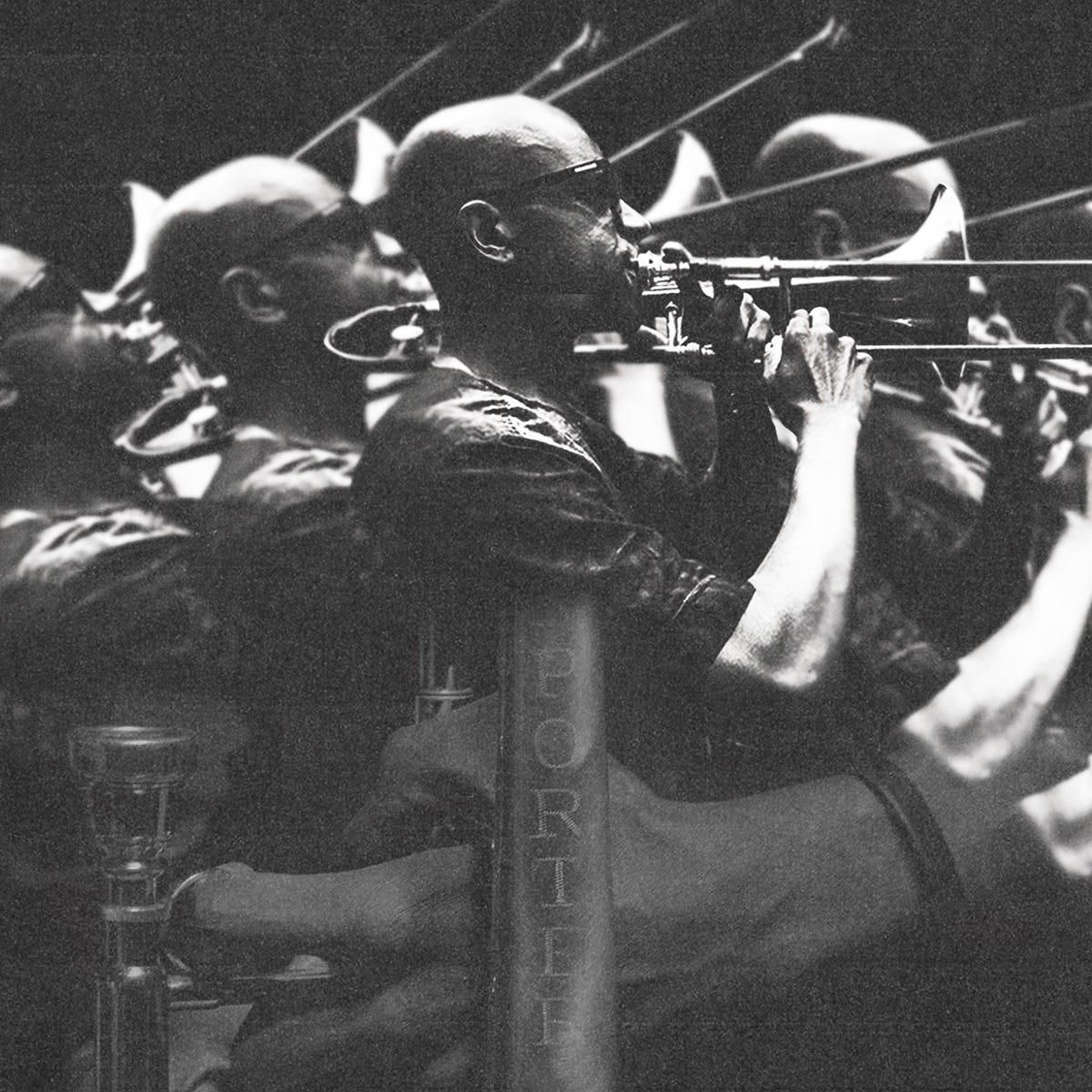
It’s romantic but heartbreaking that the only thing left of my conversations with the trombonist Ryan Porter is a feature in the departed but essential LAnd magazine. In that story about L.A.’s then-burgeoning jazz scene, we spoke about the pivotal role he played as the glue of the West Coast Get Down. The hard drives are lost, the Macbooks that once hosted the MP3 recordings of our chats are long sent to the hardware graveyard. And now, Porter, too, is gone. Tragically, cruelly. The news was shared on Sunday by his WCGD bandmate Tony Austin, who revealed that Porter died in a car accident. This is the sort of news that can easily get chewed and swallowed by the 24-hour news cycle, but Porter meant more to me, to L.A., and to the jazz world writ large to let that be the case.
Growing up in Westchester—the same neighborhood in which we spoke about his career seven years ago—Porter saw his prodigious jazz talent as an opportunity, a way out. His relationship as a young adult with Kamasi Washington signaled a way up. The trombonist was the heartbeat of the West Coast Get Down, the modern ensemble that reinvigorated the city’s jazz scene thanks to a furious barrage of essential releases from Washington, Porter, Brandon Coleman, Cameron Graves, Miles Mosley, and the brothers Bruner. They were integral performers on Kendrick Lamar’s To Pimp a Butterfly, and ran with that momentum, creating a mini Blue Note in Inglewood, offering each bandmate a chance to record an album. Porter’s integral work from that era, 2018’s The Optimist, brims with the joy and voraciousness I remember from our conversations. He was an otherworldly talent and a music obsessive. He spoke about dressing as a jazz player for Halloween as a kid, thrilled that his childhood machinations became reality. He laughed while remembering the fedora and trench coat.
Taken from the L.A. jazz community ripped from the world too soon, we decided to take the section of my LAnd story featuring Porter and run it as a standalone piece. It’s not the tribute he deserves, but it’s a conversation I’ll never forget.
“When I was seven years old I would dress as a jazz player for Halloween,” the trombonist Ryan Porter explains over coffee in Westchester. His eyes are buried beneath a black flat-brimmed Dodgers hat and blackout stunna shades that would be intimidating if he wasn’t cracking a miles-wide smile.
“I’d have a little fedora and a trench coat,” the member of the West Coast Get Down continues. “I always knew I wanted to play jazz. But we could never sit in my neighborhood like this when I was a little kid on the corner, you know what I mean? We couldn’t play outside. I needed to get out.”
Thirty years ago, when Porter was growing up, the community just north of LAX was inundated with crime and violence. From a young age, Porter saw jazz music as a physical and spiritual refuge from a gang-heavy world. Although Porter still considers the neighborhood home, he spends half of his time in Cleveland, Ohio where he has better access to treat an undisclosed medical condition.
“Jazz was a chance for me to get into a different world and all my heroes were these musicians that my peers knew nothing about,” Porter, 39, says. “I was ten years old talking about Elvin Jones. My friends would be like, ‘Who exactly is Elvin Jones, he play for the Lakers?’ Once I met [the members of West Coast Get Down], it was cool to bond with people who loved playing as much as I did.”
A fixture in Los Angeles’s music scene for two decades, Porter’s first years as a professional found him working as a go-to session musician. Gigs backing Quincy Jones, Nick Cave & The Bad Seeds, Leon Russell, and Anthony Hamilton supported random creative endeavors and late nights at Piano Bar. A jazz original forced into a session player’s discography, his credits hinted at his polymath gifts, but Porter still needed a stage from which his music could be heard.
It took nearly a decade for that to happen. Porter’s excellent 2018 release, The Optimist, was initially recorded between 2008 and 2009 with the West Coast Get Down—at Kamasi Washington’s parents’ house, a spot lovingly dubbed “The Shack.”
“We still hadn’t made a name for ourselves yet as the West Coast Get Down. No one would take a chance on us,” Porter explains of the delay. “Around the same time, we did a record called Live at 5th Street Dick’s that Kamasi put out personally. And when I say personally I mean he custom-made every CD at his house using his own computer and printer. To me, Dick’s is better than The Epic, but at the time, without help from stars like Kendrick Lamar, no one would take a chance and sign Kamasi. It was all about timing.”
The band had been playing together for 15 years by the time they recorded The Optimist, and they exhibit a telekinetic chemistry—the same evinced on Washington’s album and Uprising, the 2017 record from the Get Down’s bassist Miles Mosley. On his masterful debut, Porter’s trombone serves as the bedrock that allows his bandmates to shine atop his melodies. It’s replete with Monk-style piano solos and spiritual experiments that recall a young Charles Mingus (“Obamanomics”).
Even a decade ago, Porter was hinting at the style the West Coast Get Down members now regularly display at international festivals — a style of jazz that reveals a loose and improvisational genius defined by decades of deep practice and study. It’s both fun and scholarly, with vibrant tones exuded in each horn solo and piano vamp. “Night Court In Compton” is led by a drum groove that blends A Tribe Called Quest with James Brown. The rhythm initially seems almost alien to jazz, but fits perfectly when stacked below the contrasting horn solos of Washington and Porter—each player navigates between staccatoed short notes and extended melodic phrases like climbing a ladder to space.
The Optimist offers a rare timestamp, a retrospective look through the lens of Porter and the West Coast Get Down’s evolution.
“It’s all so surreal. When you see it from the ground up, it’s hard to take a step back,” Porter says. “There were times that we’d do all this for free. We just wanted to play our own music. I just wanted to learn all of the music. You have to know all your friends’ songs.”

Rest in Peace Ryan Porter - thank you guys for posting this and honoring his sometimes understated impact on that LA Jazz resurgence - saw him perform so many times with the WCGD members over those years especially, was always such a warm presence and player on stage - seemed so vital and permanent in a way the others in the crew might have been more interchangeable - while I loved The Optimist record, what I’ve been reaching for often with small children is his lesser known children’s album Spangle Lang Lane - which actually came out first and is worth listening to whether you have kids or not. Says something to me for an artist to have his debut be reimagining children’s songs with elevated and original instrumentation and interpretation.
Ahhhhh man, I didn't know. I played The Optimist for my son when he chose trombone in junior high. Rest In Power Ryan.