

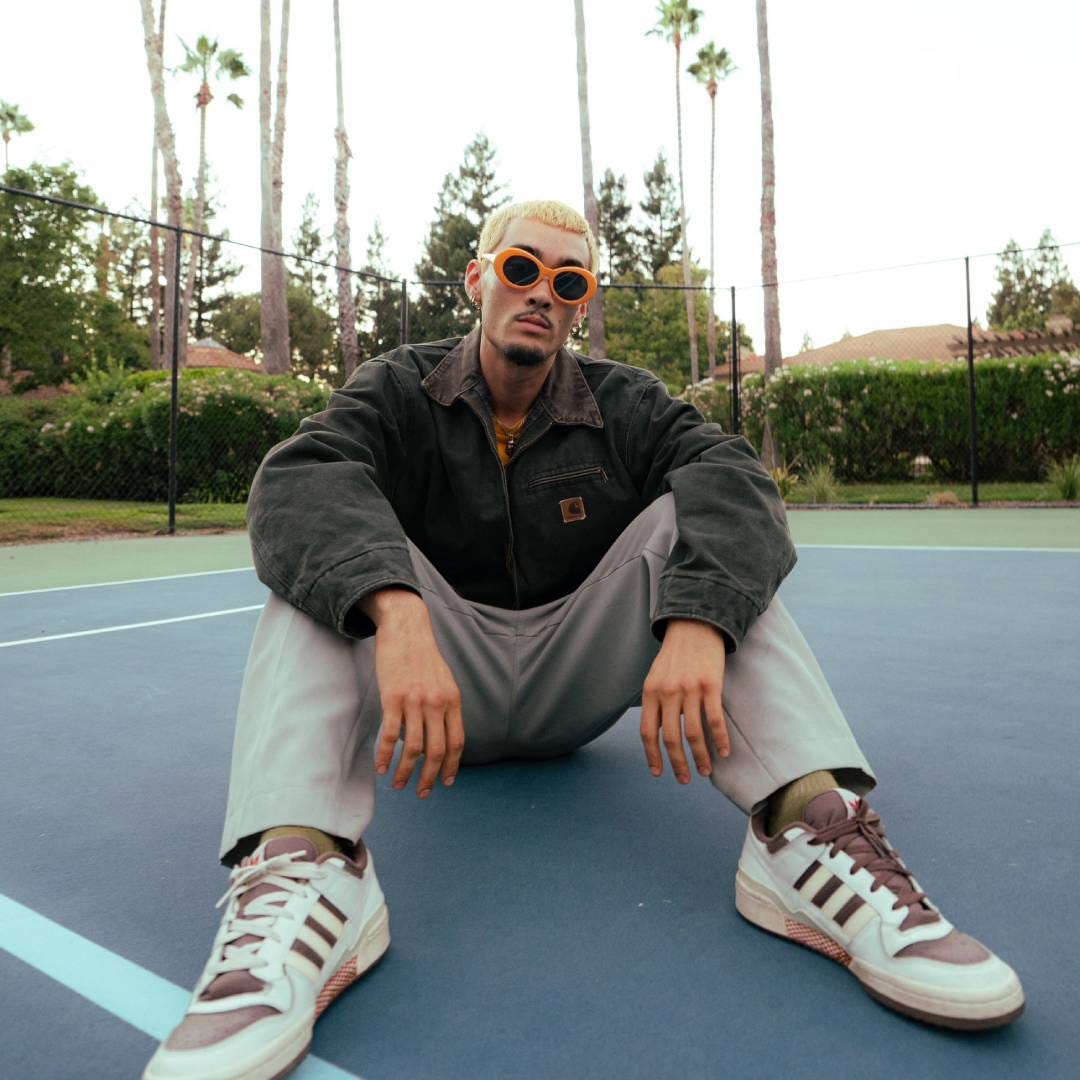
Image via Grant Wild
Dr. Dre’s The Chronic being listed as one of the best Bay Area rap albums is why Alan Chazaro doesn’t trust anything generated by AI.
On a blissfully warm summer night in San Francisco — on the eastern end of a two-block constellation of old school sushi stalls, manga shops, indoor izakayas, ramen holes, and one of the oldest bonsai nurseries on the West Coast — Seiji Oda is gigging himself into a state of higher being.
The Oakland-bred rapper specializes in spiritual-hyphy transcendence. That evening at Japan Center Malls, he blessed KOHO, a community workshop and events space hosting a vintage pop-up market. Flash tattoos were being inked for damn-near-free; passion fruit lychee teas were being distributed. It was the closing act of Seiji’s month-long California tour, which kicked off four weeks prior on a boat beneath the nearby Bay Bridge.
As the sun set over Japantown, a phalanx of Baydestrians converged to see the Japanese-Irish-Panamanian spitter celebrate his album at-the-moment, a gentle gigg… It’s an apt name for Seiji, an ancestral spirit who is three parts tranquil, one part “18 Dummy.”
Seiji’s music is like sitting in a gentle Japanese garden hidden inside a bustling metropolis while Bay Area rap slaps somewhere in the distant background. It’s the coalescence of airy vocals, lo-fi bells, wind instruments, blapping Oakland basslines and the upbeat funk of 1970s Japanese city pop. It’s at once relaxing and energizing — a combination that, on paper, sounds unexpected, if not obtuse. But once you embrace that oddness, as Seiji does, you’ll reach a certain kind of Bay Area zen unlike any other.
His artistry was on full display in the large-windowed venue overlooking the chaos of Post Street. In typical Seiji fashion, the set was barebones, accompanied by only a keyboardist, a microphone, flute samples and low bass thumping from speakers positioned on the concrete floor. A projector displayed a video of two Koi fish circling each other in an infinite loop that glowed on a concrete wall behind him.
At one point during the shindig, Seiji’s father quietly emerged from the crowd to deliver an operatic duet with his son (most of his family was in attendance, including his sister who had a booth where participants learned how to carve stamps from small blocks of rubber attached to wood). As a new father myself, watching Seiji’s dad harmonize with him in real-time was one of the more stirring moments I’ve experienced at a grassroots rap show. It’s something I don’t think I’ll ever see again. You kind of had to be there to understand the magnitude of an aging man bonding with his son. But even if you weren’t there, take my word for it: Seiji Oda’s performances have the kind of gravitational energy that only an emcee who is plugged into the universe like Mace Windu is with The Force can achieve.
Lately, he’s been getting major shine, too — racking up thousands of views on his posts and getting co-signs from artists like SZA, Jhene Aiko, G-Eazy, and ALLBLACK.
He’s not new to the spotlight, though. In 2017, Seiji debuted a joint R&B-ish project GOLD with fellow Oaklander 247zé. In 2018, Seiji’s younger brother, lil ricefield, hit over 13 million views with the music video for “TRAPANESE,” a parody-filled banger about glamorized Asian American living in which Seiji appears as a bucket hat-wearing sensei and sage lyricist. He has followed all that up with a slew of memorable LPs and EPs, including lofi // HYPHY; ORA // 太陽; LOST ONES; aero4ever; and most recently, LAST SUMMER.
Like many Bay Area rappers of yore — think Mac Dre wearing a full genie costume, or E-40 giving himself 5,000 nicknames — Seiji doesn’t shy away from his playful side. On a recent “A Trip to the Corner Store” episode, he apologizes to Sade for his womanizing antics, then proceeds to invite her over from across the Atlantic — if, perchance, she happens to be tuning in from the United Kingdom. With a healthy dosage of playerish, Bay Area weirdness and élan, he floats over the jazzy, minimalist beat like an audio embodiment of Icecold 3000, the Oakland turf dancer who glides across pavement with saucy footwork and double-jointed elbows that twirl into the fifth dimension. A liquid flow, some might say.
So, fresh off a weekend performance with HBK heavyweights Kool John and P-Lo at The Independent in Frisco and back at his apartment in L.A., Seiji teleported himself onto Zoom to sprinkle us with his eccentric serenity and collar-popping game.
https://open.spotify.com/album/1226jmllv5To2StZyFzqK1?si=RxM-atI3RDuxsCiZoRAIxw
I read a recent interview you did with DAZED and you spoke about the flamboyance and silliness of your music and personality, and how that was influenced by Bay Area rappers like Lil B. I don’t know if Lil B gets enough credit for how much he bridged the hyphy era to the era of HBK Gang and contemporary Bay music and culture. Have you ever had a chance to meet him, since you’re from neighboring cities?
Seiji Oda: Nah, I haven't been honored yet with the Based God blessing (laughs). But, nah, I mean, really, I think we just all listened to his music. I think Lil B was obviously a Bay Area legend, but I think he also was one of the people who broke into the underground rap scene and really had a cult following. Not just in the Bay, but all across the world, which I think he was one of the first rappers to really have that [from the Bay Area]. Like even some of our greatest legends, like, I think maybe E-40 is one of those household names where you can talk to people outside the Bay and they'll know who E-40 is, right? But even like Mac Dre, especially for kids in my generation, the people in LA might not even know who Mac Dre is. You know, even though to us he's for sure the president Ronald Dreagan. But it’s looked at completely differently on the outside. So I think Lil B is special because he really took that [Bay Area silliness] to the top. He took it to the most silly, the craziest, probably the most mainey shit that it could be. And I think maybe that's why it resonated with so many people. He was just like, I don't give a fuck at all. I'm just going to do me, and be me to the fullest. That connected with a lot of his fans at the time. People in the Bay have a special understanding of that already, and to us that’s not uncommon. But people outside see Lil B as like a unicorn, you know. Like, oh, why is this dude like this? And we're like, we love it, this is who we are. And we also get where he is coming from. We're serious about it, but we're also going to have fun, too.
I grew up listening to rappers like Andre Nickatina talking about getting his nails manicured while weighing triple beam scales and rocking alligator boots on the hottest day of the summer before throwing someone off the Bay Bridge. The Bay has always been on some very outlandish, silly shit.
Seiji Oda: Exactly.
Lil B was doing his thing right when the internet and social media were really emerging in their modern forms, too. All these Bay Area tech companies nearby are inventing that shit right here, and he just leveraged it all at the right time and place.
Seiji Oda: Yeah. The internet played a hella big role in all that for sure. Lil B could’ve been Soulja Boy, you know, for our generation. Didn’t Soulja Boy recently have that “LimeWire” song going up? But yeah, Lil B he was following like some hundreds of thousands of people on Twitter. He tried to follow back everyone who followed him and that was like the beginning of the internet grind for rappers. I remember people being like, oh my God, Lil B, followed me on Twitter. You know, and that's just so cool because he was using it in a way that people didn't at that point. I feel like the internet and social media was the wild, wild West at that point. And he was just kind of experimenting with it.
Wasn’t Lil B the first rapper to have his memes go viral?
Seiji Oda: Yeah, probably (laughs).
How do you use social media in this current era of consumption? You have a strong visual language and branding with your music and artistry online.
Seiji Oda: I feel like our generation of the internet is so convoluted because there's everyone now trying to be authentic [online]. So it's this performed authenticity, you know, but I think it's just like, how can we be as real and unfiltered as we can? For a lot of time social media was about filtering, and there is always going to be that. But I think our generation is trying to be as honest as we can be, and that's what people really connect with, just being yourself. For me, building the visual brand online was just figuring out what I already like to do, which is being in nature and gigging. I really like those things, and I would do them separately. That's something that I enjoy. I would be doing this anyway. So I think just how can I capture that in a way that doesn’t feel salesy or overproduced. I wasn’t necessarily thinking about it like that, to be honest, but looking back, I'm not doing this because I want to promote my songs. I'm doing this because whatever I'm doing, I'm going to do this anyways, so I might as well capture it and be like, hey, this is how I experience the music that I make, so how can I share that with people? We live in such a visual world. We all watch things and consume everything visually. Giving people a way to understand the music visually is important. It gives context to how I experience my own music.
In contrast to that, you’re very in tune with body and movement. Gigging. Tai-chi. Capoeira. These are all things you showcase in your music and everyday life. What do you enjoy about that physical connectivity?
Seiji Oda: All of the different physical practices that I have kind of inform each other in some type of way. As I've learned more about each one, I can kind of be like, okay, let me incorporate this into that. And so the other thing that I'm doing becomes mixed in. I probably wouldn't be doing a gentle gigg if I hadn't been doing tai-chi. I would be just doing a regular gigg (laughs). Something that I picked up from my brother [lil] rice[field] when I was recording with him, is that no matter what, when he records his vocals, he's always doing this [giggs on camera]. Like any time he would record, could be singing vocals at 60 BPM, doesn’t matter. He's going to be doing this [continues gigging] to keep time. So for me too, when I'm recording, I'm dancing, I'm moving around because that's just how I keep tempo. It’s probably going to end up with the vocal not being perfect or being kind of messed up or whatever, but the point of it is to be felt in the body.
You know rap is very mental and it's like, how can I be really cerebral and intellectual with this and intellectual, so I always want to keep that part of it, too. But it’s music. And music is meant to move people. It’s about opening up the channel for whatever wants to come through. And I feel like moving your body around for me is important. If I'm writing a verse, for example, and I'm sitting on one side of the room and getting stuck, I'm always gonna get up and move somewhere else, get into a different position, to look at something different, both figuratively and literally. You gain a different perspective by moving.
You’ve definitely been making moves in music for a few years now. Briefly walk me through your journey up to this point. Your sound has really evolved like a Pokemon racking up XP.
Seiji Oda: (Laughs) Yeah, I hope so, man. My debut was BLUE, originally a five song EP [in 2020]. And then it was released as BLUE+, an extended deluxe version with acoustic stuff. That was when I started getting into the lo-fi hyphy sound. I was like, okay, I'm kind of discovering this right now. And then I came out with lofi // HYPHY. That was my first real album; the other stuff was kind of just EP's. I kept messing with different sounds, and I started doing these two sided singles, which I call twingles (laughs). I was doing that because I feel like I have other albums, like ORA [太陽], for example, where it's a lot of R&B and softer stuff because I really enjoy making that music, too. Actually, there's people who tell me they only listen to that part of my catalog. They’ll tell me they really love that kind of sound and wish I would make more stuff like that.
But then there's this one guy who writes Bay Area rap blogs, and he would always write about my shit and whenever I was putting out my R&B stuff, he was like, oh man, this shit is wack. Like, we need more rap, Seiji. He would say he didn’t want to hear any auto-tune bullshit (laughs). The beauty of it though, as artists, is we can be multifaceted and we can make different kinds of music for different kinds of people. Right now, people are really connecting with “a gentle gigg…”. It would be easy for me to suddenly be like, okay, I'm just going to keep trying to make that over and over again. But I'm gonna continue to experiment and do different stuff. And so that's why those two-sided or even three-sided singles are ways for me to be like, here's another side of my music that I make and here's something maybe in between. If we keep doing the same thing, we're not really artists, you know? We're just a fucking algorithm. AI can do that shit for us. I could definitely be like, hey AI, make me another “a gentle gigg…” song.
It makes me think about Audre Lorde, and how she invented the biomythography genre as a queer Black woman who felt unseen in society. That was a human need to be heard, to be seen. I’m not sure AI could do that. AI is good at taking what already exists and remixing it, remaking it. But to create something entirely new, out of thin air, and have it be felt deeply by others, requires human experience. In a way that’s what you’re doing with hyphy and lo-fi, just squeezing those things together in a way that hasn’t been done before. When do you feel like you started to get recognition for the sound you’ve created from your unique experiences, and how has that influenced your creativity?
Seiji Oda: Honestly, it was “a gentle gigg…”. Like success-wise and on the outside, I think people began to recognize what I was doing with that song. But it was also a turning point for me, on some interpersonal shit. I was kind of like, do I really want to pursue music as my main thing? I know I love making music, but do I just want to do it without it being a career? What if I did without trying to make money off of it? I still wonder about that, but I also have seen that it doesn't necessarily have to be just one or the other. Just seeing that people were really connecting with what I was doing, especially back home, that meant a lot. In terms of major visibility and numbers, the SZA repost was probably the thing that did the most for the general population. That's fucking nuts. She's one of the biggest artists in the world, and so I was blown away when that happened. After that, I started to get props from other people and artists.
That does actually motivate me to continue to want to do what I'm doing and it helped me to see that this isn't just something that I want to do for myself but for other people, too. Especially right now, in representing the Bay, it’s important. There’s a lot in the media right now where people see the Bay as this kind of apocalyptic place where everything is falling apart. And yeah, there’s some of that. But there’s more of the story to be told. When I talk to kids my age, there’s just a lot of excitement about new artists and new energy and a lot of new growth happening. That’s what I want to keep showing. Like, we’re not just out here on some…