

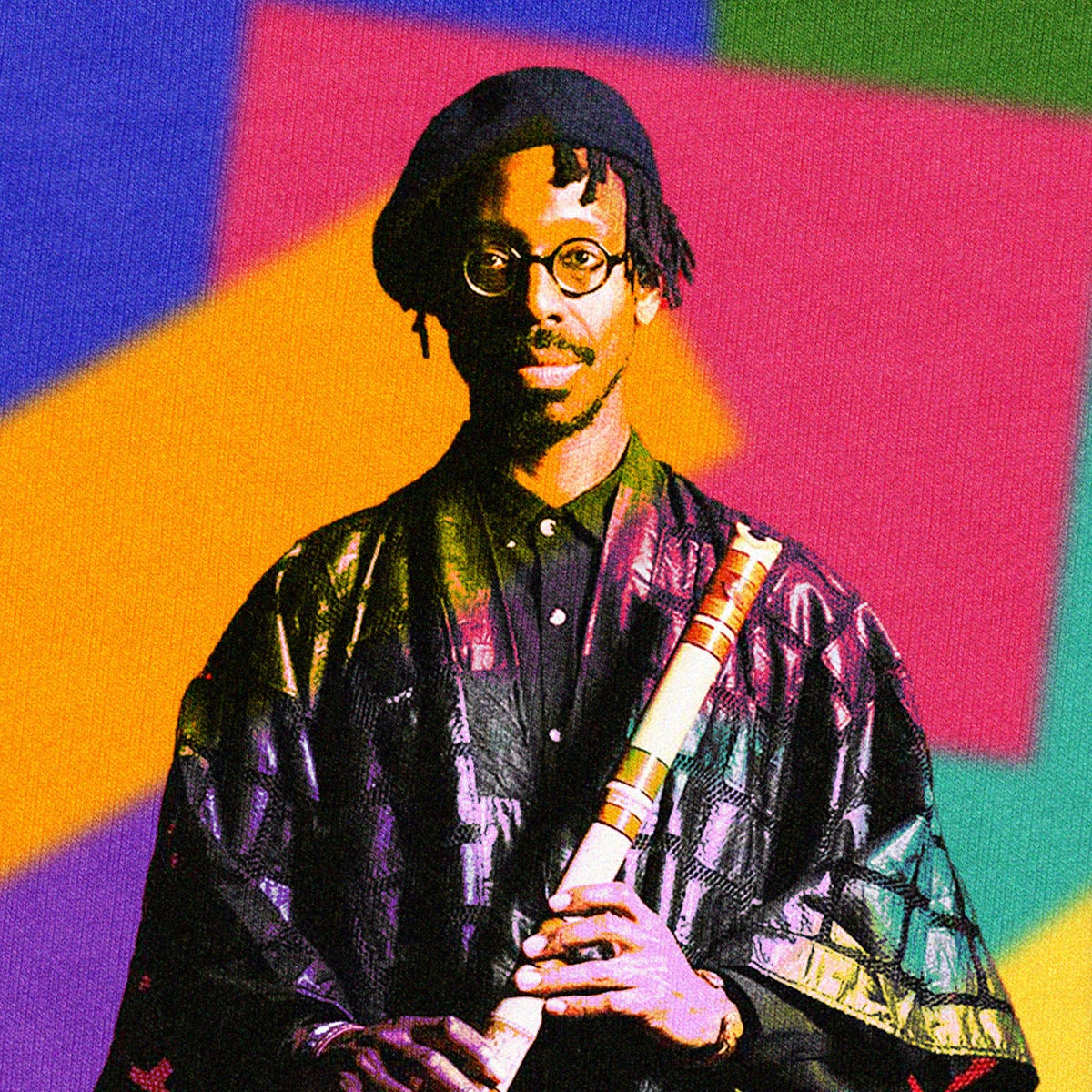
In many ways, Of the Earth is an album of firsts. This might seem counterintuitive given the numerous records Shabaka has made with The Comet Is Coming, Shabaka and the Ancestors, and Sons of Kemet, as well as his recent solo LPs Afrikan Culture, Possession, and Perceive Its Beauty, Acknowledge Its Grace. And despite his robust discography, the critical accolades, and the performances and collaborations that haven’t been recorded, the English jazz visionary still has new avenues to explore.
The list of firsts on Of the Earth is long. It’s Shabaka’s first true solo album: He played all the instruments and recorded, mixed, and mastered it himself. While it lacks guest vocalists, it does not lack vocals, as Shabaka himself appears for the first time as a rapper. It is also the first album on his new label, Shabaka Recording.
Of the Earth marks Shabaka’s return to the tenor saxophone after putting it away for a lengthy hiatus to focus on flutes and production. He came back to the tenor to play for the memorial concert for the legendary South African drummer Louis Moholo, who passed away last summer at the age of 85. Moholo was part of the wave of South African jazz musicians such as bassist Johnny Dyani, saxophonist Dudu Pukwana, and pianist Chris McGregor who swept into England in the 1960s. British saxophonist John Surman told Shabaka that when they came to London, “It was like a bomb hit. No one had ever seen that level of intensity and that level of actual joy in the music.” Shabaka says that the joy that Moholo and his peers “opened up is still around today in London. That joy in playing and the community you get from the music.”
Listening to Of the Earth, one feels and hears that joy in the layered flutes that glide over the surging percussion in “Dance in Praise”; in the reggaeton bounce of “Step Lightly” that Shabaka laces with flutes, clarinet, mbira, and synths; and in his swaggering tenor saxophone over a hypnotic drum and flute pattern. On “Stand Firm” his tenor soars, as he rides the thermals of synth pads, flutes, and crisp beats. Hearing the combination of distorted guitar, whistling synth lines, and chugging polyrhythmic percussion on “Call the Power,” one can’t help but think how fun it must have been to create an album with such a diversity of sounds and textures. Everything is not joyful, however, as on “Go Astray,” Shabaka raps about the dark state of the current world—its violence, social and economic inequality, and the multifaceted dystopia we find all around us. While Of the Earth may find Shabaka exploring new skills, techniques, and paths for the first time, it is a natural continuation of a musical project by an artist whose impact on jazz and Black music intensifies with each album.
I caught up with Shabaka over Zoom, where we discussed his new album and future projects, the relationship between breath and rhythm, why now is the right time for him to start a label, and how Louis Moholo influenced his thinking about music.
This interview has been condensed and lightly edited for clarity.
How did you decide that you wanted Of the Earth to be a true solo album, with no band and no guest instrumentalists or vocalists?
It was a process of realizing that I’ve been learning different pieces of equipment over the last couple of years and thinking more about production and making beats. I always make music for myself. I enjoy making beats. I enjoy making little sounds and playing them for myself. Most things don’t make it to albums. Sometimes I might put things on Instagram and play along to them, but oftentimes I’ll just be listening to them for myself. But at some point I realized that actually the music that I’ve been making for myself is what comprises me artistically. At first I was going to book some musicians and go to the studio and start recording some material that could make an album. Then I realized I’ve been making my album; it’s the music that I’ve been working on slowly for the last year or two, just in very cryptic form.
By working at it I realized that actually it’s got to be solo. Because solo is the only way that I can actually really focus on the full realization of the music. As soon as you bring someone into it, someone else’s vision meets your vision. Or your vision meets someone else’s vision. Whereas I got so deeply into the music, I didn’t want to open it up. I just wanted to have it be a journey of where my mind could go with the material that I had come up with.
One thing I really like about the music is on several tracks you have a lot of layers of flutes, percussion, and different elements working with and against each other. How did you approach putting those layers together?
In general, I’d make the beats or a chord sequence—something foundational first. I often make music that’s too dense, and then there’s a process of stripping away. A lot of the times I might record four tracks of music. One track might have a lot of percussion, one track might have a bunch of melodic synth material. One track might have counterpoint material to that, and another track might just have general sound effects and the whole thing might sound intense. A lot of the material from the album that I started with was a lot denser than what I ended up with. After coming back to the material a few days later and listening to all the different parts separately, I might realize that there’s something really special within four bars of the bass part. So then I would take that and put it onto Ableton, where I could mix and match it with another sound that I recorded from another body of music. I was just trying to be as creative as I could in that process.
How was the process of putting the music together in Ableton different from playing live or recording in a studio?
In Ableton you can really chip away at things and strive for perfection because you’ve got the power to actually manipulate what you are doing. If you’re dealing with live performances, then it’s about the present moment. It’s about how you engage in that moment that you’re recording, how you engage with the band, how you engage with the track or whatever. And then after that, it’s immortalized. It becomes the representation of what you’ve done, and people appreciate that you’ve captured that moment in time and are giving it to them. When you start working in production, it’s not necessarily about that moment in time. That moment in time just gives you material that you can then consider. So then it becomes about the compositional structure. It becomes about how you relate to the thing that you recorded over long periods of time and finding its true form. I like to compare it to diamond mining. When you’re in the studio, it’s the moment of explosion when you blow up the mountain. You create a kind of blast in the mountain of your creative thoughts. From that you get some raw material from the rubble of ideas. Production is the process of refinement when you can see what kind of beautiful forms can come from this raw material.
In your flute playing, breath is obviously a very important element. On the record there are a lot of percussive and rhythmic elements. What’s the relation of breath to rhythm?
I guess rhythm is tied up with breath because it’s all just the body. It’s the body reflecting its positioning in time. If you try to play rhythmically without breathing in some kind of consistent manner, you’re not going to sound very rhythmic. It’s all one like dynamic system. Let’s put it this way, if your breath is shallow and you’re actually not breathing in a way that’s wholesome, your rhythm is going to be off. It all works together, whether you’re conscious of it or not. In terms of breath and rhythm, the only way that I’m going to be able to play rhythmically is if my whole body experience is with the music and that whole body experience involves breathing with the music and actually having my whole inhalation and exhalation be really in sync with the music that’s around me. Not in sync as in I’m breathing on beat one and exhaling on beat three, but in sync on a matter of focusing on the fact that I keep breathing as deeply as possible within it.
What inspired you to rap on a couple of tracks?
I thought would be cool. You know, I was making all these beats and considering Andre 3000’s story in going to flutes, I thought it would also just be really poetic if I as an instrumentalist developed rapping. It is just one of these things where it started out as just an idea of like, “wouldn’t this be cool to do?” Then the idea stuck with me, and whenever ideas stick with me, I think I kind of have a duty to fulfill them. So then at some point I thought, “what does me rapping look like and what do I have to say?” And then things took a life of their own from that point.
Who are your favorite rappers or influences that you draw on?
2Pac’s one of my favorite rappers. I’ve listened to him for a long time. I’ve always been a really big E-40 fan. There’s people from the UK like Kojey Radical that I really like how he uses his tone of voice. Right now I listen to a lot of billy woods and Elucid. I think that what they’re doing musically is broader than any small definition of hip hop. For me it’s literature.
What albums do you have planned for the future?
I’ve got a bunch of material that I’m working on production wise, and I’ll see when I’m further into it what form it takes in terms of albums. I’ve made a duet recording with pianist Pat Thomas, which sounds really great. I’m on electronics as well as flutes. I’ve made some recordings with this Palestinian musician, Dirar Kalash. Some of that sounds really great also. I’m looking at when they can come out, hopefully within the next year. They are more on the free improvisation side of things. I don’t think I’m represented very much as a free improvisation player on record. I do so much of it in real life, so it will be good to have that element of my musicality actually reflected on record.
Are those going to be on your new label? Why did you decide to create the label?
One of the reasons I decided to form the imprint is because it will actually give me the freedom to just put out things as I record them. And that’s what the main thing is about for me, having freedom—the freedom to express myself, the freedom to put out the stuff that represents the expression that I’m feeling in that time and not have it be bound by any considerations outside of myself.
Which I’m sure is probably a goal for, you know, most musicians, right?
Yeah. I guess, maybe. I hope so. But you know, it’s like this—the music thing is complex and multifaceted, so sometimes it’s about other freedoms. Record labels can give you certain freedoms that you might need at different times in your development. It’s about being perceptive to what aspects of freedom you need at what stage. And at this stage, this is what I need.
I suppose, if you’re at some point in your career you might need the label to do the PR work.
Yeah, exactly. Or even just the basic capital, right? So if it’s an album that takes and needs more than I can provide, you know?
Right. Because, studio time is expensive.
Yeah. Or if I need to travel to make an album, or if there’s some aspect of the album that could do with having a bigger label behind it. For me it’s about understanding that there are always options and figuring out what the best option is. For me, the worst thing a musician can do is just fall into a pattern of considering of releasing their music without thought, just thinking, “oh, other people have done it, therefore I’m just gonna do it this way.” Because sometimes the things that are done most regularly aren’t necessarily the things that make any sense business wise.
I would expect that trying to figure out the right balance just comes with experience.
Yeah. There’s nothing you can do to know. You’ve just gotta, you know, learn from your mistakes and be aware of what other people do, and talk to other musicians.
As far as other musicians, how will you be taking this record on the road? Are you going to be solo or will you have a band?
It’s going to be myself and drummer Austin Williamson, who I’ve been playing with for the last year or so. At first I wanted to do it solo, but then there’s something that I appreciate about taking something I made solo and opening it up to another musician. It’s been difficult figuring out how I represent the music live, in that I don’t want to necessarily have a situation where I’m just recreating music that’s been produced quite specifically with live instruments, because I think it’s a little bit redundant. But I don’t want to also just press a button and play over it. So it’s about finding the middle ground between these things—something that keeps the interest and the creativity on my end but that also represents the music that’s been carefully produced. I guess the gigs will be a representation of where I’ve gotten to in answering those questions.
That seems like that would be quite a process to work that out, especially with another musician who wasn’t part of creating the record. I guess that would take quite a bit of work and communication.
Yeah. And the only way to you can do it is really just to do gigs. You just gotta work it out on stage. There’s no real preparation you can do for it. It is just about doing the gigs and thinking about each particular gig that happens and how it can get better for the next one.
In addition to headlining at Big Ears, you will be performing there with Thurston Moore. How did that come about?
I played with him and Moor Mother in London maybe a couple months ago. Then he just got in touch asking me to do this duet with him, which I’m really looking forward to because he’s a free musician, you know? That’s the most I can hope for, to play with musicians who are free and open, who deal in creative sound.
Speaking of musicians who deal in creative sound, you started playing the tenor saxophone again to play at Louis Moholo’s memorial concert. Is that right?
Yes, exactly.
Was that the first time you got back to the saxophone or had you been planning on coming back to it?
I hadn’t really been planning on coming back to it, but that was the first time I’d come back for a bit more than a year and a half. It really wasn’t on my mind. As the memorial kind of came closer, I realized that I’d like to honor Louis’s memory by playing the saxophone.
Did you think about it as a one-off performance—that you were going to honor his memory and then put the tenor away?
Initially I thought that, but then when I actually played it, I just thought that the saxophone is just an instrument amongst other instruments. It was like the function of the hiatus has been fulfilled, in that I had a long period of being able to focus on the flutes and having to use the flutes in certain environments that before I would’ve used a saxophone by default. So I thought now, the saxophone has been democratized: it’s not taking up the space in my musical world that it used to. Now it is just one of my many instruments.
Can you talk a little bit about Louis Moholo’s importance to you?
For me he was very incredibly important. Louis is one of the first musicians that got me thinking about psychology when I’m playing. There was this sense when I played with him that he was not just listening to what I was playing, but he was actually trying to figure out how I was thinking. And then he would do things to try to subvert that, to try to actually mess with my mind. I remember the first time I played with him, not having a good experience because it felt like the rug had been pulled out from under me and everything I tried to do was just being ruffled. It’s like he wasn’t really playing with me, but there was something that showed that he was aware of what I was doing and was just like taunting me almost. I thought so much about that experience and a lot of other experiences that I’ve had with him that I think that’s what he wants. He wants music to be something that involves your body and your mind and everything committed to the present. He didn’t want people to fall into this complacency of knowing what they’re doing and then not having to apply themselves fully. He was all about 100% application in the music.
There’s some concerts I did with him where he didn’t want anyone to stop playing at any point; he wanted full energy for the entire thing. He would shout at people if they stopped. All these instances that got me thinking after the fact about how I approach music. Like if you’ve got to play foot to the floor for a whole hour and a half by the time you finish, you really think about what you play, how you play, and why you play it, and what you choose to play in those circumstances.
This is the important thing for me with music: does it make you think about what you are doing and who you are? Or does it just leave you with a sense of fulfillment? Fulfillment is good, but I just enjoy it more when I come off of a gig and I have to really think about what happened because maybe it perplexed me or it did something to me. It’s got to move me in some way.
Thanks for this Chris - I’ve been into Shabaka across the last few of his projects, it was cool to get insight into who this brother is and how he moves - and I’ve never even heard of Louis Moholo, so another trail to embark on. Especially dug this insight about breathing while playing:
“Not in sync as in I’m breathing on beat one and exhaling on beat three, but in sync on a matter of focusing on the fact that I keep breathing as deeply as possible within it.”
Sync as depth - and out of sink, then, as shallowness - I’d say this holds true outside of musicianship too.
Thanks 🙏